Author: insights4vc
Translation: Deep Chao TechFlow
Deep Chao Introduction: The headline figure for the scale of on-chain tokenized assets looks good, but behind it lies a fundamental contradiction—products that can be freely circulated often lack real ownership rights, while products with genuine legal effect lack liquidity. This report uses specific data to dissect just how much of this "$1.89 billion market" is real money, serving as a necessary dose of sobriety for any investor considering deploying capital in on-chain securities.
The stock market hasn't moved on-chain. What has truly emerged is a set of more credible infrastructure layers—for distributing securities, recording ownership claims, and settling trades through blockchain-based systems.
Data from RWA.xyz shows that the value of distributed tokenized stocks grew from $951 million in March 2026 to $1.89 billion in July, almost doubling. However, this growth primarily came from a handful of products and platforms.
The most significant progress has come from regulated market infrastructure, notably Nasdaq's Same CUSIP Settlement model and the planned commercial rollout by DTC. Liquidity, investor distribution, and independent on-chain price discovery remain very limited. Tokenized treasuries continue to demonstrate stronger product-market fit, and equity ETFs may be easier to scale than single stocks.
Therefore, this market is best understood as a fragmented "Layer 2.5" system: products with the most robust legal foundations often have the weakest liquidity and distribution capabilities; while the most actively traded wrapped products typically have the thinnest ownership rights.
This report is an update to insights4vc's March 2026 analysis "The State of On-Chain Real Assets," focusing on what has substantively changed since its release.
The State of On-Chain Real Assets

What Has Substantively Changed Since March
The March report distinguished between two types of assets: those recorded on a blockchain, and those transferable to external wallets. This distinction remains important today. Under RWA.xyz's framework, a "represented asset" stays within the issuer's or platform's own environment; a "distributed asset" can be transferred externally, though transfers may still be limited to approved or whitelisted wallets.
But transferability alone is no longer sufficient to gauge a product's maturity.
Since March, offshore products have become more accessible for cross-chain movement and use in decentralized markets. Ondo expanded to Ethereum, BNB Chain, and Solana, introduced decentralized routing, and added continuous minting and redemption features for some products. xStocks also broadened its distribution channels and collateral integrations.
Meanwhile, regulated US infrastructure has taken a different path: the focus is not on unrestricted portability, but on legal certainty, controlled wallets, compliant custody, transfer agent records, and integration with DTC.
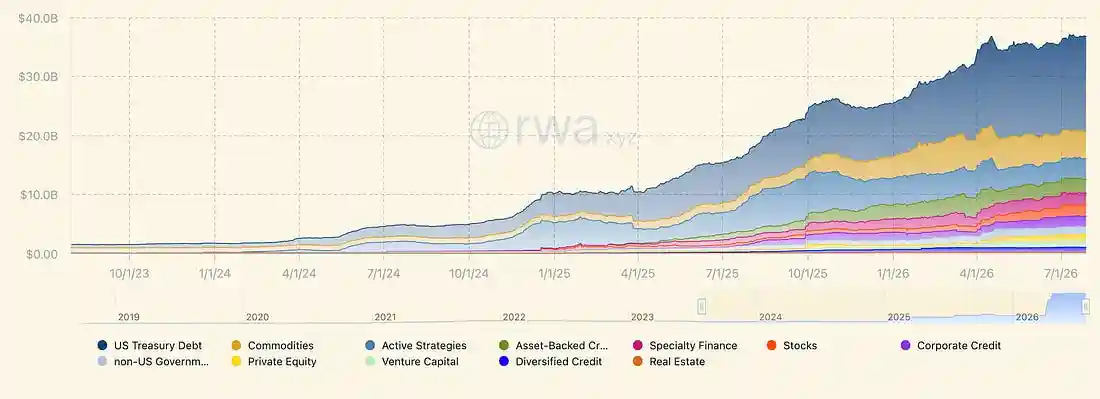
Chart: Market Cap Evolution of Various RWA Asset Types (2019–2026) (Including Tokenized Stocks, Treasuries, etc.)
These two paths solve different problems: offshore wrapped products improve accessibility and composability; regulated infrastructure strengthens the link between the token and the legal ownership claim.
A "canonical share" is the authorized form of the underlying security issued, whose transfer is recognized in the official ownership system. It is fundamentally different from third-party instruments that merely track a stock's price or performance.
Currently, no product achieves all four elements at scale: canonical ownership, broad wallet distribution, institutional liquidity, and independent on-chain price discovery.
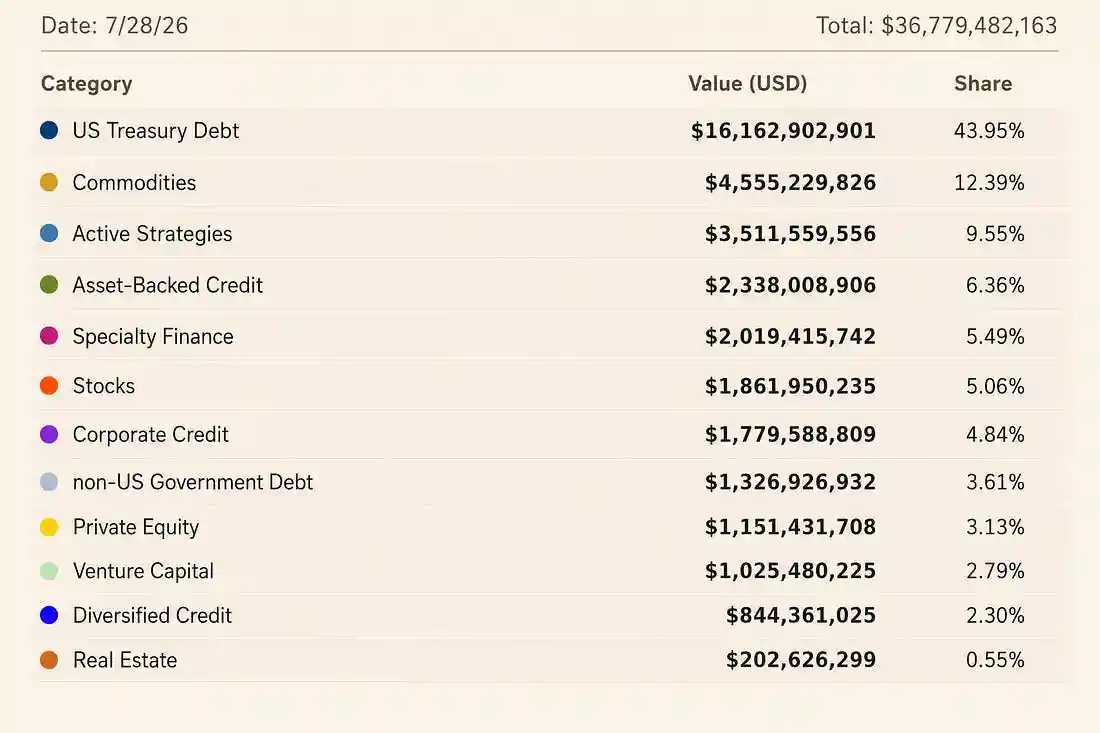
Chart: On-Chain Real Assets Summary Statistics (As of July 28, Total ~$36.78 Billion, US Treasuries Account for 43.95%)
Broader RWA total figures also require careful interpretation. Data reported by RWA.xyz on July 29: distributed value $36.81 billion, represented value $218.27 billion. The apparent $124.33 billion decrease in represented value should not be interpreted as capital outflow or a redemption wave. Between the two observation dates, numerous datasets were added, removed, reclassified, or revalued.
These numbers describe the value of interests covered by the platform's methodology at a specific point in time, not a measure of investor fund flows.
The tokenized stock series is more instructive, as the same "bridged token value" methodology can be applied across both periods. Even so, the reported 98.5% increase cannot be clearly decomposed into new issuance, price appreciation, and classification changes.
FGRS provides a useful example. Figure completed a fundraising offering 4.375 million blockchain shares at $32 per share, but subsequently reported value fluctuates with market prices. Without daily mint, burn, and net asset value data for each product, it's impossible to reliably reconstruct the net market-wide issuance.
Why the $1.888 Billion Headline Number Is Misleading
RWA.xyz uses "Bridged Token Value" to measure tokenized stocks, calculated as: Bridged circulating supply multiplied by Net Asset Value.
Circulating supply excludes balances identified as treasury holdings or pre-minted inventory. The bridged figure also removes tokens locked in known bridge contracts to avoid double-counting when an asset is locked on one network and issued on another.
This is a valid measure of distributed value, but it differs from free float. Free float refers to the portion of securities genuinely available for public trading after excluding restricted, strategic, and concentrated holdings.
The timing of the data also matters. The provided asset-level export shows a distributed total value of $1.8879 billion on July 27, consistent with the ~$1.888 billion shown on the dashboard. A snapshot across platforms and networks on July 29 sums to approximately $1.872 billion.
The difference is $15.8 million, or 0.84%, consistent with price and token supply changes between the two observation dates. Therefore, this report's growth calculations for specific instruments use July 27 data, while platform and network market share uses the July 29 snapshot, and the two datasets are not mixed in the same calculation.
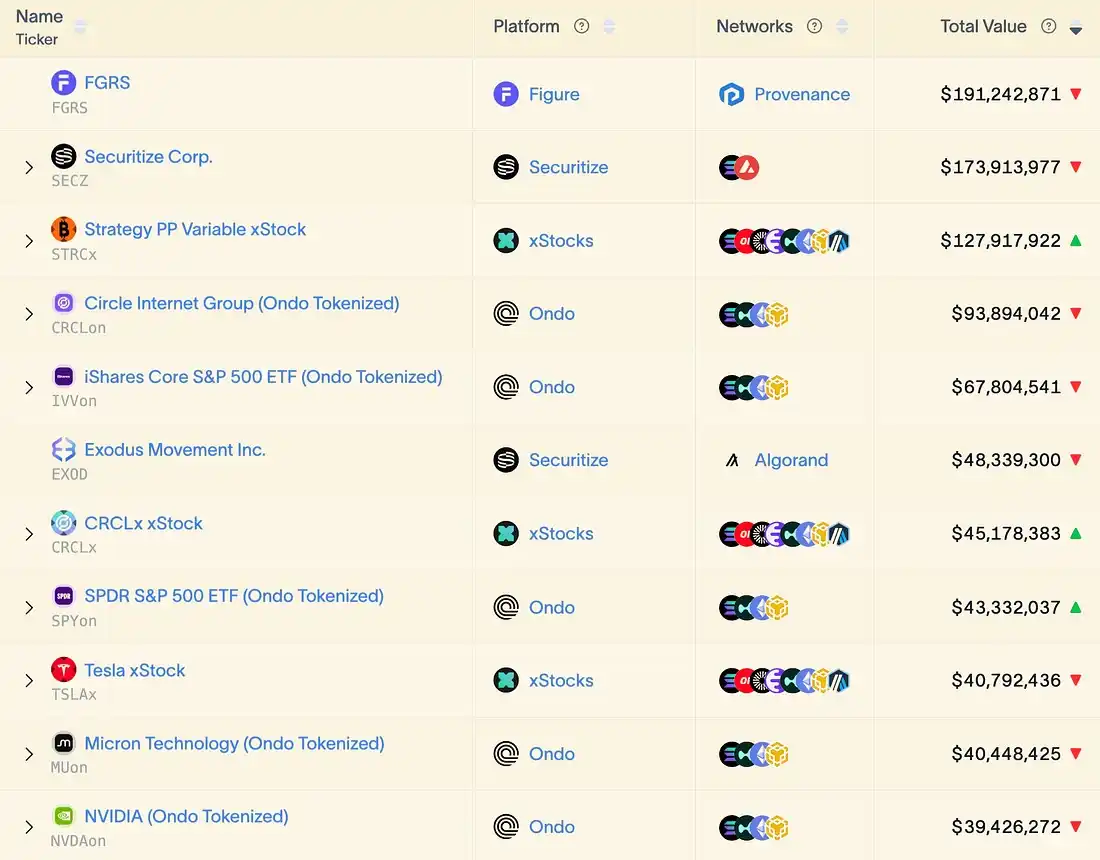
Chart: Tokenized Stock Details (10 Underlyings, Classified by Issuing Platform & Network, FGRS highest at ~$191 million)
Three named instruments contributed roughly half the increment: SECZ added $169 million post-listing, FGRS added $162.9 million, STRCx added $126.6 million. Together they contributed $458.6 million, 49% of the total $936.8 million increase. Long-tail products collectively contributed another $150.5 million, 16.1% of the increment.
These figures reflect changes in distributed value, not investor subscriptions.
SECZ is affected by both the number of represented shares and Securitize's NYSE stock price. FGRS reflects a combination of issuance, conversion activity, and market price changes. STRCx depends on the circulating supply and value of receipts tied to Strategy Floating Rate Preferred Stock.
Calling the above three increases "tokenized stock capital inflows" would merge several economically distinct events into a single, potentially misleading number.
Concentration is more evident at the platform level. In the July 29 snapshot, Ondo and xStocks together accounted for 72.7% of distributed value. Adding Securitize raises the top three platforms' share to 85.1%.
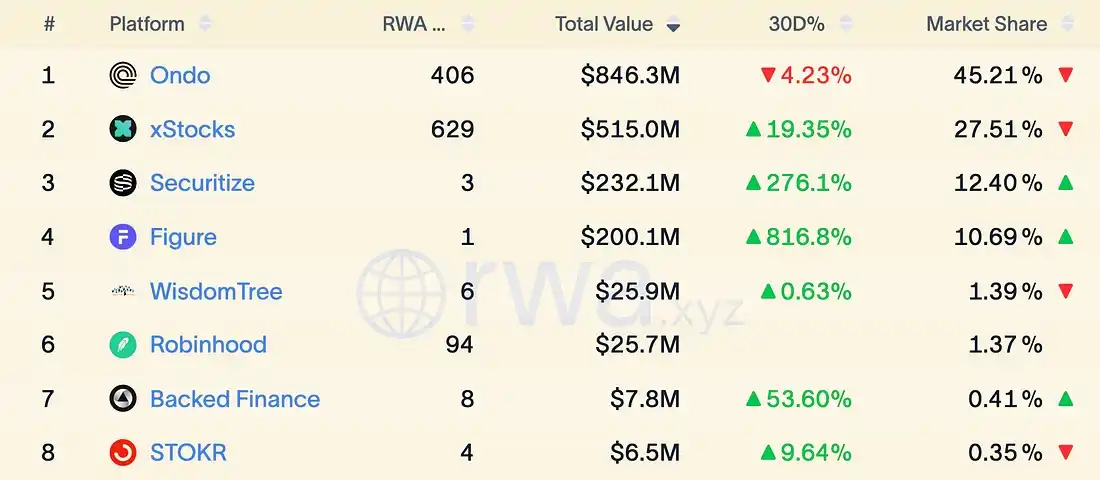
Chart: RWA.xyz Platform Rankings — Ondo (45.21%), xStocks (27.51%), Securitize (12.40%) are Top Three
Distribution across blockchain networks is more decentralized, but this doesn't eliminate underlying common dependencies. Ethereum leads with a 36.2% value share, followed by Solana (19.6%) and BNB Chain (15.8%). Provenance and Avalanche are primarily driven by Figure and Securitize, respectively.
Products issued on different networks may still rely on the same wrapping issuer, broker, custodian, transfer agent, or reference price provider.
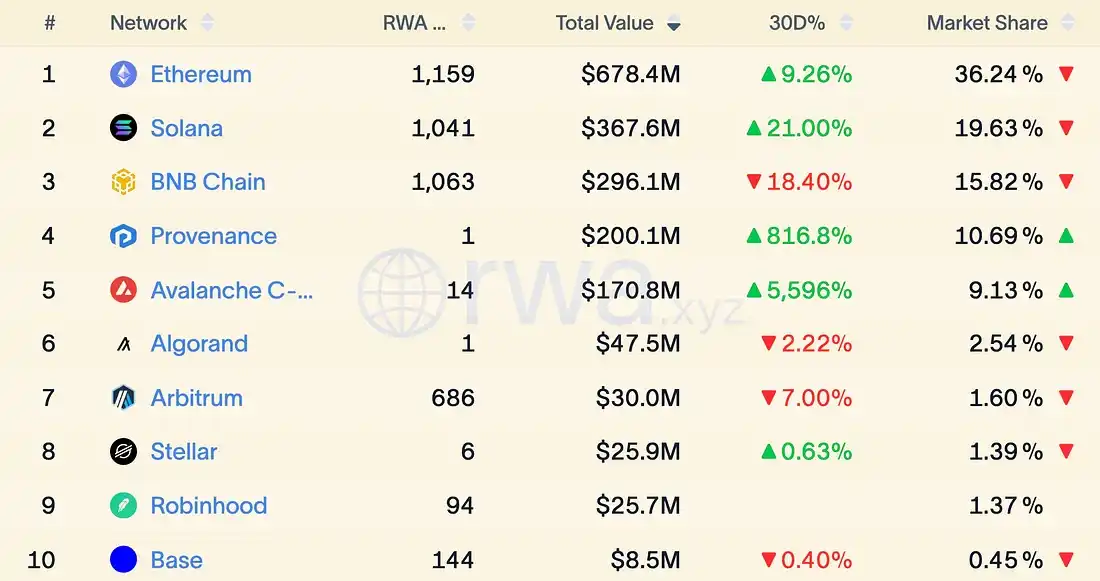
Chart: RWA.xyz Network Rankings — Ethereum (36.24%), Solana (19.63%), BNB Chain (15.82%) are Top Three
This market has broadened in scope but remains legally fragmented. Multiple tokens can simultaneously reference Apple stock or the S&P 500 ETF, but each is a separate legal liability, subject to different jurisdictions, and reliant on different intermediaries.
Bridge adjustments prevent double-counting the same token on different networks, but they cannot—and should not—consolidate products that reference similar assets but offer substantively different legal rights.