A group of Hong Kong tech startup teams cross the Shenzhen River.
July 1st marked the 29th anniversary of Hong Kong's return. The next afternoon, six startup teams with backgrounds from Hong Kong universities appeared in Nanshan, Shenzhen. At the "X-Day" Xili Lake Roadshow Hong Kong Tech Special Event, they presented projects in lithium battery materials, quantum dot displays, robot intelligent control, digital sports, smart airports, and healthcare.
In fact, scenes like this have become increasingly common in recent years. Research achievements from Hong Kong universities continue to enter the Greater Bay Area, searching for the next stop for industrialization. So, they come to Shenzhen.
The journey from the laboratory to the industry unfolds from here, a much longer path.
A Group of Hong Kong University Entrepreneurs Gather in Shenzhen
Starting from a Roadshow
The first to take the stage was Sufang New Energy, founded in October 2023 and led by City University of Hong Kong Tenured Professor Liu Qi. Headquartered in Shenzhen, the company focuses on the R&D and industrialization of lithium-rich manganese-based cathode materials.
Voltage decay is a hurdle that lithium-rich manganese-based materials have struggled to overcome for years in industrialization. The team disclosed that Sufang New Energy is the only enterprise globally capable of synthesizing ultra-low voltage decay lithium-rich manganese-based materials. A production line with an annual capacity of 300 tons has been built in Shenzhen's Pingshan district, and samples have been sent to leading battery manufacturers for testing. "Driving 1000 kilometers on a single charge is no problem," stated Sufang New Energy's R&D Vice President Wang Bo.
Coincidentally, an existing investor was sitting in the audience. ZStone Partners had previously invested in this team. Founding Partner Zhong Qiankai noted that Sufang New Energy's progress was even faster than anticipated.
Next up was Pulang Quantum. Founder Zhang Zhikuan holds a PhD from the Hong Kong University of Science and Technology, with bachelor's and master's degrees from Peking University. He previously served as CTO of Refond Optoelectronics before co-founding the company with Professor Sun Xiaowei, Chair Professor at Southern University of Science and Technology and Foreign Academician of the Russian Academy of Sciences. The company provides full-process integrated supply of high-end quantum dot materials.
Products from this company have actually already appeared in many people's daily lives - the screens of Lenovo Legion 9000K and ASUS ROG series laptops contain Pulang's quantum dot films. In the most demanding automotive field, Pulang is the first company globally to achieve mass production of front-installed automotive quantum dot films, starting with the Zeekr 7X and gradually entering models from NIO, Audi, and others, holding over 70% of the global market share for automotive quantum dot films.
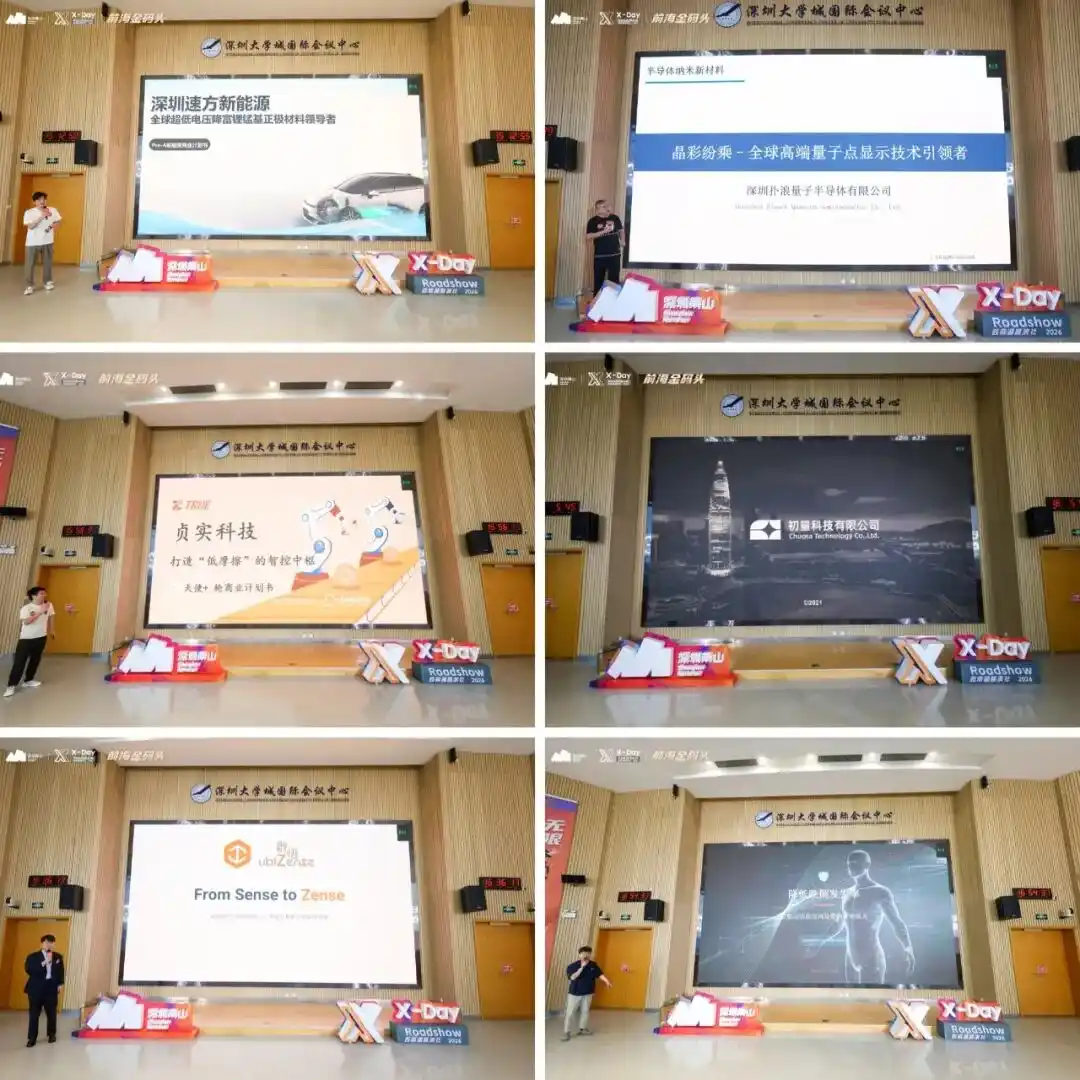
Zhenshi Technology followed, presenting a "ready-to-use" robotic embodied intelligent control system, emphasizing "vision, control, and AI integration," targeting non-standard industrial scenarios with small batches and multiple varieties. The founders are a pair of brothers: CEO Gui Kai handles the market and "cerebellum" control, while his younger brother Gui Shun, a PhD from The Hong Kong Polytechnic University, is responsible for the AI "brain." The company is headquartered in Nanjing and just established a research center this year in Shenzhen's Qianhai, joining The Hong Kong Polytechnic University Qianhai Advanced Technology Research Centre.
From there, the technology began to enter more specific life and industry scenarios.
Chuliang Technology has built the digital sports brand PARTYDAY, using self-developed hardware-software integrated devices like skiing simulators and miniature racing cars to create indoor sports and entertainment spaces. It has currently opened 7 stores in Xi'an, Shenzhen, Wuhan, Hangzhou, and Shanghai, serving over 3 million cumulative visitors. The company has settled in the University of Hong Kong Youth Science and Innovation Institute located in Qianhai, leveraging cross-border incubation platforms from Hong Kong universities to foster bidirectional development of technology and innovation between Shenzhen and Hong Kong.
Inspired by the Asian Institute of Supply Chain and Logistics at The Chinese University of Hong Kong, Qiwu Technology (Ubizense) brings AI and IoT into airports. Its apron collaborative decision-making system has been deployed and running at Hong Kong International Airport for 8 years.
Now, the team is migrating this system from the two-dimensional apron to three-dimensional airspace, developing a drone collaborative decision management system targeting the low-altitude economy. The first stop in their landing plan is Shenzhen. Co-founder Xu Shenghao stated they aim to establish roots in Shenzhen first, striving to launch a pilot at Bao'an Airport.
The final presentation was from Bugoo Health, focusing on an easily overlooked issue: falls among the elderly. According to General Manager Xu Hongyuan, the annual incidence of falls among those aged 60 and above is about 30%, while most existing solutions focus on post-fall alerts and protection.
The company originates from Hong Kong Baptist University and was incubated at the Hong Kong Science Park. It uses wearable sensors combined with AI movement analysis to screen for fall risks in advance from balance, strength, and gait data, followed by exercise interventions. Currently, nearly 20 large public hospitals and over half of community health centers in Hong Kong are its users. The product has obtained U.S. FDA certification and is preparing to enter the mainland Chinese market.
Six teams with backgrounds from Hong Kong universities came to Xili Lake in Shenzhen. With technology stepping out of the lab, the next question to answer is how to truly integrate into the industry.
From Hong Kong to Shenzhen, Searching for the Next Wang Tao
An unavoidable question is: Why are Hong Kong tech startups flocking to Shenzhen? Before the roadshow began, four investors long involved in Hong Kong tech investments discussed this matter.
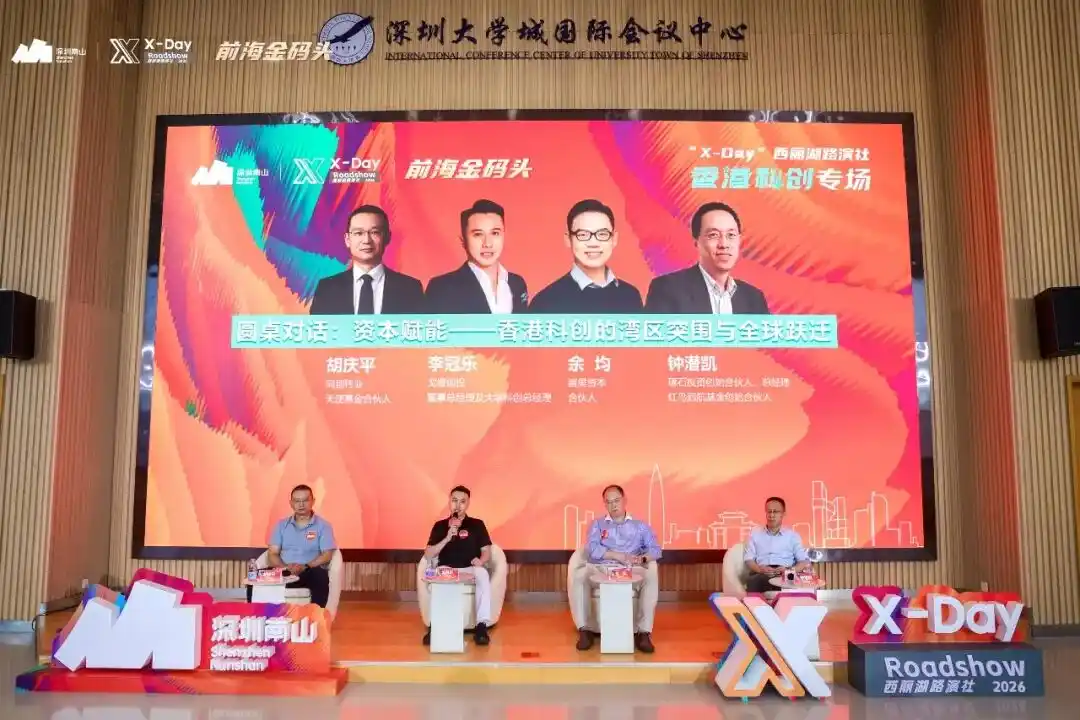
Junhao Capital Partner Yu Jun mentioned a detail: On roughly 1100 square kilometers of land in Hong Kong, there is a high-density concentration of universities and research resources, which is itself a scarce advantage.
For a technology to leave the lab, it must cross pilot-scale testing, find customers, and undergo real market validation. Yu Jun repeatedly mentioned "real demand": No matter how cutting-edge the technology, it must ultimately land on a business model.
Gobi Partners Managing Director Li Guanle feels this more deeply. Having long invested in university tech projects, he observed that many overseas scientists returning to China often choose Hong Kong as their first stop. The English-speaking environment, global academic networks, and dense university resources give Hong Kong teams a natural international perspective.
"Hong Kong teams excel at going from 0 to 1, while the Greater Bay Area can provide the engineering and industrial support to go from 1 to 100," Li Guanle stated.
ZStone Partners Founding Partner Zhong Qiankai calls it "Fusion+". Over the years, he has encountered many semiconductor, AI, and materials projects from HKUST. The technology often stands at the threshold of industrialization; the next step is to truly connect Hong Kong's research with the mainland's industry.
Shenzhen happens to be at this stage.
In fact, a Shenzhen-Hong Kong tech channel is gradually becoming clear. Platforms like the City University of Hong Kong Shenzhen Research Institute, the University of Hong Kong Youth Science and Innovation Institute, and the Hong Kong University of Science and Technology Blue Bay Qianhai Innovation Port have successively landed in Shenzhen. Beyond university labs, industry and markets are getting closer.
The six roadshow projects that day also reflected this trajectory. Separated by a river, the two cities are each taking on the parts they excel at. As Tongchuang Weiye Angel Fund Partner Hu Qingping said, from the angel stage onwards, entrepreneurial interaction between Shenzhen and Hong Kong has become increasingly close, and what's needed in the future is "two-way" collaboration.
The Xili Lake Roadshow makes this connection more concrete. Since its launch, "X-Day" has held 18 themed roadshows, attracting over 520 project applications. 53 companies have received equity investments totaling over 2.096 billion yuan, and 32 companies have obtained new bank credit lines exceeding 1.145 billion yuan. Additionally, 8 non-local roadshow projects have established entities in Nanshan.
Hong Kong has the source innovation; Shenzhen receives the next stage of industrialization. The Shenzhen River is narrow, and the distance in tech and innovation between Shenzhen and Hong Kong is getting shorter.
Perhaps the next entrepreneur like DJI's Wang Tao, who takes a product global, is setting out from here.
This article is from the WeChat public account "Investment Community" (ID: pedaily2012), by Wang Lu