ENS Founder Seeks to 'Seize Power' from DAO

Foresight News發佈於 2026-07-02更新於 2026-07-02

文章摘要

On June 29th, the ENS community entered the on-chain voting phase for a proposal to renew the ENS DAO Security Council's veto power for two more years. Shortly after voting began, ENS founder Nick Johnson used his substantial ENS holdings to cast over 3.55 million votes against the proposal, swinging the outcome despite initial strong support. The Security Council was established in July 2024 with a 4/8 multisig veto power to protect the DAO's treasury (valued over $350 million) from malicious proposals during a period of low voter participation. Its powers were limited to vetoing only harmful proposals, not normal ones. Nick Johnson's opposition stems from broader concerns about ENS DAO's governance. In late 2025, he and others expressed frustration that the DAO had become mired in political gamesmanship, with capable contributors leaving and leadership falling to less experienced or misaligned parties. This context set the stage for a major restructuring proposal by ENS COO Katherine Wu on June 19th, titled "Next Era of ENS DAO: Empowering the ENS Foundation." The controversial proposal aims to transfer daily operations, treasury management, and long-term strategy to a restructured ENS Foundation with a professional board, while the DAO would retain core protocol governance powers. Critics, including original ENS constitution author Brantly Millegan, argue this effectively transfers treasury control from token holders to ENS Labs (the core development team), undermining ...


Written by: Eric, Foresight News


On June 29, a proposal by the ENS community to extend the veto power of the ENS DAO Security Committee for two years entered the on-chain voting stage. Shortly after voting began, the over 800,000 votes in favor far exceeded the less than 300,000 votes against. However, ENS founder Nick Johnson used his substantial ENS holdings to significantly increase the opposing votes to 3.55 million in one go.
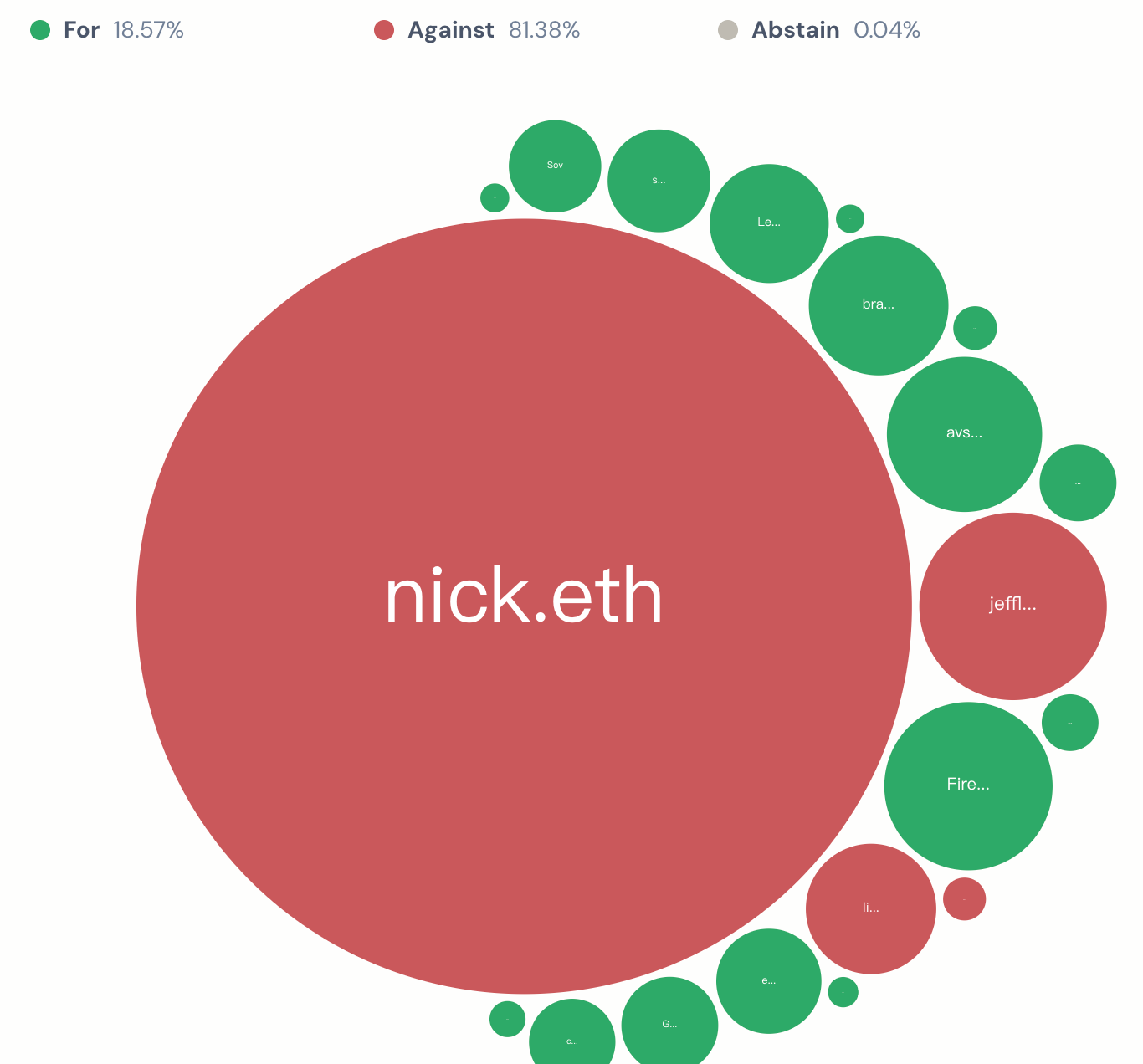


The ENS DAO Security Committee was established in July 2024. At that time, both active participants in ENS DAO proposals and the number of votes were relatively low. To prevent major holders from using this opportunity to launch malicious proposals that could jeopardize the ENS DAO treasury exceeding $350 million, the DAO chose to establish the Security Committee, granting it direct veto power over malicious proposals through a 4/8 multisig.


However, the committee's power is limited to vetoing malicious proposals. It cannot interfere with the process of normal proposals, nor can it initiate proposals. Its authority is retained for only two years at a time for easy adjustment.


Logically, renewing the authority of such an organization protecting the DAO treasury before its term ends should be quite normal. Why would the ENS founder personally step in to vote against a proposal designed to protect the DAO?


To understand this seemingly 'authoritarian' decision, we need to trace back to a discussion about ENS DAO governance in November last year.


I mentioned this incident in the article "Seeing ENS Struggling with Governance, I Think It's Time to Talk About DAO Problems" (https://foresightnews.pro/article/detail/93316): In November 2025, Nick Johnson wrote a meaningful post on the forum, roughly stating that the ENS DAO was now full of political infighting, capable people were gradually leaving, and the leadership of the DAO had fallen into the hands of inexperienced individuals, or even those whose interests were not aligned with the protocol.


Also in that month, ENS DAO Secretary Limes submitted a proposal suggesting that at the end of the sixth term, i.e., December 31, 2025, the operations of the three working groups—Metagovernance, Ecosystem, and Public Goods—be terminated. As for the reasons, firstly, because proposals had become a game of 'you support me, I support you,' with no one caring about what should actually be done; secondly, the lack of entry criteria led to the frequent phenomenon of 'bad money driving out good.' Limes believed that process improvements could not solve this structural deep-rooted problem, and shutting down was the only way out.


Although this proposal ultimately did not pass, Nick's desire for DAO reform was already clear.


On June 19, ENS COO Katherine Wu posted a new proposal on the ENS forum: "Next Era of ENS DAO: Empowering the ENS Foundation." The core contents of the proposal are twofold: first, to transfer daily operations, treasury management, and long-term capital strategy to a restructured ENS Foundation. The Foundation would be responsible for daily treasury operations, public goods grants, working group coordination, ecosystem strategy, trademark/brand assets, etc. Additionally, the Foundation would establish a 5-member board of directors to enhance professional execution and accountability.


Second, it commits that the DAO and token holders will retain core powers, including protocol-layer governance contract upgrades, registry control, fee structure, constitutional amendments, etc.


The biggest point of contention in this proposal is the DAO treasury. Critics believe this would allow the Foundation and, by extension, ENS Labs behind it, to effectively control the massive funds, weakening the direct influence of token holders. ENS original constitution author Brantly Millegan expressed strong opposition, arguing that it violates the DAO's original design where token holders should simultaneously control both the protocol and the treasury, essentially implying that ENS Labs wants direct control of the treasury.
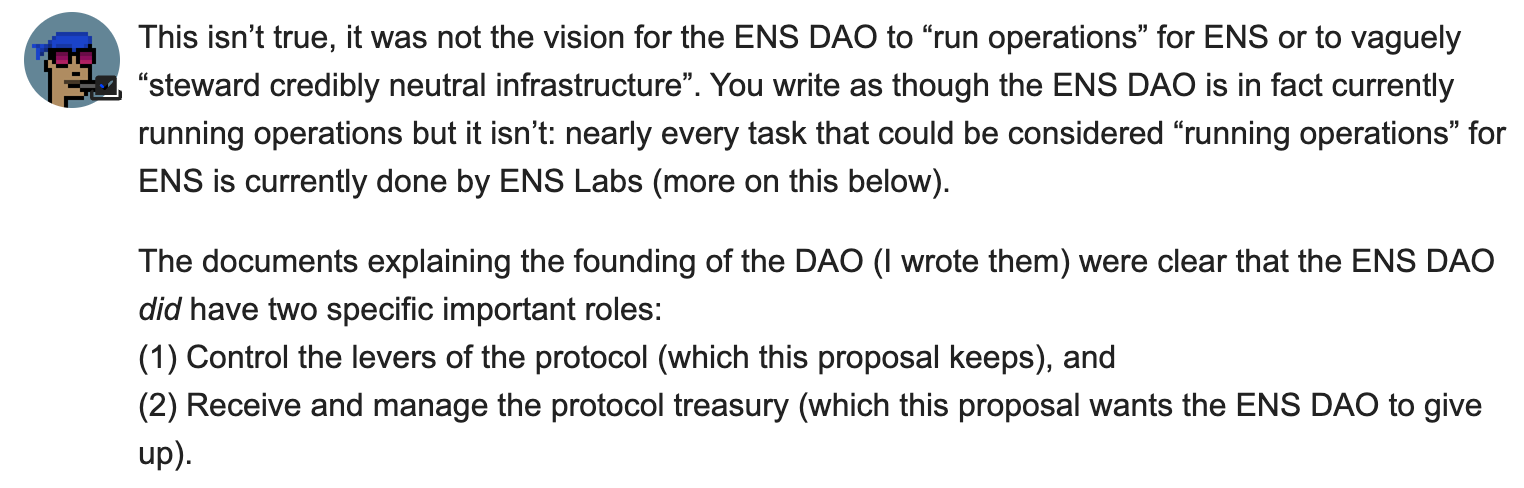


This is a conflict between decentralization fundamentalists and practical operators. One side does not believe inefficiency justifies the Foundation 'seizing power' from the DAO, while the other, after years of ups and downs, still believes that centralization, at least for now, is more beneficial for the project's development.


Nick's over 3 million opposing votes are seen as the first shot fired in the power war.


However, Nick himself also provided an explanation. His opposition stems from concerns that the current committee's power lacks sufficient checks and balances, and a two-year extension would solidify these issues. Additionally, he worries that some members might use the veto power for political purposes, blocking ordinary proposals they personally dislike, rather than limiting it to genuinely urgent situations.


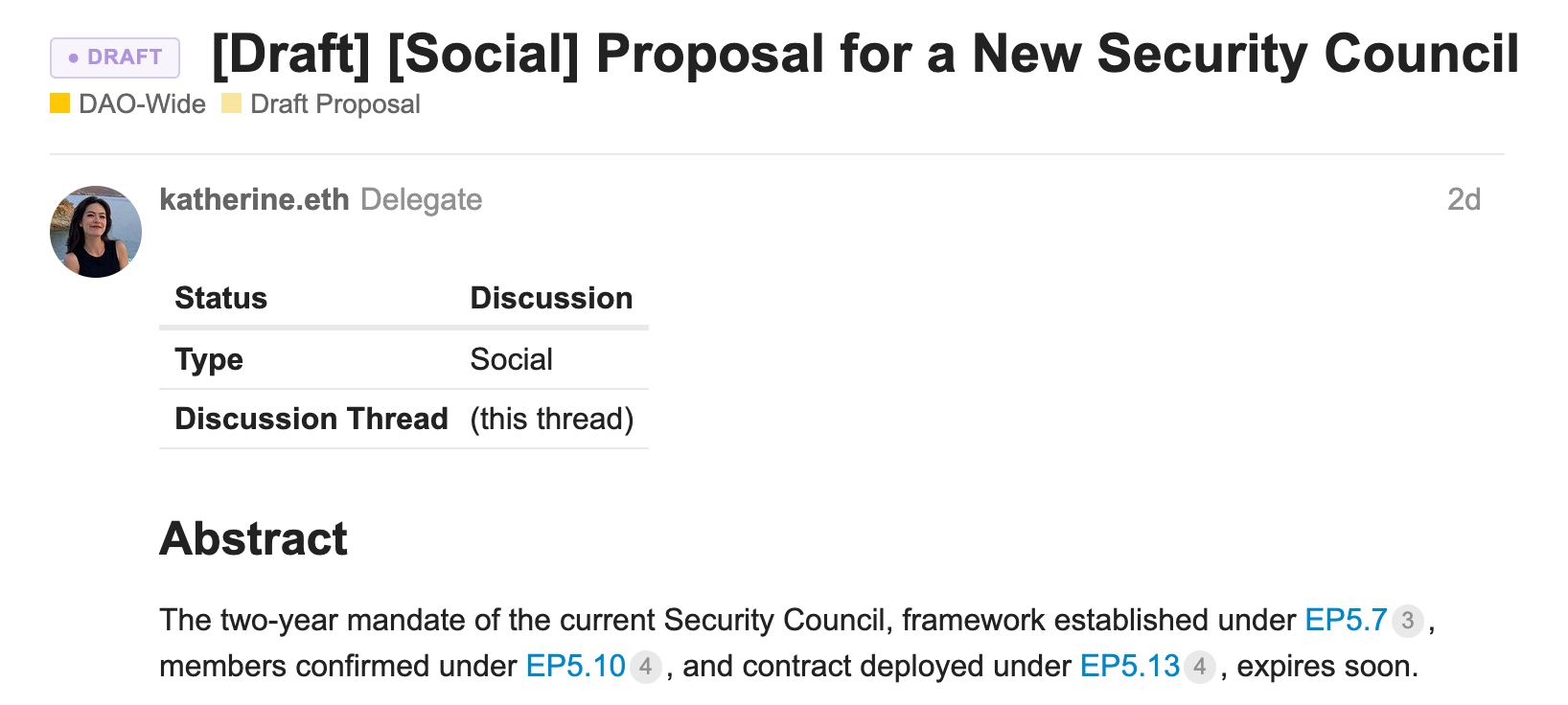
In response, Katherine released a new proposal that raised the threshold for veto execution (from 4/8 to 5/8), implemented stricter power limitations, and added member removal mechanisms, among other things, to prevent power concentration.


Data shows ENS's annual revenue exceeded $10 million in 2023, declined to $7 million in 2024, and had fallen to less than $2 million in 2025. When there is enough money, no one cares how it is spent; but when the industry is in a downturn and revenue is falling, even assets worth several hundred million dollars require careful planning.


Nick's substantial holdings of ENS are enough for him to implement these changes, but the forced implementation of change via the token-holding 'bug' leaves Nick with no retreat. The new Foundation must perform at least better than the DAO. 'How to do it' is the problem Nick must solve in the next phase. Hopefully, the ENS core team already has the answer.


熱門幣種推薦

相關問答

QWhy did ENS founder Nick Johnson vote against renewing the security committee's veto power?

ANick Johnson voted against the renewal because he was concerned about a lack of sufficient checks and balances on the committee's power. He worried that a two-year renewal would solidify these issues and that some members might misuse the veto for political purposes to block ordinary proposals they personally disliked, rather than only for genuine emergencies.

QWhat are the two main proposed changes in Katherine Wu's 'Next Era of ENS DAO' proposal?

AThe two main proposals are: 1) Transferring daily operations, treasury management, and long-term capital strategy to a restructured ENS Foundation, which would handle daily treasury operations, public goods grants, working group coordination, ecosystem strategy, and brand assets. 2) Ensuring that the DAO and token holders retain core powers, including protocol-level governance, contract upgrades, registry control, fee structure changes, and constitutional amendments.

QWhat was the core controversy surrounding the proposed new ENS Foundation?

AThe core controversy centered on the DAO treasury. Critics, including ENS's original constitution author Brantly Millegan, argued that the proposal would allow the Foundation (and by extension, ENS Labs) to gain practical control over the massive treasury funds, thereby weakening the direct influence of token holders. This was seen as a move away from the original DAO design where token holders controlled both the protocol and the treasury.

QWhat problems did Nick Johnson and Limes identify with ENS DAO's governance in late 2025?

AThey identified significant political infighting within the DAO, where competent people were leaving and leadership was falling into the hands of individuals who lacked experience or had interests misaligned with the protocol's. Limes specifically noted that proposal-making had become a reciprocal 'you support me, I support you' game, with a lack of focus on necessary work, and that the absence of entry standards led to a 'bad money driving out good' phenomenon.

QHow did Katherine Wu attempt to address the concerns about the security committee's power after Nick's vote?

AIn response to the concerns raised by Nick Johnson's vote, Katherine Wu submitted a new proposal to reform the security committee. The key changes included raising the threshold for executing a veto (from 4/8 to 5/8 members), implementing stricter power limitations, and adding a mechanism for removing committee members, all aimed at preventing the concentration of power.

你可能也喜歡

美国证交会任命投资者教育负责人,加密货币风险警示仍是关注焦点

美国证券交易委员会(SEC)任命约翰·摩西(John Moses)领导其投资者教育和援助办公室。这一职位对于加密货币领域的重要性可能超出表面所见。 该办公室负责面向公众的投资者保护信息传播,而加密货币风险教育一直是SEC沟通策略的关键部分。虽然此类人事任命通常不会直接影响代币价格,也不代表政策突变,但其意义在于:投资者教育部门塑造着散户投资者接收市场风险、诈骗、披露以及复杂产品警告的方式。 多年来,加密货币一直是投资者警报中的常见主题。从欺诈警告到波动性提醒,该机构的教育工作能够在未提起执法诉讼的情况下,影响公众信息的基调。摩西的任命表明,这个介于监管和公众沟通之间的办公室将保持连续性。对于加密公司而言,这意味着投资者教育既可能成为增进理解的桥梁,也可能成为发布广泛警告的另一渠道。 需明确的是,此事并非新的市场催化剂,SEC的政策方向仍由委员、法院、立法及部门优先事项驱动。但此类任命决定了机构如何向普通投资者传达这些重点。核心启示在于:加密货币依然牢牢处于SEC关于零售投资者风险的讨论范围内。即使部分调查结束,该机构的投资者保护信息传播也不会消失。

bitcoinist17 分鐘前

美国证交会任命投资者教育负责人,加密货币风险警示仍是关注焦点

bitcoinist17 分鐘前

DEXE交易量飙升200%后大涨——它能否突破30美元大关?

山寨币市场市值自月初以来上涨近7%。在AI板块中,除了DeXe [DEXE]外,其他主要代币并未显示出强劲的短期上涨势头。 过去24小时内,去中心化社交交易和资产管理网络的原生代币DEXE飙升了17.5%。其日交易量增长了201%,表明市场信心支撑着这轮快速上涨。 从日线图来看,DEXE的波段结构看涨稳固。在从9.81美元涨至24.49美元后,经历了深度回调并再次推高。此次上涨尚未结束,且已突破23.6%的斐波那契扩展位。资金流量指标(CMF)稳步上升至+0.24,显示有大量资金流入支持DEXE。交易量激增也支撑着看涨价格持续扩张的观点。 然而,MACD指标处于2026年以来的最高水平,随机相对强弱指数(Stochastic RSI)近日持续处于超买区域。动量指标暗示可能存在过度延伸的状况,但这未必会立即引发价格回调。 从2小时图看,走势也呈强势看涨。尚不确定上涨是会立即延续,还是将开始回调。若价格跌破26.93美元,则可能是更深回调的早期信号。交易者和投资者可等待价格回调至24.65美元附近时买入,但也需意识到,价格可能在回调前就直接突破30美元。 可能影响DEXE走势的另一个因素是比特币(BTC),其正逼近6.4万美元的局部供应区。 **最终摘要要点:** * DeXe价格走势坚定看涨,其近期的突出表现是其他AI板块代币所不及的。 * 这种相对强势伴随着高买入量,目前尚不确定其上涨动能是否会在继续走高前经历低于25美元的深度回调。

ambcrypto23 分鐘前

DEXE交易量飙升200%后大涨——它能否突破30美元大关?

ambcrypto23 分鐘前

交易

現貨

熱門文章

如何購買DAO

歡迎來到HTX.com!在這裡,購買DAO Maker (DAO)變得簡單而便捷。跟隨我們的逐步指南,放心開始您的加密貨幣之旅。第一步:創建您的HTX帳戶使用您的 Email、手機號碼在HTX註冊一個免費帳戶。體驗無憂的註冊過程並解鎖所有平台功能。立即註冊第二步:前往買幣頁面,選擇您的支付方式信用卡/金融卡購買:使用您的Visa或Mastercard即時購買DAO Maker (DAO)。餘額購買:使用您HTX帳戶餘額中的資金進行無縫交易。第三方購買:探索諸如Google Pay或Apple Pay等流行支付方式以增加便利性。C2C購買:在HTX平台上直接與其他用戶交易。HTX 場外交易 (OTC) 購買:為大量交易者提供個性化服務和競爭性匯率。第三步:存儲您的DAO Maker (DAO)購買DAO Maker (DAO)後,將其存儲在您的HTX帳戶中。您也可以透過區塊鏈轉帳將其發送到其他地址或者用於交易其他加密貨幣。第四步:交易DAO Maker (DAO)在HTX的現貨市場輕鬆交易DAO Maker (DAO)。前往您的帳戶,選擇交易對,執行交易,並即時監控。HTX為初學者和經驗豐富的交易者提供了友好的用戶體驗。

428 人學過發佈於 2024.12.13更新於 2026.06.02

如何購買DAO

相關討論

歡迎來到 HTX 社群。在這裡,您可以了解最新的平台發展動態並獲得專業的市場意見。 以下是用戶對 DAO (DAO)幣價的意見。

活动图片