Karpathy's Genius Strikes Again, Challenging RAG, Turning Your Notes into a Second Brain

marsbit發佈於 2026-07-01更新於 2026-07-01

文章摘要

Andrej Karpathy has proposed a revolutionary concept for managing personal knowledge: treating notes as immutable "source code" and using LLMs as "compilers" to build a structured, interlinked wiki. This approach fundamentally shifts the cognitive workflow away from the limitations of RAG (Retrieval-Augmented Generation), which merely retrieves and pieces together fragments, leading to contradictions and "digital mummies"—unused, decaying notes. The LLM-Wiki framework introduces a three-layer architecture: the **Raw Layer** for original, immutable notes; the **Schema Layer** defining rules for structuring knowledge; and the **Wiki Layer**, where the LLM continuously compiles and maintains a coherent, cross-referenced knowledge base. Key operations are **Ingest** (adding new material, which triggers updates across related pages), **Query** (asking the compiled wiki, with answers that can become new pages), and **Lint** (periodic AI audits to find contradictions, outdated claims, or gaps). This system automates the tedious maintenance—updating links, resolving conflicts, keeping summaries fresh—that has historically made large-scale personal knowledge management unsustainable. It realizes Vannevar Bush's 1945 "Memex" vision by finally solving the maintenance problem. Karpathy's proposal represents a third piece in human-AI collaboration, following "Vibe Coding" and "Agentic Engineering." It liberates human attention from organizational drudgery, refocusing it on what matters:...

Saving does not mean owning. Highlighting does not mean understanding.

Those deeply insightful articles that stirred your heart at 2 a.m., the dense web of bidirectional links you created in Obsidian, the meticulously formatted databases in Notion—they are all "cyber mummies" lying dormant in your note-taking apps.

The graphs look impressive, but they have long since decayed.

This is a systemic failure of the entire information-overload era.

Andrej Karpathy, a current Anthropic engineer, former OpenAI co-founder, and former Tesla AI director, couldn't stand it any longer. He dropped a bombshell.
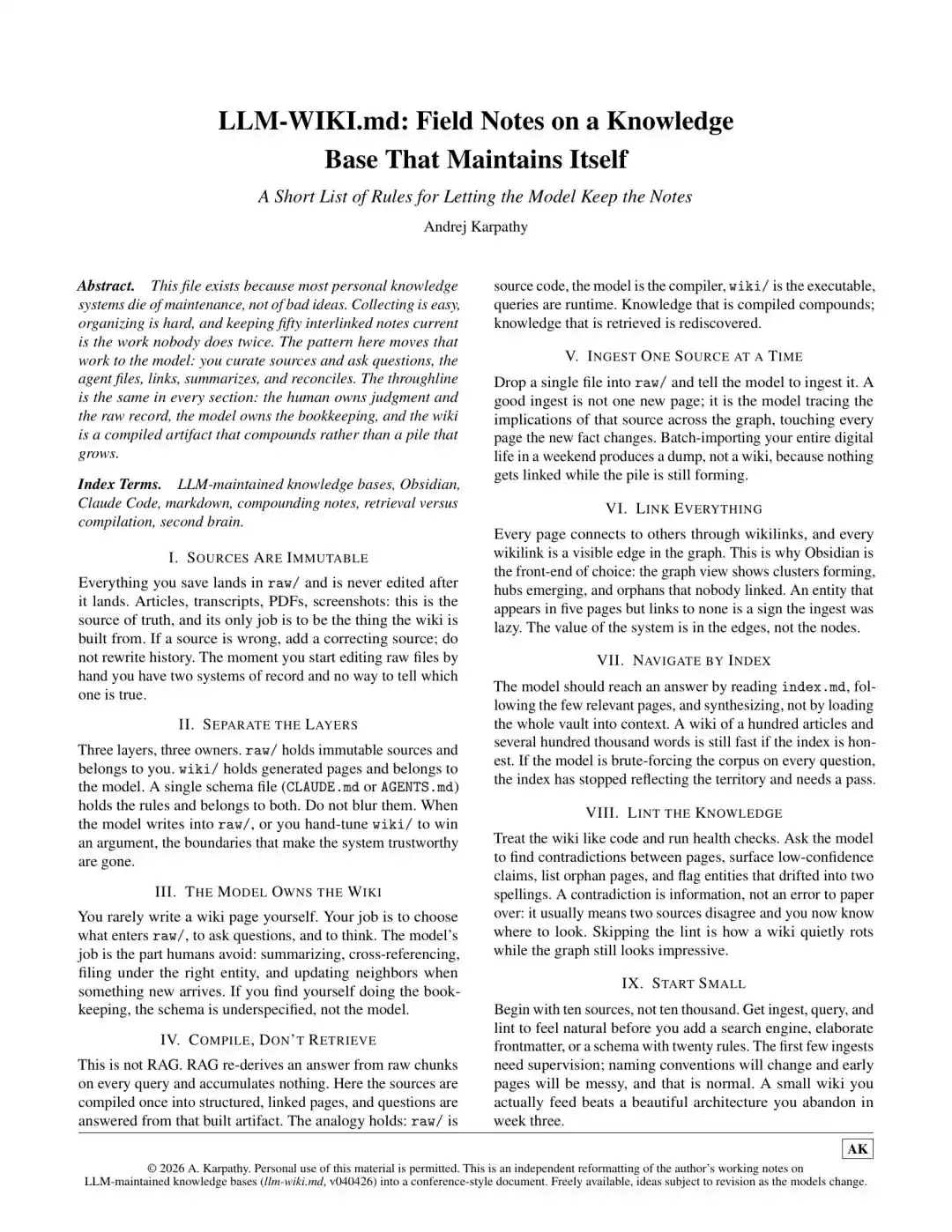
Portal:https://gist.github.com/karpathy/442a6bf555914893e9891c11519de94f

He didn't announce a new model or release a new framework. He simply said: Treat your notes as immutable source code, and let the LLM be the compiler.

Two months later, this document has sparked a quiet yet profound migration across the Obsidian, Claude, and Cursor communities.

Some have already expanded their personal wikis to hundreds of pages and hundreds of thousands of words.

Automated plugins are emerging. Academic researchers, independent entrepreneurs, and lifelong learners are collectively shifting towards a new mode of knowledge production.

The Twilight of RAG: Information Hauling Cannot Save Your Thinking

Before LLM-WIKI, the mainstream solution was RAG (Retrieval-Augmented Generation).

Simply put, it gives a large language model a "filer." When you ask a question, it searches your notes for a few snippets and pieces together an answer.
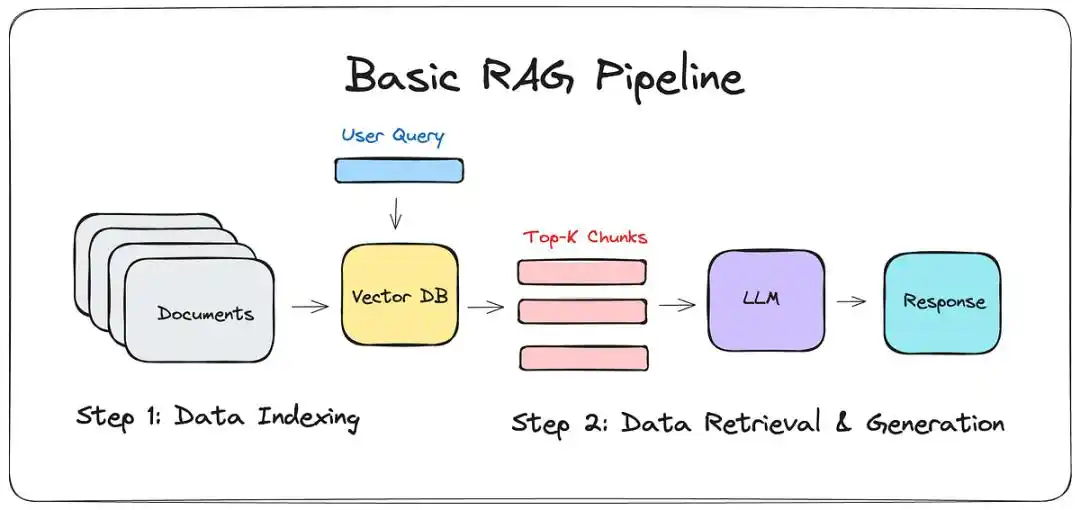
It sounds beautiful, but anyone who has used it knows the gap between "seller's show" and "buyer's reality."

It's merely a hauler: RAG only handles local context, incapable of global understanding.

It can tell you that note #5 mentions A, but it cannot tell you the underlying logic that all 500 notes collectively point towards.

It suffers from "split personality": If you believed A was correct six months ago but wrote a note refuting A yesterday, RAG often ends up contradicting itself, spouting a bunch of logically incoherent nonsense.

Graph Decay: Manually maintained knowledge links are like code without an automatic cleanup function. Over time, broken links are everywhere, and retrieval efficiency plummets exponentially.

Karpathy's insight is sharp: Search and retrieval are manifestations of human incapability. What we need is "consensus," "structure," "truth."

Treat Knowledge as Source Code, Let the LLM Be the Compiler

Karpathy's answer comes from an action programmers do every day but never think to apply to knowledge: compilation.

You write a piece of source code. You don't reread the entire code every time you run the program.

You compile it into a binary file. Compiling once is laborious, but every subsequent run is lightning-fast. The cost of compilation is amortized over thousands of future uses.

Why can't knowledge work the same way?

Karpathy says: Treat your raw notes as immutable source code. Treat the LLM as the compiler. Let it "compile" that pile of messy material once into a structured, interlinked Wiki.
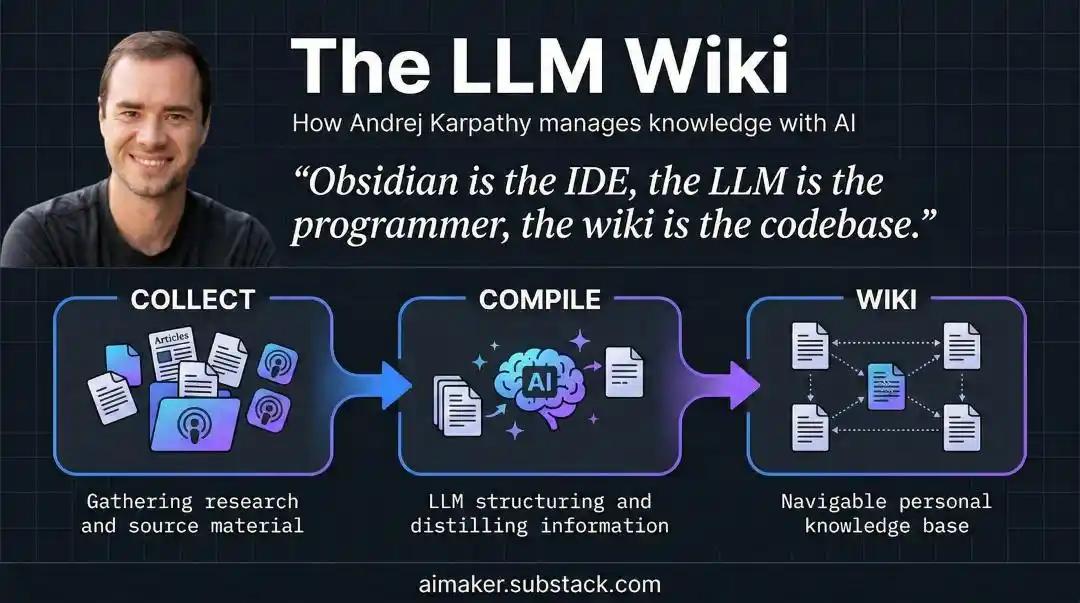
Every time you add new material, the AI performs a merge: it updates relevant entry pages, revises summaries, flags conflicts where new data clashes with old conclusions, and, in the process, reinforces or challenges existing judgments.
The key difference is here: Knowledge is compiled once and then kept fresh, not reconstructed from scratch for every query.

By the time you ask a question, cross-references are already there, contradictions have been flagged, and summaries already reflect everything you've read.

You don't recompile your source code every time you run a program. So why make the AI reread all your notes for every question?

A Fundamental Shift in the Production Relations of Cognition

In his LLM-WIKI framework, notes are no longer dead text; they are "source code."

The large model is no longer a translator looking up a dictionary; it is the "compiler."

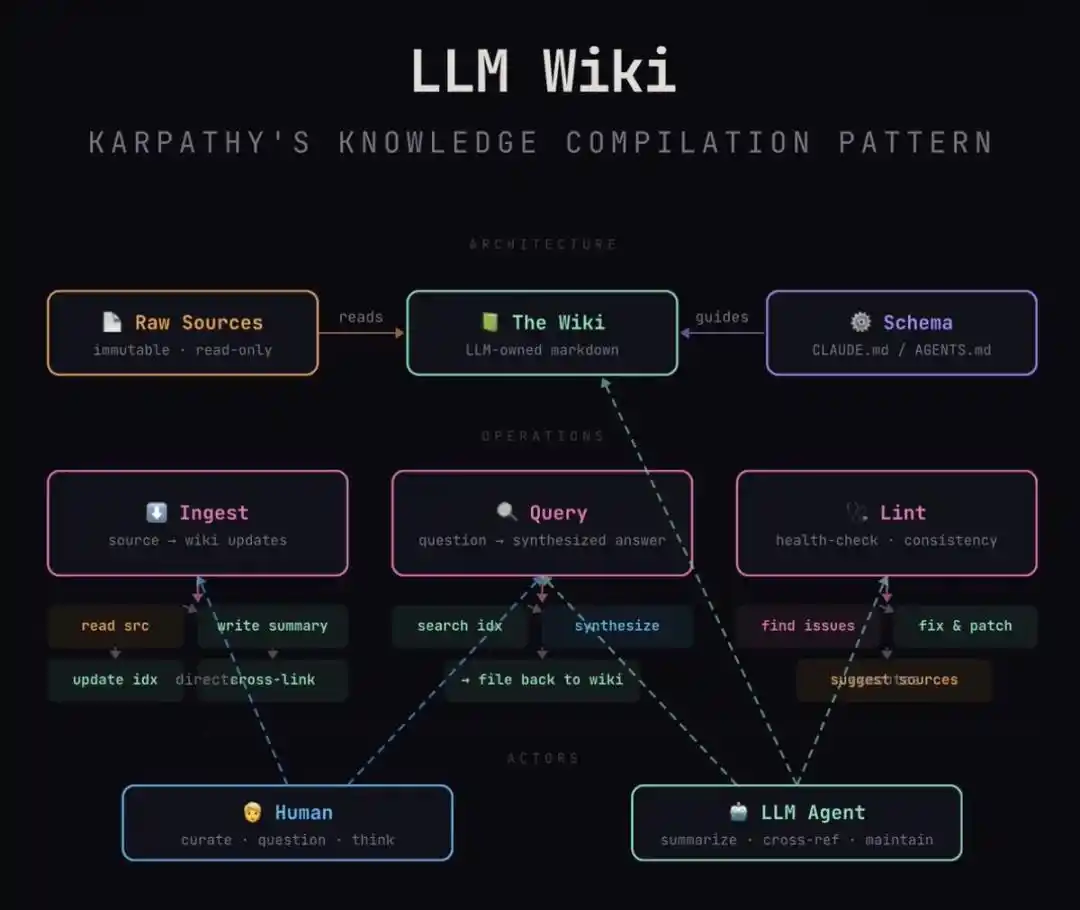
This architecture brilliantly achieves a three-layer decoupling:

1. Raw Layer (Raw Material): This is your mine of inspiration. Random insights you jot down, clipped articles, meeting minutes. It is "immutable," preserving the rawness and messiness of human input.

2. Schema Layer (Knowledge Constitution): This is the "rules of engagement" you write for the AI. For example, you dictate: every person entry must contain "motivation, limitations, key achievements"; every technology stack must explain "pros and cons."

3. Wiki Layer (Compiled Product): This is the zone maintained autonomously by the AI. Following your Schema, it compiles that messy pile of Raw material into structured, cross-linked, logically coherent encyclopedia pages.
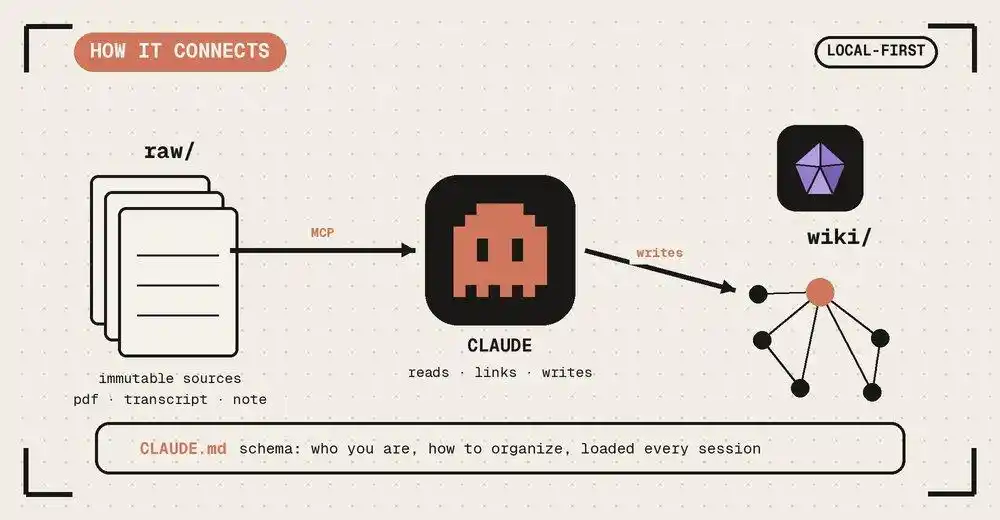
The daily workflow is three actions:

1. Ingest: Toss in a new piece of material. The AI reads it, discusses key points with you, writes a summary, and sweeps through the entire library to update related pages—one source can potentially affect a dozen pages.

2. Query: Ask the compiled Wiki directly. Answers come with citations. The best part: Excellent answers can be archived directly as new pages. Every exploration you make compounds interest.

3. Lint: Periodically have the AI perform a self-check, like code review—find contradictions, find outdated assertions, find isolated pages with no links, find gaps that need filling. Clean early, don't let the library grow rotten.

You are no longer a porter of knowledge; you are the architect of this intellectual empire.

You are only responsible for input and final review. The AI handles all the "grunt work": organizing, aligning, cross-linking, detecting contradictions.

This is a fundamental shift in the production relations of cognition.

This is not another chatbot. ChatGPT understands the internet. LLM-Wiki understands you—or more precisely, what you've taught it.

Every answer comes with [wiki-links] back to your knowledge graph. Every response is the starting point of an exploration path, not the end.

An Invention 80 Years Late

At this point, you might think this is just a clever workflow.

It's more than that.

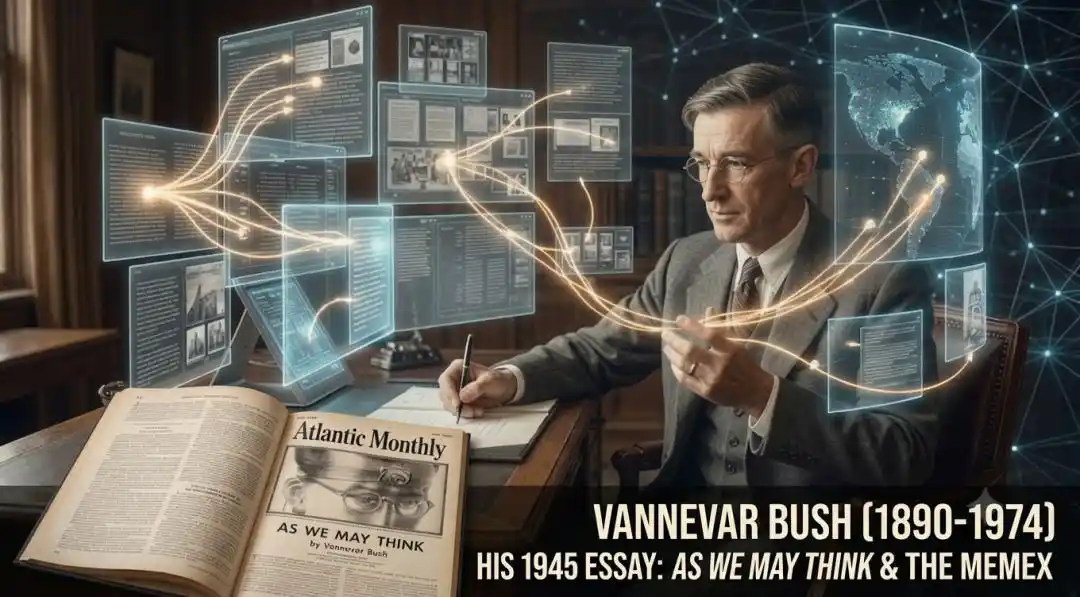
At the end of his gist, Karpathy casually drops a name: Vannevar Bush, and his 1945 essay "As We May Think."
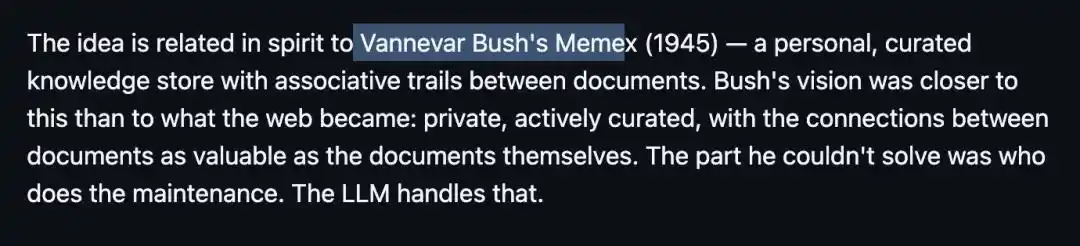
In 1945, just after WWII, this giant of American science envisioned a machine called "Memex":

A mechanical desk that could store all your books, records, and correspondence, and create "associative trails" between related items—connections between documents as valuable as the documents themselves.
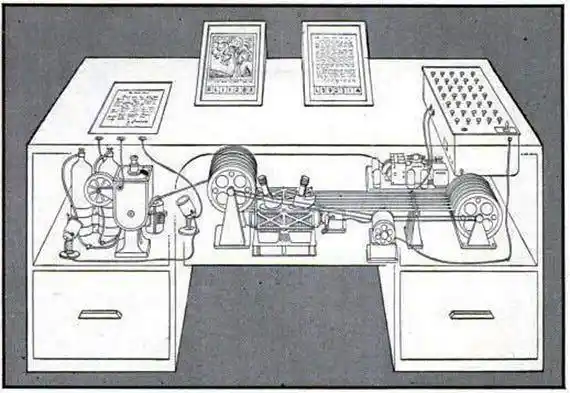
Sound familiar? This is almost a word-for-word description of LLM-Wiki.

Bush's vision was, in fact, closer to this than the later World Wide Web: a private, personally curated knowledge network where connections *are* the value.
So why wasn't Memex built in 80 years?

Because Bush was stuck on a problem he couldn't solve—who maintains it?

Every associative trail had to be created manually. Every cross-reference had to be linked by someone.

Bush imagined dedicated "operators" laying down these little paths through knowledge for you.

But reality is, no one could sustain this tedious chore at scale. Humans abandon maintenance because the cost of maintenance always grows faster than the value it brings.

Karpathy's sentence is the crux of the entire paradigm: The hardest part of maintaining a knowledge base was never reading; it was bookkeeping.

Updating cross-references, keeping summaries fresh, tagging conflicts between new data and old conclusions, keeping dozens of pages consistent. This drudgery was enough to deter anyone.

But a large language model won't forget to update a cross-reference. It can modify fifteen files in one go.

It doesn't get tired. It doesn't get annoyed. It doesn't collapse from late-night fatigue. The maintenance cost is driven to near zero.

Thus, the machine that had stumped humanity for eighty years suddenly started running.

What's Liberated is Human Attention

Looking back, LLM-Wiki is Karpathy's third piece in the puzzle of "human-computer collaboration," and also the most restrained.

The first piece, Vibe Coding (Feb 2025): Accepting AI-written code, not reviewing line-by-line, trusting the model, testing the outcome.

The second piece, Agentic Engineering (Jan 2026): Humans orchestrating AI agents, not writing code themselves.

The third piece, LLM Knowledge Bases (April 2026): What the AI manages is no longer just code, but knowledge itself.
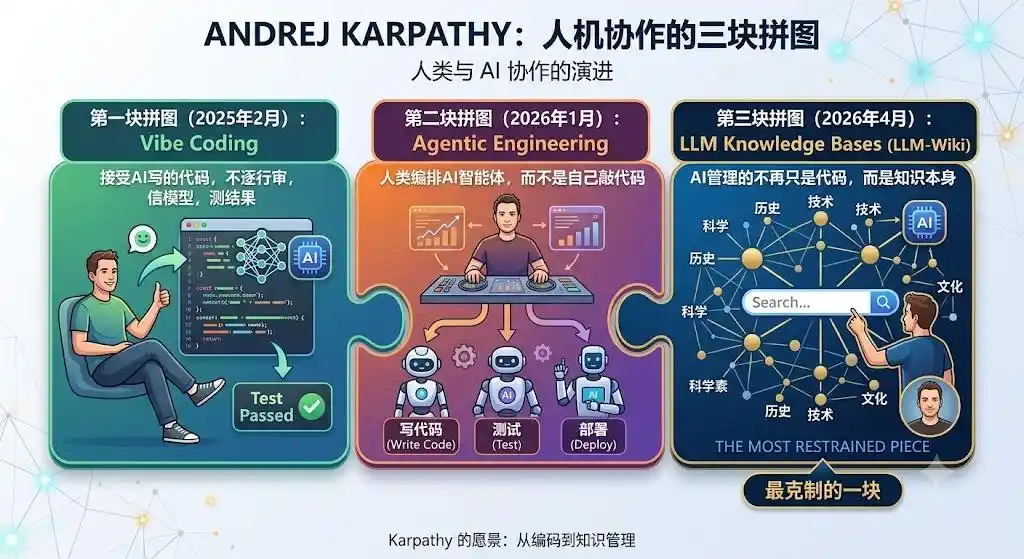
In this new paradigm, what is stripped away from humans are the chores no one likes to do: saving, organizing, linking, bookkeeping.

What remains for humans are only two things: deciding *what* to read, and figuring out what all of it *really means*. These are precisely the two things machines still cannot do and should never do for you.

This is a story of a tool evolving to its extreme, ultimately coming full circle to return human attention back to humans themselves.

That plain, almost unassuming markdown file didn't announce a model or top a leaderboard.

It just quietly reminded us: Your brain was never meant for bookkeeping.

This article is from the WeChat public account "新智元" (New Zhiyuan), author: ASI启示录

熱門幣種推薦

相關問答

QWhat is the core concept behind Karpathy's LLM-Wiki approach, as described in the article?

AThe core concept is to treat your raw notes as immutable 'source code' and use an LLM as a 'compiler' to process them all at once into a structured, cross-referenced, and logically consistent wiki. This compiled knowledge base is then used for querying, unlike RAG which retrieves and processes raw notes for each query.

QWhat are the three main layers of Karpathy's LLM-Wiki architecture?

A1. Raw Layer: The immutable, original source material like ideas, clipped articles, and meeting notes. 2. Schema Layer: The 'constitution' or rules you define for the AI, specifying the required structure for different types of entries (e.g., person entries must include motivation, limitations, key achievements). 3. Wiki Layer: The compiled, structured, and cross-referenced encyclopedia pages that the AI maintains based on the Raw Layer and Schema Layer.

QAccording to the article, what are key limitations of the traditional RAG (Retrieval-Augmented Generation) approach for personal knowledge bases?

AKey limitations include: - It acts as a mere 'porter,' handling local fragments without understanding the global context. - It can produce contradictory or 'split-personality' answers if notes contain conflicting views over time. - Manually maintained knowledge graphs decay over time, with broken links and decreasing retrieval efficiency. - It rebuilds an answer from scratch for each query instead of leveraging a pre-compiled, consistent knowledge structure.

QHow does the LLM-Wiki approach solve the maintenance problem that hindered Vannevar Bush's 'Memex' vision for decades?

AThe LLM-Wiki approach solves the maintenance problem by automating the 'accounting'—the tedious work of updating cross-references, keeping summaries fresh, flagging conflicts, and ensuring consistency across dozens of pages. The LLM, acting as a tireless compiler, handles this maintenance at near-zero cost, which was the impractical manual burden that prevented Memex from becoming a reality.

QWhat fundamental shift in the 'cognitive relations of production' does the LLM-Wiki paradigm represent, according to the article?

AIt represents a shift where humans are no longer the 'porters' of knowledge, responsible for the manual labor of collecting, organizing, linking, and maintaining consistency. Instead, humans become the 'architects'—focusing only on input (deciding what to read/ingest) and final review (determining what it all means). The AI handles all the 'drudge work' of synthesis, alignment, cross-referencing, and contradiction detection, freeing human attention for higher-order thinking.

你可能也喜歡

Base DEX交易量反超Arbitrum,Layer-2竞赛再次升温

Base网络的去中心化交易所(DEX)日交易量已超过Arbitrum,这标志着Layer-2竞争正重新升温。此次超越的关键在于,它反映了资本的真实流动和用户行为,而不仅仅是市场炒作。Base凭借其与Coinbase的关联优势和不断扩张的生态应用,正在实际交易活动这一DeFi核心领域展开竞争。 尽管Arbitrum仍是重要的参与者,但这一变化凸显了以太坊二层网络间流动性的快速转移能力。市场正在观察Base的优势能否转化为持久的链上深度。 对于市场而言,此次变化不应被简单解读为永久性的胜负信号。加密市场常将单一动态过度解读,但可持续的趋势往往更为复杂。重要的是后续发展:若此数据方向得以延续,可能形成更大趋势;若停滞,则仅是当前市场关注点的缩影。 读者和交易者应区分已确认的发展与围绕它的 speculation(推测)。已确认的部分值得关注,而对 speculation 需保持谨慎。该动态为DeFi参与者提供了更清晰的观察框架,指明了需关注的领域、市场的反应部分以及潜在风险点,其价值在于将市场更新与流动性、采用度等深层因素联系起来,而非宣称单一头条能主导整个市场。最终,关键在于观察生态建设者、交易所、大额持有者等在初始新闻热度消退后的后续行动。

bitcoinist18 分鐘前

Base DEX交易量反超Arbitrum,Layer-2竞赛再次升温

bitcoinist18 分鐘前

Kraken上线SN64现货交易,交易所上币通道保持活跃

加密货币交易所Kraken宣布上线SN64进行现货交易。此举虽对市值影响有限,但揭示了交易所在当前严格监管环境下的一种行为模式:主要平台仍在根据用户需求和运营考量,有选择性地扩展现货市场。 关键点在于,交易所的上架行为并非对资产的背书,但确实改变了资产的可得性。登陆Kraken后,专业和零售用户能更方便地在成熟平台进行交易,这对提升流动性和可见性具有重要意义。这表明交易所的上市通道并未关闭,而是变得更加审慎,它们会仔细权衡上架何种资产、如何表述以及向哪些司法辖区开放。 对于市场而言,不应过度解读单一资产的上线,而应聚焦于交易所的准入动态和上市策略。加密市场常将任何消息转化为单向交易信号,但更具持久性的故事往往层次更丰富,因为它们会逐步改变头寸分布、激励机制、基础设施或监管环境。 当下的重点是观察后续发展。若相关数据、公司动态或链上记录持续同向变动,则可能形成更大趋势;若停滞不前,其价值则更多是反映了特定时刻(如7月8日)的市场关注点。对于读者和交易者,关键在于将已确认的事实与围绕它的推测区分开来。事实值得关注,而推测则需要警惕。 总之,此次上线消息仅是一个起点。更值得关注的是在首次公告发布后,开发者、交易所、基金、监管机构或大持有者等市场各方的后续反应,这将决定这是一个孤立事件还是一个更宏大叙事的开端。

bitcoinist52 分鐘前

Kraken上线SN64现货交易,交易所上币通道保持活跃

bitcoinist52 分鐘前

交易

現貨

熱門文章

什麼是 $S$

理解 SPERO:全面概述 SPERO 簡介 隨著創新領域的不斷演變,web3 技術和加密貨幣項目的出現在塑造數字未來中扮演著關鍵角色。在這個動態領域中,SPERO(標記為 SPERO,$$s$)是一個引起關注的項目。本文旨在收集並呈現有關 SPERO 的詳細信息,以幫助愛好者和投資者理解其基礎、目標和在 web3 和加密領域內的創新。 SPERO,$$s$ 是什麼? SPERO,$$s$ 是加密空間中的一個獨特項目,旨在利用去中心化和區塊鏈技術的原則,創建一個促進參與、實用性和金融包容性的生態系統。該項目旨在以新的方式促進點對點互動,為用戶提供創新的金融解決方案和服務。 SPERO,$$s$ 的核心目標是通過提供增強用戶體驗的工具和平台來賦能個人。這包括使交易方式更加靈活、促進社區驅動的倡議,以及通過去中心化應用程序(dApps)創造金融機會的途徑。SPERO,$$s$ 的基本願景圍繞包容性展開,旨在彌合傳統金融中的差距,同時利用區塊鏈技術的優勢。 誰是 SPERO,$$s$ 的創建者? SPERO,$$s$ 的創建者身份仍然有些模糊,因為公開可用的資源對其創始人提供的詳細背景信息有限。這種缺乏透明度可能源於該項目對去中心化的承諾——這是一種許多 web3 項目所共享的精神,優先考慮集體貢獻而非個人認可。 通過將討論重心放在社區及其共同目標上,SPERO,$$s$ 體現了賦能的本質,而不特別突出某些個體。因此,理解 SPERO 的精神和使命比識別單一創建者更為重要。 誰是 SPERO,$$s$ 的投資者? SPERO,$$s$ 得到了來自風險投資家到天使投資者的多樣化投資者的支持,他們致力於促進加密領域的創新。這些投資者的關注點通常與 SPERO 的使命一致——優先考慮那些承諾社會技術進步、金融包容性和去中心化治理的項目。 這些投資者通常對不僅提供創新產品,還對區塊鏈社區及其生態系統做出積極貢獻的項目感興趣。這些投資者的支持強化了 SPERO,$$s$ 作為快速發展的加密項目領域中的一個重要競爭者。 SPERO,$$s$ 如何運作? SPERO,$$s$ 採用多面向的框架,使其與傳統的加密貨幣項目區別開來。以下是一些突顯其獨特性和創新的關鍵特徵: 去中心化治理:SPERO,$$s$ 整合了去中心化治理模型,賦予用戶積極參與決策過程的權力,關於項目的未來。這種方法促進了社區成員之間的擁有感和責任感。 代幣實用性:SPERO,$$s$ 使用其自己的加密貨幣代幣,旨在在生態系統內部提供多種功能。這些代幣使交易、獎勵和平台上提供的服務得以促進,增強了整體參與度和實用性。 分層架構:SPERO,$$s$ 的技術架構支持模塊化和可擴展性,允許在項目發展過程中無縫整合額外的功能和應用。這種適應性對於在不斷變化的加密環境中保持相關性至關重要。 社區參與:該項目強調社區驅動的倡議,採用激勵合作和反饋的機制。通過培養強大的社區,SPERO,$$s$ 能夠更好地滿足用戶需求並適應市場趨勢。 專注於包容性:通過提供低交易費用和用戶友好的界面,SPERO,$$s$ 旨在吸引多樣化的用戶群體,包括那些以前可能未曾參與加密領域的個體。這種對包容性的承諾與其通過可及性賦能的總體使命相一致。 SPERO,$$s$ 的時間線 理解一個項目的歷史提供了對其發展軌跡和里程碑的關鍵見解。以下是建議的時間線,映射 SPERO,$$s$ 演變中的重要事件: 概念化和構思階段:形成 SPERO,$$s$ 基礎的初步想法被提出,與區塊鏈行業內的去中心化和社區聚焦原則密切相關。 項目白皮書的發布:在概念階段之後,發布了一份全面的白皮書,詳細說明了 SPERO,$$s$ 的願景、目標和技術基礎設施,以吸引社區的興趣和反饋。 社區建設和早期參與:積極進行外展工作,建立早期採用者和潛在投資者的社區,促進圍繞項目目標的討論並獲得支持。 代幣生成事件:SPERO,$$s$ 進行了一次代幣生成事件(TGE),向早期支持者分發其原生代幣,並在生態系統內建立初步流動性。 首次 dApp 上線:與 SPERO,$$s$ 相關的第一個去中心化應用程序(dApp)上線,允許用戶參與平台的核心功能。 持續發展和夥伴關係:對項目產品的持續更新和增強,包括與區塊鏈領域其他參與者的戰略夥伴關係,使 SPERO,$$s$ 成為加密市場中一個具有競爭力和不斷演變的參與者。 結論 SPERO,$$s$ 是 web3 和加密貨幣潛力的見證,能夠徹底改變金融系統並賦能個人。憑藉對去中心化治理、社區參與和創新設計功能的承諾,它為更具包容性的金融環境鋪平了道路。 與任何在快速發展的加密領域中的投資一樣,潛在的投資者和用戶都被鼓勵進行徹底研究,並對 SPERO,$$s$ 的持續發展進行深思熟慮的參與。該項目展示了加密行業的創新精神,邀請人們進一步探索其無數可能性。儘管 SPERO,$$s$ 的旅程仍在展開,但其基礎原則確實可能影響我們在互聯網數字生態系統中如何與技術、金融和彼此互動的未來。

170 人學過發佈於 2024.12.17更新於 2024.12.17

什麼是 $S$

什麼是 AGENT S

Agent S:Web3中自主互動的未來 介紹 在不斷演變的Web3和加密貨幣領域,創新不斷重新定義個人如何與數字平台互動。Agent S是一個開創性的項目,承諾通過其開放的代理框架徹底改變人機互動。Agent S旨在簡化複雜任務,為人工智能(AI)提供變革性的應用,鋪平自主互動的道路。本詳細探索將深入研究該項目的複雜性、其獨特特徵以及對加密貨幣領域的影響。 什麼是Agent S? Agent S是一個突破性的開放代理框架,專門設計用來解決計算機任務自動化中的三個基本挑戰: 獲取特定領域知識:該框架智能地從各種外部知識來源和內部經驗中學習。這種雙重方法使其能夠建立豐富的特定領域知識庫,提升其在任務執行中的表現。 長期任務規劃:Agent S採用經驗增強的分層規劃,這是一種戰略方法,可以有效地分解和執行複雜任務。此特徵顯著提升了其高效和有效地管理多個子任務的能力。 處理動態、不均勻的界面:該項目引入了代理-計算機界面(ACI),這是一種創新的解決方案,增強了代理和用戶之間的互動。利用多模態大型語言模型(MLLMs),Agent S能夠無縫導航和操作各種圖形用戶界面。 通過這些開創性特徵,Agent S提供了一個強大的框架,解決了自動化人機互動中涉及的複雜性,為AI及其他領域的無數應用奠定了基礎。 誰是Agent S的創建者? 儘管Agent S的概念根本上是創新的,但有關其創建者的具體信息仍然難以捉摸。創建者目前尚不清楚,這突顯了該項目的初期階段或戰略選擇將創始成員保密。無論是否匿名,重點仍然在於框架的能力和潛力。 誰是Agent S的投資者? 由於Agent S在加密生態系統中相對較新,關於其投資者和財務支持者的詳細信息並未明確記錄。缺乏對支持該項目的投資基礎或組織的公開見解,引發了對其資金結構和發展路線圖的質疑。了解其支持背景對於評估該項目的可持續性和潛在市場影響至關重要。 Agent S如何運作? Agent S的核心是尖端技術,使其能夠在多種環境中有效運作。其運營模型圍繞幾個關鍵特徵構建: 類人計算機互動:該框架提供先進的AI規劃,力求使與計算機的互動更加直觀。通過模仿人類在任務執行中的行為,承諾提升用戶體驗。 敘事記憶:用於利用高級經驗,Agent S利用敘事記憶來跟蹤任務歷史,從而增強其決策過程。 情節記憶:此特徵為用戶提供逐步指導,使框架能夠在任務展開時提供上下文支持。 支持OpenACI:Agent S能夠在本地運行,使用戶能夠控制其互動和工作流程,與Web3的去中心化理念相一致。 與外部API的輕鬆集成:其多功能性和與各種AI平台的兼容性確保了Agent S能夠無縫融入現有技術生態系統,成為開發者和組織的理想選擇。 這些功能共同促成了Agent S在加密領域的獨特地位,因為它以最小的人類干預自動化複雜的多步任務。隨著項目的發展,其在Web3中的潛在應用可能重新定義數字互動的展開方式。 Agent S的時間線 Agent S的發展和里程碑可以用一個時間線來概括,突顯其重要事件: 2024年9月27日:Agent S的概念在一篇名為《一個像人類一樣使用計算機的開放代理框架》的綜合研究論文中推出,展示了該項目的基礎工作。 2024年10月10日:該研究論文在arXiv上公開,提供了對框架及其基於OSWorld基準的性能評估的深入探索。 2024年10月12日:發布了一個視頻演示,提供了對Agent S能力和特徵的視覺洞察,進一步吸引潛在用戶和投資者。 這些時間線上的標記不僅展示了Agent S的進展,還表明了其對透明度和社區參與的承諾。 有關Agent S的要點 隨著Agent S框架的持續演變,幾個關鍵特徵脫穎而出,強調其創新性和潛力: 創新框架:旨在提供類似人類互動的直觀計算機使用,Agent S為任務自動化帶來了新穎的方法。 自主互動:通過GUI自主與計算機互動的能力標誌著向更智能和高效的計算解決方案邁進了一步。 複雜任務自動化:憑藉其強大的方法論,能夠自動化複雜的多步任務,使過程更快且更少出錯。 持續改進:學習機制使Agent S能夠從過去的經驗中改進,不斷提升其性能和效率。 多功能性:其在OSWorld和WindowsAgentArena等不同操作環境中的適應性確保了它能夠服務於廣泛的應用。 隨著Agent S在Web3和加密領域中的定位,其增強互動能力和自動化過程的潛力標誌著AI技術的一次重大進步。通過其創新框架,Agent S展現了數字互動的未來,為各行各業的用戶承諾提供更無縫和高效的體驗。 結論 Agent S代表了AI與Web3結合的一次大膽飛躍,具有重新定義我們與技術互動方式的能力。儘管仍處於早期階段,但其應用的可能性廣泛且引人入勝。通過其全面的框架解決關鍵挑戰,Agent S旨在將自主互動帶到數字體驗的最前沿。隨著我們深入加密貨幣和去中心化的領域,像Agent S這樣的項目無疑將在塑造技術和人機協作的未來中發揮關鍵作用。

938 人學過發佈於 2025.01.14更新於 2025.01.14

什麼是 AGENT S

如何購買S

歡迎來到HTX.com!在這裡,購買Sonic (S)變得簡單而便捷。跟隨我們的逐步指南,放心開始您的加密貨幣之旅。第一步:創建您的HTX帳戶使用您的 Email、手機號碼在HTX註冊一個免費帳戶。體驗無憂的註冊過程並解鎖所有平台功能。立即註冊第二步:前往買幣頁面,選擇您的支付方式信用卡/金融卡購買:使用您的Visa或Mastercard即時購買Sonic (S)。餘額購買:使用您HTX帳戶餘額中的資金進行無縫交易。第三方購買:探索諸如Google Pay或Apple Pay等流行支付方式以增加便利性。C2C購買:在HTX平台上直接與其他用戶交易。HTX 場外交易 (OTC) 購買:為大量交易者提供個性化服務和競爭性匯率。第三步:存儲您的Sonic (S)購買Sonic (S)後,將其存儲在您的HTX帳戶中。您也可以透過區塊鏈轉帳將其發送到其他地址或者用於交易其他加密貨幣。第四步:交易Sonic (S)在HTX的現貨市場輕鬆交易Sonic (S)。前往您的帳戶,選擇交易對,執行交易,並即時監控。HTX為初學者和經驗豐富的交易者提供了友好的用戶體驗。

2.0k 人學過發佈於 2025.01.15更新於 2026.06.02

如何購買S

相關討論

歡迎來到 HTX 社群。在這裡,您可以了解最新的平台發展動態並獲得專業的市場意見。 以下是用戶對 S (S)幣價的意見。

活动图片