The Arrival of 'Tokenpocalypse': When Costs Outweigh Productivity Gains, Who Pays the Bill?

marsbit發佈於 2026-06-10更新於 2026-06-10

文章摘要

The article discusses the emergence of the term "Tokenpocalypse" (Token Doomsday), triggered by Microsoft's shift to a token-based pricing model for GitHub Copilot on June 1st. This change introduces significant cost multipliers between different AI models, with some premium models becoming up to 60 times more expensive per token. As leading AI companies like Anthropic and OpenAI prepare for IPOs, increasing profit pressures may lead more vendors to raise prices. This creates a dilemma for enterprises. Companies that once encouraged or mandated high AI token usage to boost productivity now face budget overruns under the new pricing. The lack of granular per-employee token limits means a single developer could exhaust a company's monthly budget. This forces a paradoxical situation where employees are criticized for both using too little and too much AI. The piece cites Uber as a case study, where AI budget depletion led to rapid implementation of usage caps. It highlights the growing disconnect between AI utility and cost, noting that even initial pricing for services like ChatGPT Plus was somewhat arbitrary. The industry now grapples with balancing AI's productivity gains against its escalating expenses. Ultimately, the article suggests the focus is shifting from fears of "AI replacing jobs" to the reality of "AI consuming budgets." The mental overhead and operational hours spent managing token costs are beginning to undermine the very productivity benefits AI promises. Th...

A new term has recently sparked widespread discussion: "Tokenpocalypse."

The trigger was Microsoft's pricing restructuring for GitHub Copilot. Starting June 1st, Copilot has fully transitioned to a token-based billing model. The token cost multipliers differ drastically between various models, with some models costing 60 times more per token than others.

And the advanced models widely regarded by users as "truly effective" are precisely the ones experiencing the most severe price hikes.

As leading AI companies like Anthropic and OpenAI prepare for IPOs, AI firms will face increasingly intense profitability pressures, which may compel more vendors to follow suit with price increases.

The cost of using AI is an inevitable issue for enterprises expanding productivity. The recent "tokenmaxxing" trend, driven by competition over employee token usage, is approaching its end as Tokenpocalypse looms.

"The entire tokenmaxxxing craze, from rise to peak to disdain, lasted just six months."

The Corporate Dilemma

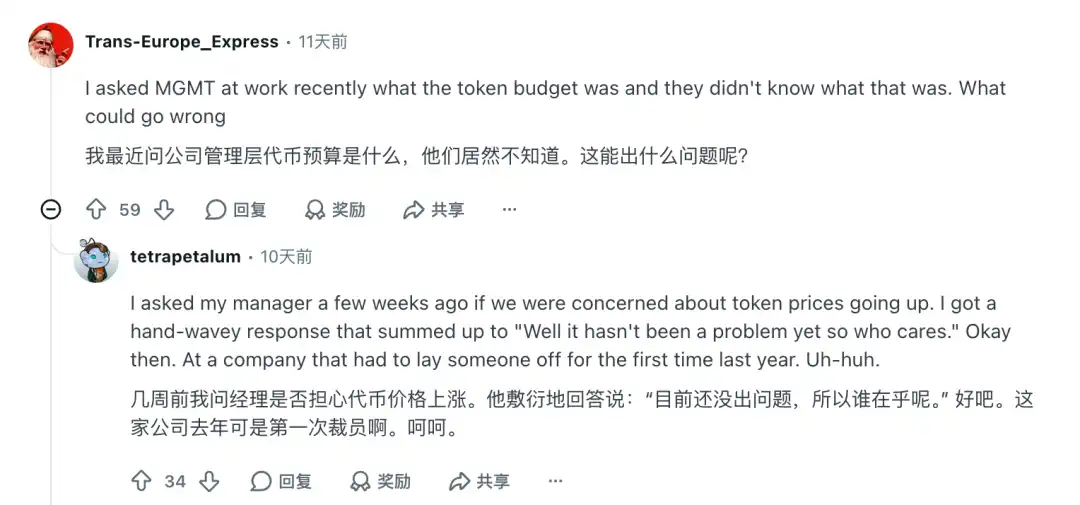
A developer from a large corporation described an absurd predicament: the company had long mandated employee use of AI tools, and using too few tokens would result in a meeting. But with the new pricing, using too many tokens now also leads to a meeting.
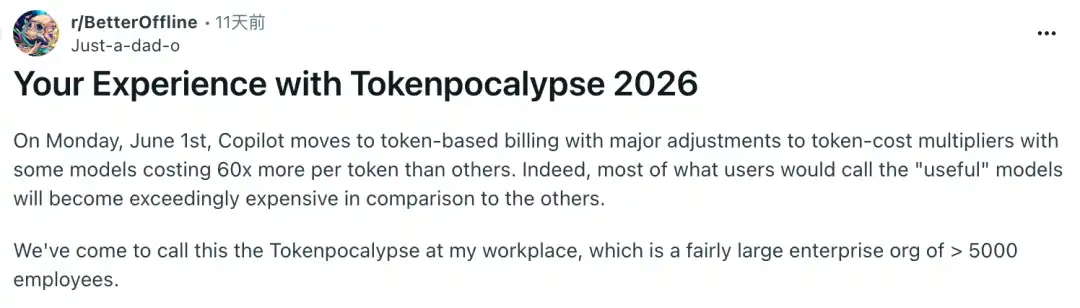
More critically, the Copilot team has yet to launch an "employee-level token quota" feature. This means that under the new billing model, a single employee could potentially exhaust the company's entire monthly token budget in one day.

"My job is no longer about using software to solve business problems," the developer wrote. "My job has become solving the token usage problem."

The comments section offers even more gems. One user summarized it: "Company policy became: 'Use AI for everything, but be careful not to use too much, because if the LLM consumes too many tokens you'll be deactivated, and then you'll be criticized for not using AI for the rest of the month.'"

A company's excessive focus on AI productivity can also be a double-edged sword.

An information director from a major law firm even "boasted" at an AI seminar: after their AI system crashed, the lawyers were essentially at a standstill, as they could no longer work without AI.

"A person trained for years in a specialized field freely admits they can't work without an AI chatbox? I'd be so ashamed I'd start re-evaluating my entire career."

The Uber Overspend Incident: An Industry Microcosm

Most AI models now have usage packages, but the issue of budget control becomes more severe as tokens increasingly trend towards pay-as-you-go pricing.
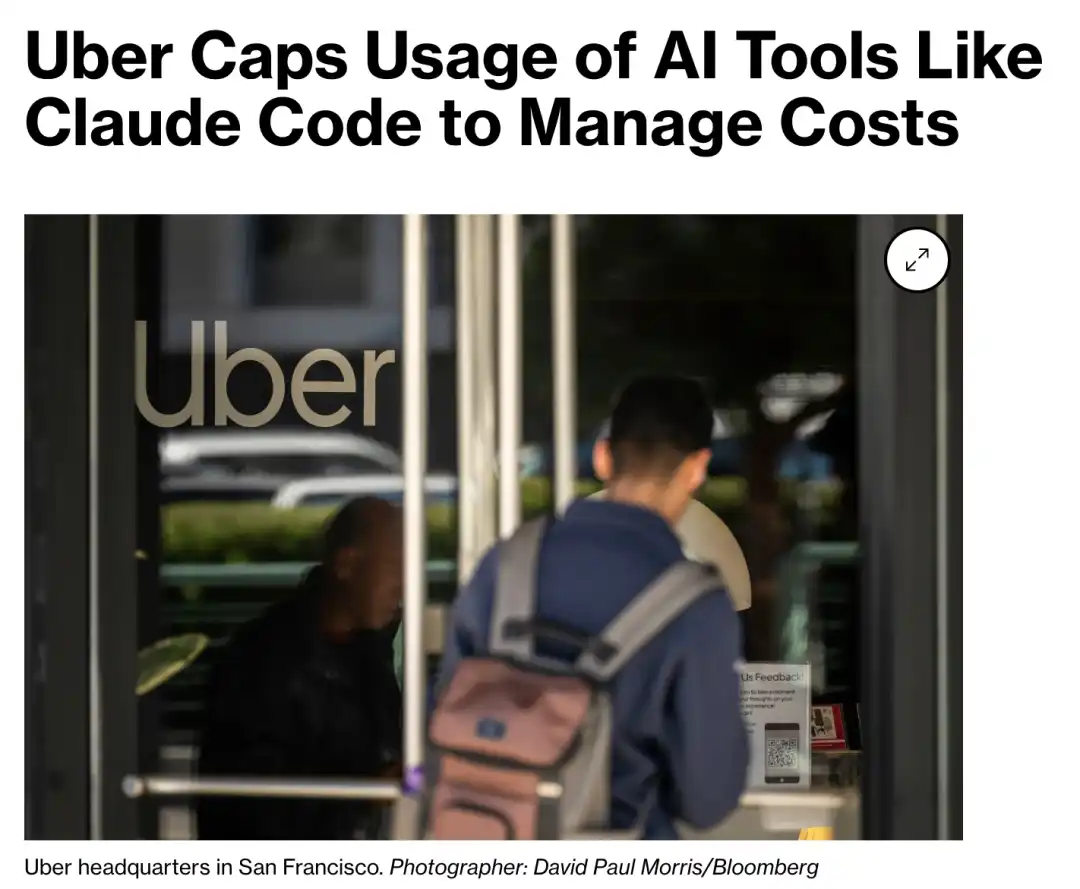
Uber completed a full arc in just one and a half months: first discovering that "the AI budget was burning much faster than anticipated," then urgently implementing usage caps and employee restrictions.
"Imagine a company as heavily reliant on AI as Uber hitting a wall this quickly," was discussed on a TechCrunch podcast. "The question is: Can AI labs bring costs down to meet customers' willingness to pay?"

A little-known fact: When ChatGPT Plus was initially priced at $20/month, there wasn't much strategic consideration; "they just threw out a number." The entire industry is still paying for that starting point.

"Your Job Won't Be Replaced by AI, But Your Budget Might"

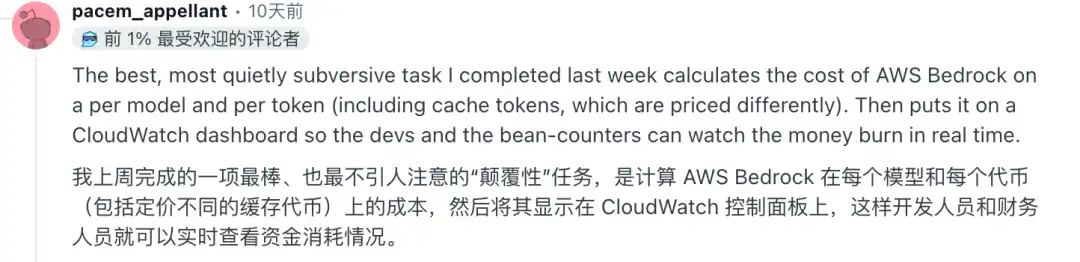
There are more thought-provoking details on Reddit. Someone built an AWS Bedrock cost monitoring dashboard at their company, displaying real-time spending per model and per token (including cached tokens) on CloudWatch, "so developers and finance can watch the money burn together." The comment section's reaction was: "Congratulations, you just gave them a new KPI."
Another large company has already faced similar tightening: after AI credits ran out, everyone was forcibly downgraded to GPT-4.2, losing even the VSCode integration.

An observer from outside the tech industry voiced a sentiment shared by many: "The mental energy and actual man-hours this whole thing consumes have already started impacting the delivery of work that actually makes the company money."

While the entire industry remains immersed in the narrative that "AI will replace everything," a more realistic question has surfaced: the bill for compute power must ultimately be paid. And "Tokenpocalypse" might just be the beginning of this reckoning.


熱門幣種推薦

相關問答

QWhat is 'Tokenpocalypse' and what event triggered its discussion?

A'Tokenpocalypse' or 'Token Doomsday' refers to a scenario where the rising costs of using AI tokens begin to outweigh their productivity benefits. The discussion was triggered by Microsoft's pricing overhaul for GitHub Copilot, which, starting June 1, shifted entirely to a token-based billing model with significant cost disparities between models.

QWhat is the 'absurd dilemma' faced by enterprises regarding AI tool usage as described in the article?

AThe article describes an absurd dilemma where companies have previously mandated employees to use AI tools, reprimanding those who used too few tokens. However, with the new pricing model, employees are now also reprimanded for using too many tokens, putting them in a 'damned if you do, damned if you don't' situation.

QWhat key functionality does GitHub Copilot currently lack, according to the article, and what is its potential consequence under the new pricing?

AAccording to the article, GitHub Copilot's team has not yet implemented an 'employee-level token limit' feature. This means that under the new pay-per-use model, a single employee could potentially exhaust the company's entire monthly token budget in one day.

QHow does the Uber case illustrate a broader industry problem with AI costs?

AThe Uber case serves as an industry microcosm. The company discovered its AI budget was being depleted much faster than anticipated within just a month and a half, forcing it to hastily implement usage caps and employee restrictions. This highlights the challenge of unpredictable and escalating AI operational costs even for large, tech-savvy companies.

QAccording to the article's conclusion, what is the more immediate and realistic threat compared to the narrative of 'AI replacing everything'?

AThe article concludes that a more immediate and realistic threat than 'AI replacing everything' is the financial burden of the compute bill. The 'Tokenpocalypse' represents the beginning of a financial reckoning where someone ultimately has to pay for the computational power, potentially impacting budgets and work delivery more directly than job replacement.

你可能也喜歡

Vitalik算法稳定币设想:从期权视角解读机制与挑战

Vitalik Buterin 近期提出了一种新颖的算法稳定币设想,该方案从期权视角出发,试图规避传统抵押债务头寸(CDP)稳定币的清算风险。其核心设计是将1单位ETH拆分为两类权益:稳定侧(P)和上涨侧(N)。稳定侧类似一个深度实值的合成备兑看涨期权,旨在获得低于某一执行价的“稳定”价值;上涨侧则获得执行价以上的全部上涨收益。两部分权益之和始终等于1 ETH,因此系统无需债务、保证金或清算机制。 然而,该设计面临显著挑战。为实现稳定,稳定侧资产需持续滚动(展期)深度实值期权,这会带来交易滑点、固定交易路径被抢跑以及流动性不足等问题。更根本的难点在于,每一份稳定资产的创造,都需要有参与者持续持有对应的上涨侧资产——这本质上是一种无资金费率、无清算风险的杠杆ETH多头。该需求能否长期、规模化存在,是系统成功扩张的关键。 作者结合其DeFi期权协议Rysk的经验指出,期权过去难以在DeFi中成为主流交易产品,因其过于复杂。但若转变思路,将期权作为底层金融基础模块,用于构建稳定币、结构化收益产品等更复杂的资产,则可能展现出巨大潜力。期权的未来机会或许不在于成为下一个永续合约,而在于成为下一代链上金融产品的定价与风险分配引擎。

marsbit1 小時前

Vitalik算法稳定币设想:从期权视角解读机制与挑战

marsbit1 小時前

交易

現貨
合約

熱門文章

如何購買BILL

歡迎來到HTX.com!在這裡,購買Billions Network (BILL)變得簡單而便捷。跟隨我們的逐步指南,放心開始您的加密貨幣之旅。第一步:創建您的HTX帳戶使用您的 Email、手機號碼在HTX註冊一個免費帳戶。體驗無憂的註冊過程並解鎖所有平台功能。立即註冊第二步:前往買幣頁面,選擇您的支付方式信用卡/金融卡購買:使用您的Visa或Mastercard即時購買Billions Network (BILL)。餘額購買:使用您HTX帳戶餘額中的資金進行無縫交易。第三方購買:探索諸如Google Pay或Apple Pay等流行支付方式以增加便利性。C2C購買:在HTX平台上直接與其他用戶交易。HTX 場外交易 (OTC) 購買:為大量交易者提供個性化服務和競爭性匯率。第三步:存儲您的Billions Network (BILL)購買Billions Network (BILL)後,將其存儲在您的HTX帳戶中。您也可以透過區塊鏈轉帳將其發送到其他地址或者用於交易其他加密貨幣。第四步:交易Billions Network (BILL)在HTX的現貨市場輕鬆交易Billions Network (BILL)。前往您的帳戶,選擇交易對,執行交易,並即時監控。HTX為初學者和經驗豐富的交易者提供了友好的用戶體驗。

354 人學過發佈於 2026.05.07更新於 2026.06.02

如何購買BILL

相關討論

歡迎來到 HTX 社群。在這裡,您可以了解最新的平台發展動態並獲得專業的市場意見。 以下是用戶對 BILL (BILL)幣價的意見。

活动图片