Selling 32 BTC to Pay Dividends: Strategy Breaks the 'Never Sell' Vow

marsbit發佈於 2026-06-02更新於 2026-06-02

文章摘要

On June 1st, Strategy (formerly MicroStrategy) disclosed in an SEC filing that it sold 32 BTC between May 26-31 for approximately $2.5 million at an average price of $77,135. The proceeds were explicitly used to pay dividends on its preferred stock series. While negligible compared to its 843,706 BTC holdings and recent $2 billion monthly purchases, this move broke its long-standing "never sell" policy, signaling a shift in capital management. This sale is linked to Strategy's substantial dividend obligations from preferred stock issued since early 2025, which have consumed a significant portion of its dedicated $2.25 billion cash reserve. During a recent earnings call, the CEO mentioned "disciplined sale of bitcoin" as a potential tool, foreshadowing this event. Analysts note the financial impact is minimal, but the symbolic precedent is significant, indicating future sales are possible if cash reserves dwindle. The disclosure coincided with Bitcoin's price falling below $72,000 amid broader market weakness, including record monthly outflows from spot Bitcoin ETFs in May. Strategy is not alone; Q1 2026 saw other corporate Bitcoin holders like MARA, Riot Platforms, and Nakamoto Holdings collectively selling tens of thousands of BTC for debt repayment, liquidity, or strategic shifts, reversing the previous "buy and hold" corporate treasury trend.

Original author: ChandlerZ, Foresight News

On June 1, Strategy filed an 8-K form with the SEC, disclosing the sale of 32 bitcoins between May 26 and 31 at an average price of $77,135, totaling approximately $2.5 million. After the sale, the company still holds 843,706 BTC, with a total cost of $63.87 billion and an average cost basis of $75,699.

The 32 BTC represents 0.004% of its total holdings, and the $2.5 million is equivalent to Strategy's average daily purchase volume over the past 12 months. From a financial perspective, this transaction is almost meaningless. However, what it broke is far more significant than the amount realized. Since its first bitcoin purchase in August 2020, Strategy has only sold once before: in December 2022, it sold 704 BTC for $11.8 million at an average price of $16,776 for the purpose of tax-loss harvesting, repurchasing 810 BTC at a lower price two days later. That sale was essentially a tax operation, not a genuine reduction in holdings.

But this time is different. The $2.5 million is explicitly marked for paying preferred stock dividends, and Strategy does not intend to buy them back.

The Dividend Bills Are Coming Due

Strategy began issuing preferred stock intensively from early 2025: STRK with an 8% annual coupon, STRF at 10%, STRD at 10%, and STRC at 11.5%. With these four series stacked together, the company has cumulatively paid over $693 million in dividends so far.

The logic behind these preferred shares is that investors give money to Strategy, Strategy uses it to buy Bitcoin, and then pays fixed-rate dividends from its cash reserves and operating income. If Bitcoin rises, the mNAV premium expands, and Strategy can continue to issue new shares to raise funds and keep the cycle going. If Bitcoin falls or moves sideways, the dividend obligations do not disappear, but the financing window narrows.
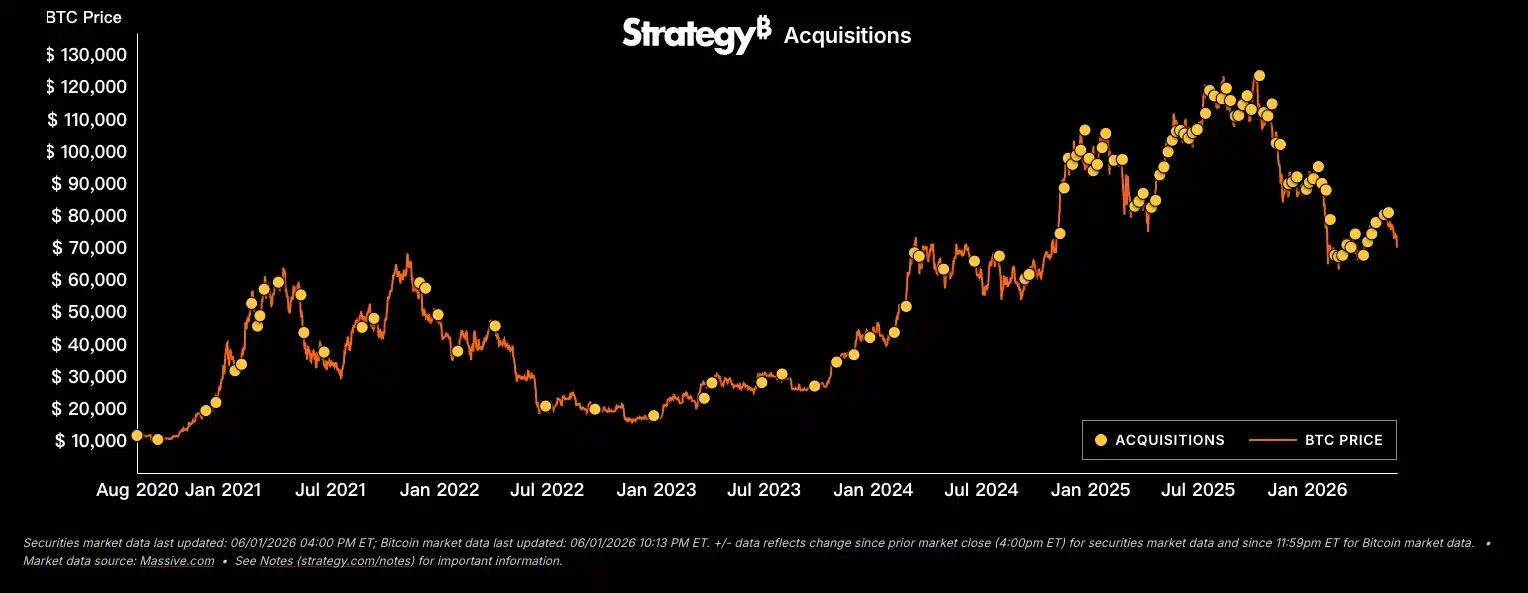
MicroStrategy's Bitcoin Accumulation Pace

In December 2025, Strategy established a $2.25 billion cash reserve specifically to cover dividends and debt payments, which at the time could last about 30 months. But by May 31, 2026, this reserve had fallen to $900 million, a $1.35 billion drawdown in six months.

During the Q1 earnings call, Strategy CEO Phong Le, for the first time in a public setting, listed a 'disciplined sale of bitcoin' as one of the capital management tools. Not many people noticed that statement at the time; in retrospect, it was a preview of this 32 BTC sale.

Saylor posted a tweet on February 2, 2025, saying 'Never sell your bitcoin.' This tweet was widely shared after the 8-K disclosure. He himself only discussed STRC's product positioning in a post afterward, stating Strategy's goal is to make STRC the world's best credit instrument, completely sidestepping the topic of selling Bitcoin.

MSTR's stock price fell about 6% that day. Mizuho maintained its Buy rating but lowered its price target from $320 to $265. Most analysts believe the $2.5 million sale is not materially impactful financially, but the core significance of this event lies in the signal it sends: a crack has been opened. If cash reserves continue to deplete while dividend obligations remain unchanged, the scale of future sales might not stop at 32 bitcoins.

A $110 Million Word Game on Polymarket

Strategy's selling timing also ignited a prediction market on Polymarket.

The market's question was: Will Strategy sell Bitcoin before May 31? The cumulative trading volume currently exceeds $111 million. The 8-K filing shows the transactions occurred between May 26 and 31, with the filing itself timestamped 'May 31, 2026, 4:00 PM ET'. However, the 8-K was only submitted to the SEC on June 1, and the public learned about it after the deadline had passed.
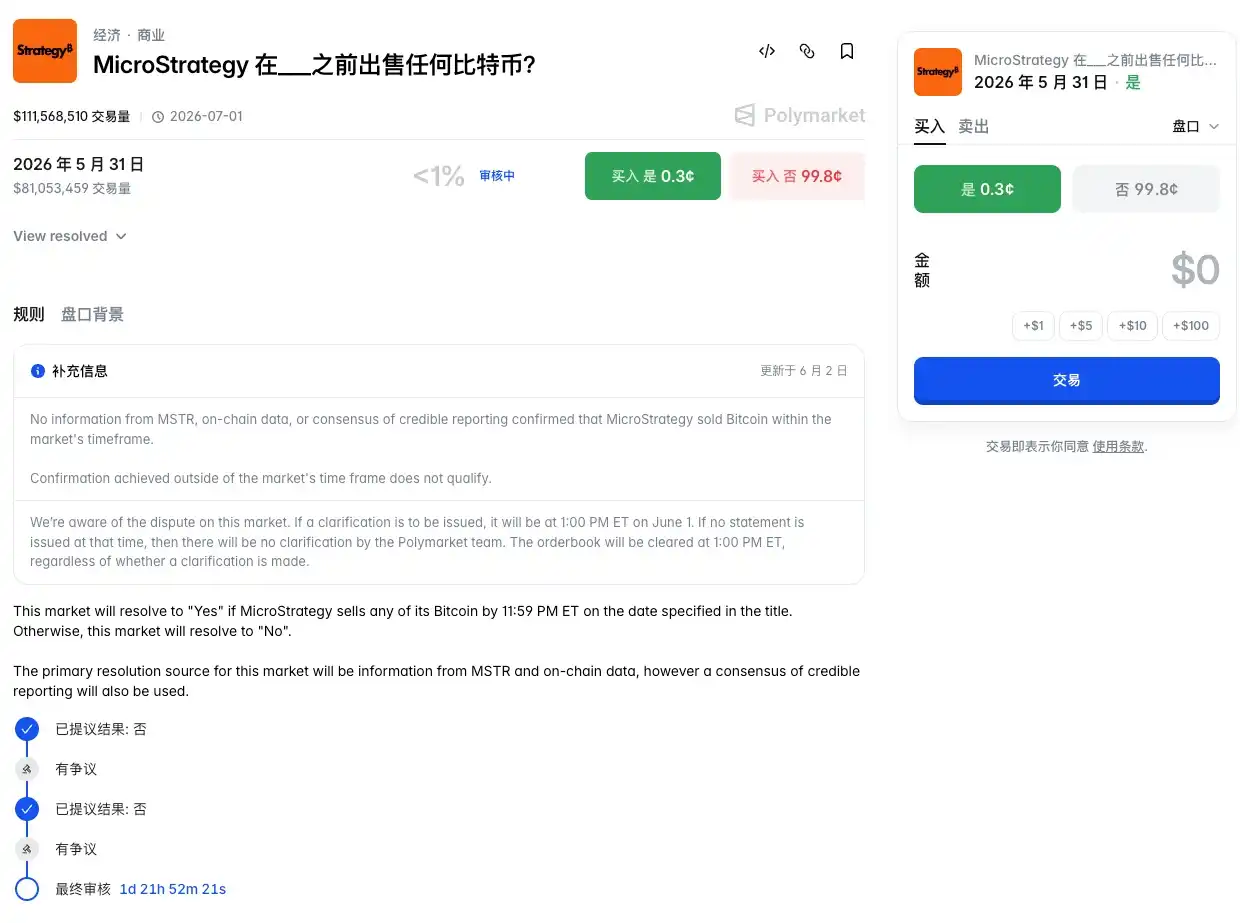
Those who bought 'Yes' argued that the transaction happened before the deadline, as the 8-K clearly states May 31. Those who bought 'No' argued that there was no public information before the deadline proving the sale occurred, so according to the rules, it should be judged as 'No'. After two 'No' proposals were challenged, the dispute escalated to UMA's token-voting arbitration.

Polymarket subsequently added a note to the page, stating that 'consensus from MSTR, on-chain data, or reliable reporting did not confirm that Strategy sold bitcoin within the market's defined time frame. Confirmations obtained outside the market-defined time frame do not satisfy the requirement.'

Behind this controversy lies a deeper issue with Polymarket's arbitration mechanism. A May investigation by *The Wall Street Journal* found that in most of Polymarket's disputed markets, over half of UMA voting power is concentrated in the top 10 largest wallets, approximately 60% of active voters can be linked to Polymarket accounts, and roughly one in five disputes involves voters simultaneously holding positions in the contracts being adjudicated. So far in 2026, Polymarket has generated over 1,150 disputed markets, exceeding the total for all of 2025.

It's Not Just Strategy Selling; Bitcoin Drops Below $72K

Strategy's 8-K disclosure overlapped with an already weak market environment. Bitcoin fell below $72,000 on June 1, hitting its lowest level since April 13. CoinShares data shows digital asset investment products saw net outflows of $1.67 billion last week, the second-largest weekly outflow in 2026. For the entire month of May, Bitcoin spot ETFs saw net outflows of $2.3 billion, the largest monthly net outflow this year. Total digital asset assets under management have dropped to approximately $141 billion, a low since the beginning of the year.

Strategy sold 32 bitcoins, but it is not the first Bitcoin treasury company to make a move. Q1 data shows selling has become a collective behavior. MARA Holdings sold 15,133 BTC between March 4 and 25, raising about $1.1 billion, mostly used to repurchase convertible bonds maturing in 2030 and 2031. Riot Platforms sold 3,778 BTC during the same period, raising $289.5 million, reducing its holdings from 19,223 BTC to 15,680 BTC, a 18% shrinkage. David Bailey's Nakamoto Holdings sold 284 BTC in March, about 5% of its holdings. Empery Digital sold 370 BTC in April to repay loans. Genius Group liquidated its final 84 BTC to repay $8.5 million in debt.

Just MARA, Riot, and Nakamoto collectively offloaded over 19,000 BTC in Q1. On-chain data from CryptoQuant shows that Bitcoin's apparent demand fell to negative 63,000 BTC by late March. This apparent demand (a measure of total demand relative to changes in new supply) turning negative indicates a deep market contraction, with overall selling pressure significantly outweighing buying pressure.

Some companies aren't just selling but are directly abandoning the treasury model. Forum Markets (formerly ETHZilla) liquidated approximately $114 million worth of ETH at the beginning of the year, pivoting to tokenization business. VivoPower, which originally planned to build an XRP treasury, directly pivoted to data centers and AI infrastructure in February, disposing of its entire XRP holdings along the way.

On May 28, French semiconductor company Sequans Communications confirmed it had fully repaid its convertible bonds by selling its Bitcoin holdings, and also planned to gradually liquidate its remaining 658 bitcoins. The company's Bitcoin holdings once peaked at 3,234 BTC.

Sequans had previously publicly stated its intention to accumulate over 3,000 bitcoins as long-term reserve assets. But this so-called 'long-term' ultimately lasted less than a year. The company's stock (ticker SQNS) has fallen 77% year-to-date, with a cumulative decline of 97% over the past five years.

The business model of Bitcoin treasury companies was validated during the upward cycle in the second half of 2025. Rising Bitcoin prices pushed up the mNAV premium, allowing companies to issue new shares or convertible bonds at a premium to raise funds to buy more Bitcoin, further pushing up the price and premium, creating a positive feedback loop. After the market peaked last October, this flywheel reversed. Falling Bitcoin prices compress the premium, narrowing the financing window, while dividend and debt payment obligations do not decrease with the price drop. Selling Bitcoin became the most direct source of liquidity. According to Bitwise statistics, as of the end of Q1, publicly traded companies collectively held about 1.15 million BTC, representing 5.47% of the total supply. This scale itself constitutes a risk. If multiple treasury companies are forced to reduce holdings within the same time window, they, being the largest buyers of Bitcoin, could also become the most concentrated source of selling pressure.

Currently, there are very few companies still buying. Strive accumulated purchases of approximately 1,944 BTC in May, spending about $150 million. Metaplanet bought 5,075 BTC in early April. Strategy itself was also buying in May, accumulating purchases of over 25,000 BTC for the month, worth over $2 billion.

Spending $2 billion to buy while taking out $2.5 million to pay dividends illustrates that Strategy is far from a liquidity crisis at this point. But the signaling significance of the 32 BTC is that even the largest HODLer has begun to acknowledge that selling is an option in the toolbox.


相關問答

QWhat was the primary reason for Strategy's sale of 32 BTC in late May, and why is it significant?

AStrategy sold 32 BTC to generate approximately $2.5 million in cash specifically for paying preferred stock dividends. This is significant because it breaks the company's long-standing 'never sell' principle regarding its Bitcoin holdings. Unlike its previous sale in 2022 for tax-loss harvesting, this sale represents a real, non-strategic reduction of its Bitcoin treasury to meet a recurring financial obligation.

QAccording to the article, what broader trend is observed among Bitcoin treasury companies in Q1 2026?

AIn Q1 2026, a broader trend of Bitcoin selling was observed among several major treasury companies. Notably, MARA Holdings sold 15,133 BTC, Riot Platforms sold 3,778 BTC, and Nakamoto Holdings sold 284 BTC. Other companies like Empery Digital and Genius Group also sold significant portions or all of their holdings to repay debt or restructure. This collective action indicates a shift from accumulation to distribution due to market pressures.

QWhat controversy erupted on Polymarket related to Strategy's BTC sale, and what core issue does it highlight about the platform?

AA controversy erupted on a Polymarket prediction market asking if Strategy would sell Bitcoin by May 31st, with over $111 million in volume. The dispute centered on whether sales occurring on May 31st but reported on June 1st should count as a 'Yes.' This highlights deeper issues with Polymarket's arbitration mechanism, including centralization of UMA token voting power among a few wallets and potential conflicts of interest where voters also hold positions in the contracts they are arbitrating.

QHow did Strategy's sale and the broader market context impact the Bitcoin price in early June?

AThe disclosure of Strategy's sale, combined with an already weak market environment, contributed to Bitcoin's price dropping below $72,000 on June 1st, reaching its lowest level since April 13th. This was part of a larger trend of outflows, with digital asset investment products seeing a net outflow of $1.67 billion the prior week and Bitcoin spot ETFs experiencing a record monthly net outflow of $2.3 billion in May.

QWhat is the fundamental risk posed by the large Bitcoin holdings of public companies, as described in the article?

AThe fundamental risk is that public companies collectively hold about 1.15 million BTC, or 5.47% of the total supply. If multiple treasury companies are forced to sell in the same time window due to liquidity needs (e.g., to cover dividends or debt), they could transform from being the largest buyers into a concentrated source of significant selling pressure, potentially exacerbating market downturns.

你可能也喜歡

TechFlow 情报局:芯片股单日蒸发万亿美元,比特币跌破 6 万美元,美伊冲突升级

科技情报摘要:宏观波动与AI进展交织 市场因强劲非农数据遭遇剧烈震荡。美国5月非农就业新增17.2万,远超预期,重燃加息担忧,导致美股、加密市场和芯片股同步暴跌。费城半导体指数创六年最大单日跌幅,芯片股市值蒸发逾万亿美元;比特币跌破6万美元,技术指标显示超卖程度已达2020年疫情暴跌水平。与此同时,消费品巨头CEO警告美国消费者正在耗尽积蓄,与强劲就业数据形成矛盾信号。地缘政治方面,美伊冲突升级,美军拦截伊朗导弹并打击其雷达站,霍尔木兹海峡持续受阻,引发原油供应与通胀忧虑。 AI领域进展与争议并存。Anthropic发布报告称AI已能参与改进自身研究流程,引发对递归自我改进(RSI)的讨论。另一方面,Claude被指在协助开发rsync代码库时引入了更多bug,引发关于AI编程工具利弊的争论。此外,研究出现新转向,有发现认为思维链(chain-of-thought)在某些场景会降低性能,研究者正尝试训练“内隐推理”模型。DeepSeek V4 Flash在本地部署测试中表现惊艳,GitHub Copilot也开放了自定义端点,支持连接本地模型。 其他要闻包括:Gemma 4量化版在AMD GPU上运行良好;谷歌被曝每月向SpaceX支付9.2亿美元用于AI训练算力;微软内部文件显示其希望AI产品让用户“上瘾”引批评;标普500指数维持规则,拒绝将SpaceX、OpenAI等未盈利的AI独角兽纳入。

marsbit9 分鐘前

TechFlow 情报局:芯片股单日蒸发万亿美元,比特币跌破 6 万美元,美伊冲突升级

marsbit9 分鐘前

我用了一年,才看清 Agent 支付扎心的真相

我用了一年时间深入研究Agent支付领域,发现当前市场存在诸多扎心现实。总体来看,真正的、大规模的需求尚未形成,初创公司面临结构性问题。 首先,在Agent对商户的“代购式商业”方面,用户体验存在根本缺陷。对于需要视觉比价的大多数商品(如服装、电子产品),纯文本对话界面远不如传统电商界面直观高效。虽然AI在理解需求和比价指令上表现不错,但无法替代并排浏览、挑选的体验。商户目前接入主要是出于“防御性”的“Agent引擎优化”考虑,担心未来落后,而非当前有实际客流。外卖等高频低决策场景有潜力,但受限于平台未开放API和过高的推理成本。另一个突破口是帮助用户处理复杂、体验差的购物流程(如叠加优惠、非母语操作),但这需要强大的B2C分发渠道,而这是巨头的优势。 其次,在Agent对API(机器间调用服务)方面,虽然存在机器间支付场景,但当前开发者大多已通过预付额度等方式解决小额支付问题。更深层矛盾在于,主流SaaS供应商的商业模式依赖大额企业合同,不愿支持极小额、临时性的API访问。新兴协议更适合服务长尾、小众的需求,但这个市场的付费意愿和规模有限。 第三,Agent对Agent的商业模式目前几乎完全停留在理论层面,尚未产生有意义的交易量。虽然这是一个需要专用结算基础设施的长期愿景,但与当前市场脱节。 相比之下,Agent对金融是目前唯一存在既有需求和付费意愿的类别。将AI嵌入基金经理、财务团队等现有工作流是自然演进,并能创造全新能力(如实时监控、自动调仓)。但该领域竞争激烈,受严格监管,老牌机构拥有显著优势。 文章最后指出,行业巨头因资金充足和防御心态仍在投入建设,但对初创公司而言,时间线至关重要。真正的机遇不在于单纯的支付层,而在于解决“协同”这一更宏大的问题——即如何协调Agent与人类的工作、验证成果并进行结算。大规模协同将自然催生结算机制,解决协同问题的公司终将吞并支付业务。经过一年探索,作者团队已将方向转向一个市场需求真实存在、增长迅速且尚未被充分服务的新领域。

链捕手1 小時前

我用了一年,才看清 Agent 支付扎心的真相

链捕手1 小時前

Claude Opus 4.8 找到一个 45 亿美元的 Bug,AI时代正在批量生产黑客

一名安全研究员使用AI模型Claude Opus 4.8在Zcash加密货币的隐私协议Orchard中发现了一个严重的“无限增发”漏洞,导致其市值短时间内蒸发约45亿美元。这一事件并非由Anthropic公司最尖端但受限的Claude Mythos模型完成,而是由已公开发布、进入日常工具的普通模型实现的,凸显了AI正在将发现高危漏洞的能力“民主化”和“廉价化”。 AI降低了漏洞挖掘的门槛,带来了双重影响:一方面,它催生了大量由AI生成的虚假或低质量安全报告,如同“注意力DDoS”攻击,消耗着本就人力匮乏的开源维护者精力;另一方面,它也能更快地找出那些隐藏多年、以往需要专家耗费巨大成本才能发现的真实漏洞。我们的数字世界一直建立在存在诸多潜在缺陷的代码之上,过去的“安全”在相当程度上源于发现成本高昂。 然而,能力的扩散并未带来责任的均摊。网络安全行业本就面临巨大的人才缺口,尤其是在复杂分析和应急响应层面。当AI让攻击和漏洞报告变得泛滥时,修复漏洞、守护系统的人力链条却变得更加紧张。破坏可以被自动化脚本轻易复制,但重建信任与安全仍需依赖稀缺的专业人力进行艰苦、细致的修复工作。 AI时代揭示了一个现实:我们习以为常的平稳数字生活,并非理所当然,而是依赖于一条脆弱的人力协作防线在持续对抗风险。未来真正的挑战或许不是找到漏洞,而是是否有足够的人愿意并能够修复它们。

marsbit1 小時前

Claude Opus 4.8 找到一个 45 亿美元的 Bug,AI时代正在批量生产黑客

marsbit1 小時前

交易

現貨
合約

熱門文章

什麼是 BITCOIN

理解 HarryPotterObamaSonic10Inu (ERC-20) 及其在加密空間中的地位 近年來,加密貨幣市場見證了迷因幣的流行激增,吸引了不僅是交易者的注意,還有尋求社區參與和娛樂價值的人士。在這些獨特的代幣中,有一個有趣的項目 HarryPotterObamaSonic10Inu (ERC-20),它將文化參考融入加密貨幣的織造中。本文深入探討 HarryPotterObamaSonic10Inu 的關鍵方面,探索其機制、以社區為驅動的精神,以及其與更廣泛的加密生態的互動。 HarryPotterObamaSonic10Inu (ERC-20) 是什麼? 正如其名所示,HarryPotterObamaSonic10Inu 是一種建立在以太坊區塊鏈上的迷因幣,按照 ERC-20 標準分類。與強調實用性或投資潛力的傳統加密貨幣不同,這項代幣依賴於娛樂價值和其社區的力量。該項目旨在促進一個讓互動用戶可以聚在一起、分享想法和參與受不同文化現象啟發的活動的環境。 HarryPotterObamaSonic10Inu 的一個顯著特點是其 交易零稅。這一引人注目的元素旨在鼓勵交易和社區參與,無需擔心可能會阻礙小型交易者的額外費用。該幣的總供應量定為十億個代幣,這一數字標示其意圖在社區內保持較大的流通量。 HarryPotterObamaSonic10Inu (ERC-20) 的創建者 HarryPotterObamaSonic10Inu 的起源有些神秘;對創建者的具體資訊尚不清楚。這個代幣的開發缺乏可識別的團隊或明確的藍圖,這在迷因幣領域並不罕見。相反,該項目是自然產生的,其進展主要依賴於社區的熱情和參與。 HarryPotterObamaSonic10Inu (ERC-20) 的投資者 關於外部投資和支持,HarryPotterObamaSonic10Inu 亦保持模稜兩可。該代幣並未列出任何已知的投資基金或顯著的組織支持。相反,該項目的生命力來自其草根社區,通過集體行動和參與在加密空間促進其增長和可持續性。 HarryPotterObamaSonic10Inu (ERC-20) 如何運作? 作為一種迷因幣,HarryPotterObamaSonic10Inu 主要在傳統的資產價值框架之外運作。以下是幾個定義該項目運作方式的獨特方面: 零稅交易:由於交易沒有稅費,使用者可以自由地買賣該代幣,而不必擔心隱藏成本。 社區參與:該項目依賴於社區互動,利用社交媒體平台創造話題並促進參與。討論、內容分享及互動是幫助擴展其影響力和加強支持者忠誠度的重要元素。 無實用性:需要指出的是,HarryPotterObamaSonic10Inu 在金融生態中並不提供具體的實用性。相反,它被定義為主要用於娛樂和社區活動的代幣。 文化參考:該代幣巧妙地融入了流行文化中的元素,以吸引興趣,與迷因愛好者和加密追隨者建立聯繫。 HarryPotterObamaSonic10Inu 範例展示了迷因幣如何與更傳統的加密貨幣項目運作不同,作為創新的社會構造進入市場,而非實用資產。 HarryPotterObamaSonic10Inu (ERC-20) 的時間線 HarryPotterObamaSonic10Inu 的歷史標誌著幾個值得注意的里程碑: 創建:這個代幣源於一個病毒式的迷因,捕捉了許多加密愛好者的想像力。具體的創建日期目前並不清楚,凸顯其自然興起。 上架交易所:HarryPotterObamaSonic10Inu 已經在多個交易所上架,使社區更容易存取和交易。 社區互動倡議:持續進行旨在增進社區互動的活動,包括比賽、社交媒體活動和來自粉絲和支持者的內容創作。 未來擴展計劃:該項目的路線圖包括推出 NFT 收藏品、周邊商品及相關電子商務網站,進一步與社區互動並嘗試為其生態系統增添更多維度。 關於 HarryPotterObamaSonic10Inu (ERC-20) 的關鍵點 以社區為驅動的特質:該項目優先考慮集體意見和創意,確保用戶參與在其發展過程中居於核心地位。 迷因幣分類:它代表了以娛樂為基礎的加密貨幣的典範,與傳統投資工具大相徑庭。 與比特幣無直接關聯:儘管在代碼名稱上有相似之處,HarryPotterObamaSonic10Inu 是獨特的,並不與比特幣或其他已建立的加密貨幣存在關係。 協作焦點:HarryPotterObamaSonic10Inu 旨在為持有者創造一個共享故事和協作的空間,提供創意和社區聯結的途徑。 未來前景:向超越其初步主題擴展至 NFT 和周邊商品的雄心,描繪了該項目潛在進入數字文化的更主流途徑。 隨著迷因幣繼續吸引加密貨幣社區的想像力,HarryPotterObamaSonic10Inu (ERC-20) 由於其文化聯繫和以社區為中心的方式而脫穎而出。儘管它可能不符合以實用性為導向的代幣的典型模式,其本質在於支持者間培育的快樂和友誼,突顯了在日益數字化的時代中,加密貨幣的演變特性。隨著該項目的持續發展,觀察社區動態如何影響其在不斷變化的區塊鏈技術格局中的軌跡將是重要的。

2.2k 人學過發佈於 2024.04.01更新於 2024.12.03

什麼是 BITCOIN

如何購買BTC

歡迎來到HTX.com!在這裡,購買Bitcoin (BTC)變得簡單而便捷。跟隨我們的逐步指南,放心開始您的加密貨幣之旅。第一步:創建您的HTX帳戶使用您的 Email、手機號碼在HTX註冊一個免費帳戶。體驗無憂的註冊過程並解鎖所有平台功能。立即註冊第二步:前往買幣頁面,選擇您的支付方式信用卡/金融卡購買:使用您的Visa或Mastercard即時購買Bitcoin (BTC)。餘額購買:使用您HTX帳戶餘額中的資金進行無縫交易。第三方購買:探索諸如Google Pay或Apple Pay等流行支付方式以增加便利性。C2C購買:在HTX平台上直接與其他用戶交易。HTX 場外交易 (OTC) 購買:為大量交易者提供個性化服務和競爭性匯率。第三步:存儲您的Bitcoin (BTC)購買Bitcoin (BTC)後,將其存儲在您的HTX帳戶中。您也可以透過區塊鏈轉帳將其發送到其他地址或者用於交易其他加密貨幣。第四步:交易Bitcoin (BTC)在HTX的現貨市場輕鬆交易Bitcoin (BTC)。前往您的帳戶,選擇交易對,執行交易,並即時監控。HTX為初學者和經驗豐富的交易者提供了友好的用戶體驗。

5.5k 人學過發佈於 2024.12.12更新於 2026.06.02

如何購買BTC

什麼是 $BITCOIN

數字黃金 ($BITCOIN):全面分析 數字黃金 ($BITCOIN) 介紹 數字黃金 ($BITCOIN) 是一個基於區塊鏈的項目,運行於 Solana 網絡,旨在將傳統貴金屬的特徵與去中心化技術的創新相結合。雖然它與比特幣同名,常被稱為「數字黃金」,因其被視為價值儲存工具,但數字黃金是一個獨立的代幣,旨在於 Web3 生態系統中創造一個獨特的生態系。其目標是將自己定位為一個可行的替代數字資產,儘管有關其應用和功能的具體細節仍在發展中。 什麼是數字黃金 ($BITCOIN)? 數字黃金 ($BITCOIN) 是一個專門為 Solana 區塊鏈設計的加密貨幣代幣。與比特幣提供廣泛認可的價值儲存角色不同,這個代幣似乎更專注於更廣泛的應用和特徵。值得注意的方面包括: 區塊鏈基礎設施:該代幣建立在 Solana 區塊鏈上,以其處理高速和低成本交易的能力而聞名。 供應動態:數字黃金的最大供應量上限為 100 萬兆代幣(100P $BITCOIN),儘管有關其流通供應的詳細信息目前尚未披露。 實用性:雖然具體功能尚未明確說明,但有跡象表明該代幣可能被用於各種應用,可能涉及去中心化應用(dApps)或資產代幣化策略。 誰是數字黃金 ($BITCOIN) 的創建者? 目前,數字黃金 ($BITCOIN) 的創建者和開發團隊的身份仍然是 未知 的。這種情況在許多創新項目中是典型的,特別是那些與去中心化金融和迷因幣現象相關的項目。雖然這種匿名性可能促進社區驅動的文化,但也加劇了對治理和問責制的擔憂。 誰是數字黃金 ($BITCOIN) 的投資者? 可用的信息顯示,數字黃金 ($BITCOIN) 沒有任何已知的機構支持者或知名的風險投資。該項目似乎運行在一個以社區支持和採用為重點的點對點模型上,而不是傳統的資金籌集途徑。其活動和流動性主要位於去中心化交易所(DEXs),如 PumpSwap,而不是已建立的集中交易平台,進一步突顯其草根方法。 數字黃金 ($BITCOIN) 如何運作 數字黃金 ($BITCOIN) 的運作機制可以根據其區塊鏈設計和網絡特徵進行詳細說明: 共識機制:通過利用 Solana 的獨特歷史證明(PoH)結合權益證明(PoS)模型,該項目確保高效的交易驗證,促進網絡的高性能。 代幣經濟學:雖然具體的通縮機制尚未詳細說明,但巨大的最大代幣供應量暗示它可能適合微交易或尚待定義的利基用例。 互操作性:存在與 Solana 更廣泛生態系統的整合潛力,包括各種去中心化金融(DeFi)平台。然而,關於具體整合的詳細信息仍未明確。 重要事件時間表 以下是關於數字黃金 ($BITCOIN) 的重要里程碑時間表: 2023:該代幣首次在 Solana 區塊鏈上部署,並以其合約地址為標誌。 2024:數字黃金獲得曝光,因其在去中心化交易所如 PumpSwap 上可供交易,允許用戶以 SOL 進行交易。 2025:該項目見證了零星的交易活動和社區主導參與的潛在興趣,儘管截至目前尚未記錄到任何顯著的合作夥伴關係或技術進展。 關鍵分析 優勢 可擴展性:基於 Solana 的基礎設施支持高交易量,這可能增強 $BITCOIN 在各種交易場景中的實用性。 可及性:每個代幣潛在的低交易價格可能吸引零售投資者,促進更廣泛的參與,因為存在分割所有權的機會。 風險 缺乏透明度:缺乏公眾已知的支持者、開發者或審計過程可能引發對該項目可持續性和可信度的懷疑。 市場波動性:交易活動在很大程度上依賴於投機行為,這可能導致價格波動和投資者的不確定性。 結論 數字黃金 ($BITCOIN) 在快速發展的 Solana 生態系統中,作為一個引人入勝但模糊的項目出現。雖然它試圖利用「數字黃金」的敘事,但其與比特幣作為價值儲存工具的既定角色的脫離,突顯了對其預期實用性和治理結構更清晰區分的需求。未來的接受度和採用率可能取決於解決當前的不透明性,並更明確地定義其運營和經濟策略。 注意:本報告涵蓋截至 2023 年 10 月的綜合信息,並且在研究期間可能發生了進展。

83 人學過發佈於 2025.05.13更新於 2025.05.13

什麼是 $BITCOIN

相關討論

歡迎來到 HTX 社群。在這裡,您可以了解最新的平台發展動態並獲得專業的市場意見。 以下是用戶對 BTC (BTC)幣價的意見。

活动图片