The End of the 'Bitcoin Hoarding Myth': MicroStrategy Sells BTC for the First Time in 3 Years

Odaily星球日报發佈於 2026-06-02更新於 2026-06-02

文章摘要

The article discusses the significant move by MicroStrategy, often dubbed the "Bitcoin whale," which sold 32 BTC at an average price of $77,135 last week, marking its first sale in three years. This action, primarily to service obligations on its STRC digital credit product, has impacted market sentiment, contributing to a BTC price drop below $71,000 and declines in related crypto stocks. While the sale was small relative to its total holdings of over 843,706 BTC (with a cost basis of ~$75,699), it symbolically challenges the firm's long-standing "HODL" strategy and the broader "digital gold" narrative for Bitcoin. The piece also highlights a related event on the Polymarket prediction platform, where a contract on the sale was settled as "no" due to the lack of an official statement, underscoring how such markets trade on defined rules rather than absolute facts. Furthermore, it notes growing skepticism from figures like Mark Cuban and Peter Schiff regarding Bitcoin's role as a hedge, suggesting a potential shift in investor perception amid current market pressures.

Original|Odaily Planet Daily (@OdailyChina)

Author|Wenser(@wenser 2010 )
MicroStrategy, the "first public BTC stock" and "biggest Bitcoin diamond hand," has started selling! According to MicroStrategy's disclosure, it sold 32 Bitcoin last week at an average price of $77,135, generating $2.5 million.

Possibly influenced by this news, BTC fell below $71,000 last night, currently trading around $70,560; crypto-related stocks closed broadly lower on the US market, with Bullish down 7.99%, DeFi Development down 7.97%, Circle down 7.11%, MicroStrategy down 5.85%, and Upexi down 5.04%.

MicroStrategy's move to stop buying BTC and sell a small amount has added fuel to the fire for the already liquidity-tight crypto market. At a time when major CEXs are vying for US stock trading, the bleeding in the crypto market continues.

MicroStrategy Selling: Not the First Time, But This Time is Different

This sale of BTC is not MicroStrategy's first in history.

In 2022, following the collapse of the then second-largest crypto exchange FTX, the crypto industry entered a deep winter, with BTC once falling below $20,000; on December 22, 2022, MicroStrategy sold 704 BTC at a price of $16,776, and quickly repurchased 810 BTC on December 24, 2022, at $16,845.

This sale operation by MicroStrategy is primarily to repay the STRC financing dividend.

As a fixed-income digital credit product launched by MicroStrategy, STRC can be called its "flagship product." However, after repurchasing $1.5 billion in convertible debt last month, MicroStrategy's cash reserves fell to approximately $871 million, covering only about 6 months of its projected $1.7 billion annual preferred dividend obligation. On May 29, STRC once fell to $97.11 before recovering and closing at $98.57.

When MicroStrategy released its Q1 earnings in early May, it had already stated clearly: "If the convertible notes mature or are called for redemption without being converted into common stock, the company may need to sell common stock or Bitcoin to generate sufficient cash to fulfill these obligations." At that time, MicroStrategy's Q1 report recorded a net loss of $12.54 billion, almost entirely from paper losses on BTC ($14.46 billion); as of the end of Q1, the total cost basis for 818,334 BTC was $61.81 billion, corresponding to an average purchase price of approximately $75,537 per coin. Recommended reading: MicroStrategy Q1 Earnings: Paper Loss of $14.4 Billion, Does Not Rule Out Selling Bitcoin to Pay Dividends

Of course, from an operational perspective, MicroStrategy's move is understandable, and Michael Saylor had previously stated: "Even if we sell 1 BTC, we will buy 10 to 20 times more." Selling is for better buying. However, from the perspective of industry confidence, this move not only temporarily declares a "deadlock in the BTC treasury model," but also significantly dampens the enthusiasm for hoarding and buying cryptocurrencies within the industry, having a substantial impact on short-term market sentiment.

After this sale of 32 BTC, MicroStrategy still holds 843,706 BTC, worth $60.936 billion, with an average cost of $75,699, representing an unrealized loss of $2.932 billion. Last month, benefiting from the overall market rebound, MicroStrategy's holdings once showed an unrealized profit of $8.2 billion.

It is worth mentioning that on May 28, MicroStrategy founder Michael Saylor published an article with the theme "HODL" (Hold On for Dear Life), calling on the market to hold Bitcoin firmly amid the current downturn.

The "Messy Account" Behind MicroStrategy's Sale: Polymarket's "No Official Word Means No Sale" Farce

Besides the sale itself, the "event adjudication farce" it stirred up on the prediction market Polymarket is also quite comical.

As we mentioned in the article MicroStrategy Q1 Earnings: Paper Loss of $14.4 Billion, Does Not Rule Out Selling Bitcoin to Pay Dividends, the probability of "MicroStrategy selling BTC before May 31" was only around 40% at that time.

As May ended, on June 1, Polymarket data showed that the probability for "MicroStrategy sold Bitcoin in May" skyrocketed from yesterday's low of 12% to 80%, but then fell back to 58%, with over $16.4 million in cumulative market trading.
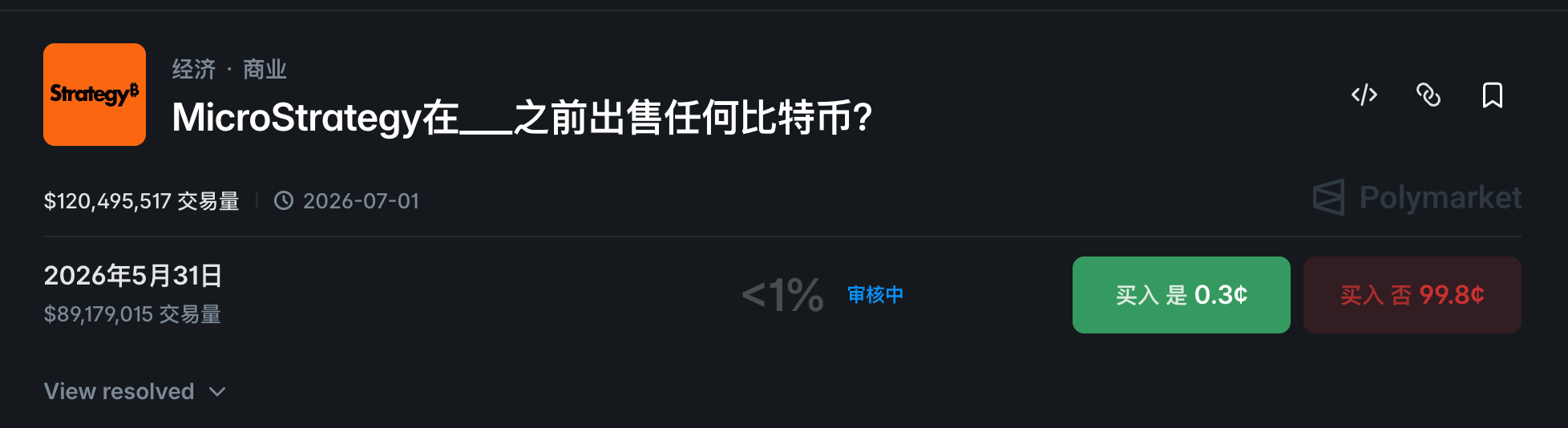
Ultimately, this matter was settled with a "No" outcome following Polymarket's official ruling. Polymarket stated, "We are aware of the controversy surrounding this prediction market. If a clarification announcement is to be issued, it will be released at 1 PM ET on June 1; if no statement is issued by then, it means the Polymarket team will not provide further clarification. Regardless of whether clarification content is issued, the order book will be settled at 1 PM ET that afternoon."

Because MicroStrategy did not issue an official statement about the sale, the event was ultimately settled as "MicroStrategy did not sell BTC in May." This once again verifies that prediction markets trade not on "the truth itself," but on "events within the defined rules."

BTC's "Digital Gold" Narrative Shaken, "Safe Haven Asset" Property Undermined

After the news of MicroStrategy's sale broke, economist, gold investment advocate, and cryptocurrency critic Peter Schiff posted, stating that "MicroStrategy selling 32 Bitcoin last week" is a signal of MicroStrategy transitioning from the "biggest Bitcoin buyer" to a seller, and questioning the source of future incremental demand.

Billionaire investor Mark Cuban, who previously viewed BTC as "a better version of gold," recently stated that he has sold most of his Bitcoin holdings, citing diminished confidence in Bitcoin as a hedge against fiat currency devaluation and geopolitical risks, expressing clear disappointment with the BTC "digital gold" narrative.

JPMorgan also noted in a previous analysis that "devaluation trades" for gold and BTC are heating up, with investors exiting safe-haven assets.

With prices falling repeatedly, perhaps BTC and the crypto market can only wait for the Trump administration to "love crypto once again."


相關問答

QWhat action did Strategy take regarding Bitcoin after 3 years, and what was the result?

AStrategy sold 32 Bitcoin at an average price of $77,135, raising $2.5 million. This marks its first Bitcoin sale in over 3 years.

QWhat was the main reason for Strategy's sale of Bitcoin this time?

AThe primary reason was to raise cash to cover dividend obligations for its STRC financing product, following a decline in its cash reserves.

QHow did the prediction market Polymarket handle the resolution of the event 'Strategy sells Bitcoin in May'?

APolymarket settled the event as 'No' because Strategy did not issue an official announcement confirming the sale by the specified deadline. It highlighted that prediction markets trade based on defined rules and conditions, not necessarily the underlying truth.

QWhat impact did Strategy's sale of Bitcoin have on market perception according to the article?

AThe sale was seen as a significant blow to market confidence, undermining the 'Bitcoin treasury' model and dampening enthusiasm for accumulating Bitcoin. It also contributed to a decline in Bitcoin's price and related stocks.

QWhat is the current state of Strategy's Bitcoin holdings after this sale?

AAfter selling 32 BTC, Strategy holds 843,706 Bitcoin with an average cost basis of $75,699 per coin, resulting in an unrealized loss of approximately $2.932 billion based on the article's figures.

你可能也喜歡

Anthropic全球警告,OpenAI已跨“可靠性阈值”:AI自我加速启动

AI领域出现重要警告与发展洞察。Anthropic发出全球警告,指出AI递归自我改进进程加速,已接近“自己造自己”的临界点,呼吁减缓研究。 与此同时,OpenAI后训练团队负责人Yann Dubois在访谈中揭示了关键内部视角: 1. **能力提升是连续线性,但实用性感知是跳跃的**。AI能力在达到“可靠性阈值”前如同玩具,跨越后则成为可托付工作的可靠工具。OpenAI被认为在去年12月左右跨过了此阈值。 2. **AI正进入自我加速循环**。模型能力提升后,本身已成为研发的有力工具(如辅助编程),从而加速下一代模型的开发,形成越转越快的正反馈回路。 3. **AI构建更像“手艺”而非纯科学**。在硬核领域,经验、直觉和反复试错(类似“炼金术”)目前扮演关键角色,科学解释常事后补足。 4. **垂直应用(Harness)价值巨大,甚至能触及AGI体验**。Dubois认为,若冻结现有模型,仅通过精心打磨针对特定领域的编排系统,即可在许多场景中实现类似通用人工智能(AGI)的效果。当前瓶颈常在于“最后一公里”——权限、数据连接与业务流程集成,而非模型智能本身。 5. **持续学习仍是核心挑战**。模型难以像人类一样在特定环境中持续学习和优化,其学习曲线容易趋于平缓,这是亟待解决的重要问题。 综上,AI发展已迈过关键可靠性门槛,进入自我加速阶段,同时为垂直领域的深度应用与集成创造了巨大机遇与挑战。

marsbit2 小時前

Anthropic全球警告,OpenAI已跨“可靠性阈值”:AI自我加速启动

marsbit2 小時前

交易

現貨
合約

熱門文章

什麼是 BITCOIN

理解 HarryPotterObamaSonic10Inu (ERC-20) 及其在加密空間中的地位 近年來,加密貨幣市場見證了迷因幣的流行激增,吸引了不僅是交易者的注意,還有尋求社區參與和娛樂價值的人士。在這些獨特的代幣中,有一個有趣的項目 HarryPotterObamaSonic10Inu (ERC-20),它將文化參考融入加密貨幣的織造中。本文深入探討 HarryPotterObamaSonic10Inu 的關鍵方面,探索其機制、以社區為驅動的精神,以及其與更廣泛的加密生態的互動。 HarryPotterObamaSonic10Inu (ERC-20) 是什麼? 正如其名所示,HarryPotterObamaSonic10Inu 是一種建立在以太坊區塊鏈上的迷因幣,按照 ERC-20 標準分類。與強調實用性或投資潛力的傳統加密貨幣不同,這項代幣依賴於娛樂價值和其社區的力量。該項目旨在促進一個讓互動用戶可以聚在一起、分享想法和參與受不同文化現象啟發的活動的環境。 HarryPotterObamaSonic10Inu 的一個顯著特點是其 交易零稅。這一引人注目的元素旨在鼓勵交易和社區參與,無需擔心可能會阻礙小型交易者的額外費用。該幣的總供應量定為十億個代幣,這一數字標示其意圖在社區內保持較大的流通量。 HarryPotterObamaSonic10Inu (ERC-20) 的創建者 HarryPotterObamaSonic10Inu 的起源有些神秘;對創建者的具體資訊尚不清楚。這個代幣的開發缺乏可識別的團隊或明確的藍圖,這在迷因幣領域並不罕見。相反,該項目是自然產生的,其進展主要依賴於社區的熱情和參與。 HarryPotterObamaSonic10Inu (ERC-20) 的投資者 關於外部投資和支持,HarryPotterObamaSonic10Inu 亦保持模稜兩可。該代幣並未列出任何已知的投資基金或顯著的組織支持。相反,該項目的生命力來自其草根社區,通過集體行動和參與在加密空間促進其增長和可持續性。 HarryPotterObamaSonic10Inu (ERC-20) 如何運作? 作為一種迷因幣,HarryPotterObamaSonic10Inu 主要在傳統的資產價值框架之外運作。以下是幾個定義該項目運作方式的獨特方面: 零稅交易:由於交易沒有稅費,使用者可以自由地買賣該代幣,而不必擔心隱藏成本。 社區參與:該項目依賴於社區互動,利用社交媒體平台創造話題並促進參與。討論、內容分享及互動是幫助擴展其影響力和加強支持者忠誠度的重要元素。 無實用性:需要指出的是,HarryPotterObamaSonic10Inu 在金融生態中並不提供具體的實用性。相反,它被定義為主要用於娛樂和社區活動的代幣。 文化參考:該代幣巧妙地融入了流行文化中的元素,以吸引興趣,與迷因愛好者和加密追隨者建立聯繫。 HarryPotterObamaSonic10Inu 範例展示了迷因幣如何與更傳統的加密貨幣項目運作不同,作為創新的社會構造進入市場,而非實用資產。 HarryPotterObamaSonic10Inu (ERC-20) 的時間線 HarryPotterObamaSonic10Inu 的歷史標誌著幾個值得注意的里程碑: 創建:這個代幣源於一個病毒式的迷因,捕捉了許多加密愛好者的想像力。具體的創建日期目前並不清楚,凸顯其自然興起。 上架交易所:HarryPotterObamaSonic10Inu 已經在多個交易所上架,使社區更容易存取和交易。 社區互動倡議:持續進行旨在增進社區互動的活動,包括比賽、社交媒體活動和來自粉絲和支持者的內容創作。 未來擴展計劃:該項目的路線圖包括推出 NFT 收藏品、周邊商品及相關電子商務網站,進一步與社區互動並嘗試為其生態系統增添更多維度。 關於 HarryPotterObamaSonic10Inu (ERC-20) 的關鍵點 以社區為驅動的特質:該項目優先考慮集體意見和創意,確保用戶參與在其發展過程中居於核心地位。 迷因幣分類:它代表了以娛樂為基礎的加密貨幣的典範,與傳統投資工具大相徑庭。 與比特幣無直接關聯:儘管在代碼名稱上有相似之處,HarryPotterObamaSonic10Inu 是獨特的,並不與比特幣或其他已建立的加密貨幣存在關係。 協作焦點:HarryPotterObamaSonic10Inu 旨在為持有者創造一個共享故事和協作的空間,提供創意和社區聯結的途徑。 未來前景:向超越其初步主題擴展至 NFT 和周邊商品的雄心,描繪了該項目潛在進入數字文化的更主流途徑。 隨著迷因幣繼續吸引加密貨幣社區的想像力,HarryPotterObamaSonic10Inu (ERC-20) 由於其文化聯繫和以社區為中心的方式而脫穎而出。儘管它可能不符合以實用性為導向的代幣的典型模式,其本質在於支持者間培育的快樂和友誼,突顯了在日益數字化的時代中,加密貨幣的演變特性。隨著該項目的持續發展,觀察社區動態如何影響其在不斷變化的區塊鏈技術格局中的軌跡將是重要的。

2.2k 人學過發佈於 2024.04.01更新於 2024.12.03

什麼是 BITCOIN

如何購買BTC

歡迎來到HTX.com!在這裡,購買Bitcoin (BTC)變得簡單而便捷。跟隨我們的逐步指南,放心開始您的加密貨幣之旅。第一步:創建您的HTX帳戶使用您的 Email、手機號碼在HTX註冊一個免費帳戶。體驗無憂的註冊過程並解鎖所有平台功能。立即註冊第二步:前往買幣頁面,選擇您的支付方式信用卡/金融卡購買:使用您的Visa或Mastercard即時購買Bitcoin (BTC)。餘額購買:使用您HTX帳戶餘額中的資金進行無縫交易。第三方購買:探索諸如Google Pay或Apple Pay等流行支付方式以增加便利性。C2C購買:在HTX平台上直接與其他用戶交易。HTX 場外交易 (OTC) 購買:為大量交易者提供個性化服務和競爭性匯率。第三步:存儲您的Bitcoin (BTC)購買Bitcoin (BTC)後,將其存儲在您的HTX帳戶中。您也可以透過區塊鏈轉帳將其發送到其他地址或者用於交易其他加密貨幣。第四步:交易Bitcoin (BTC)在HTX的現貨市場輕鬆交易Bitcoin (BTC)。前往您的帳戶,選擇交易對,執行交易,並即時監控。HTX為初學者和經驗豐富的交易者提供了友好的用戶體驗。

5.5k 人學過發佈於 2024.12.12更新於 2026.06.02

如何購買BTC

什麼是 $BITCOIN

數字黃金 ($BITCOIN):全面分析 數字黃金 ($BITCOIN) 介紹 數字黃金 ($BITCOIN) 是一個基於區塊鏈的項目,運行於 Solana 網絡,旨在將傳統貴金屬的特徵與去中心化技術的創新相結合。雖然它與比特幣同名,常被稱為「數字黃金」,因其被視為價值儲存工具,但數字黃金是一個獨立的代幣,旨在於 Web3 生態系統中創造一個獨特的生態系。其目標是將自己定位為一個可行的替代數字資產,儘管有關其應用和功能的具體細節仍在發展中。 什麼是數字黃金 ($BITCOIN)? 數字黃金 ($BITCOIN) 是一個專門為 Solana 區塊鏈設計的加密貨幣代幣。與比特幣提供廣泛認可的價值儲存角色不同,這個代幣似乎更專注於更廣泛的應用和特徵。值得注意的方面包括: 區塊鏈基礎設施:該代幣建立在 Solana 區塊鏈上,以其處理高速和低成本交易的能力而聞名。 供應動態:數字黃金的最大供應量上限為 100 萬兆代幣(100P $BITCOIN),儘管有關其流通供應的詳細信息目前尚未披露。 實用性:雖然具體功能尚未明確說明,但有跡象表明該代幣可能被用於各種應用,可能涉及去中心化應用(dApps)或資產代幣化策略。 誰是數字黃金 ($BITCOIN) 的創建者? 目前,數字黃金 ($BITCOIN) 的創建者和開發團隊的身份仍然是 未知 的。這種情況在許多創新項目中是典型的,特別是那些與去中心化金融和迷因幣現象相關的項目。雖然這種匿名性可能促進社區驅動的文化,但也加劇了對治理和問責制的擔憂。 誰是數字黃金 ($BITCOIN) 的投資者? 可用的信息顯示,數字黃金 ($BITCOIN) 沒有任何已知的機構支持者或知名的風險投資。該項目似乎運行在一個以社區支持和採用為重點的點對點模型上,而不是傳統的資金籌集途徑。其活動和流動性主要位於去中心化交易所(DEXs),如 PumpSwap,而不是已建立的集中交易平台,進一步突顯其草根方法。 數字黃金 ($BITCOIN) 如何運作 數字黃金 ($BITCOIN) 的運作機制可以根據其區塊鏈設計和網絡特徵進行詳細說明: 共識機制:通過利用 Solana 的獨特歷史證明(PoH)結合權益證明(PoS)模型,該項目確保高效的交易驗證,促進網絡的高性能。 代幣經濟學:雖然具體的通縮機制尚未詳細說明,但巨大的最大代幣供應量暗示它可能適合微交易或尚待定義的利基用例。 互操作性:存在與 Solana 更廣泛生態系統的整合潛力,包括各種去中心化金融(DeFi)平台。然而,關於具體整合的詳細信息仍未明確。 重要事件時間表 以下是關於數字黃金 ($BITCOIN) 的重要里程碑時間表: 2023:該代幣首次在 Solana 區塊鏈上部署,並以其合約地址為標誌。 2024:數字黃金獲得曝光,因其在去中心化交易所如 PumpSwap 上可供交易,允許用戶以 SOL 進行交易。 2025:該項目見證了零星的交易活動和社區主導參與的潛在興趣,儘管截至目前尚未記錄到任何顯著的合作夥伴關係或技術進展。 關鍵分析 優勢 可擴展性:基於 Solana 的基礎設施支持高交易量,這可能增強 $BITCOIN 在各種交易場景中的實用性。 可及性:每個代幣潛在的低交易價格可能吸引零售投資者,促進更廣泛的參與,因為存在分割所有權的機會。 風險 缺乏透明度:缺乏公眾已知的支持者、開發者或審計過程可能引發對該項目可持續性和可信度的懷疑。 市場波動性:交易活動在很大程度上依賴於投機行為,這可能導致價格波動和投資者的不確定性。 結論 數字黃金 ($BITCOIN) 在快速發展的 Solana 生態系統中,作為一個引人入勝但模糊的項目出現。雖然它試圖利用「數字黃金」的敘事,但其與比特幣作為價值儲存工具的既定角色的脫離,突顯了對其預期實用性和治理結構更清晰區分的需求。未來的接受度和採用率可能取決於解決當前的不透明性,並更明確地定義其運營和經濟策略。 注意:本報告涵蓋截至 2023 年 10 月的綜合信息,並且在研究期間可能發生了進展。

83 人學過發佈於 2025.05.13更新於 2025.05.13

什麼是 $BITCOIN

相關討論

歡迎來到 HTX 社群。在這裡,您可以了解最新的平台發展動態並獲得專業的市場意見。 以下是用戶對 BTC (BTC)幣價的意見。

活动图片