I. Sector Definition & Evolutionary Logic: From Automated Tools to On-Chain Economic Agents
Robotics technology is nothing new. Over the past decade, industrial robotic arms, warehouse robots, and drones have achieved large-scale deployment across manufacturing and logistics sectors. Yet these robots remain fundamentally closed-system tools—they execute pre-programmed instructions but lack identity recognition, autonomous decision-making, value exchange, or cross-platform collaboration capabilities. As large AI models endow machines with “thinking” ability and blockchain provides identity and settlement infrastructure, a new paradigm is emerging: machines are no longer mere hardware—they are autonomous economic agents capable of holding on-chain identities, executing transactions independently, and participating in real-world production.
This transformation is driven by technological maturity across three dimensions. First, breakthroughs in embodied AI: large language models and multimodal models have endowed robots with natural language understanding, environmental perception, and task planning capabilities. For example, OpenMind’s OM1 operating system unifies perception, memory, reasoning, and action into a single framework, evolving robots from “capable of movement” to “capable of understanding and thinking”. Second, the rise of decentralized physical infrastructure networks (DePIN): blockchain provides physical devices with decentralized identifiers (DIDs), trusted data recording, and automated settlement, enabling machines to participate in market transactions as economic agents. Third, the maturation of stablecoins and Layer-2 solutions: efficient micropayment infrastructure makes high-frequency, low-value settlements between machines feasible, laying the financial foundation for the Machine Economy.
Forbes’ 2026 forecast states that blockchain will become AI’s trust network—every significant agent action will be recorded on a lightweight ledger, enabling compliance, governance, and accountability. In essence, the Web3 Robots sector is constructing a new economic system wherein machines can prove themselves, trust others, create value, and participate in distribution. This system comprises three architectural layers: the base layer is the OS empowering machine intelligence (e.g., OpenMind OM1); the middle layer is the protocol layer providing identity and collaborative networks (e.g., OpenMind FABRIC, peaq); and the top layer consists of labor markets and tokenized platforms targeting specific applications (e.g., Konnex, Virtuals). Synergy among these three layers is reshaping robots from “tools” into “digital citizens”.
II. Infrastructure Layer: Co-Evolution of Operating Systems, Data, and Networks
Foundational infrastructure development for the Web3 Robots sector is advancing simultaneously across multiple dimensions, with OpenMind’s OS-layer strategy, PrismaX’s data-layer exploration, and peaq’s network-layer construction standing out as most representative. Together, these three projects form a complete infrastructure loop of “system–data–network”, providing the operational bedrock for upper-layer applications.
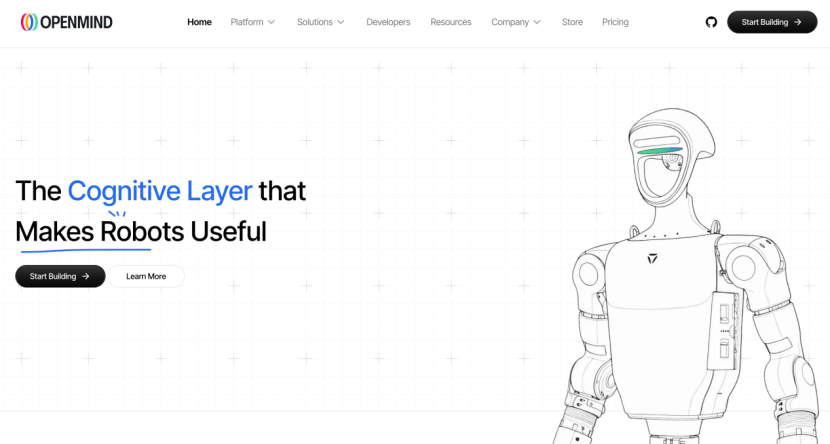
OpenMind is hailed as “Android for robotics”. Its core products include the open-source, AI-native robot operating system OM1 and the decentralized collaboration network FABRIC. OM1, licensed under MIT, has garnered over 2,500 stars on GitHub, attracted more than 500 global contributors, and welcomed over 7,500 independent developers. Unlike traditional robot operating systems (ROS), which focus solely on motion control and navigation, OM1 integrates four core modules—perception, memory, reasoning, and action—and supports advanced functions such as natural language interaction, environment mapping, and object recognition. OM1 has already been adapted for over ten leading hardware manufacturers including Unitree, Fourier Intelligence, UBTECH, and Deep Robotics, covering humanoid robots, quadrupeds, and robotic arms. The FABRIC protocol establishes a decentralized machine collaboration network, assigning each robot an on-chain identity (peaq ID) and supporting inter-machine skill sharing, task coordination, and USDC micropayments. In February 2026, FABRIC Protocol (ROBO) was launched on Binance Alpha and Binance Futures, achieving over $140 million in 24-hour trading volume, and was subsequently listed on OKX, Coinbase, Kraken, and other major exchanges. The project raised about $20 million in August 2025, led by Pantera Capital, with participation from Coinbase Ventures, DCG, and Sequoia China. Its latest valuation stands at approximately $200 million, while its Kaito Launchpad presale reached a $400 million FDV. Current participation avenues include Season 1 points programs, NFT minting on the FABRIC Identity Network, and GitHub code contributions, with strong expectations for upcoming airdrops.
PrismaX is dubbed the “gold mine” of physical-world training data. If algorithms are robots’ “brains”, then data is their “nourishment”. PrismaX targets the AI-robotics data layer, solving the industry’s most scarce resource—“physical-world interaction data”—Reinforcement Learning from Human Feedback (RLHF). Its platform allows users to remotely control real robotic arms via web interface and the system to record those operations, and sell the resulting datasets to robotics companies for AI training, rewarding users with points redeemable for future tokens. This “Play-to-Train” model creates a data flywheel: more users → more data → better models → more users. PrismaX recently closed an $11 million seed round led by top-tier VC a16z, with participation from Virtuals Protocol. Its ecosystem already hosts over 500 participants who’ve completed remote robotic arm operations, and it has deployed two fully functional robotic arm systems (“Tommy” and “Bill” from Unitech Walker). Users earn points via daily check-ins, whitepaper quizzes, or even paid training ($99), with market expectations pointing toward future airdrop distributions. Key risks include potential dilution of point value due to influxes of “airdrop-farming groups", and ongoing industry debate over whether remote-operation data can truly train commercially viable robots.
peaq is the Layer-1 network for the Machine Economy. peaq is a Layer-1 blockchain purpose-built for the Machine Economy, offering core functionalities including machine identity (peaq IDs), on-chain wallets, access control, and nanosecond-level time synchronization and supporting autonomous transactions among millions of robots and devices. Unlike many DePIN projects stuck at the conceptual stage, peaq has already validated a genuine commercial closed loop. Its Hong Kong-based Robo-farm deploys automated robots to grow hydroponic vegetables; users purchase NFTs representing farm equity, and vegetable sales revenue—converted into stablecoins—is distributed directly on-chain to NFT holders. Its first revenue distribution in late January 2026 yielded $3,820 USDT per claim, translating to an annualized return of approximately 18%. This “earn money by selling vegetables—not inflating tokens” model positions peaq as a flagship case of RWA (real-world asset) adoption. Partnerships include Bosch, Mastercard, and Airbus—spanning IoT sensor integration, payment gateway interoperability, and supply chain tracking. Its mainnet was launched in 2024; current circulating market cap stands at $34.25 million or so, with FDV at about $78 million. It hosts 50–60 live DePIN applications connecting over 2 million physical devices. Its native token $PEAQ serves primarily for gas fees and staking. The ongoing “Get Real” campaign offers a $210 million $PEAQ reward pool (valued at >$100 million), allowing users to earn XP/NP and claim tokens by completing real-world DePIN tasks.
The relationship among these three projects mirrors a complete production system: PrismaX supplies the “raw material” (data) for robot training; OpenMind’s OM1 serves as the “operating system” enabling intelligent robot operation; and peaq provides the “network and incentive layer” facilitating economic settlement. Their synergy forms the full infrastructure stack for decentralized embodied intelligence.
III. Financial Layer of the Machine Economy: Tokenized Platforms & Positioning Networks
Once the infrastructure layer resolves “how machines become intelligent” and “how machines collaborate”, the financial layer of the Machine Economy emerges. This layer addresses the core question: how do we price, trade, and circulate machine value? Virtuals Protocol and Geodnet offer distinct answers from complementary angles.
Virtuals Protocol is a tokenization platform for AI agents/robots, enabling community participation in agent issuance, staking, and governance. Its core mechanisms include the Pegasus/Unicorn ecosystem, the Agent Commerce Protocol (ACP) marketplace, and the Butler toolset. The ACP marketplace facilitates trustless commercial transactions among AI agents, supporting fully on-chain task posting, verification, and settlement. In March 2026, Virtuals co-developed the ERC-8183 standard (Agentic Commerce) with the Ethereum Foundation’s dAI team, introducing work primitives featuring on-chain escrow, evaluator certification, and modular hooks, enabling trustless agent-to-agent commerce. Data shows on-chain agent-generated revenue on Virtuals has surpassed $3 million (excluding fees), marking the emergence of verifiable, AI-agent-created economic output at scale. Its native token $VIRTUAL was launched at the end of 2023, currently commanding a $500 million or so market cap and being listed on major CEXs like Gate.io. Its weekly Epoch airdrop program remains active, allocating rewards based on veVIRTUAL staking and Butler usage: 2% to stakers, 3% to ecosystem participants. Early 2026 saw Virtuals partner with OpenMind’s FABRIC protoco, enabling robots to acquire economic identity via FABRIC, receive tasks from agents and settle them on-chain via ACP, achieving deep integration between the machine economy layer and infrastructure layer.
Geodnet is dubbed the centimeter-accurate navigation infrastructure for robots. Built on Solana, Geodnet is a decentralized high-precision positioning network delivering RTK (Real-Time Kinematic) centimeter-grade navigation services for robots, drones, and autonomous vehicles. Its network comprises globally distributed reference stations; node operators earn $GEOD tokens by deploying hardware, while users subscribe to access positioning data. Geodnet’s business model exhibits classic “real yield” traits: 80% of data revenue funds $GEOD buybacks and burns, creating a deflationary mechanism. At CES 2026 in January, Geodnet showcased its Geoswarm home-security drone, which autonomously launches from a compact rooftop docking station, patrols using GEODNET’s high-precision positioning data, and returns to dock without human intervention. Additionally, Geodnet launched consumer-facing RTK automotive hardware ($150) and an RTK survey receiver ($695), with the latter winning a CES Innovation Award. Geodnet has raised over $15 million total, including a round led by Multicoin Capital. Its token has migrated from Polygon to Solana and is now tradable on Coinbase. For investors, Geodnet’s buyback-and-burn mechanism and real hardware sales provide fundamental value support; notable ongoing incentives include node deployment rewards and staking yields.
From the financial-layer perspective, Virtuals Protocol solves the “liquidity” problem for AI agents, enabling agent capabilities to be tokenized, traded, and priced; Geodnet solves robots’ “spatial awareness” problem, enabling precise physical-world localization and navigation. Together, they expand the boundaries of the Machine Economy: the former allows machine value to flow within the digital world; the latter ensures machine activity in the physical world becomes more accurate and reliable.
IV. Application-Deployment Layer: From DePIN Investment to Real-World Assets
The infrastructure and financial layers constitute the “skeleton” and “blood” of the Web3 Robots sector, but what ultimately determines its vitality is whether the application-deployment layer can generate value in the real world. XMAQUINA and Robonomics explore this proposition from divergent angles.
XMAQUINA is a DAO-governed robot investment bank. XMAQUINA is a DePIN project that invests in and tokenizes real humanoid robot companies through DAO governance, allowing token holders to share in the companies’ earnings. Its core mechanisms include the “Robotics Bank” and the “Machine Economy Launchpad”. The DAO allocates capital to promising robotics startups (e.g., Apptronik, Figure AI) and manages them via specialized SubDAOs. In January 2026, XMAQUINA completed its final public auction, raising over $3.25 million from the community in less than 30 minutes, bringing its cumulative fundraising to $10 million. Its native token $DEUS was scheduled for TGE activation in January–February 2026, with 33% unlocked at launch and 67% released linearly. Current participation paths include holding $DEUS for governance voting and profit-sharing, monitoring DAO proposals and staking mechanisms, and preparing for upcoming Launchpad project listings. XMAQUINA’s model is essentially a “robotics-focused investment fund”, lowering the barrier for retail investors to participate in early-stage robotics company investments while decentralizing investment decisions via DAO governance.
Robonomics represents the earliest Web3 robot coordination platform. A pioneer in Web3 robotics since launching its testnet back in 2018, Robonomics provides cloud robotics services and smart-contract-based task assignment. Its core capabilities include IoT device integration, sensor data on-chain recording, and automated task execution. Its native token $XRT was launched in 2019 and trades on exchanges including Kraken, but maintains a relatively small market cap, making it an established project within the sector. Compared to newer entrants, Robonomics’ ecosystem is comparatively mature yet growth-stagnant, lacking recent large-scale airdrops or incentive campaigns, making it better suited for long-term observers focused on IoT-robotics integration.
Notably, innovative models are emerging across the application-deployment layer. peaq’s “Universal Basic Ownership Pilot” explores inclusive ownership of machine assets, while its tokenized machine deployment mechanism enables ordinary users to invest in and share profits from robot operations. Meanwhile, Virtuals’ ecosystem has given birth to agents like ArAIstotle ($FACY), achieving 382,000 queries, possessing 8,000 users, and generating $760,000 in tax revenue with ACP monthly growth surging 413x MoM, demonstrating the immense potential of the AI agent economy.
V. Challenges, Risks, and Future Outlook
Although the Web3 Robots sector holds vast promise, it remains in its infancy and faces multiple challenges and risks.
Technically, the sector still faces bottlenecks in hardware reliability and environmental adaptability. As OpenMind founder Jan Liphardt notes, reliability of critical components like dexterous hands remains a challenge: a five-fingered, 12-degree-of-freedom robotic hand failing after just 100 hours of operation would severely undermine its practical utility. Moreover, gaps between simulation tools and real environments as well as voice-interaction simulation requirements for social robots demand sustained engineering effort.
Valuation-wise, some projects face high-valuation/low-circulation risk. Take OpenMind for instance, its Kaito Launchpad presale is valued the project at $400 million FDV, doubling its prior round valuation ($200 million), potentially overextending secondary-market upside and exposing it to sell pressure from early VC unlocks. Investors must remain wary of projects where “narrative premiums” far exceed actual deployment progress.
Data-quality-wise, data-layer projects like PrismaX confront risks from “airdrop-farming groups" flooding in the system. If teams fail to effectively filter high-quality training data, points lose value, triggering sharp sell-offs during airdrops. Balancing user incentives with data integrity remains a universal challenge for all data-layer projects.
On the competition landscape, traditional robotics vendors favor closed systems (e.g., Tesla Optimus), akin to Apple’s iOS model. Whether open-source “Android-style” alternatives like OpenMind can survive amid tech giants hinges on their ability to attract sufficient mid-tier hardware vendors to build collective ecosystem momentum.
Looking ahead, the Web3 Robots sector will evolve along three primary trajectories: First, standardization. A2A (Agent-to-Agent) communication protocols are becoming the universal language for robots and agents. Just as HTTP unified the early internet, A2A will serve as the foundational communication layer for the autonomous world. Second, real yield. The peaq robot farm demonstrates that Web3 robotics projects can generate genuine cash flow independent of token inflation. More projects will explore “Device-as-a-Service” and “Robot-as-an-Asset” business models. Third, compliance and governance. As robots deepen economic participation, regulators will demand explainability and traceability for AI decisions. Blockchain’s immutable ledger will become critical infrastructure for meeting compliance requirements.
VI. Conclusion: Participation Strategy & Investment Logic
The Web3 Robots sector stands at a pivotal inflection point of transitioning from proof-of-concept to scalable application. For investors and ecosystem participants, the core strategic imperative today is to prioritize foundational capability building, track real-world deployment scale, and seize early participation opportunities.
On the ecosystem side, infrastructure-layer projects (OpenMind, peaq) offer higher certainty and moats, but valuations may already partially reflect expectations; data-layer projects (PrismaX) offer high optionality alongside data-quality risks; financial-layer (Virtuals) and application-layer (XMAQUINA) projects depend more heavily on ecosystem vitality and community engagement.
Reflecting on the mobile industry’s evolution from “copycat phone era” to the “Android/iOS duopoly”, the Web3 robotics sector may be experiencing a similar nascent phase. As OpenMind’s founder observes, there won’t be just one winner, rather, many strong players will emerge. For investors tracking this space, it is the optimal window now for observation, learning, and selective participation. The future of machines as on-chain economic agents is no longer science fiction, rather, it’s becoming reality.