The Bitcoin Future Now Runs On Wall Street Inflows, BlackRock Exec Says

bitcoinist發佈於 2025-11-12更新於 2025-11-12

文章摘要

BlackRock’s head of crypto, Robbie Mitchnick, says the gravitational center of Bitcoin’s market structure has shifted decisively from miner issuance...

Trusted Editorial content, reviewed by leading industry experts and seasoned editors. Ad Disclosure

BlackRock’s head of crypto, Robbie Mitchnick, says the gravitational center of Bitcoin’s market structure has shifted decisively from miner issuance to exchange-traded fund demand—and that’s why classic four-year “halving cycles” should command far less attention than they used to. In a Bankless interview released November 10, Mitchnick argued that the ETF era is now the dominant flow regime for BTC, even as leverage and short-term derivatives noise continue to whipsaw prices.

ETF Inflows Now Dwarf The Bitcoin Halving

“It’s not over,” Mitchnick said when asked whether the latest sell-off marked the end of Bitcoin’s current cycle. “This is the fifth cycle we’ve seen […] through each successive cycle, the level that Bitcoin reached was massively higher than the prior cycle.” He added a pointed caveat for anyone still treating halvings as the metronome of BTC: “A lot of people believe the cycle is tied to [the] Bitcoin halving. The Bitcoin halving at this point is almost totally irrelevant […] when ETFs are accumulating inflows, the magnitude of those inflows is many, many multiples larger than any change in supply created by a Bitcoin halving event.”

Mitchnick’s framing puts Wall Street, not the protocol schedule, at the center of the next phase. BlackRock’s spot Bitcoin ETF, IBIT, “has been the fastest-growing ETF post-launch in history,” he said, reaching milestones at roughly four times the pace of the previous record. More telling than raw AUM, in his view, is the changing composition of holders. In the first quarter after launch, “IBIT was over 80% direct retail investors. Every quarter thereafter that number has come down […] today it’s close to 50%,” reflecting the steady rise of wealth advisory and institutional channels.

That institutional cohort is still early, but broadening. “If you think about the big categories of institutional investors, you’ve got family offices, asset managers, sovereign wealth funds, university endowments, foundations, corporate treasurers, insurers, pension funds. You have some adopters in every one of those archetypes, but not the majority, not even close,” he said.

For those allocating, typical position sizes land in the “1% to 3% range.” The gating factor, again, is less about custody or access—and more about how Bitcoin behaves inside a portfolio. “It’s all about correlation,” Mitchnick noted, recounting a conversation with a pension CIO who is “literally” watching that metric. If Bitcoin persistently tracks “digital gold” rather than “levered NASDAQ,” he argued, “it’s a slam dunk to put a couple percentage of portfolio allocation in it.”

The tension is that short-term market action still looks like crypto. Mitchnick called the October 10 washout—roughly “$21 billion in liquidations”—a leverage event rather than a shift in fundamentals, and contrasted it with the steadiness of fund buyers: “What was the impact on ETF outflows? Tiny […] a couple hundred million.” That discrepancy, he said, is precisely why cycles should attenuate over time: a larger, slower-moving base of ETF and advisory capital can absorb derivatives-driven shocks without mechanically exiting.

He also pushed back on narratives that Bitcoin’s 2025 underperformance versus gold invalidates the “uncorrelated hedge” thesis. The digital asset, he argued, already banked its “debasement trade” in late 2024, rallying from the “high $60s to over $100K,” and even notched a new all-time high around $126,000 before the October crash “derailed the momentum.” In other words, the year-to-date scoreboard reflects sequencing and leverage, not a structural repudiation of Bitcoin’s store-of-value pitch.

On supply dynamics, Mitchnick acknowledged that legacy cohorts have taken profits at psychological levels, but he dismissed the idea that Bitcoin is in an “IPO moment” where early adopters permanently hand the float to institutions. What’s more plausible, he said, is simple risk management by ultra-early holders whose basis sits at “$100 or $500,” many of whom had $100,000 as a round-number trim target. “At some point you do have to take some chips off the table,” he said, adding that long-term performance has favored patience over short-term, levered trading.

Mitchnick was careful not to oversell universal adoption among big pools of capital. Central banks, he suggested, remain a tail-risk buyer rather than a base case. The near-term path instead runs through the institutions already tiptoeing in—pensions, insurers, sovereign wealth funds—whose conviction will hinge on medium-term behavior and policy clarity.

The message for allocators facing their first full drawdown with ETFs live was direct: don’t mistake derivatives noise for broken fundamentals, and be selective. “There’s a reason Bitcoin is still roughly 65% of the market cap of the space,” he said. “One has to be very wary going far down the table […] the vast majority of [tokens] are or will be totally worthless.”

For Bitcoin, the test is whether it keeps behaving like what institutions think they’re buying. “People have to look beyond these short-term moves […] and more about, you know, medium and longer term how does it track,” Mitchnick said.

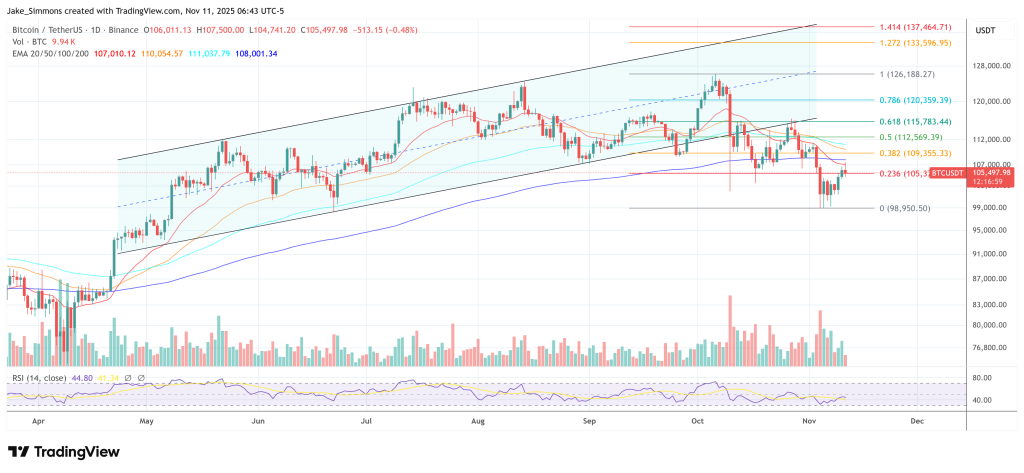
At press time, BTC traded at $105,497.
Bitcoin price
Bitcoin price, 1-day chart | Source: BTCUSDT on TradingView.com
Featured image created with DALL.E, chart from TradingView.com
Editorial Process for bitcoinist is centered on delivering thoroughly researched, accurate, and unbiased content. We uphold strict sourcing standards, and each page undergoes diligent review by our team of top technology experts and seasoned editors. This process ensures the integrity, relevance, and value of our content for our readers.

Jake Simmons has been a Bitcoin enthusiast since 2016. Ever since he heard about Bitcoin, he has been studying the topic every day and trying to share his knowledge with others. His goal is to contribute to Bitcoin's financial revolution, which will replace the fiat money system. Besides BTC and crypto, Jake studied Business Informatics at a university. After graduation in 2017, he has been working in the blockchain and crypto sector. You can follow Jake on Twitter at @realJakeSimmons.

你可能也喜歡

AI救了一批新能源投资人

当大盘震荡时,电力板块近期强势爆发,多只个股涨停,相关ETF资金持续流入。与此同时,储能、绿电企业迎来IPO热潮,背后投资机构收获巨大回报,让一度沉寂的新能源投资人迎来“翻身时刻”。 这波行情并非简单补涨,而是AI时代下新能源资产价值重估的开始。过去两年,新能源赛道经历估值腰斩、融资遇冷的低谷。但随着2026年多地算力与新型电力项目集中启动,新规要求大型算力中心必须配套绿电与储能设施。“算电协同”上升为国家战略,电力成为AI基础设施的核心底层,赛道逻辑彻底转变,“绿电即资产”的新叙事就此展开。 逻辑转变直接反映在投融资上:锂电产业链投资提速,头部绿电项目估值显著回升,与算力底座相关的电网调度、储能解决方案等领域获得大额融资。投资人指出,电力是AI发展的核心瓶颈之一,绿电系统的可靠能力迎来新一轮投资机遇。 行业认为,最难熬的时期恰是投资的播种期。如今,受AI需求驱动,数据中心电力缺口巨大,直接拉动了电力投资、电网升级、储能等领域的增长空间。一级市场重点关注液冷温控、大储集成、虚拟电厂、绿电配套等板块,部分PE巨头已通过布局相关硬核资产获得超高回报。 新叙事下,新能源投资人的翻身仗或许刚刚开始,在行业低谷期坚守的投资者正迎来收获季。

marsbit2 分鐘前

AI救了一批新能源投资人

marsbit2 分鐘前

交易

現貨
合約

熱門文章

什麼是 BITCOIN

理解 HarryPotterObamaSonic10Inu (ERC-20) 及其在加密空間中的地位 近年來,加密貨幣市場見證了迷因幣的流行激增,吸引了不僅是交易者的注意,還有尋求社區參與和娛樂價值的人士。在這些獨特的代幣中,有一個有趣的項目 HarryPotterObamaSonic10Inu (ERC-20),它將文化參考融入加密貨幣的織造中。本文深入探討 HarryPotterObamaSonic10Inu 的關鍵方面,探索其機制、以社區為驅動的精神,以及其與更廣泛的加密生態的互動。 HarryPotterObamaSonic10Inu (ERC-20) 是什麼? 正如其名所示,HarryPotterObamaSonic10Inu 是一種建立在以太坊區塊鏈上的迷因幣,按照 ERC-20 標準分類。與強調實用性或投資潛力的傳統加密貨幣不同,這項代幣依賴於娛樂價值和其社區的力量。該項目旨在促進一個讓互動用戶可以聚在一起、分享想法和參與受不同文化現象啟發的活動的環境。 HarryPotterObamaSonic10Inu 的一個顯著特點是其 交易零稅。這一引人注目的元素旨在鼓勵交易和社區參與,無需擔心可能會阻礙小型交易者的額外費用。該幣的總供應量定為十億個代幣,這一數字標示其意圖在社區內保持較大的流通量。 HarryPotterObamaSonic10Inu (ERC-20) 的創建者 HarryPotterObamaSonic10Inu 的起源有些神秘;對創建者的具體資訊尚不清楚。這個代幣的開發缺乏可識別的團隊或明確的藍圖,這在迷因幣領域並不罕見。相反,該項目是自然產生的,其進展主要依賴於社區的熱情和參與。 HarryPotterObamaSonic10Inu (ERC-20) 的投資者 關於外部投資和支持,HarryPotterObamaSonic10Inu 亦保持模稜兩可。該代幣並未列出任何已知的投資基金或顯著的組織支持。相反,該項目的生命力來自其草根社區,通過集體行動和參與在加密空間促進其增長和可持續性。 HarryPotterObamaSonic10Inu (ERC-20) 如何運作? 作為一種迷因幣,HarryPotterObamaSonic10Inu 主要在傳統的資產價值框架之外運作。以下是幾個定義該項目運作方式的獨特方面: 零稅交易:由於交易沒有稅費,使用者可以自由地買賣該代幣,而不必擔心隱藏成本。 社區參與:該項目依賴於社區互動,利用社交媒體平台創造話題並促進參與。討論、內容分享及互動是幫助擴展其影響力和加強支持者忠誠度的重要元素。 無實用性:需要指出的是,HarryPotterObamaSonic10Inu 在金融生態中並不提供具體的實用性。相反,它被定義為主要用於娛樂和社區活動的代幣。 文化參考:該代幣巧妙地融入了流行文化中的元素,以吸引興趣,與迷因愛好者和加密追隨者建立聯繫。 HarryPotterObamaSonic10Inu 範例展示了迷因幣如何與更傳統的加密貨幣項目運作不同,作為創新的社會構造進入市場,而非實用資產。 HarryPotterObamaSonic10Inu (ERC-20) 的時間線 HarryPotterObamaSonic10Inu 的歷史標誌著幾個值得注意的里程碑: 創建:這個代幣源於一個病毒式的迷因,捕捉了許多加密愛好者的想像力。具體的創建日期目前並不清楚,凸顯其自然興起。 上架交易所:HarryPotterObamaSonic10Inu 已經在多個交易所上架,使社區更容易存取和交易。 社區互動倡議:持續進行旨在增進社區互動的活動,包括比賽、社交媒體活動和來自粉絲和支持者的內容創作。 未來擴展計劃:該項目的路線圖包括推出 NFT 收藏品、周邊商品及相關電子商務網站,進一步與社區互動並嘗試為其生態系統增添更多維度。 關於 HarryPotterObamaSonic10Inu (ERC-20) 的關鍵點 以社區為驅動的特質:該項目優先考慮集體意見和創意,確保用戶參與在其發展過程中居於核心地位。 迷因幣分類:它代表了以娛樂為基礎的加密貨幣的典範,與傳統投資工具大相徑庭。 與比特幣無直接關聯:儘管在代碼名稱上有相似之處,HarryPotterObamaSonic10Inu 是獨特的,並不與比特幣或其他已建立的加密貨幣存在關係。 協作焦點:HarryPotterObamaSonic10Inu 旨在為持有者創造一個共享故事和協作的空間,提供創意和社區聯結的途徑。 未來前景:向超越其初步主題擴展至 NFT 和周邊商品的雄心,描繪了該項目潛在進入數字文化的更主流途徑。 隨著迷因幣繼續吸引加密貨幣社區的想像力,HarryPotterObamaSonic10Inu (ERC-20) 由於其文化聯繫和以社區為中心的方式而脫穎而出。儘管它可能不符合以實用性為導向的代幣的典型模式,其本質在於支持者間培育的快樂和友誼,突顯了在日益數字化的時代中,加密貨幣的演變特性。隨著該項目的持續發展,觀察社區動態如何影響其在不斷變化的區塊鏈技術格局中的軌跡將是重要的。

2.0k 人學過發佈於 2024.04.01更新於 2024.12.03

什麼是 BITCOIN

如何購買BTC

歡迎來到HTX.com!在這裡,購買Bitcoin (BTC)變得簡單而便捷。跟隨我們的逐步指南,放心開始您的加密貨幣之旅。第一步:創建您的HTX帳戶使用您的 Email、手機號碼在HTX註冊一個免費帳戶。體驗無憂的註冊過程並解鎖所有平台功能。立即註冊第二步:前往買幣頁面,選擇您的支付方式信用卡/金融卡購買:使用您的Visa或Mastercard即時購買Bitcoin (BTC)。餘額購買:使用您HTX帳戶餘額中的資金進行無縫交易。第三方購買:探索諸如Google Pay或Apple Pay等流行支付方式以增加便利性。C2C購買:在HTX平台上直接與其他用戶交易。HTX 場外交易 (OTC) 購買:為大量交易者提供個性化服務和競爭性匯率。第三步:存儲您的Bitcoin (BTC)購買Bitcoin (BTC)後,將其存儲在您的HTX帳戶中。您也可以透過區塊鏈轉帳將其發送到其他地址或者用於交易其他加密貨幣。第四步:交易Bitcoin (BTC)在HTX的現貨市場輕鬆交易Bitcoin (BTC)。前往您的帳戶,選擇交易對,執行交易,並即時監控。HTX為初學者和經驗豐富的交易者提供了友好的用戶體驗。

5.3k 人學過發佈於 2024.12.12更新於 2025.03.21

如何購買BTC

什麼是 $BITCOIN

數字黃金 ($BITCOIN):全面分析 數字黃金 ($BITCOIN) 介紹 數字黃金 ($BITCOIN) 是一個基於區塊鏈的項目,運行於 Solana 網絡,旨在將傳統貴金屬的特徵與去中心化技術的創新相結合。雖然它與比特幣同名,常被稱為「數字黃金」,因其被視為價值儲存工具,但數字黃金是一個獨立的代幣,旨在於 Web3 生態系統中創造一個獨特的生態系。其目標是將自己定位為一個可行的替代數字資產,儘管有關其應用和功能的具體細節仍在發展中。 什麼是數字黃金 ($BITCOIN)? 數字黃金 ($BITCOIN) 是一個專門為 Solana 區塊鏈設計的加密貨幣代幣。與比特幣提供廣泛認可的價值儲存角色不同,這個代幣似乎更專注於更廣泛的應用和特徵。值得注意的方面包括: 區塊鏈基礎設施:該代幣建立在 Solana 區塊鏈上,以其處理高速和低成本交易的能力而聞名。 供應動態:數字黃金的最大供應量上限為 100 萬兆代幣(100P $BITCOIN),儘管有關其流通供應的詳細信息目前尚未披露。 實用性:雖然具體功能尚未明確說明,但有跡象表明該代幣可能被用於各種應用,可能涉及去中心化應用(dApps)或資產代幣化策略。 誰是數字黃金 ($BITCOIN) 的創建者? 目前,數字黃金 ($BITCOIN) 的創建者和開發團隊的身份仍然是 未知 的。這種情況在許多創新項目中是典型的,特別是那些與去中心化金融和迷因幣現象相關的項目。雖然這種匿名性可能促進社區驅動的文化,但也加劇了對治理和問責制的擔憂。 誰是數字黃金 ($BITCOIN) 的投資者? 可用的信息顯示,數字黃金 ($BITCOIN) 沒有任何已知的機構支持者或知名的風險投資。該項目似乎運行在一個以社區支持和採用為重點的點對點模型上,而不是傳統的資金籌集途徑。其活動和流動性主要位於去中心化交易所(DEXs),如 PumpSwap,而不是已建立的集中交易平台,進一步突顯其草根方法。 數字黃金 ($BITCOIN) 如何運作 數字黃金 ($BITCOIN) 的運作機制可以根據其區塊鏈設計和網絡特徵進行詳細說明: 共識機制:通過利用 Solana 的獨特歷史證明(PoH)結合權益證明(PoS)模型,該項目確保高效的交易驗證,促進網絡的高性能。 代幣經濟學:雖然具體的通縮機制尚未詳細說明,但巨大的最大代幣供應量暗示它可能適合微交易或尚待定義的利基用例。 互操作性:存在與 Solana 更廣泛生態系統的整合潛力,包括各種去中心化金融(DeFi)平台。然而,關於具體整合的詳細信息仍未明確。 重要事件時間表 以下是關於數字黃金 ($BITCOIN) 的重要里程碑時間表: 2023:該代幣首次在 Solana 區塊鏈上部署,並以其合約地址為標誌。 2024:數字黃金獲得曝光,因其在去中心化交易所如 PumpSwap 上可供交易,允許用戶以 SOL 進行交易。 2025:該項目見證了零星的交易活動和社區主導參與的潛在興趣,儘管截至目前尚未記錄到任何顯著的合作夥伴關係或技術進展。 關鍵分析 優勢 可擴展性:基於 Solana 的基礎設施支持高交易量,這可能增強 $BITCOIN 在各種交易場景中的實用性。 可及性:每個代幣潛在的低交易價格可能吸引零售投資者,促進更廣泛的參與,因為存在分割所有權的機會。 風險 缺乏透明度:缺乏公眾已知的支持者、開發者或審計過程可能引發對該項目可持續性和可信度的懷疑。 市場波動性:交易活動在很大程度上依賴於投機行為,這可能導致價格波動和投資者的不確定性。 結論 數字黃金 ($BITCOIN) 在快速發展的 Solana 生態系統中,作為一個引人入勝但模糊的項目出現。雖然它試圖利用「數字黃金」的敘事,但其與比特幣作為價值儲存工具的既定角色的脫離,突顯了對其預期實用性和治理結構更清晰區分的需求。未來的接受度和採用率可能取決於解決當前的不透明性,並更明確地定義其運營和經濟策略。 注意:本報告涵蓋截至 2023 年 10 月的綜合信息,並且在研究期間可能發生了進展。

83 人學過發佈於 2025.05.13更新於 2025.05.13

什麼是 $BITCOIN

相關討論

歡迎來到 HTX 社群。在這裡,您可以了解最新的平台發展動態並獲得專業的市場意見。 以下是用戶對 BTC (BTC)幣價的意見。

活动图片