European Central Bank Trials XRP Ledger For Bonds—But There’s A Catch

bitcoinist發佈於 2025-06-25更新於 2025-06-25

文章摘要

The European Central Bank (ECB) has quietly given the XRP Ledger a place in its wholesale-DLT sandbox—yet only behind the...

Trusted Editorial content, reviewed by leading industry experts and seasoned editors. Ad Disclosure

The European Central Bank (ECB) has quietly given the XRP Ledger a place in its wholesale-DLT sandbox—yet only behind the walls of a closed network. Annex II of the ECB’s June 2025 report describes 48 trials and experiments, but a single project run by Lithuanian fintech Axiology is the only one grounded in its technology.

XRP Ledger Powers ECB Trial

Axiology’s DLT Trading and Settlement System (TSS) is, in the ECB’s own words, a “private, permissioned infrastructure built using the open-source code of the XRP Ledger.” The central bank immediately qualifies that pedigree: “While Axiology benefits from XRP Ledger technology, it operates as an independent system, designed to streamline trading, settlement, and custody of tokenized assets.” In short, the code is XRPL-inspired, but the sandbox itself is hermetically sealed.

The trial rehearsed three events—primary issuance, coupon payments, and maturity redemption—while the Banque de France’s Trigger Solution handled central-bank money. In the issuance phase the ledger recorded that “Node sends asset amount from issuer’s operational wallet to created escrow wallet, which uses XRP Payment transaction,” after which “Operator transfers amount of asset from escrow wallet to final investor’s wallet, using XRP Payment transaction and thus finalizing DVP.”

Later, during redemption, the report shows the flow reversing: “Node sends amount of asset from end-investor wallet to created escrow wallet, which uses XRP Payment transaction,” and finally “Operator transfers amount of asset from escrow wallet to Issuer Agent Operational Wallet using XRP Payment transaction, thereby finalising DVP and initiating burning process.”

Those six sentences—the two structural descriptions plus four transaction steps—are the document’s entire reference set to “XRP.” Nowhere does the annex suggest that the token, open-network validators, or public liquidity pools were involved; every transfer ran strictly inside a permissioned ledger, and the cash side remained pure central-bank money.

Axiology says its goal was to test the “performance and reliability” of synchronizing delivery-versus-payment in central-bank euros with a tokenized bond ledger. For the ECB, the exercise is one of many in a comparative sweep that already includes Canton, Corda, and Ethereum variants. The findings will inform whatever wholesale CBDC architecture the Eurosystem may one day pursue.

The upshot is stark: the ECB did trial Ripple’s technology, but only in a sealed environment, detached from the public ecosystem. For proponents it is a technical validation; for skeptics it shows regulators are still wary of open networks. Either way, the catch remains: the technology was allowed inside the room, yet the door to public adoption stays seemingly firmly shut.

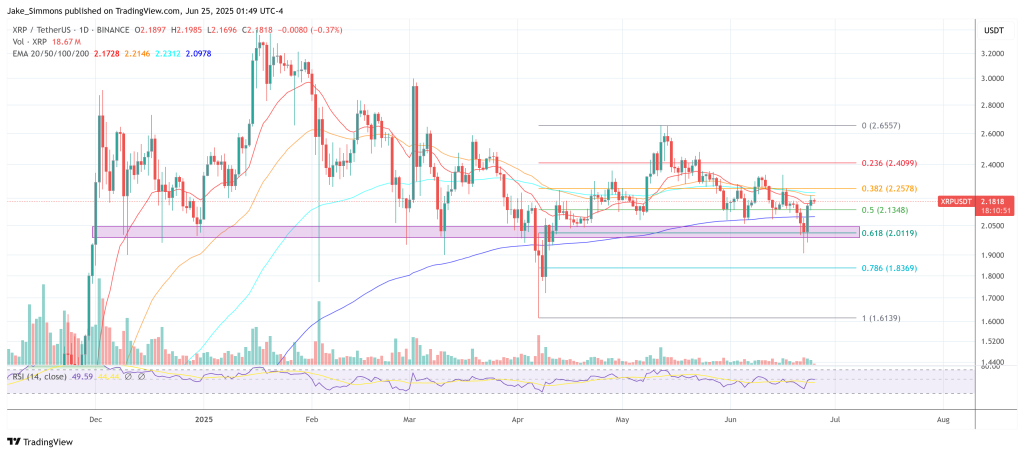
At press time, XRP traded at $2.18, up 13% since the Sunday low at $1.90.
XRP price
Key resistance looms ahead, 1-day chart | Source: XRPUSDT on TradingView.com
Featured image created with DALL.E, chart from TradingView.com
Editorial Process for bitcoinist is centered on delivering thoroughly researched, accurate, and unbiased content. We uphold strict sourcing standards, and each page undergoes diligent review by our team of top technology experts and seasoned editors. This process ensures the integrity, relevance, and value of our content for our readers.

Jake Simmons has been a Bitcoin enthusiast since 2016. Ever since he heard about Bitcoin, he has been studying the topic every day and trying to share his knowledge with others. His goal is to contribute to Bitcoin's financial revolution, which will replace the fiat money system. Besides BTC and crypto, Jake studied Business Informatics at a university. After graduation in 2017, he has been working in the blockchain and crypto sector. You can follow Jake on Twitter at @realJakeSimmons.

熱門幣種推薦

你可能也喜歡

刚刚,Claude Fable 5续命5天,省钱攻略来了

7月7日,Anthropic突然宣布将其最强模型Claude Fable 5的限时免费访问期延长至7月12日,为用户提供了额外五天的免费使用时间。免费额度为每周使用限额的50%,超出部分需购买积分。 此前,社区已涌现各种“抢救”Fable 5的指南。开发者Alex Prompter提供了将Fable 5的“思考方式”通过提示词抽取并移植到Opus 4.8的方法。另一位开发者Machina则总结了五个步骤来“榨干”Fable 5的能力,核心思想是将其知识迁移训练成本更低的小模型。 与此同时,Anthropic官方亲自推荐了两套节省成本的架构方案: 1. **顾问模式**:让主力模型Sonnet 5执行任务,仅在关键决策节点咨询Fable 5。在SWE-bench Pro测试中,该组合以约63%的成本取得了Fable 5单模型约92%的性能。 2. **编排者模式**:让Fable 5担任指挥官,负责规划和任务拆分,将具体的、需大量读取Token的研究工作分配给多个Sonnet 5子智能体并行处理。在BrowseComp测试中,该组合实现了单模型96%的性能,但成本大幅降至46%。 Anthropic通过一个核查全美十大国家公园政策的实例展示了编排者模式的效率:团队方案成本约1.61美元,耗时194秒;而单Fable 5方案成本约4美元,耗时608秒。团队方案在成本降低约2.5倍的同时,速度还快了3倍。 文章指出,Anthropic通过此次延期传递的核心信息是:顶级模型的正确用法并非全程使用,而是将其作为决策大脑,与成本更低的模型协同工作,从而实现高性能与低成本的平衡。

marsbit1 小時前

刚刚,Claude Fable 5续命5天,省钱攻略来了

marsbit1 小時前

交易

現貨

熱門文章

什麼是 $BANK

銀行人工智能:銀行未來的革命性步伐 介紹 在這個科技迅速進步的時代,銀行人工智能處於人工智能(AI)和銀行服務的交匯點。這個創新的項目旨在重新定義金融格局,通過人工智能的力量提高運營效率、安全措施和客戶體驗。在我們探索銀行人工智能的過程中,將深入探討這一項目的內涵、運作動態、歷史背景以及重要里程碑。 銀行人工智能是什麼? 從本質上講,銀行人工智能代表了一項變革性倡議,旨在將人工智能整合進各種銀行運營中。這個項目利用人工智能的能力來自動化流程、改善風險管理協議,並通過個性化服務增強客戶互動。 銀行人工智能的主要目標包括: 銀行功能自動化:通過利用人工智能技術,銀行人工智能旨在自動化日常任務,減輕人力資源的負擔並提高效率。 加強風險管理:該項目利用人工智能算法來預測和識別風險,從而強化針對欺詐和其他威脅的安全措施。 銀行服務個性化:銀行人工智能專注於通過分析客戶數據和行為提供量身定制的金融產品和服務。 改善客戶體驗:實施由人工智能驅動的解決方案,如聊天機器人和虛擬助手,旨在為用戶提供更接近人類的互動,徹底改變客戶與銀行的互動方式。 有了這些目標,銀行人工智能將自己定位為在提高銀行效率、安全性和以用戶為中心的關鍵角色。 銀行人工智能的創造者是誰? 關於銀行人工智能的創造者的具體細節尚不清楚。因此,在可用信息中尚未確定具體的個人或組織。圍繞該項目創建的匿名性引發了問題,但並未減少其雄心壯志的願景和目標。 銀行人工智能的投資者是誰? 與項目的創造者類似,關於銀行人工智能的投資者或支持組織的具體信息尚未披露。沒有這些信息,很難概述可能推動該項目向前發展的財務支持和機構支持。儘管如此,擁有堅實的投資基礎對於在這樣一個創新領域中保持發展至關重要。 銀行人工智能是如何運作的? 銀行人工智能在幾個創新領域運作,專注於使其與傳統銀行框架區分開來的獨特因素。以下是主要的運作特點: 自動化:通過應用機器學習算法,銀行人工智能自動化銀行內的各種手動流程。這樣不僅減少了運營成本,還使人力工作者能夠將精力轉向更具戰略性的活動。 先進的風險管理:將人工智能整合到風險管理實踐中,使銀行獲得準確預測潛在威脅(如欺詐)的工具,確保客戶信息和資產的安全。 量身定制的財務建議:通過持續學習客戶互動,人工智能系統發展出對用戶需求的細緻理解,能夠對財務決策提供量身定制的建議。 增強的客戶互動:利用由人工智能驅動的聊天機器人和虛擬助手,銀行人工智能提供了更具吸引力的客戶體驗,使用戶能夠快速解決問題,從而減少等待時間並提高滿意度。 這些運作特徵使銀行人工智能成為銀行業的先驅,建立服務交付和運營卓越的新標準。 銀行人工智能的時間線 了解銀行人工智能的發展軌跡需要看其歷史背景。以下是突顯重要里程碑和發展的時間線: 2010年代早期:對人工智能整合到銀行服務的概念開始引起關注,隨著銀行機構認識到潛在利益。 2018年:隨著銀行開始使用聊天機器人等人工智能工具進行基本客戶服務和風險管理系統以改善安全處理,人工智能技術的實施顯著增加。 2023年:人工智能的技術不斷進步,生成式人工智能被引入進行更複雜的任務,如文件處理和實時投資分析。今年標誌著人工智能技術為銀行提供能力的重要飛躍。 2024-當前狀態:截至今年,銀行人工智能正處於上升軌道,持續的研究和開發預示著將進一步提升銀行業務的能力。對人工智能應用的持續探索暗示著未來令人興奮的發展。 銀行人工智能的關鍵點 人工智能在銀行中的整合:銀行人工智能專注於採用人工智能來簡化銀行流程並改善用戶體驗。 自動化和風險管理的聚焦:該項目強烈關注這些領域,旨在減輕例行任務的負擔,同時通過預測分析增強安全框架。 個性化的銀行解決方案:通過利用客戶數據,銀行人工智能提供滿足個別用戶需求的量身定制銀行服務。 對發展的承諾:銀行人工智能致力於持續的研究和開發,確保其隨著技術的持續演變而保持適應性和持續相關性。 結論 總結來說,銀行人工智能展現了銀行業的一個重要進步,利用人工智能重塑運營範式、提高安全性,並促進客戶滿意度。儘管有關創造者和投資者的信息仍有缺口,但銀行人工智能的明確目標和功能機制為其持續發展提供了堅實基礎。隨著人工智能技術的不斷進步和與銀行業的融合,銀行人工智能在金融服務未來的影響力將十分顯著,改善我們對銀行的理解和互動方式。

173 人學過發佈於 2024.04.06更新於 2024.12.03

什麼是 $BANK

如何購買BANK

歡迎來到HTX.com!在這裡,購買Lorenzo Protocol (BANK)變得簡單而便捷。跟隨我們的逐步指南,放心開始您的加密貨幣之旅。第一步:創建您的HTX帳戶使用您的 Email、手機號碼在HTX註冊一個免費帳戶。體驗無憂的註冊過程並解鎖所有平台功能。立即註冊第二步:前往買幣頁面,選擇您的支付方式信用卡/金融卡購買:使用您的Visa或Mastercard即時購買Lorenzo Protocol (BANK)。餘額購買:使用您HTX帳戶餘額中的資金進行無縫交易。第三方購買:探索諸如Google Pay或Apple Pay等流行支付方式以增加便利性。C2C購買:在HTX平台上直接與其他用戶交易。HTX 場外交易 (OTC) 購買:為大量交易者提供個性化服務和競爭性匯率。第三步:存儲您的Lorenzo Protocol (BANK)購買Lorenzo Protocol (BANK)後,將其存儲在您的HTX帳戶中。您也可以透過區塊鏈轉帳將其發送到其他地址或者用於交易其他加密貨幣。第四步:交易Lorenzo Protocol (BANK)在HTX的現貨市場輕鬆交易Lorenzo Protocol (BANK)。前往您的帳戶,選擇交易對,執行交易,並即時監控。HTX為初學者和經驗豐富的交易者提供了友好的用戶體驗。

1.1k 人學過發佈於 2025.05.09更新於 2026.06.02

如何購買BANK

相關討論

歡迎來到 HTX 社群。在這裡,您可以了解最新的平台發展動態並獲得專業的市場意見。 以下是用戶對 BANK (BANK)幣價的意見。

活动图片