Why Tokenization Took Center Stage at Davos 2026 and What It Signals for Crypto Investors

bitcoinist发布于2026-01-23更新于2026-01-23

文章摘要

At the 2026 World Economic Forum in Davos, the crypto conversation shifted from price speculation to practical integration, with tokenization of real-world assets (RWAs) taking center stage. Valued at over $22 billion, tokenization is now seen as active financial infrastructure rather than an experiment. Discussions featured central bankers, major asset managers, and executives from firms like BlackRock and BNY Mellon, who confirmed moving beyond pilots to deploying tokenized assets at scale. Ethereum hosts over 65% of these assets. Regulatory clarity, including the US GENIUS Act, was cited as key to this growth. Stablecoins are increasingly used as settlement "plumbing." For investors, this signals a structural, less speculative growth phase, with tokenization projected to reach $2-16 trillion by 2030.

At the 2026 World Economic Forum in Davos, crypto moved away from price cycles and ideological debates toward a more practical focus: how blockchain is being used inside the global financial system.

Across panels, side events, and executive interviews, tokenization of real-world assets (RWAs) emerged as the clearest signal of where crypto is heading next. With the value of tokenized assets now exceeding $22 billion, Davos framed tokenization less as an experiment and more as infrastructure in active use.

The shift was evident in both the tone and the participants. Rather than startups pitching concepts, conversations featured central bank officials, large asset managers, and executives from firms in the tokenization space. The emphasis shifted from whether blockchain belongs in finance to how quickly it can be scaled.
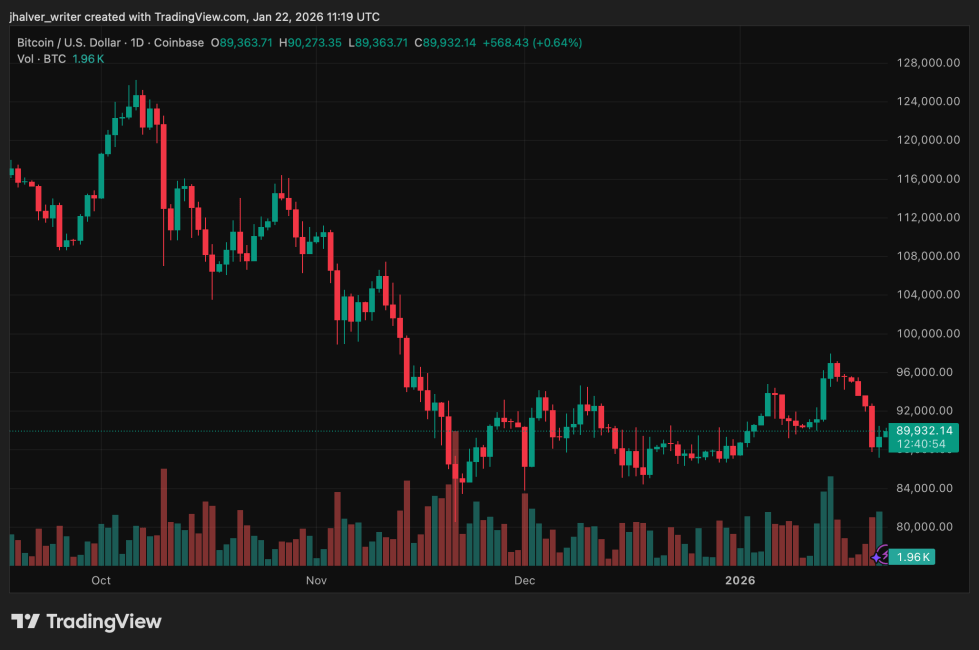
BTC's price trends sideways on the daily chart. Source: BTCUSD on Tradingview

Tokenization Moves From Concept to Financial Infrastructure

Panels such as “Is Tokenization the Future?” underlined how assets traditionally seen as illiquid, bonds, equities, funds, and real estate, are increasingly represented on-chain.

Executives from Coinbase and Ripple, alongside European Central Bank officials, described tokenization as a way to reduce settlement times, improve liquidity, and allow fractional ownership without rebuilding the financial system from scratch.

Institutions including BlackRock, BNY Mellon, and Euroclear confirmed they have moved beyond pilot programs and are deploying tokenized instruments at scale.

Data shared during the forum showed that the total value locked in tokenized RWAs has passed $22 billion, reflecting broader asset coverage and growing institutional participation. Ethereum currently hosts more than 65% of these assets, underlining its role as the main settlement layer for tokenization activity.

Regulation and Stablecoins Shape the Next Phase

Regulatory clarity was repeatedly cited as the key factor behind this momentum. Frameworks finalized in 2025 in the US and parts of Europe provided banks and custodians with clearer rules on issuance, custody, and compliance.

In Davos, US President Donald Trump reinforced this direction by pointing to the GENIUS Act, which established a federal framework for payment stablecoins.

Stablecoins were described as the “plumbing” connecting traditional finance, decentralized finance, and tokenized assets. Rather than competing with banks, they are increasingly used for settlement, treasury operations, and cross-border transfers.

What Davos 2026 Signals for Crypto Investors

For investors, Davos 2026 suggested that crypto’s next growth phase may be less speculative and more structural.

Consulting firms such as McKinsey and Boston Consulting Group estimate that tokenized assets could reach between $2 trillion and $16 trillion by 2030. The focus on regulated products, institutional adoption, and market infrastructure points to a longer-term shift.

Tokenization’s rise at Davos indicates that crypto’s role in global finance is being defined less by volatility and more by utility, an important signal for how the sector may evolve in the years ahead.

Cover image from ChatGPT, BTCUSD chart from Tradingview

相关问答

QWhat was the main focus of crypto discussions at Davos 2026, according to the article?

AThe main focus shifted away from price cycles and ideological debates toward the practical use of blockchain in the global financial system, specifically the tokenization of real-world assets (RWAs).

QWhat evidence was presented at Davos to show that tokenization is more than just an experiment?

AThe value of tokenized assets was reported to exceed $22 billion, and institutions like BlackRock, BNY Mellon, and Euroclear confirmed they have moved beyond pilot programs and are deploying tokenized instruments at scale.

QWhich blockchain was highlighted as the main settlement layer for tokenization activity and what percentage of tokenized RWAs does it host?

AEthereum was underlined as the main settlement layer, currently hosting more than 65% of tokenized real-world assets.

QWhat key factor was repeatedly cited as crucial for the momentum behind tokenization?

ARegulatory clarity was repeatedly cited as the key factor, with frameworks finalized in 2025 in the US and parts of Europe providing clearer rules on issuance, custody, and compliance.

QWhat future market size for tokenized assets was estimated by consulting firms like McKinsey and BCG?

AConsulting firms such as McKinsey and Boston Consulting Group estimated that tokenized assets could reach between $2 trillion and $16 trillion by 2030.

你可能也喜欢

BTC“数字黄金”的叙事是不是失败了?

这篇文章从三个核心问题探讨了比特币的现状与未来,强调提供的是思考框架而非投资建议。 **如何看待比特币资产?** 作者认为比特币是一种全新的、更优秀的“黄金”资产。其优势在于总量恒定、转移便捷、交易可审计。尽管早期与灰色地带关联,但合规化是趋势。目前全球数字货币渗透率仅3%-4%,类比互联网和电商的早期阶段,意味着比特币仍处于发展初期,潜力巨大但波动性也极高。 **如何理解本轮下跌?** 比特币自2025年10月高点(近12.6万美元)持续下跌,2026年2月一度跌破6.1万美元,单日跌幅达15%,随后又快速反弹。这被解读为遵循四年减半周期的共识性获利了结。特别之处在于,美国比特币ETF的批准引入了机构资金,也促使早期低成本持有者(如矿工和信仰者)进行大规模“换手”,这是资产迈向主流化的必经过程。历史数据显示,比特币历次大跌的幅度在收窄(从93%到当前的约50%),表明资产正在成熟,波动率逐步下降,但高波动仍是其获取超额回报的固有特征。 **长期如何看待发展?** 长期价值可对标黄金。当前比特币市值仅为黄金市值的约7%,若“数字黄金”叙事实现一半,上行空间依然显著。但作者提醒,短期市场脆弱,换手可能未完,底部无法预测。真正的风险并非资产归零(概率较低),而在于错误的仓位管理(如All-in或加杠杆)以及对资产缺乏深刻理解。投资者必须计算并承受潜在的最大回撤(例如从已跌50%的位置再跌50%),才能存活至长期价值兑现。 文章最后以亚马逊在互联网泡沫后暴涨为例,指出关键不在于比特币未来是否上涨,而在于投资者能否通过理性的仓位管理和深度认知,扛过剧烈波动存活到那一天。文末提问引导读者反思:当前黄金涨、比特币跌的局面,究竟意味着“数字黄金”叙事失败,还是资产进化过程中的换手阵痛?这取决于每个人对比特币最底层的信仰。

marsbit8小时前

BTC“数字黄金”的叙事是不是失败了?

marsbit8小时前

BTC“数字黄金”的叙事是不是失败了?

标题:BTC“数字黄金”的叙事是不是失败了? 作者:@wuk_Bitcoin 本文从三个核心问题出发,探讨比特币的现状与未来。 **如何看待比特币?** 作者认为比特币是一种全新的、更优秀的“黄金”类资产。其优势在于:总量恒定(2100万枚);资产可转移性极强,在全球不确定性时代具备溢价;所有交易链上可审计,透明度高。反驳了比特币主要用于灰色地带的过时观点,指出其正走向合规。目前全球数字货币渗透率仅约3%-4%,类比互联网和电商早期,意味着该资产类别仍处早期,潜力与巨大波动并存。 **如何理解本轮下跌?** 比特币自2025年10月高点(近12.6万美元)持续下跌,2026年2月初曾单日暴跌15%,跌破6.1万美元。这被视为遵循其四年减半周期的规律性回调,是长期持有者在周期高点锁定利润的结果。本轮下跌的特殊性在于:美国比特币ETF的批准引入了大量机构新资金,但也促使成本极低的早期持有者(矿工、OG)进行历史性抛售,即从“早期信仰者”向“长期配置机构”的换手过程。历史数据显示,比特币历次大回撤的跌幅在逐步收窄(从93%到目前的约50%),表明资产在成熟,波动率在下降,但高波动仍是获取超额回报的代价。 **长期怎么看?** 若将比特币视为“数字黄金”,其当前总市值(约1.4万亿美元)仅为黄金总市值(约20万亿美元)的7%。即使该叙事仅部分实现,上行空间依然可观。但作者强调短期风险:换手可能未结束,市场脆弱,不排除进一步下跌。真正的风险不在于资产归零(概率极低),而在于错误的仓位管理(如All-in、加杠杆)和对资产缺乏深度理解,这可能导致投资者无法承受巨大波动而提前被迫出局。 **最后对比** 作者以亚马逊在互联网泡沫破裂后股价跌95%又最终上涨42倍为例,指出关键在于“活着等到那一天”。对于比特币,核心同样是能否通过理性仓位管理活到其价值兑现之时。文末提问:当黄金大涨而比特币大跌,这究竟是“数字黄金”叙事的失败,还是资产进化过程中的阵痛?答案取决于每个人对比特币最底层的信仰。

链捕手8小时前

BTC“数字黄金”的叙事是不是失败了?

链捕手8小时前

从代码到认知:机器人大脑进化的万字指南

本文概述了机器人大脑从传统代码控制到现代人工智能模型驱动的演进历程。文章首先回顾了前大型语言模型(LLM)时代,机器人依赖手工编码的模块化技术栈(感知、状态估计、规划、控制)和行为树,虽稳定但泛化能力差。随后,深度学习改进了感知,强化学习和模仿学习进入了控制层,但策略仍较为狭窄。 ChatGPT的出现带来了转折。LLM最初被用作自然语言编译器,将指令转化为机器人可执行的原子技能序列(如谷歌的SayCan)。但更重要的突破是视觉-语言-动作模型(VLA),例如谷歌的RT-2和开源的OpenVLA,它能将视觉、语言信息融合,直接输出动作指令,实现了推理与行动的耦合。 目前最先进的系统采用“双脑”架构(如Figure AI的Helix、NVIDIA GR00T):一个慢速、参数多的“系统2”负责高层次推理和规划;一个快速、小巧的“系统1”负责高频动作生成。其下还可能有一个“系统0”反射层处理平衡等底层控制。出于延迟和可靠性考虑,安全关键的控制回路通常在机器人本地(如NVIDIA Jetson模块)运行,而对话界面和集群学习等任务可交由云端。 开源模型(如OpenVLA、GR00T、π0)降低了行业门槛,让初创公司能在其基础上用自有数据微调。然而,当前VLA机器人仍存在任务中途恢复能力弱、样本效率低、缺乏物理常识和长期规划能力等局限。 这催生了下一代方向:世界模型。这类模型(如NVIDIA Cosmos、Meta V-JEPA)能根据当前状态和动作预测未来结果,让机器人在行动前进行模拟和评估,从而改善恢复能力、泛化能力和长期规划。架构上主要分为像素级视频扩散、联合嵌入预测架构(JEPA)和潜在动作世界模型等流派。 文章最后指出,数据采集(特别是远程操作数据)是核心竞争力,仿真训练至关重要,机器人成本正在迅速下降。当前物理AI的发展阶段大约相当于“GPT-2时代”,虽未完全自主,但正通过架构的持续演进(从代码到感知、规划、策略,最终到世界模型),朝着更通用、更强大的方向稳步前进。

marsbit9小时前

从代码到认知:机器人大脑进化的万字指南

marsbit9小时前

交易

现货
合约
活动图片