What Happens When Two Miners Find a Block in the Same Second? How the 'Orphan Race' Unfolds

cryptonews.ru发布于2026-07-29更新于2026-07-29

文章摘要

Bitcoin mining is a race without a real-time referee. A newly mined block must physically propagate across the global peer-to-peer network before consensus is reached on the chain's tip. This takes seconds, sometimes longer on congested connections. If a second miner finds a valid block before learning of a competing one, they build on their last-known version and broadcast their own block. For a short time, two equally valid blocks exist at the same height, creating a temporary chain split. The network resolves this not by voting or timestamps, but by Proof-of-Work: the chain that accumulates the most work becomes canonical. Blocks on the losing side are "orphaned" or "stale." Their miners lose the block reward and fees, though unconfirmed transactions return to the mempool. Usually, a single subsequent block resolves the tie. A notable two-block reorganization occurred on March 24, 2026. Antpool and Foundry USA mined competing versions of block 941,881 seconds apart. ViaBTC extended Antpool's chain, while Foundry extended its own, creating a one-block split. Foundry then pulled ahead by mining six consecutive blocks, making its chain the heaviest. All nodes switched to Foundry's chain, orphaning blocks from Antpool and ViaBTC. While such multi-block reorganizations are rare, the underlying race condition is common. Analysis shows about 9.2% of block intervals in a sample period were under 60 seconds, each representing a potential short-lived race. Fast relay networks hav...

Bitcoin mining is a race with no referee watching the finish line in real time. A new block must physically propagate (i.e., 'hop' from node to node) across the global network before all participants agree on where the current tip of the chain is. This process takes a few seconds, and over a congested connection—sometimes longer.

If a second miner finds its own valid block before the first block has reached it, it continues working on the last version it saw (usually the previous block) and broadcasts its own competing block. For a short period of time, two equally valid blocks exist at the same height, each with its own set of confirmed transactions and its own proposal for what comes next.

Neither block is 'incorrect,' as both satisfy all protocol rules; the only thing separating them is timing and which nodes randomly learned about which one first. Roughly half the network ultimately mines on one candidate, the other part mines on the other, and Bitcoin briefly has two honest, simultaneous versions of itself.

How a Tie Is Actually Resolved

Bitcoin resolves this issue not through voting, authority, or who technically found their block first. It resolves it the same way it resolves everything else: the chain that accumulates more proof-of-work becomes the one all nodes switch to, and the block(s) from the other side are discarded.

'Discarding' does not mean that history has been rewritten or destroyed, but means that this block, called an 'orphan' or 'stale' block, ceases to be part of the chain recognized by everyone. Any transactions within it that were not also confirmed on the winning side simply return to the mempool to be included in a future block.

In most cases, the situation is resolved after just one additional block appears, and no one outside of circles connected to mining infrastructure even notices. A genuine two-block race (where the tie somehow persists through an entire extra round, preventing either side from pulling ahead) happens so rarely that it makes news headlines when it does, precisely because it requires the odds of a coin toss to come out the same twice in a row.

The March 2026 Case: When the Coin Toss Repeated

This is exactly what happened on March 24, 2026. After Antpool and Foundry USA each released their version of block 941,881 with a twelve-second interval, ViaBTC continued AntPool's chain with block 941,882, while Foundry, working on its own fork, also continued its version. For one block, the network was genuinely split in half between two valid chains. Then Foundry pulled ahead, mining blocks 941,883 through 941,886 consecutively (six blocks in a row on its branch), until its chain became, in the words of one Bitcoin developer monitoring the event, 'the heaviest by a wide margin.'

All nodes switched to Foundry's version, and the blocks mined by AntPool and ViaBTC became 'orphans'; their miners lost the block reward and fees for that work, although the transactions themselves returned to the mempool and were reconfirmed shortly thereafter.
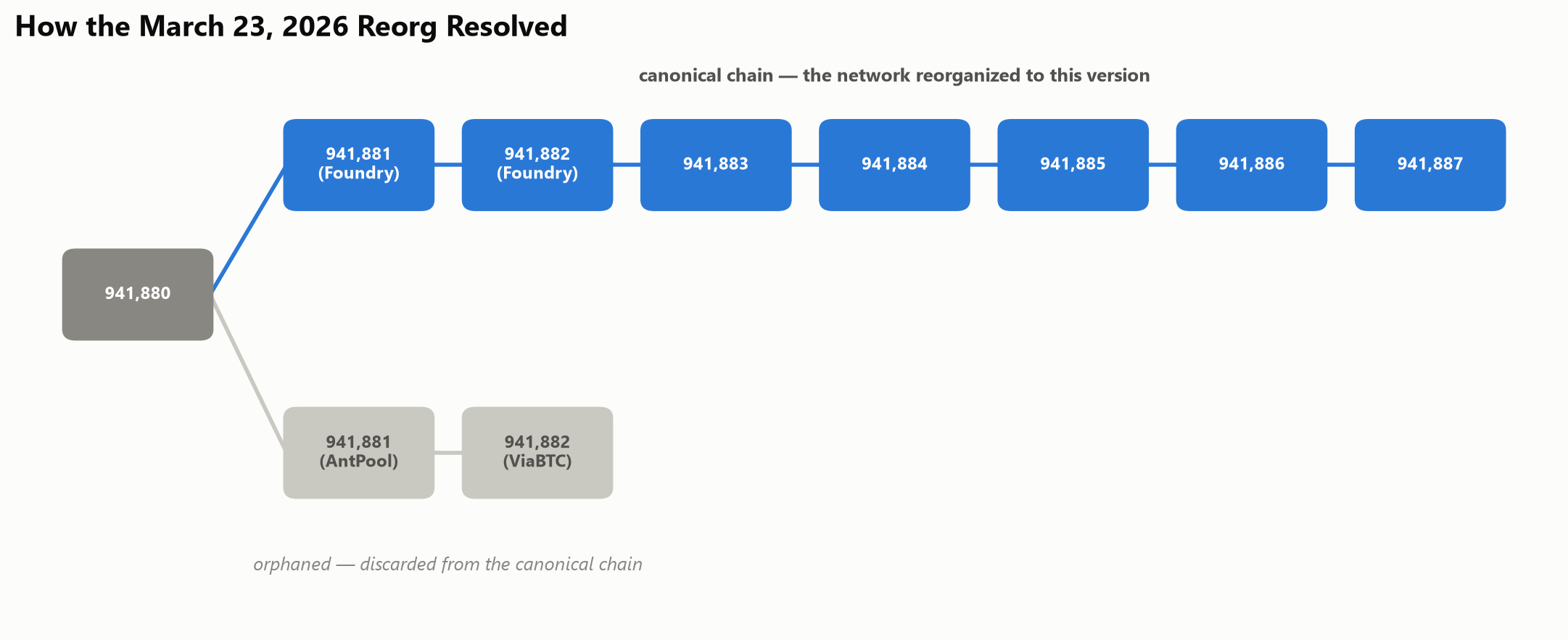
Diagram of the reorganization during simultaneous block mining.

Bitcoin analyst b10c, who first publicly highlighted this event, called it a 'fairly rare case of a two-block fork/reorganization between Foundry and AntPool+ViaBTC.' 'Rare' is true, but the event also drew attention to a less pleasant trend: for a pool that already controls a significant share of the network's hash rate, stringing six blocks together is easier than it is for others. Coverage of the event noted that shrinking margins are squeezing out smaller miners and leading to a concentration of hash power in fewer, larger pools.

A more concentrated network doesn't make one-block races more common, but it noticeably increases the chances of a well-resourced pool winning any particular race (and stringing together the subsequent blocks that finish it) compared to the chances of a smaller miner.
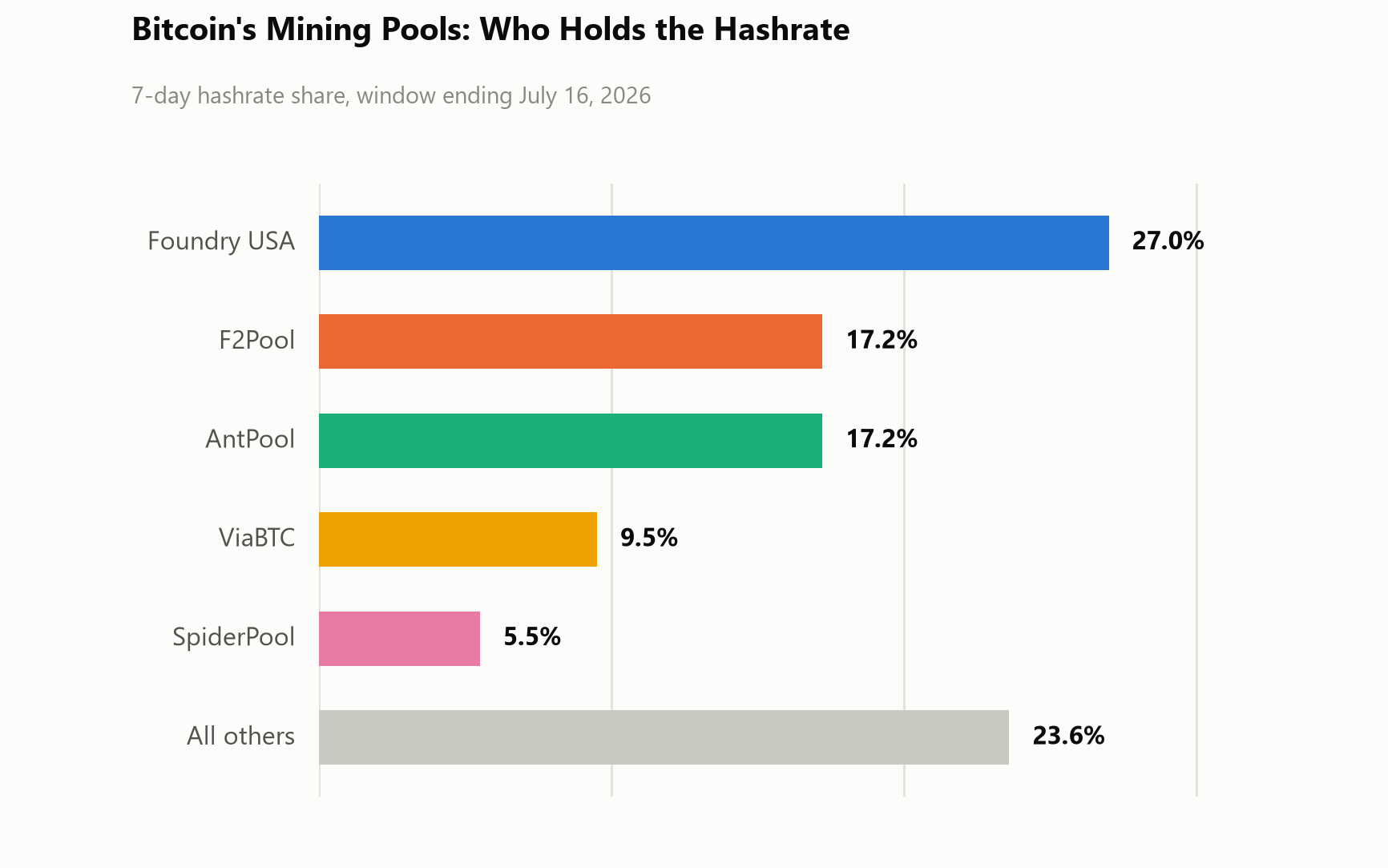
Hashrate controllers, main entities, recorded July 16, 2026.

The Boring Version Is Normal, and That's the Point

Two-block reorganizations are the exception; the underlying condition of a race is not. Looking at real block timestamps directly from mempool.space for the three days preceding the reorganization (heights 941,452 to 941,887), 40 of the 435 intervals between successive blocks (about 9.2%) were within 60 seconds of each other, including one pair with only a 5-second difference. Each of these cases where the difference was minimal is a moment when a genuine race condition existed in the network, albeit briefly.
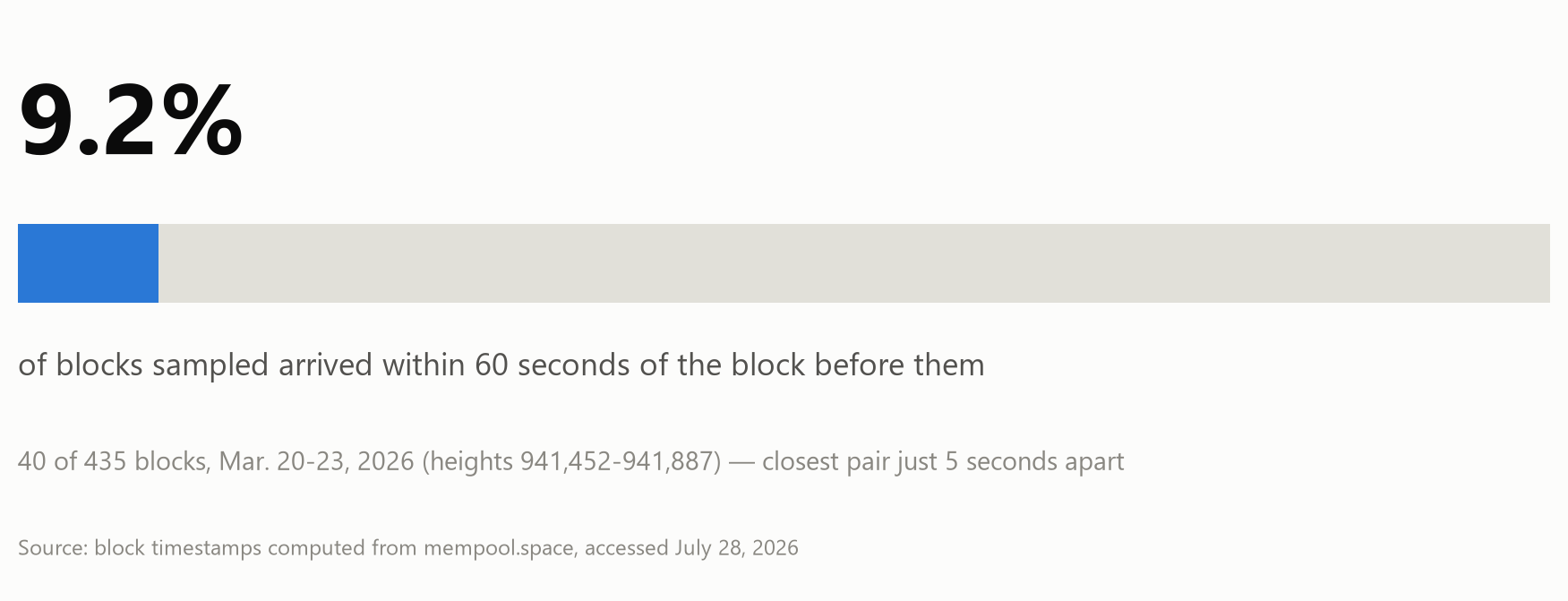
Nearly all of them are resolved within that same block, unnoticed, because the next miner finding a block in the overwhelming majority of cases simply continues working on the fork that reached them first, and the probability of two ties in a row is extremely low. The compact relay of blocks and specialized low-latency relay networks like FIBRE, now used by most major pools, have reduced the propagation delays that cause races compared to Bitcoin's early years (which is why a race that persists through two full blocks, as happened with AntPool and Foundry, is rare enough to be news, not commonplace).

end-content

热门币种推荐

相关问答

QWhat happens in the Bitcoin network when two miners find a valid block at nearly the same time?

ATwo equally valid blocks exist at the same height for a short period. The network splits temporarily, with some nodes building on one block and others on the second. This creates two competing, honest versions of the chain.

QHow does Bitcoin ultimately resolve a tie between two competing blocks?

ABitcoin resolves it through the proof-of-work rule. Nodes will eventually switch to the chain that accumulates the most proof-of-work. The block(s) on the shorter, losing chain become 'orphaned' or 'stale' and are discarded from the consensus chain.

QWhat is an 'orphaned' or 'stale' block, and what happens to the transactions inside it?

AAn orphaned or stale block is a valid block that is not part of the ultimately accepted longest chain. Its block reward and fees are forfeited by its miner. However, the transactions within it return to the mempool and can be included in a future block.

QWhat was significant about the event that occurred on March 24, 2026, involving Antpool and Foundry USA?

AIt was a rare two-block reorganization (fork). After both mined competing blocks at height 941,881, the tie persisted for another block (941,882) before Foundry USA pulled ahead by mining several consecutive blocks. This caused the blocks from Antpool and ViaBTC to be orphaned.

QAccording to the article, what trend does the March 2026 event highlight as a less pleasant consequence?

AIt highlights the trend of hash power concentration. Larger mining pools with significant network share have a higher chance of winning such races and extending their chain, which can marginalize smaller miners and lead to greater centralization of mining power.

你可能也喜欢

美联储深夜投下“鹰派炸弹”:利率按兵不动,内部分歧十年罕见

2026年7月29日,美联储宣布维持联邦基金利率目标区间在3.50%-3.75%不变,为年内连续第五次按兵不动。尽管这一决定符合市场普遍预期,但联邦公开市场委员会内部出现罕见分歧:克利夫兰、明尼阿波利斯和达拉斯联储的三位主席投下反对票,均主张加息25个基点。这是自2016年以来首次出现三名票委就政策调整持同一立场的反对意见,被视为强烈的鹰派信号。 美联储主席沃什在发布会上重申,对抗通胀的承诺坚定不移,2%的通胀目标是“唯一红线”,没有弹性空间。他强调,如果通胀持续高企,提高利率将是主要应对工具。同时,沃什宣布将大幅减少“前瞻指引”,要求市场更多地依据经济数据而非央行表态来判断利率路径。他还特别提及,过去四个季度与人工智能相关的资本开支增速接近20%,其如何影响总体通胀和生产率是当前政策评估的关键不确定性。 决议公布后,金融市场剧烈波动。30年期美债收益率飙升并突破5.2%,创2007年6月以来新高;美元指数下跌;黄金价格一度站上4100美元。美国三大股指全线收跌,其中道琼斯工业平均指数暴跌1153点,创下近15个月来最大单日点数跌幅。市场分析认为,美联储内部的鹰派分歧和沃什强硬的通胀表态,是引发市场震荡的主要原因。

marsbit1小时前

美联储深夜投下“鹰派炸弹”:利率按兵不动,内部分歧十年罕见

marsbit1小时前

交易

现货

热门文章

加密市场宏观研报:《GENIUS Act》法案取得重大进展,BTC突破历史新高,后市全新展望

2025年5月22日,比特币价格正式突破11万美元大关,创下历史新高。在政策面、宏观经济、资金面与投资者结构共同作用下,一场结构性牛市浪潮正在展开。而此轮上涨背后的核心驱动,是美国《GENIUS稳定币法案》的实质性进展以及多项利好的叠加。本文将从政策端突破、宏观环境转向、链上与ETF资金结构、交易行为演化,以及重点受益赛道五大维度,全面解析此轮BTC再创新高的深层逻辑,并前瞻下半年市场的潜在趋势。

1.8k人学过发布于 2025.05.22更新于 2025.05.22

加密市场宏观研报:《GENIUS Act》法案取得重大进展,BTC突破历史新高,后市全新展望

相关讨论

欢迎来到HTX社区。在这里,您可以了解最新的平台发展动态并获得专业的市场意见。以下是用户对BTC(BTC)币价的意见。

活动图片