Original Author / Stacy Muur
Compiled by / Odaily Planet Daily Golem(@web 3_golem)

Every month, Green Dots conducts research on KOL promotional campaigns on Platform X to understand the strategies of other Web3 marketing teams and track which strategies and post styles are truly effective. However, due to the new paid partnership policy introduced by X, which has changed the marketing landscape on Platform X(Related reading: Musk casually overturns the rice bowl of crypto KOLs), most Web3 projects' promotional strategies are no longer suitable. Stacy Muur reveals in this article the common problems in many recent Web3 promotional activities, using Starknet as the case study for this analysis.
Author's statement: This is not targeting Starknet; their technical strength remains strong. Despite the many doubts and suspicions from the outside world after the airdrop and TGE, the team continues to release and develop products, which deserves respect. But this article focuses only on one aspect: marketing strategy. Starknet's recent new product promotion is just a typical example.
How did Starknet conduct its advertising promotion?
Starknet recently launched strkBTC [₿] and invited some content creators on Platform X to promote this event. They adopted a very classic promotion model:
- First, release an announcement with a promotional video;
- Within 12-48 hours of the announcement, KOLs will post collaborative promotional posts;
- Subsequently, publish articles to specifically explain the advantages of the product.
Even though this promotion was conducted in late February, to comply with Platform X's paid partnership policy, some creators included the paid partnership label when posting related content. But the focus of this article is not on the disclosure of payments, but on the effectiveness of this promotion strategy itself.
On February 10th, around another announcement released by Starknet, their marketing team conducted another KOL promotion. Exactly the same routine: first release a video announcement, then promote it through KOLs.
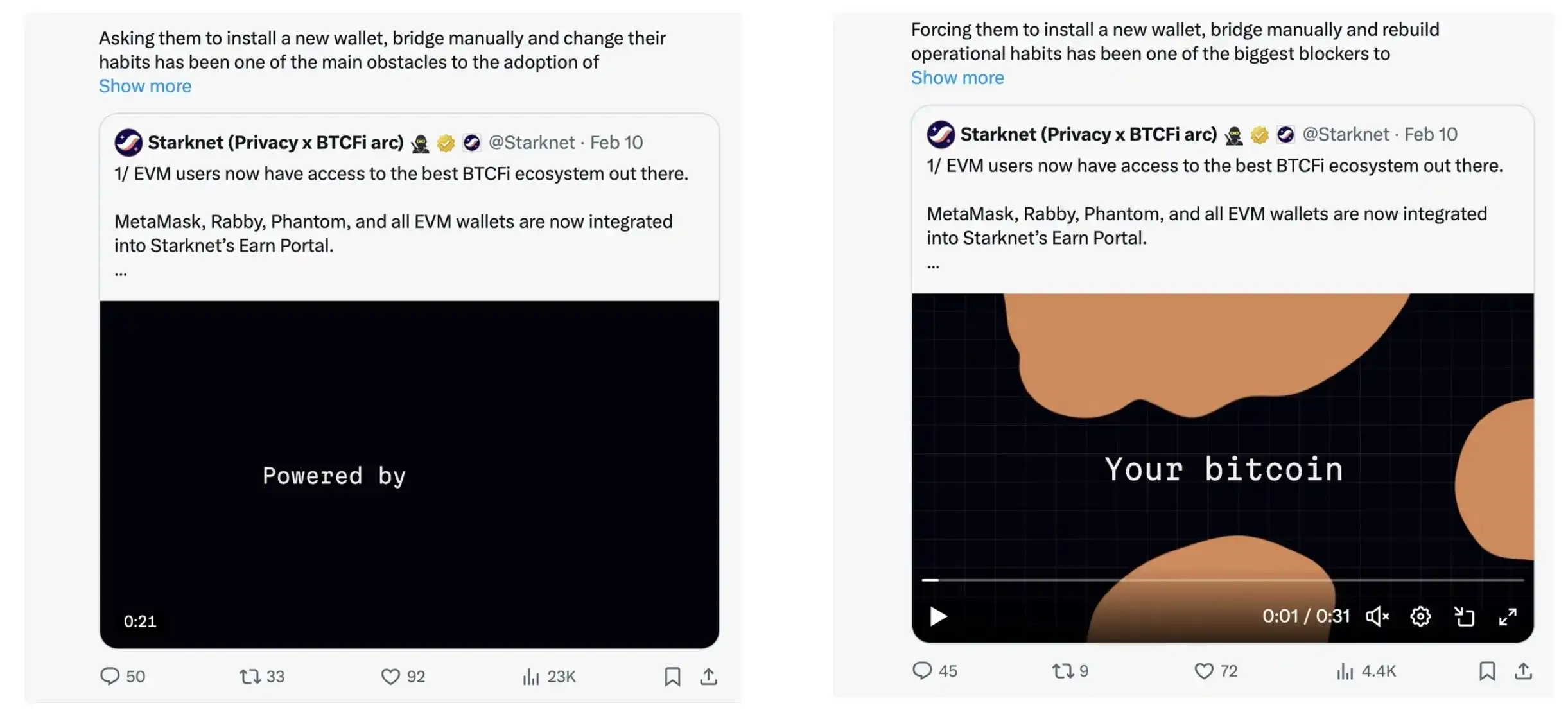
Of course, Starknet also has other promotional methods, such as publishing several long articles and conducting some promotional activities in the Korean language region.
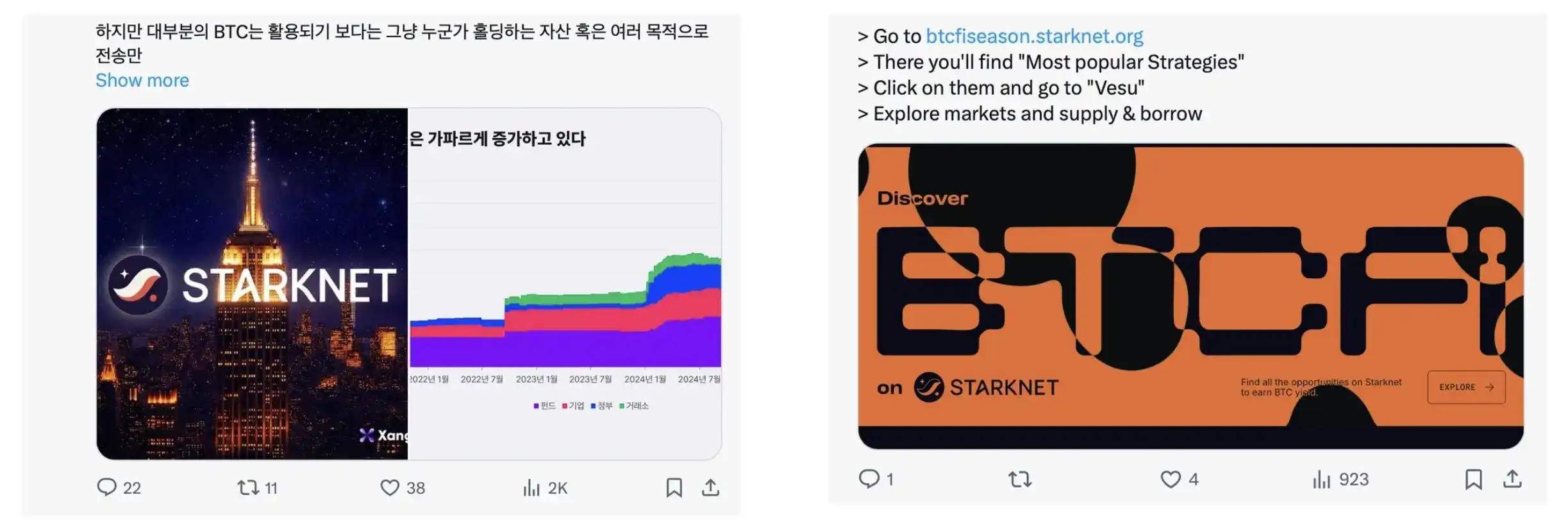
For the record, I don't know who was responsible for managing this campaign, nor whether any agency was involved. I am merely providing some thoughts from an outsider's perspective, from a marketer's point of view.
One problem is obvious throughout the promotion: the screening of creators participating in the promotion is weak.
X is essentially a perception layer. Ideally, creator promotions on X should bring:
- More discussion about the brand
- Trigger more voluntary posts from independent creators
- Drive the production of more community content
- Stronger ecosystem activation
But is that what we see? Not really.
If you use simple filtering conditions on X to view popular posts mentioning Starknet in February, the results are obvious.
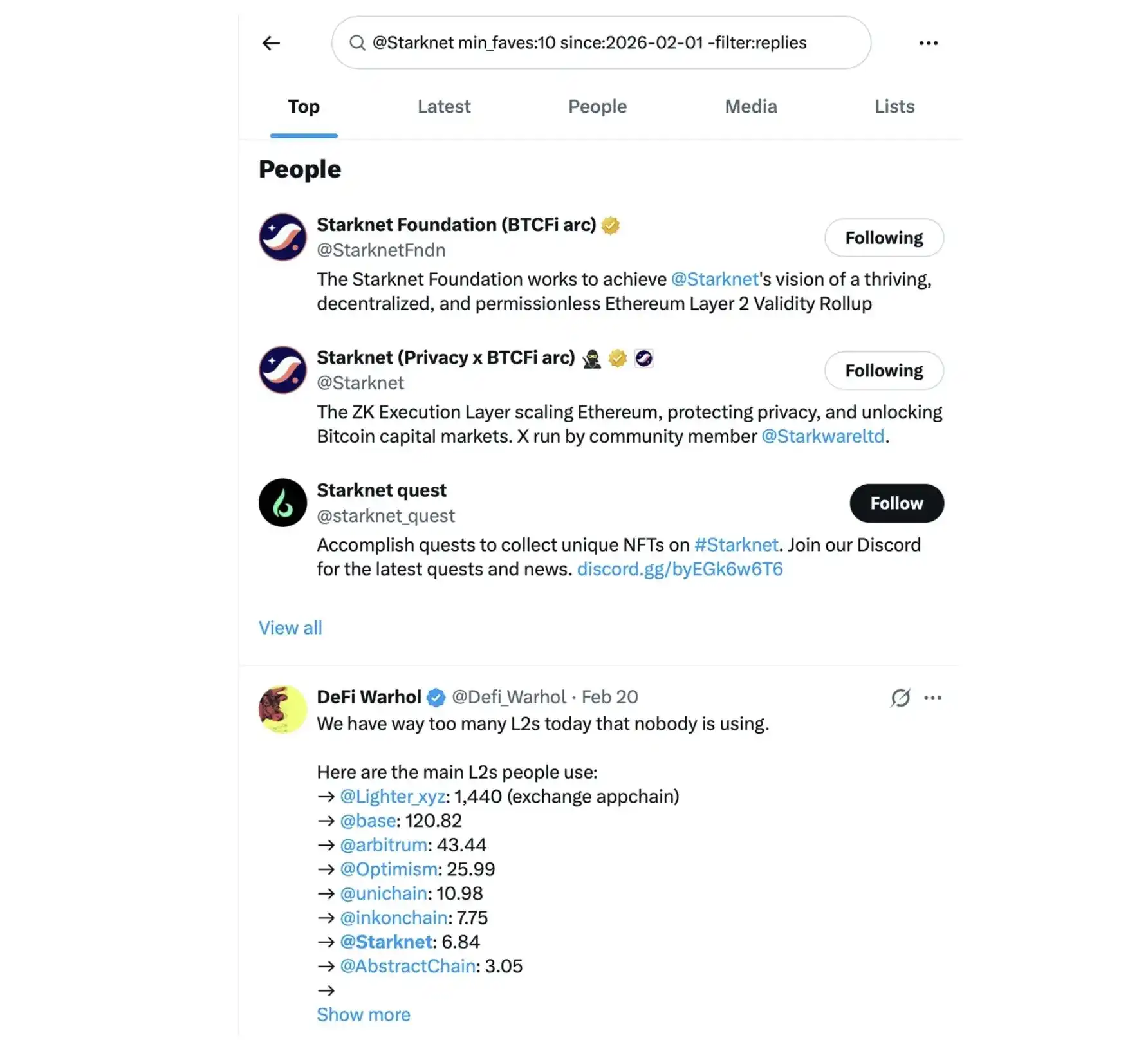
The most mentioned post was actually from Warhol. Overall, in February, only a little over 100 independent posts mentioning Starknet received more than 10 likes. For a well-known L2 ecosystem, this number is not high.
Some popular organic mentions of Starknet included:
- Mookie's post about token unlocks (approx. 10k views)
- Warhol's post about the best internship brands in the crypto industry (approx. 16k views)
- Warhol's L2 rating list (approx. 30k views)
- santiment's post ranking L2s by developer activity (approx. 50k views)
- mztacat's post about the "Big Four companies" (approx. 82k views)
The above roughly constitutes Starknet's mention volume on Platform X in February. This leads to a more important question, not just concerning Starknet, but concerning the fact that the classic Web3 marketing strategy is gradually failing on Platform X.
Why is the classic Web3 advertising strategy failing?
For years, the default mode of Web3 marketing has been this: Announcement -> KOL promotion -> Community discussion.
This classic model worked when X's timeline was less crowded, narratives were strong, and most promotions were not easily identifiable as paid promotions. But it started failing after the following changes occurred.
Paid disclosure kills implicit virality
Once creators started adding paid disclosure information, this promotion model became obvious to followers.
First, users see an announcement, then within the next 24 hours, 5-10 similar promotional posts appear, all with largely identical content. Users can immediately recognize this structure. It doesn't trigger community discussion; instead, it sends a signal that "this is an ad campaign."
In the environment of Crypto Twitter, ads rarely spark community discussion; they are usually just scrolled past.
KOL behavior is now very easy to identify
Crypto Twitter has matured; people understand how KOL marketing works.
When the same group of creators quotes the same announcement with slightly different wording, it's easily interpreted as a coordinated promotion. And once KOL content is clearly identified as a promotion, user engagement drops because the audience switches from curiosity mode to ad-filtering mode.
X rewards buzz, not announcements
X is not a distribution channel; it's a narrative space. Unless a Web3 project's announcement can trigger the following, they rarely become trending topics:
- Arguments and debates
- Meme coins
- Hot takes
- Competition between KOLs
Without these dynamic factors, dissemination can only bring brief user reach but cannot truly win users' minds. Therefore, to truly gain buzz, Web3 projects should change the sequence of their marketing campaigns.
The old promotion flow was: Announcement -> KOL promotion -> Community discussion. The new promotion structure should be: First build the topic -> Spark creator debate -> Generate community content -> Finally announce, so the announcement becomes the final confirmation moment, not the starting point.
If the project skips the narrative stage, promotion has nothing to build on.
How to redesign a promotion campaign for Starknet
Let's get back to reality. Starknet carries heavy baggage. The previous airdrop phase triggered a lot of fear, uncertainty, and doubt. Explanations and promotional videos alone cannot solve this problem; the project needs to control the conversation to resolve it. Different goals also require different marketing strategies.
If the goal is to win mindshare
The strategy should be to actively engage in controversy. Don't try to suppress critics; design topics that can spark debate.
For example:
- "Which L2 is better for developing BTCFi?"
- "Ethereum L2 vs Bitcoin L2"
- "Top 5 ecosystems for BTCFi developers"
Then sponsor posts related to ranking lists, posts comparing Starknet with other projects, and posts with debates. Maybe half the timeline will support Starknet, and the other half will attack Starknet, but both sides increase exposure. Creating drama is not bad marketing; marketing that goes unnoticed is bad.
If the goal is to dominate the narrative
Then stop publishing lengthy PR articles; few people read them. Instead, publish visual infographics, ecosystem maps, competitor comparisons, and short frameworks that KOLs can reuse. Giving creators space to remix content is far more powerful than content they can only quote.
The goal of dominating the narrative is not one good article, but dozens of derivative articles. This is how narratives spread.
If the goal is to attract developers
Then remember that developer acquisition is a B2B model. Posting announcements on X is not effective for developer onboarding. What projects should do is:
- Build topic momentum
- Build ecosystem prestige
- Showcase developers who have already found success there
Once this trend forms, onboarding developers becomes much easier. Because developers also chase hotspots.
Conclusion
The traditional Web3 promotion model (Announcement -> KOL promotion) is dying on X. The new model is more like: Design the topic -> Spark creator interest -> Trigger discussion -> Let the community run with it.
The project's announcement is still important, but it should no longer be the beginning of the promotion campaign; it should be the end point.







