Violent Attacks On Crypto Holders Escalate Worldwide, Data Shows

bitcoinist发布于2026-01-06更新于2026-01-06

文章摘要

Data shows a significant escalation in violent "wrench attacks" – physical robberies and kidnappings targeting cryptocurrency holders to force asset transfers – both in frequency and severity worldwide. Security researcher Haseeb Qureshi analyzed an incident database maintained by Jameson Lopp, finding 269 categorized attacks, with over half classified as "Serious" and 5% as "Fatal." The data indicates attacks are becoming more violent over time, with 2025 showing the highest incident count. Approximately 45% of the variation in attacks is explained by crypto market capitalization, meaning higher prices correlate with more incidents. However, when normalized per user (using Coinbase active users as a proxy), attack rates spiked in earlier market cycles, fell after 2019, and have recently risen again toward 2021 levels. Geographically, Western Europe and North America have the most incidents, but Latin America and Africa have significantly higher fatality rates. Notably, zero fatal attacks have occurred in North America. Researchers warn these events are transitioning from rare occurrences to a recurring risk for crypto participants.

Violent “wrench attacks” against crypto holders, physical robberies and kidnappings meant to force victims to hand over coins, appear to be rising in absolute terms and trending more severe, according to a new visualization built from a long-running incident database maintained by security researcher Jameson Lopp.

Dragonfly partner Haseeb Qureshi said he analyzed Lopp’s dataset and built an interactive dashboard to stress-test a question many traders and builders have been asking quietly for years: is simply holding crypto becoming physically more dangerous? “You’re not imagining it: the number of attacks has been increasing over time,” Qureshi wrote on X. “Not only that, the attacks are getting more violent.”
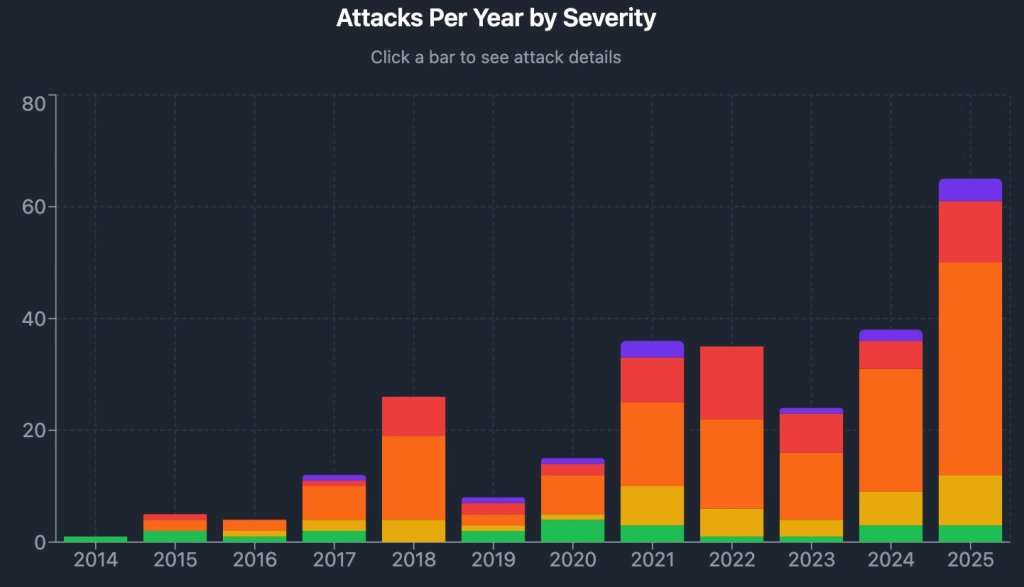
Attacks per year by severity | Source: X @hosseeb

The dashboard breaks reported incidents into five severity bands — Minor, Moderate, Serious, Severe, and Fatal and the distribution skews heavily toward the sharp end of the spectrum. Of 269 categorized incidents shown, 137 (51%) were labeled “Serious,” 57 (21%) “Severe,” and 13 (5%) “Fatal,” with the remainder split between 39 (14%) “Moderate” and 23 (9%) “Minor.”

The year-by-year bars show the later years carrying a larger share of “Severe” and “Fatal” outcomes than the early history of the dataset, with 2025 appearing as the highest-incident year on the chart.
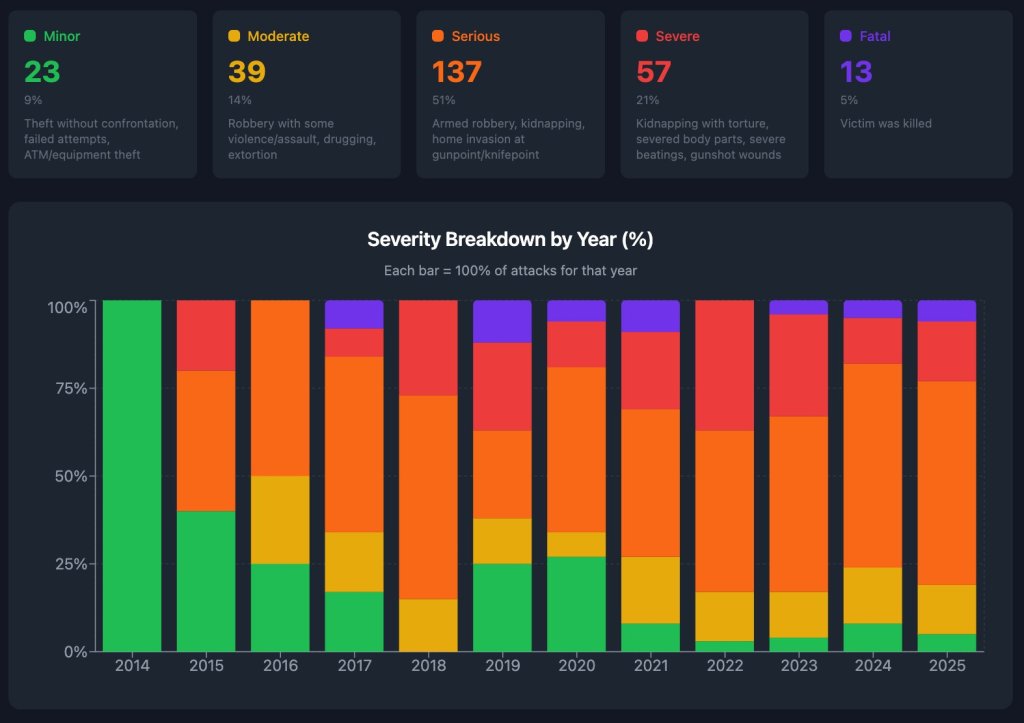
Severity breakdown by year | Source: X @hosseeb

Qureshi’s analysis also puts a number on the most intuitive driver: price. Charting incidents against total crypto market capitalization, he reported a simple regression with an R2 of 0.45 — implying roughly 45% of the variation in reported violence is explained by market cap alone. In plain terms, higher prices coincide with more attacks.

But the more consequential question for everyday holders is not raw counts; it’s risk per person. Because comprehensive “number of crypto users” data is hard to pin down, Qureshi used Coinbase monthly active users as a proxy, and separately normalized incidents by market cap to approximate attacks per dollar of wealth.

The resulting “normalized attack rates” chart tells a less linear story: per-user attack rates spiked in earlier market eras (notably around 2015 and again in 2018), then fell sharply after 2019, before ticking higher in the most recent observations. “So is that it?” Qureshi asked. “Proof crypto is becoming more physically dangerous?”
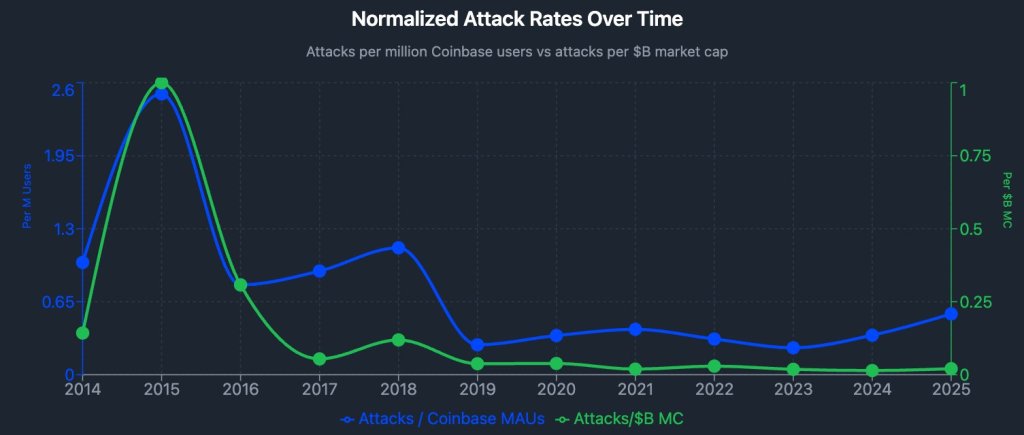
Normalized attack rate over time | Source: X @hosseeb

On his telling, not quite. Coinbase MAUs, he noted, expanded dramatically over the decade, while normalized attack rates did not rise proportionally, suggesting a meaningful “population effect” behind the higher headline totals. Still, the per-user line has moved up from its post-2019 lows, roughly back toward the levels seen during the 2021 cycle, even as the “attacks per $ of market cap” line remains comparatively flat in recent years.

Geography adds another uncomfortable layer. A regional table in the dashboard shows Western Europe (73 attacks) and North America (64) as the two largest buckets by incident count, with Asia-Pacific also substantial (53). But the most lethal outcomes cluster elsewhere: Latin America shows a 21% fatality rate and Africa 17%, versus 0% in North America. Qureshi underscored that point directly: “Notably, there have been 0 fatalities in North America ever,” he wrote, adding that the “lion’s share” of fatalities are in Latin America and Africa.
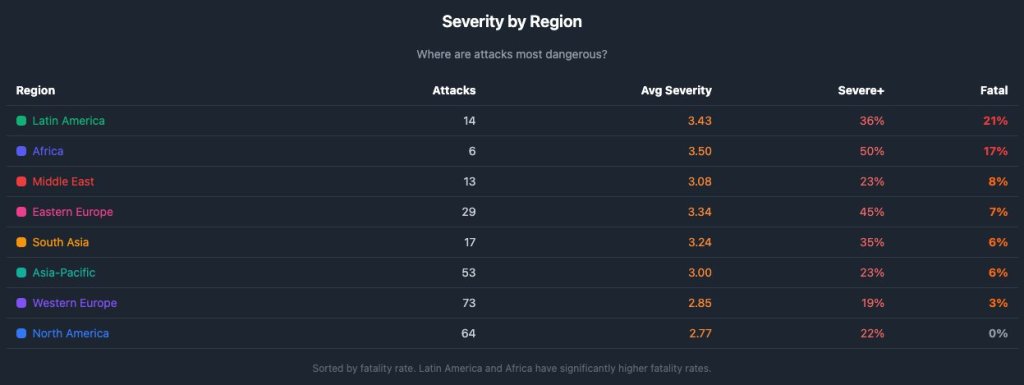
Severity by region | Source: X @hosseeb

Lopp, who has maintained the underlying “Bitcoin Wrench Attack” archive for years, has warned the workload and frequency are becoming harder to treat as isolated incidents. “When an event goes from being rare to happening every few days, it’s no longer newsworthy — it’s just a fact of life,” he wrote in a Dec. 21 post cited in the thread, while inviting others to help maintain the database.

At press time, the total crypto market cap stood at $3.12 trillion.
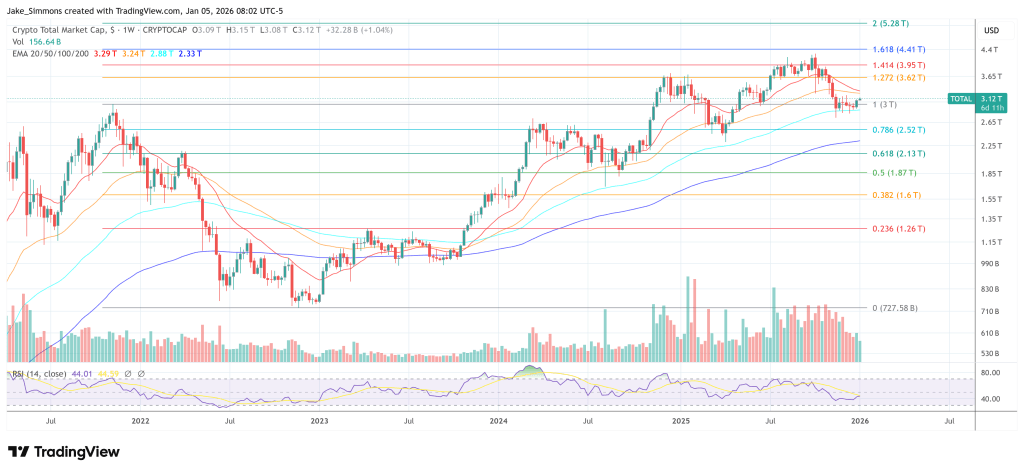
Total crypto market cap recovers above the 2021 high, 1-week chart | Source: TOTAL on TradingView.com

相关问答

QAccording to the analysis, what is the relationship between crypto market capitalization and violent attacks?

AThe analysis shows a correlation between higher crypto prices and increased attacks, with a regression R2 of 0.45 indicating that approximately 45% of the variation in reported violence is explained by market cap alone.

QWhich regions have the highest fatality rates in crypto-related attacks, according to the data?

ALatin America has a 21% fatality rate and Africa has a 17% fatality rate in crypto-related attacks, while North America has recorded 0% fatalities.

QWhat does the normalized attack rate analysis reveal about per-user risk over time?

AThe normalized attack rate shows that risk per user spiked in earlier market eras (2015 and 2018), fell sharply after 2019, but has recently ticked higher toward 2021 levels, though it didn't rise proportionally to the dramatic expansion of crypto users.

QHow are the severity of attacks distributed across the 269 incidents analyzed?

AThe severity distribution is heavily skewed toward serious outcomes: 51% were 'Serious', 21% 'Severe', 5% 'Fatal', 14% 'Moderate', and 9% 'Minor'.

QWhat trend does Jameson Lopp observe regarding the frequency of these attacks?

AJameson Lopp notes that attacks have moved from being rare events to happening every few days, making them 'no longer newsworthy' but rather 'a fact of life' in the crypto space.

你可能也喜欢

区块链用了 18 年终于开始驶向主航道

本月初,老牌加密风投机构Variant完成新基金募集,将投资主题从“数字所有权”扩展为“自主性”。这背后传递出关键信号:加密正从一个独立赛道,转变为嵌入AI、金融、社交等主流领域的底层技术范式。面对AI浪潮的冲击,加密VC给出的回应并非直接竞争,而是寻求成为AI世界的底层金融轨道。 当前,加密市场自身财富效应减弱,叙事轮动带来的回报逻辑正在失灵。加密基金不仅要与其他加密基金竞争,更要与AI、机器人等所有代表未来的增长资产竞争。这迫使越来越多加密VC主动模糊边界,如Paradigm、Haun Ventures等已将投资范围扩展至AI和前沿科技。 文章指出,AI智能体可能是加密技术实现大规模落地的关键。加密不一定要成为用户直接使用的前台应用,而可以成为AI时代机器与机器、应用与应用之间的经济结算层。AI智能体需要钱包进行支付、需要开放账户体系携带身份、需要可验证的机制建立信任——这些正是加密技术多年积累的能力。 Tether投资德国机器人公司NEURA Robotics是这一趋势的典型案例。该公司的机器人平台计划集成Tether的钱包工具,未来机器人可通过完成任务获得微支付并自主交易,这为稳定币等加密基础设施开辟了全新的高频、小额应用场景。 然而,“AI+加密”并非万能公式。许多项目只是粗暴拼接,缺乏真实需求和产品壁垒。真正有价值的结合,应满足“没有加密就无法成立,或有了加密明显更好”的条件,例如为AI智能体提供自托管钱包、为数据市场提供开放结算等。 结语认为,加密行业亟需找到新的真实需求,而非仅仅依赖新叙事。当AI智能体和机器人成为新的经济参与者时,加密技术搭建的钱包、稳定币、智能合约等基础设施,或将首次迎来高频、刚需且非投机化的巨大应用场景。

链捕手27分钟前

区块链用了 18 年终于开始驶向主航道

链捕手27分钟前

「无限增发」真的发生了吗?Zcash创始人回应市场四大疑问

6月5日,Zcash被曝其新一代隐私池Orchard曾存在关键伪造漏洞,导致其代币ZEC价格一度腰斩。经过十余天,市场情绪有所缓和,ZEC价格回升至500美元左右。Zcash创始人Zooko Wilcox发布长文,回应了市场关切的四大核心问题。 首先,关于Orchard漏洞是否曾被利用,Wilcox认为可能性不大。该漏洞由安全研究人员通过先进工具主动发现,发现后开发团队迅速协调矿池冻结了Orchard池并修复,限制了攻击窗口。历史上加密货币漏洞利用多为快速套现,目前尚无证据表明该漏洞已被利用。 其次,关于合法Orchard资金能否追回,团队认为若漏洞未被利用,所有资金应可完全追回。现有的转门机制会将从该池迁移的ZEC总量限制在合法流入的数额内。团队建议谨慎用户可将资金转移至透明池或Sapling池,但也需注意由此带来的隐私泄露或依赖可信设置等额外风险。 第三,关于用户能否验证ZEC供应量未被超发,目前尚不能。但即将进行的Ironwood升级将通过封存Orchard池来解决此问题。升级后,新资金无法进入,池内资金也无法再流通,只能通过转门机制迁出,从而恢复了用户独立验证Zcash总供应量是否健全的能力。 最后,关于是否存在其他伪造漏洞,多个团队正在持续审查,并使用了先进的AI辅助分析。截至目前尚未发现其他类似漏洞,团队对不存在更多未发现漏洞的信心正在增强。 总结而言,团队评估漏洞很可能未被利用,合法资金可追回,当前供应量安全,且未发现其他漏洞。但用户最终不应依赖他人评估,而Ironwood升级将关键性地恢复用户自行验证供应量健全性的能力。

marsbit50分钟前

「无限增发」真的发生了吗?Zcash创始人回应市场四大疑问

marsbit50分钟前

交易

现货
合约
活动图片