Author: WuBlockchain
Original Title: What Are Crypto Users Most Concerned About in 2025? Answers from 10 AI Models Vary
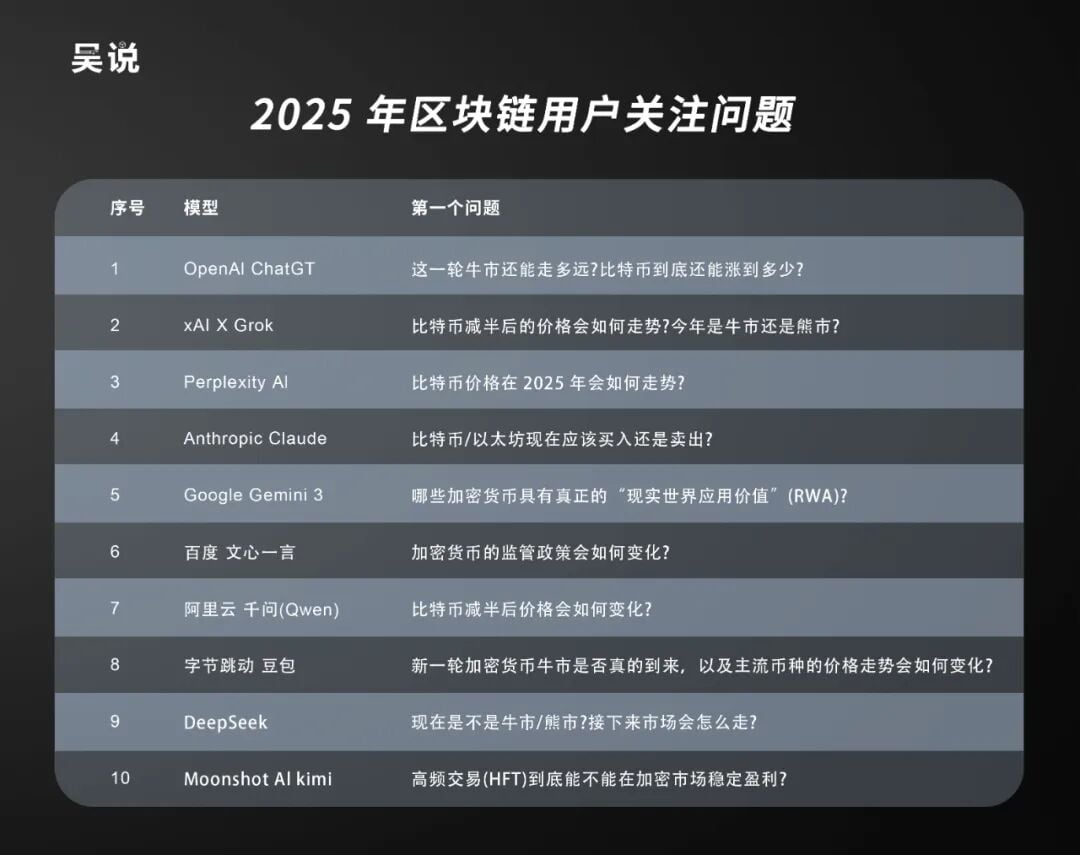
What are crypto users most concerned about in 2025? We conducted a user survey using AI models by asking the same question to different large models: "What are the three most frequently asked questions about cryptocurrencies in 2025?"
To minimize homogenized answers due to real-time retrieval and considering that large models generally cannot and are not allowed to provide verifiable statistics or disclosures of their training data, we added a note to the question: "Please do not perform real-time searches or cite specific articles; answer based solely on your understanding of long-term discussion patterns."
ChatGPT
1. How much further can this bull run go? Has Bitcoin already peaked?
2. Is there still genuine Alpha in this market cycle, and how can ordinary users make money?
3. Do current hot projects or sectors have long-term viability, or are they structurally exploitative?
X Grok
1. Is the market in a bull or bear phase after the Bitcoin halving?
2. What are the most promising crypto assets or sectors to invest in for 2025?
3. How are Ethereum spot ETFs performing, and what is the inflow of institutional funds?
Perplexity AI
1. How might Bitcoin's price evolve in 2025?
2. How to identify and avoid cryptocurrency-related scams?
3. How will ETF and regulatory developments impact the crypto market?
Claude
1. Is now the right time to buy or sell Bitcoin or Ethereum?
2. Is a particular crypto project a scam, and is it trustworthy?
3. How should new users start investing in cryptocurrencies and manage risks?
Gemini 3
1. Which crypto projects have real-world application value (RWA)?
2. How will current and future regulatory policies affect personal asset security?
3. Among Ethereum L2, Solana, and AI+Crypto, which technological path is likely to emerge as the ultimate winner?
DeepSeek
1. Is the current market in a bull or bear phase?
2. Which crypto sectors or assets show the most potential in 2025?
3. How will changes in regulatory policies impact asset security and investment decisions?
Douban
1. Has a new cryptocurrency bull market arrived?
2. How will changes in regulatory policies across countries affect ordinary investors?
3. What does the Bitcoin halving trend mean for retail investment strategies?
Qianwen
1. How will Bitcoin's price trend evolve after the halving?
2. Have Ethereum and mainstream public chains achieved substantive breakthroughs in practical applications?
3. How will regulatory policies in various countries affect the legitimate use of cryptocurrencies?
Wenxin Yiyan
1. How will global cryptocurrency regulatory policies change?
2. Do Bitcoin and mainstream crypto assets have long-term investment value?
3. Can real-world application scenarios for cryptocurrencies truly be realized?
Kimi
1. Can retail investors achieve stable profits through high-frequency trading in the crypto market?
2. What is the safest way to store private keys and wallet assets?
3. How should slippage be set in on-chain transactions to avoid MEV losses?
Summary
The reason these models provide slightly different "top three questions" may relate to their respective positioning and contexts. ChatGPT seems to adopt a trader's perspective, framing the discussion as a structured chain of anxieties: "How much longer will the cycle last — Is Alpha still available — Is there structural exploitation?" Grok aligns more with social media hotspots, focusing on narratives like halving, bull/bear markets, and ETF fund flows. Perplexity's style resembles a retrieval-based summary, concentrating on price trends, scam prevention, and ETF/regulatory progress. Claude is more cautious, emphasizing timing for buying/selling, project trustworthiness, and risk management for newcomers. Gemini leans more toward industry and technological routes, focusing on RWA, regulatory impacts on asset security, and the "final choice" among L2/Solana/AI. Chinese models overall focus more on cycles, halving, and regulation—the "most hardcore deterministic variables." Kimi is an exception, delving into on-chain execution details (wallet security, slippage/MEV, HFT), resembling real friction points from high-frequency on-chain users.
Another minor but noteworthy possibility is that model capability differences also affect the "sharpness" of outputs. More capable models tend to frame the same topic more specifically and systematically; conversely, weaker models are more likely to fall back on "price/regulation/scams"—these broad, common expressions—making answers appear more similar and offering less incremental information. This factor may not be the main cause, but in macro open-ended questions, it could amplify the perception of homogeneity.
Overall, these questions highly concentrate on three core themes: cycle positioning, profit pathways, and risk boundaries. The crypto market's notable features are high volatility and strong narrative drive, so "which phase of the bull/bear market are we in?" almost determines all subsequent user actions (holding, selling, switching positions, leveraging, or exiting). As the market matures and becomes more crowded, users quickly shift from "is there an opportunity?" to "where is the opportunity, and can I still capture it?" Thus, Alpha, sector selection, and institutional funds (ETFs) naturally become high-frequency topics. Meanwhile, scams, project credibility, asset security, and regulatory compliance reflect that crypto users are long situated in a "high-reward/high-uncertainty" environment: chasing returns while fearing pitfalls, ultimately forming a typical behavioral structure—first assess the trend, then seek opportunities, and finally control risks.
Twitter:https://twitter.com/BitpushNewsCN
Bitpush TG Discussion Group:https://t.me/BitPushCommunity
Bitpush TG Subscription: https://t.me/bitpush