The 'Big Short' Burry: Now is an Excellent Time to Bottom-Fish in Hong Kong Stocks

marsbit发布于2026-07-17更新于2026-07-17

文章摘要

The article discusses growing optimism towards Hong Kong stocks, led by prominent investor Michael Burry of "The Big Short" fame. Burry recently stated it is an "excellent time" to find cheap stocks in the Hong Kong market. His bullish view is based on the prediction that as the global AI chip stock frenzy cools, capital will flow out of markets like South Korea and Japan and seek undervalued opportunities, positioning Hong Kong as a potential beneficiary. Supporting this view, Goldman Sachs' Asia equity capital markets head, Wang Yajun, argues the Hong Kong market has already entered the AI era, but major indices have not yet reflected this reality. He points to active AI-related IPOs and transactions as evidence of underlying market vitality, contrasting with the weak performance of key indices like the Hang Seng. Data highlights Hong Kong's underperformance: the Hang Seng Index is down about 7% year-to-date, while markets in South Korea and Japan and semiconductor ETFs have seen significant gains. This disparity is seen by Burry and others as creating a valuation gap and a potential buying opportunity. The article notes Burry has acted on his view by increasing holdings in Chinese e-commerce firm JD.com. Morgan Stanley has also recently advocated buying Hong Kong stocks, citing positive corporate earnings expectations. However, challenges remain, including persistent concerns over Chinese consumer spending and e-commerce profitability, which continue to weigh on the ma...

Author: Zhao Ying

A battle between bulls and bears, epitomized by Michael Burry, is playing out in the Hong Kong stock market, with bullish sentiment steadily gathering.

Investor Michael Burry, who gained fame for accurately predicting the 2008 U.S. subprime mortgage crisis and served as the prototype for the film 'The Big Short,' recently stated publicly that now is an 'excellent time' to look for cheap stocks in the Hong Kong market. His bullish logic is based on the expectation that the global AI chip stock frenzy will cool down, leading capital to flow out of South Korea, Japan, and the semiconductor sector in search of undervalued opportunities.

Simultaneously, Wang Yajun, Head of Asia (ex-Japan) Equity Capital Markets at Goldman Sachs, also noted that the Hong Kong market has in fact entered the AI era, though this reality is not yet reflected in the major indices.

Both perspectives point to the same conclusion from different angles: there is a significant divergence between Hong Kong stocks' current weak performance and the underlying vitality within the market. This divergence itself may constitute an investment opportunity. For investors seeking value, the attractiveness of Hong Kong stocks is on the rise.

Burry Bullish on HK Stocks: A Value Play Post-AI Frenzy

Michael Burry, founder of Scion Asset Management, posted on X on July 17, stating, 'It is an excellent time to look for cheap stocks in Hong Kong. They should do well as the shine comes off Korea, Japan, and SOXX (a semiconductor ETF).'

Burry's statement has its market context. Global chip stocks have recently faced massive sell-offs, as doubts persist about whether AI companies can translate technological investments into actual profits. Coupled with high capital expenditure pressures, this has weighed on the semiconductor sector, which previously led global gains. In contrast, Hong Kong stocks' decline this year has made their valuations relatively more attractive.

Notably, Burry had already taken action earlier this month. According to Bloomberg, he increased his stake in Chinese e-commerce giant JD.com and opened new positions in DraftKings and Flutter, indicating his bullish stance on Hong Kong stocks and related Chinese tech stocks is not merely verbal.

Hong Kong Stocks Lag Far Behind Global Major Markets This Year

The relative weakness of Hong Kong stocks is clear from the data. The Hang Seng Index has fallen about 7% year-to-date, and the Hang Seng Tech Index has dropped even more deeply by 15.22%. Major drags include weak consumer spending and insufficient market confidence in the outlook for China's e-commerce industry.
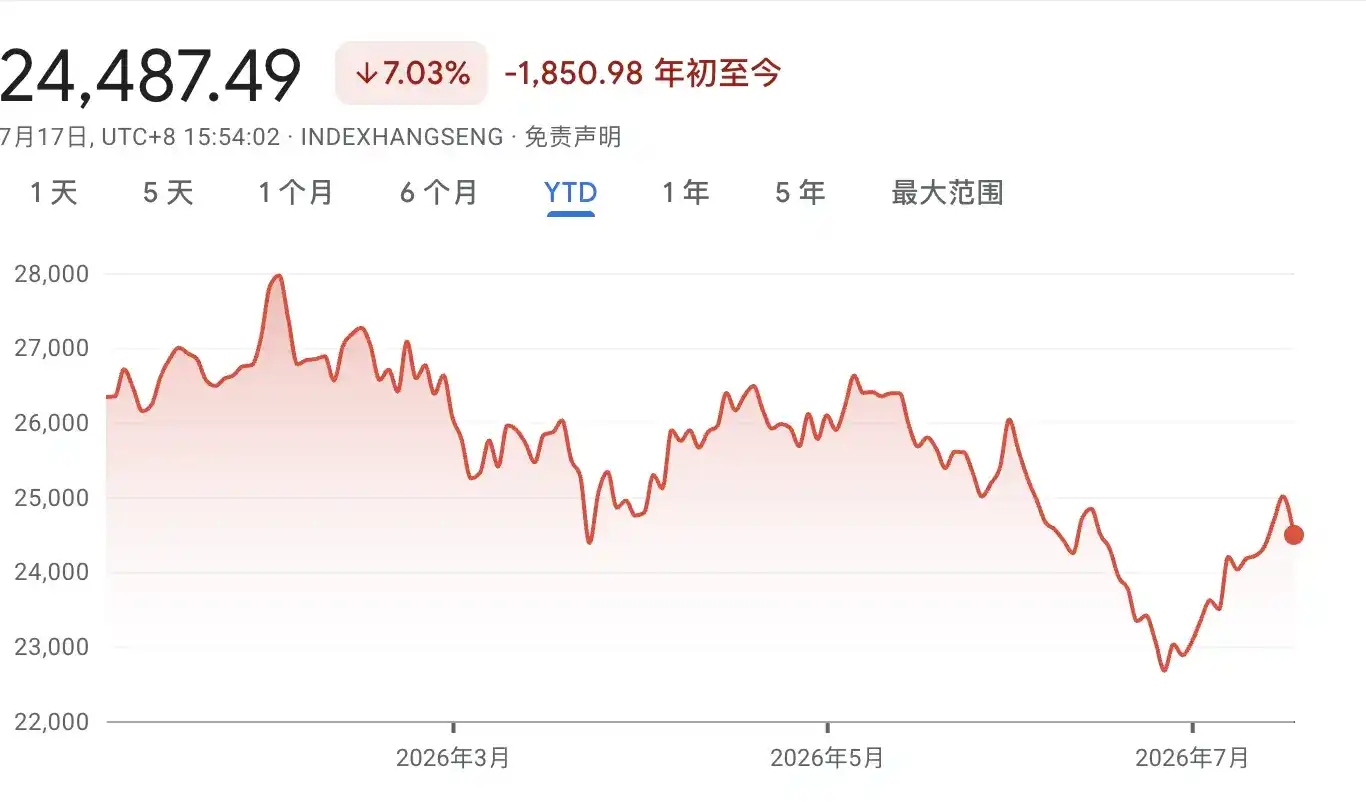
This stands in stark contrast to the strong performance of other major global markets. According to Bloomberg data, South Korea's benchmark index has surged 62% year-to-date, benefiting from the robust performance of two major chip giants; Japan's Nikkei 225 has risen 26%; and the iShares SOXX ETF tracking the semiconductor sector has skyrocketed 76%.

It is precisely this significant underperformance that leads Burry to believe Hong Kong stocks present a 'bargain-hunting' condition—when global capital begins to reassess the sustainability of the AI frenzy, previously overlooked Hong Kong stocks may usher in a catch-up opportunity.

Goldman Sachs: Index Distortion, HK Market Already in AI Era

Goldman Sachs' perspective offers another dimension of interpretation—the sluggishness of Hong Kong stocks is, to some extent, a 'false impression' caused by the structural lag of the indices.

Wang Yajun, Goldman Sachs' Head of Asia (ex-Japan) Equity Capital Markets, bluntly stated at a recent media briefing, the Hong Kong market has entered the AI era, but the major stock indices have not yet been able to reflect this reality. This is the fundamental reason for the 'hot IPO market vs. weak index performance' dichotomy.

Wang pointed out that the hottest topic in the Hong Kong stock market this year is AI. The most actively traded, best performing, and largest fundraising stocks are all AI-related. However, adjustments to index components take a relatively long time, leading to a mismatch between the indices and the true market landscape. He expects total equity financing volume in the Hong Kong market this year could hit a record high, with full-year IPO proceeds potentially surpassing the historical peak of 2021. More AI companies are also expected to list in Hong Kong in the second half of the year.

Regarding fundamental judgment, Wang believes that supported by end-demand growth, capital expenditure by AI companies will continue, providing a basis for the long-term performance of related sectors.

Multiple Bullish Voices Converge, Divergence Remains

Burry is not alone. According to Bloomberg, Morgan Stanley recently also urged investors to buy Hong Kong stocks, citing optimism about corporate earnings prospects and the belief that the impact of restricted share sales will be relatively limited.

However, the bullish logic for Hong Kong stocks is not without challenges. The Hang Seng Index's decline this year reflects persistent market concerns about the pace of China's consumption recovery and the profitability of the e-commerce sector. These structural pressures are difficult to dissipate completely in the short term. The 'index-market mismatch' described by Goldman's Wang also means that ordinary investors, referencing only the indices, may both underestimate the structural opportunities within Hong Kong stocks and overlook the pressures still facing traditional heavyweights.

For investors, Burry's bottom-fishing signal and Goldman's AI narrative together sketch a picture of opportunity for Hong Kong stocks. Yet, the core challenge facing the market remains how to precisely position between overall index pressure and structural bright spots.


相关问答

QWhy does Michael Burry believe that now is a 'great time' to look for bargains in the Hong Kong stock market?

AMichael Burry believes it's a great time to look for bargains in Hong Kong stocks because he anticipates a cooling off of the global AI chip stock frenzy, which would cause capital to flow out of markets like South Korea and Japan and out of semiconductor sectors. This shift would make the currently underperforming and more attractively valued Hong Kong market a potential destination for that capital.

QWhat supporting action has Michael Burry taken regarding his bullish view on Hong Kong/Chinese stocks?

AAccording to Bloomberg, Michael Burry has taken action by increasing his holdings in the Chinese e-commerce company JD.com and establishing new positions in DraftKings and Flutter, indicating his view extends beyond just verbal statements.

QHow has the performance of the Hong Kong stock market compared to other major global markets in 2024, according to the article?

AThe Hong Kong stock market has significantly underperformed other major global markets in 2024. The Hang Seng Index is down about 7% and the Hang Seng Tech Index is down over 15%. In contrast, South Korea's benchmark index is up 62%, Japan's Nikkei 225 is up 26%, and the iShares Semiconductor ETF (SOXX) has surged 76%.

QWhat is Goldman Sachs' Wang Yajun's argument regarding the perceived disconnect between Hong Kong's market activity and its main stock indices?

AGoldman Sachs' Wang Yajun argues that while the Hong Kong market has already entered the AI era, its main stock indices have not yet reflected this reality. He states that AI-related stocks are the most active, best-performing, and largest in fundraising, but index composition lags, creating a mismatch between the index performance and the market's true dynamism.

QAccording to the article, what are some of the key challenges or risks that remain for the Hong Kong stock market despite the bullish views presented?

AKey challenges include persistent concerns about the pace of China's consumption recovery and the profitability of the e-commerce sector, which have weighed on the market. Additionally, the 'mismatch' between index performance and market reality means that while there are structural opportunities in AI, traditional heavyweights in the index may continue to face pressure.

你可能也喜欢

微策公司股票MSTR暴跌79%——若STRC重启,看涨期权会否变成“武器”?

迈克尔·赛勒旗下的微策略公司(MSTR)股价在过去一年中暴跌79.17%,近期交易于94.03美元。股价下跌源于公司从激进的比特币积累转向防御性的资本管理策略。 微策略在近期出售了约3620枚比特币,仅占其持有总量(843,775枚BTC)的0.43%,表明其目的更多是流动性管理而非退出比特币。同时,公司通过市场增发(ATM)出售了482万股MSTR股票,筹集约4.667亿美元,并将用于支付债务利息和优先股股息的美元储备从14.4亿美元大幅增加至30亿美元,暂时停止了比特币购买。 公司将其优先股(STRC)的年度股息率提高至12%,并将股息支付覆盖时间从约14个月延长至约29个月。分析师指出,公司面临的关键决策在于何时重启比特币购买,以及在下一轮牛市中是否会出售部分持仓以锁定利润,而非坚持长期持有策略。 尽管比特币批评者彼得·希夫借此抨击微策略的投资逻辑,但也有支持者如亚当·利文斯顿认为,如果微策略能重新通过发行STRC优先股(而非增发MSTR普通股)来筹集资金购买比特币,将可能提升每股比特币价值,从而使MSTR的看涨期权成为一种高潜在回报的“武器”。 最后,文章总结道,微策略仅出售了少量比特币并大幅增加了现金储备,未来STRC融资可能重启比特币购买,但MSTR股权稀释风险仍是核心股东关切。

ambcrypto38分钟前

微策公司股票MSTR暴跌79%——若STRC重启,看涨期权会否变成“武器”?

ambcrypto38分钟前

WEEX 2026世界杯攻略手册:数据智能、预测洞察与百万社区奖励

WEEX交易所在2026年世界杯期间,为其社区推出了名为“WEEX杯”的系列活动,结合数据洞察、游戏化互动与行业观点,帮助用户在赛事中发现价值。 **数据驱动的赛事指南**:WEEX与Solana链上预测市场ForeGate合作,发布《ForeGate 2026世界杯获胜指南》。这份动态报告将足球赛事视作市场,实时追踪各队晋级概率、潜在对阵与夺冠路径,让用户能基于动态数据而非猜测做出判断。 **百万奖池的互动游戏**:WEEX同步推出了“Dice Rush”游戏,设置总价值**100万美元**的奖池。用户通过完成存款、交易等任务获得骰子,掷骰前进可赢取BTC、ETH等奖励,积累积分还可参与冠军球队预测,与预测正确的所有用户分享奖池。活动已吸引超10万用户参与,发放奖励超百万美元。 **传奇球星的先见之明**:在开赛前,WEEX首席运营官Andrew Weiner采访了足球传奇迈克尔·欧文。欧文指出,当你的观点属于少数派时,往往潜藏着最大价值,并预言48支球队的新赛制将催生惊喜。随后,首次参赛、世界排名70开外的**佛得角**队用表现印证了这一观点:他们小组赛三场平局出线,并在十六强赛中常规时间1-1逼平卫冕冠军阿根廷,成为本届赛事最大黑马。 **核心理念**:WEEX通过这三项举措传递了一个统一理念:无论是在足球还是市场中,最佳价值往往不在众人瞩目之处。WEEX致力于为用户提供工具,帮助他们在赛事中洞察先机。 *免责声明:本文内容与FIFA或任何官方足球管理机构无关联、赞助或认可。*

TheNewsCrypto51分钟前

WEEX 2026世界杯攻略手册:数据智能、预测洞察与百万社区奖励

TheNewsCrypto51分钟前

矿企股离加密越来越远了

近期比特币矿企股与加密货币市场呈现明显脱钩。尽管近一年BTC价格下跌46.12%,但多家主要矿企股价逆势大涨,如HUT上涨363.26%。推动股价上涨的核心因素已非传统的币价、产量或算力,而是矿企向AI基础设施转型的叙事。 矿企拥有现成的电力容量、土地和运维体系,恰好能满足AI数据中心对快速部署的急切需求。例如,CleanSpark签署了价值约66亿美元的20年基础设施租约,TeraWulf计划融资35亿美元扩建数据中心。市场开始按照AI基建逻辑对其估值,其股价波动也与半导体等科技板块关联性增强。 然而,这种估值重塑伴随三层风险:一是估值受整体AI叙事波动影响;二是转型项目的实际回报率存在不确定性,行业基线回报率较低;三是未来收入依赖长期合同的顺利执行,面临融资、监管许可和租户质量等挑战。 与此同时,矿工行为模式也在改变。为了筹集转型所需资金,上市矿企大幅增加比特币抛售,卖币逻辑从维持运营现金流转向为AI建设融资。部分退出网络的算力及其背后的电力资源,可能因长期AI合约而被锁定,难以回流比特币挖矿。 综上所述,资本市场正在按照矿企脱离纯挖矿框架、向AI基础设施服务商转型的前景进行定价。虽然它们仍参与比特币网络,但对电力、土地和长期合同的追逐,正使其业务本质逐渐远离纯粹的加密矿业。

链捕手1小时前

矿企股离加密越来越远了

链捕手1小时前

交易

现货
活动图片