Stablecoins are leaving exchanges – and traders aren’t buying the dip

ambcrypto发布于2025-12-23更新于2025-12-23

文章摘要

Stablecoins are being withdrawn from cryptocurrency exchanges at the fastest rate in the current market cycle, signaling a sharp decline in short-term risk appetite among traders. Despite a growing overall stablecoin supply—largely backed by U.S. Treasuries—investors are choosing to hold capital off exchanges rather than deploy it during the market downturn. This cautious behavior is evident in the significant outflows from major exchanges like Binance, which saw nearly $1.9 billion in net outflows over 30 days. While Bitcoin has corrected roughly 36% from its October highs, traders have been unwinding leverage, with open interest falling more than 40%. However, stablecoins aren't exiting the crypto ecosystem entirely. Instead, they are migrating to safer blockchain networks like TON, Ethereum, and Polygon, while trading-focused chains such as Solana and Tron experience outflows. The shift reflects a defensive strategy: investors are prioritizing safety and yield offered by stablecoins—which function like low-risk money market instruments—over exposure to volatile assets. This trend is likely to persist until market confidence returns.

Stablecoins are moving off crypto exchanges at the fastest pace this cycle. Instead of putting capital to work, investors are choosing to wait.

This is happening even as stablecoin supply continues to grow, backed largely by U.S. Treasuries. Everyone’s staying liquid, but holding back until market conditions improve.

Traders take a step back

The speed at which stablecoins are being pulled has caused a drop in short-term risk appetite.

While Bitcoin’s correction fell further (now down roughly 36% from its early October highs), traders have been unwinding leverage. OI has fallen more than 40%.

Source: CryptoQuant

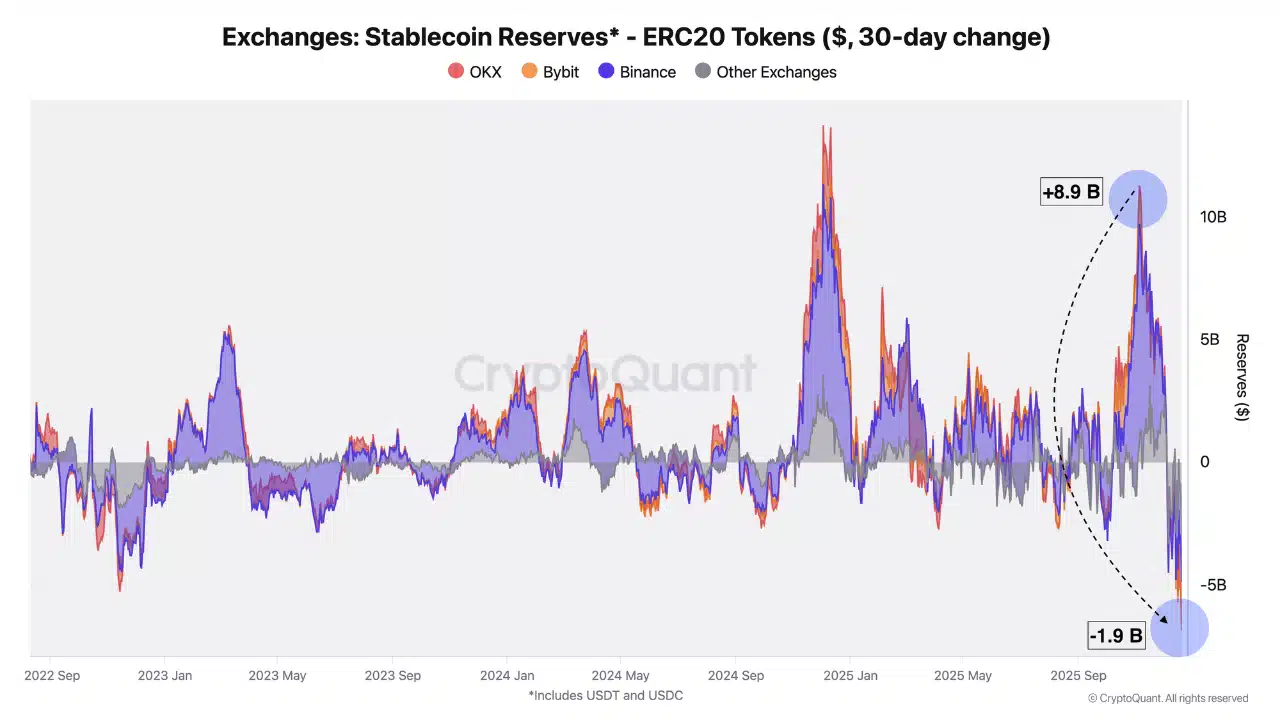
December was the steepest decline in ERC-20 stablecoin reserves across major exchanges in this cycle. These tokens are usually on exchanges ready to be deployed.

This time, they are being pulled out instead. The change is easily visible on Binance, where an inflow trend flipped into nearly $1.9 billion in net outflows over 30 days. This is an obviously cautious move.

Stablecoins aren’t quitting crypto altogether though

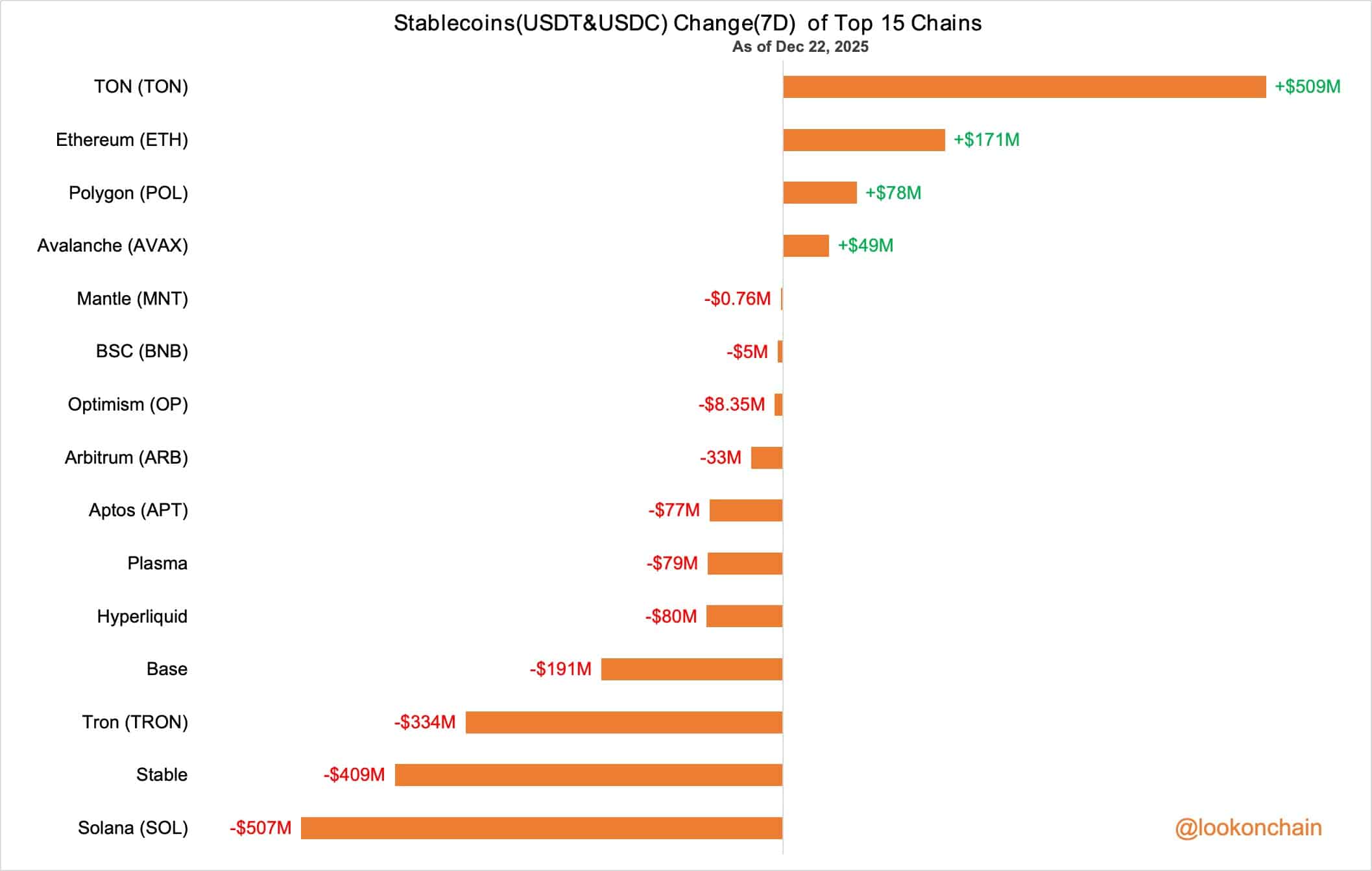
They are simply shifting across networks instead of being on exchanges. Over the past week, total stablecoin supply still grew by about $509 million.

Source: Lookonchain

The biggest inflows were seen on TON, which added over $500 million, followed by Ethereum and Polygon. In contrast, networks tied more closely to trading activity, such as Solana and Tron, saw large outflows.

Investors aren’t taking any new risks, and are simply waiting for clear signs before committing.

Defensive, not disappearing

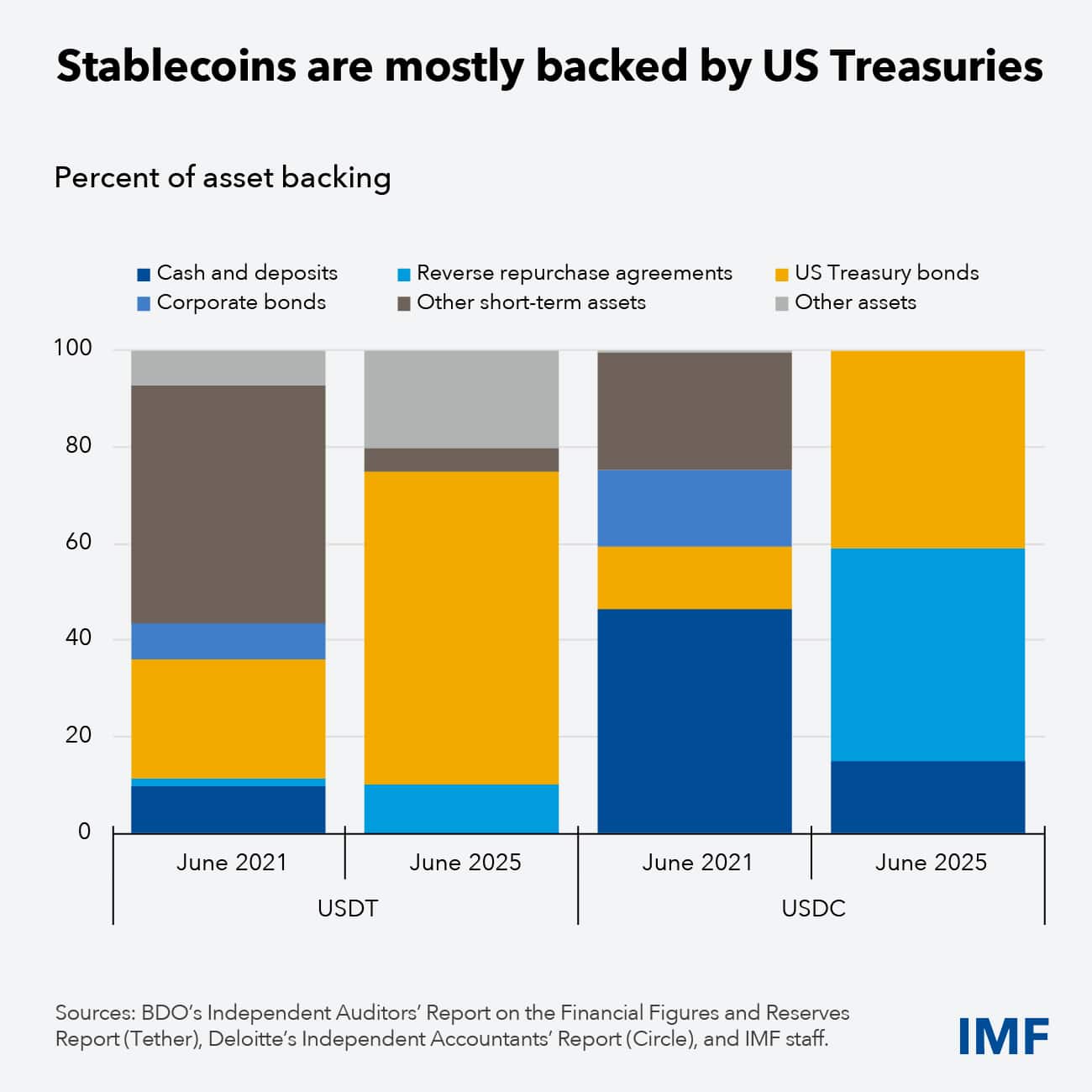
Today, most major stablecoins are backed largely by U.S. Treasuries and other short-term government assets, making them more or less low-risk money market instruments.

Source: IMF

This explains why capital is staying in stablecoins even as it leaves exchanges. Investors are choosing safety and yield over chaos. Until confidence returns, this defensive positioning is likely to persist.


Final Thoughts

  • Stablecoins are leaving exchanges at record speed as traders cut risk.
  • Capital is on safer chains until confidence returns.
Next: Solana: Short-term pain, long-term hope? SOL faces liquidation test
Share
  • Share
  • Tweet

相关问答

QWhat is the main trend observed with stablecoins on crypto exchanges in the current cycle?

AStablecoins are moving off crypto exchanges at the fastest pace this cycle, with investors choosing to hold liquid assets rather than deploying capital.

QHow has the withdrawal of stablecoins affected market activity and trader behavior?

AThe rapid withdrawal of stablecoins has caused a drop in short-term risk appetite, leading traders to unwind leverage, with open interest falling more than 40%.

QWhich blockchain networks saw the largest inflows of stablecoins, and what does this indicate?

ATON saw the largest inflows, adding over $500 million, followed by Ethereum and Polygon, indicating a shift to safer chains rather than those tied to active trading like Solana and Tron.

QWhy are investors choosing to hold stablecoins even as they leave exchanges?

AInvestors are opting for safety and yield, as stablecoins are largely backed by U.S. Treasuries and short-term government assets, making them low-risk money market instruments.

QWhat was notable about Binance's stablecoin flows in December?

ABinance experienced a significant shift from inflows to nearly $1.9 billion in net outflows over 30 days, reflecting a cautious move by investors.

你可能也喜欢

Arbitrum 假装成黑客,把 KelpDAO 损失的钱“偷”回来了

Arbitrum安全理事会近日采取非常规手段,成功追回了KelpDAO被盗资金中滞留在其链上的约7000万美元ETH。该事件源于上周KelpDAO遭遇的黑客攻击,总损失达2.92亿美元,被认为是今年DeFi领域最大安全事件之一。 被盗资金部分留在Arbitrum链上,黑客地址中的ETH被转移至一个看似黑洞的0x0000...地址。实际上,这是Arbitrum安全理事会通过紧急升级跨链桥Inbox合约,新增了一个无需私钥即可模拟任意地址发起交易的功能。他们以此冒充黑客身份,将资金转入冻结地址。整个操作在一次交易中完成,随后合约立即恢复原状。 据公告,安全理事会在行动前已与执法部门确认黑客身份为朝鲜的Lazarus组织,并经过技术评估确保不影响其他用户。该操作需12名理事会成员中9人签署批准,无需经过DAO治理投票。 社区反应两极:一方赞扬Arbitrum果断护产,另一方则质疑其中心化风险——9人多签即可临时升级核心合约、模拟任意用户操作。但事实上,主流L2普遍设有类似安全机制。 此次事件反映出DeFi安全攻防已进入新阶段:国家级黑客持续升级攻击手段,而链平台开始动用底层权限反击。尽管追回部分资金,但KelpDAO仍有超2亿美元资产流失于其他链上,Aave坏账未解,整体恢复仍面临挑战。

marsbit1分钟前

Arbitrum 假装成黑客,把 KelpDAO 损失的钱“偷”回来了

marsbit1分钟前

交易

现货
合约

热门文章

如何购买T

欢迎来到HTX.com!我们已经让购买Threshold Network Token(T)变得简单而便捷。跟随我们的逐步指南,放心开始您的加密货币之旅。第一步:创建您的HTX账户使用您的电子邮件、手机号码注册一个免费账户在HTX上。体验无忧的注册过程并解锁所有平台功能。立即注册第二步:前往买币页面,选择您的支付方式信用卡/借记卡购买:使用您的Visa或Mastercard即时购买Threshold Network Token(T)。余额购买:使用您HTX账户余额中的资金进行无缝交易。第三方购买:探索诸如Google Pay或Apple Pay等流行支付方法以增加便利性。C2C购买:在HTX平台上直接与其他用户交易。HTX场外交易台(OTC)购买:为大量交易者提供个性化服务和竞争性汇率。第三步:存储您的Threshold Network Token(T)购买完您的Threshold Network Token(T)后,将其存储在您的HTX账户钱包中。您也可以通过区块链转账将其发送到其他地方或者用于交易其他加密货币。第四步:交易Threshold Network Token(T)在HTX的现货市场轻松交易Threshold Network Token(T)。访问您的账户,选择您的交易对,执行您的交易,并实时监控。HTX为初学者和经验丰富的交易者提供了友好的用户体验。

1.1k人学过发布于 2024.07.04更新于 2025.03.21

如何购买T

相关讨论

欢迎来到HTX社区。在这里,您可以了解最新的平台发展动态并获得专业的市场意见。以下是用户对T(T)币价的意见。

活动图片