Solana co-founder Anatoly Yakovenko and several accounts tied to the network’s ecosystem said this week that Solana has been hit by a large distributed denial-of-service attack, with some posts citing traffic that peaked near six terabits per second (Tbps).
Yakovenko wrote in a Dec. 9 X post that Solana was under a six Tbps distributed denial-of-service (DDoS) attack. Earlier today, Solana Labs co-founder and president Raj Gokal suggested the attack was still ongoing. Cointelegraph was unable to independently verify the attack or its scale.
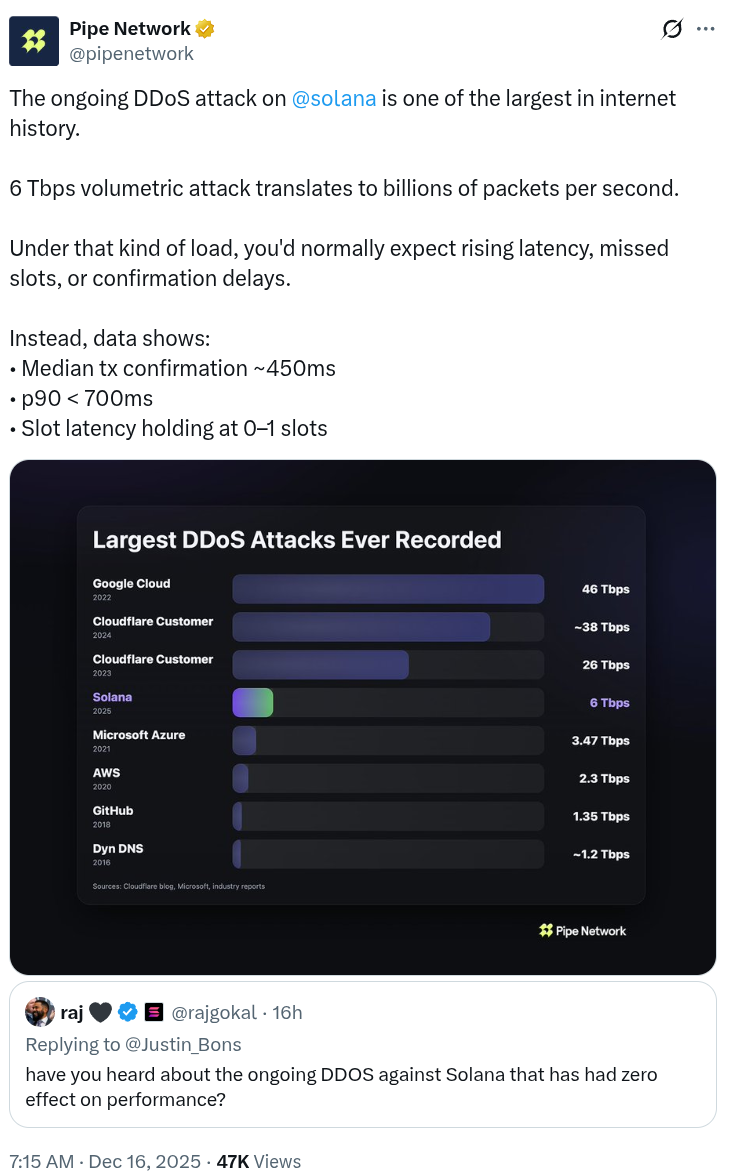
On Monday, the CEO of Solana-based decentralized physical infrastructure network (DePIN) project Pipe Network, David Rhodus, pointed out that the shared metric puts the attack at an “industrial-scale.” In a Monday update, Pipe Petwork also claims that the attack is “one of the largest in internet history” since six Tbps “translates to billions of packets per second.”
A “bullish” attack, co-founder says
A DDoS attack involves many devices flooding a target with traffic to overwhelm it and knock it offline or slow it down. A chart shared by Pipe Network suggests that Solana has faced the fourth-largest DDoS attack ever reported. Still, in 2025 alone, Cloudflare reported a 29.7 Tbps attack, KrebsOnSecurity reported a 6.3 Tbps attack, and Gcore disclosed a six Tbps attack, with none appearing on Pipe Network’s chart.
Yakovenko wrote in a Dec. 9 post that the attack is bullish, also suggesting that “someone is spending as much as the chain makes in revenue to send it.” Similarly, Pipe Network highlights that “under that kind of load, you’d normally expect rising latency, missed slots, or confirmation delays” while the network is not showing any significant signs of stress.
Solana Labs had not answered Cointelegraph’s request for comment by publication.
Related: Coinbase fixes Solana transaction backlog after 48-hour delay
Solana outage history and fixes
Solana has a history of multiple downtimes, some of which are tied to DDoS-like causes. In December 2020, a block propagation bug halted the network operation. Back in September 2021, Solana’s mainnet saw a 17-hour downtime as Grape Protocol’s launch of its onchain initial DEX offering (IDO) on the crowdfunding platform Raydium AcceleRaytor overwhelmed the network, much like a DDoS would.
In 2022, Solana saw three downtime instances. First, it experienced seven hours of downtime due to transaction spam from bot accounts, then the network saw four and a half hours of downtime due to a bug that caused a consensus failure. Again in 2022, Solana experienced 8.5 hours of downtime due to a bug in the fork choice rules, resulting in consensus failure.
This is where the network stability seemed to pick up slightly. Cointelegraph was able to locate only one instance of downtime in 2023, when, in late February, a fault in Solana’s deduplication logic led to almost 19 hours of downtime. In 2024, the network again saw only one downtime instance when it went down for nearly five hours due to a bug causing an infinite recompile loop.
Related: Solana users hit by delays after Trump memecoins debut
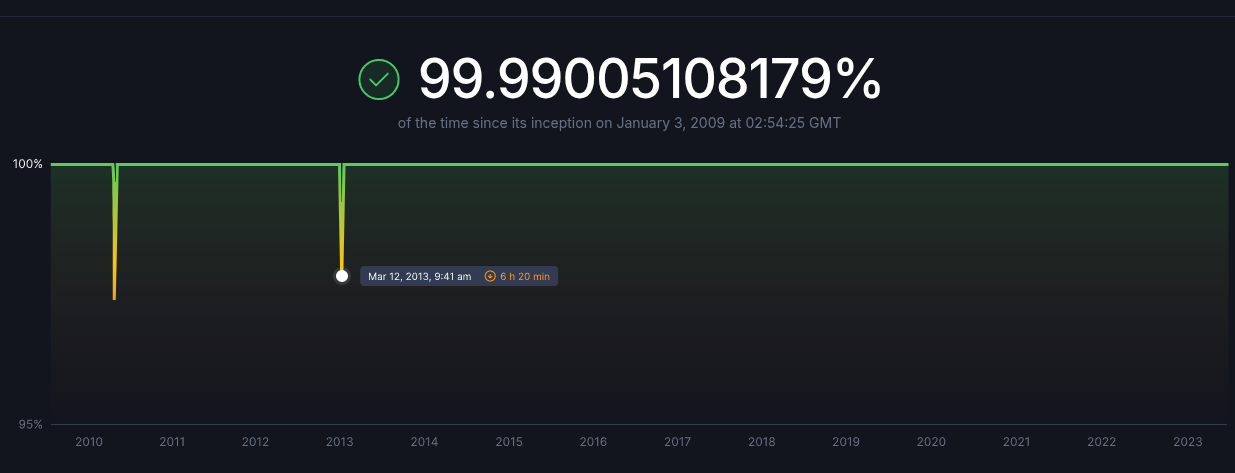
Despite the clear downtrend, this is a lot of downtime for blockchain standards. Bitcoin (BTC), the world’s first blockchain, currently has an uptime of over 99.99%, with the last downtime incident taking place in 2013.
Bitcoin has seen only two downtime incidents since its first block was mined in January 2009. The first one took place in August 2010, when a value-overflow bug was exploited, briefly creating nearly 184.47 billion BTC until a patch reversed the issue. The second one happened in March 2013, when a bug split the network between Bitcoin Core 0.7 and 0.8. The 2013 event did not create new Bitcoin.