Solana under ‘industrial scale’ DDoS attack: Co-founder says it’s ‘bullish’

cointelegraph发布于2025-12-16更新于2025-12-16

文章摘要

Solana has been hit by a large-scale distributed denial-of-service (DDoS) attack, with traffic reportedly peaking near six terabits per second (Tbps), as stated by co-founder Anatoly Yakovenko and others in the ecosystem. Yakovenko described the attack as "bullish," suggesting that the attacker spent as much as the chain generates in revenue. Despite the massive scale, the network reportedly showed no significant signs of stress, such as latency or delays. This is not the first time Solana has faced such issues; the network has a history of downtimes, including several in 2022 due to bugs and transaction overloads. However, downtime incidents have decreased in recent years. In comparison, Bitcoin has maintained over 99.99% uptime, with only two major downtime events since 2009. The article highlights Solana’s ongoing challenges with stability despite improvements, contrasting its performance with Bitcoin’s reliability.

Solana co-founder Anatoly Yakovenko and several accounts tied to the network’s ecosystem said this week that Solana has been hit by a large distributed denial-of-service attack, with some posts citing traffic that peaked near six terabits per second (Tbps).

Yakovenko wrote in a Dec. 9 X post that Solana was under a six Tbps distributed denial-of-service (DDoS) attack. Earlier today, Solana Labs co-founder and president Raj Gokal suggested the attack was still ongoing. Cointelegraph was unable to independently verify the attack or its scale.

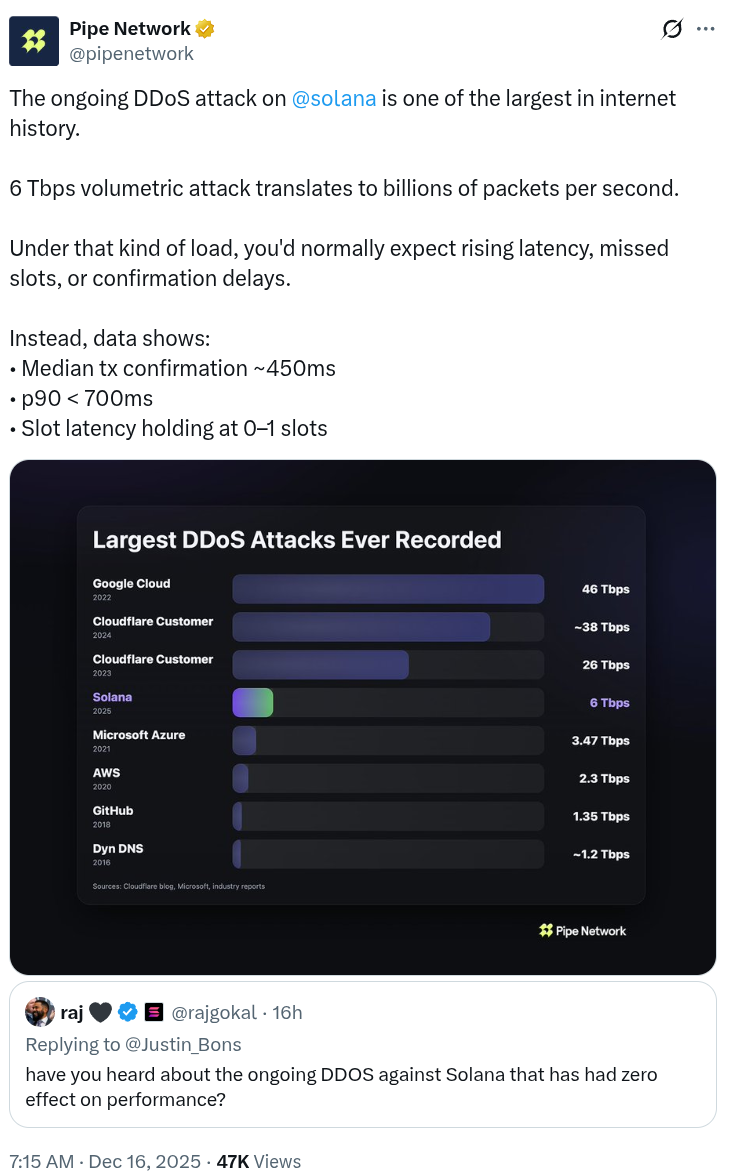
On Monday, the CEO of Solana-based decentralized physical infrastructure network (DePIN) project Pipe Network, David Rhodus, pointed out that the shared metric puts the attack at an “industrial-scale.” In a Monday update, Pipe Petwork also claims that the attack is “one of the largest in internet history” since six Tbps “translates to billions of packets per second.”

A “bullish” attack, co-founder says

A DDoS attack involves many devices flooding a target with traffic to overwhelm it and knock it offline or slow it down. A chart shared by Pipe Network suggests that Solana has faced the fourth-largest DDoS attack ever reported. Still, in 2025 alone, Cloudflare reported a 29.7 Tbps attack, KrebsOnSecurity reported a 6.3 Tbps attack, and Gcore disclosed a six Tbps attack, with none appearing on Pipe Network’s chart.

Yakovenko wrote in a Dec. 9 post that the attack is bullish, also suggesting that “someone is spending as much as the chain makes in revenue to send it.” Similarly, Pipe Network highlights that “under that kind of load, you’d normally expect rising latency, missed slots, or confirmation delays” while the network is not showing any significant signs of stress.
Source: Pipe Network

Solana Labs had not answered Cointelegraph’s request for comment by publication.

Related: Coinbase fixes Solana transaction backlog after 48-hour delay

Solana outage history and fixes

Solana has a history of multiple downtimes, some of which are tied to DDoS-like causes. In December 2020, a block propagation bug halted the network operation. Back in September 2021, Solana’s mainnet saw a 17-hour downtime as Grape Protocol’s launch of its onchain initial DEX offering (IDO) on the crowdfunding platform Raydium AcceleRaytor overwhelmed the network, much like a DDoS would.

In 2022, Solana saw three downtime instances. First, it experienced seven hours of downtime due to transaction spam from bot accounts, then the network saw four and a half hours of downtime due to a bug that caused a consensus failure. Again in 2022, Solana experienced 8.5 hours of downtime due to a bug in the fork choice rules, resulting in consensus failure.

This is where the network stability seemed to pick up slightly. Cointelegraph was able to locate only one instance of downtime in 2023, when, in late February, a fault in Solana’s deduplication logic led to almost 19 hours of downtime. In 2024, the network again saw only one downtime instance when it went down for nearly five hours due to a bug causing an infinite recompile loop.

Related: Solana users hit by delays after Trump memecoins debut

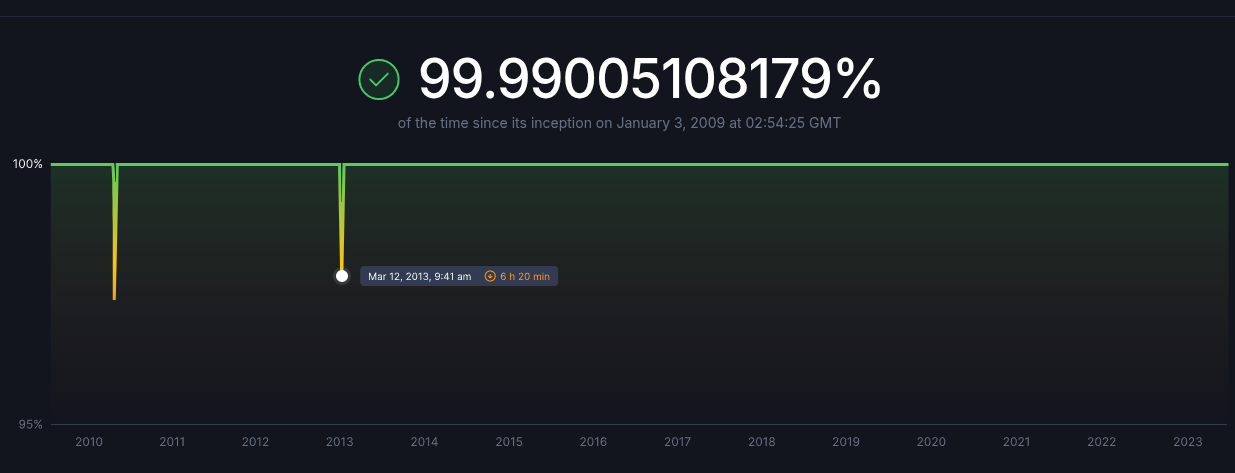
Despite the clear downtrend, this is a lot of downtime for blockchain standards. Bitcoin (BTC), the world’s first blockchain, currently has an uptime of over 99.99%, with the last downtime incident taking place in 2013.

Bitcoin has seen only two downtime incidents since its first block was mined in January 2009. The first one took place in August 2010, when a value-overflow bug was exploited, briefly creating nearly 184.47 billion BTC until a patch reversed the issue. The second one happened in March 2013, when a bug split the network between Bitcoin Core 0.7 and 0.8. The 2013 event did not create new Bitcoin.
Bitcoin uptime chart. Source: BitBo

你可能也喜欢

美伊备忘录签署为比特币交易者提供宏观催化剂

比特币交易者本周迎来一个新的宏观催化剂:瑞士将于2026年6月19日主办美伊谅解备忘录签署仪式。该事件虽非加密领域直接相关,但可能通过地缘政治、油价、通胀预期和整体风险偏好等宏观渠道影响比特币。 协议旨在讨论军事行动、制裁及重新开放霍尔木兹海峡航运等议题。作为全球重要能源通道,该海峡的局势变化可能影响油价。地缘风险上升时,比特币往往像高贝塔宏观资产一样交易,通胀预期可能强化,风险资产承压;反之,若风险下降,则可能为比特币等风险资产带来支撑。 对于比特币而言,应持谨慎态度。成功的外交进展可能改善全球风险情绪、缓解能源市场压力,从而利好比特币;但如果谈判停滞或结果令人失望,其影响可能迅速消退。该事件类似于通胀数据、央行决议等地缘政治新闻,比特币会通过流动性预期和市场心理对其做出反应,而非协议本身发生变化。 交易者可将6月19日视为一个需关注的宏观日历日期。直接影响或将首先体现在石油、美元和股指期货市场,而非直接冲击加密订单簿。若能源价格缓和、整体市场转向风险偏好,比特币可能间接受益;反之,若事件未明显改变航运或制裁预期,其对加密货币的影响可能有限。因此,该事件值得关注,但不应被视为独立的比特币价格催化剂。

bitcoinist2分钟前

美伊备忘录签署为比特币交易者提供宏观催化剂

bitcoinist2分钟前

Cursor,为什么上了马斯克的飞船?

美国当地时间6月16日,SpaceX在完成史上最大规模IPO仅四天后,宣布以600亿美元全股票交易收购AI编程初创公司Cursor的母公司Anysphere,交易预计于2026年第三季度完成。消息公布后,SpaceX股价一度大涨,市值短暂突破2.94万亿美元。 Cursor是全球热门AI编程工具之一,支持在多家主流AI模型间切换,可自动生成、编辑和审查代码。其年化营收增长迅猛,从2025年11月的10亿美元迅速增长至2026年初的40亿美元。然而,随着其主要AI供应商Anthropic推出竞争产品Claude Code,Cursor市场占有率有所下滑,面临被核心供应商制约的风险。 Cursor的CEO迈克尔·特鲁尔年少成名,拥有出色的编程天赋。面对竞争与依赖风险,Cursor于2026年初决定自研AI模型Composer,但缺乏足够算力。今年4月,Cursor与SpaceX达成合作,后者获得了收购选择权。SpaceX完成IPO后迅速行使该权利,宣布收购。 对Cursor而言,此次收购使其能接入SpaceX强大的Colossus超算系统,解决算力瓶颈。对SpaceX而言,则能借助Cursor在顶尖开发者中的渗透力,提升其AI模型(如Grok)的编程能力,实现在AI竞赛中的弯道超车。 此外,收购也服务于SpaceX更宏大的AI战略,包括探索部署轨道数据中心。马斯克为SpaceX设定了2030年约1万亿美元营收的雄心目标。此次收购是双方各取所需的一场豪赌,特鲁尔将其形容为“前所未有”的特别经历。

链捕手15分钟前

Cursor,为什么上了马斯克的飞船?

链捕手15分钟前

越涨越危险?SpaceX估值狂飙背后的系统性风险

本文就SpaceX市值在盘后交易中突破3万亿美元、超越亚马逊和微软的现象,提出一个核心关切:当前资本市场机制可能已从“价格发现”异化为“制造价格”的自我强化投机机器,并埋下系统性风险。 文章指出,推动SpaceX估值狂飙的主要力量并非其基本面(公司仍处亏损),而是市场结构因素:包括有限的流通盘、即将开始的期权交易(可能引发类似特斯拉过去的“gamma squeeze”逼空循环)、做市商对冲行为、动量资金追逐以及被动资金配置。这种机制使得价格上涨本身成为看涨理由,估值与经济现实脱钩。 作者担忧,若这种趋势持续,SpaceX市值膨胀到5万亿甚至10万亿美元,它将因其巨大规模被强制纳入各类主要指数和被动投资组合(如ETF、养老金)。届时,其估值波动将直接影响整个市场表现,使单一公司的投机性泡沫转化为广泛的系统性风险——当所有人都无法避开它时,即便一次温和回调也可能冲击无数普通投资者的长期资产。 因此,本文的讨论超越了SpaceX是否值这个价钱,而是警示现代金融市场存在的结构性悖论:当叙事、杠杆和流动性能够压倒基本面时,市场是否已丧失其资本配置与价格发现的根本功能?SpaceX只是一个极端案例,但它折射的问题可能更为普遍和危险。

marsbit20分钟前

越涨越危险?SpaceX估值狂飙背后的系统性风险

marsbit20分钟前

你交给Claude的订阅费,光模块公司能拿到多少?

一张将Claude Pro约20美元月费拆解给模型公司、云算力、GPU折旧、电力及供应链的估算图,引发了投资者对AI应用估值逻辑的重新审视。 核心问题在于:用户为AI应用支付的订阅费,有多少能像传统SaaS(软件即服务)那样沉淀为高软件毛利?传统SaaS新增用户成本极低,毛利率可达70%-80%。而AI应用不同,用户每一次调用模型(推理)都会消耗GPU算力、电力和云资源,导致边际成本显著。固定月费背后是随使用量波动的成本链,重度用户的成本可能急剧上升。 因此,AI应用公司要获得高估值,不仅需证明用户付费意愿,更需证明在考虑使用量后,其毛利率能持续改善并接近传统软件公司。当前阶段,AI使用量的增长更直接地转化为对底层基础设施(如英伟达GPU、台积电芯片、HBM内存、电力及数据中心)的需求,这使得基础设施供应商的业绩和估值更早、更确定地得到验证。 支持AI应用高毛利前景的观点认为,当前推理成本高是早期现象。通过模型优化、缓存技术、使用小模型、自研芯片以及提高集群利用率,单位成本有望快速下降。行业已有案例显示,部分模型的单位成本大幅降低。 然而,挑战在于,AI应用正从简单问答转向更复杂、耗能更高的任务(如代码生成、长文档处理)。关键在于,推理成本下降的速度能否超越用户使用量和任务复杂度的增长速度。 总之,该分析图的价值在于提醒市场:在AI应用公司缺乏透明毛利率数据的情况下,不应简单将其收入等同于高毛利SaaS收入。投资者需要关注其成本结构、用户使用行为分层以及效率提升的实际证据。模型公司最终需要证明,即使在重度使用下,订阅收入也能转化为可观的利润。

marsbit30分钟前

你交给Claude的订阅费,光模块公司能拿到多少?

marsbit30分钟前

交易

现货
合约

热门文章

如何购买S

欢迎来到HTX.com!我们已经让购买Sonic(S)变得简单而便捷。跟随我们的逐步指南,放心开始您的加密货币之旅。第一步:创建您的HTX账户使用您的电子邮件、手机号码注册一个免费账户在HTX上。体验无忧的注册过程并解锁所有平台功能。立即注册第二步:前往买币页面,选择您的支付方式信用卡/借记卡购买:使用您的Visa或Mastercard即时购买Sonic(S)。余额购买:使用您HTX账户余额中的资金进行无缝交易。第三方购买:探索诸如Google Pay或Apple Pay等流行支付方法以增加便利性。C2C购买:在HTX平台上直接与其他用户交易。HTX场外交易台(OTC)购买:为大量交易者提供个性化服务和竞争性汇率。第三步:存储您的Sonic(S)购买完您的Sonic(S)后,将其存储在您的HTX账户钱包中。您也可以通过区块链转账将其发送到其他地方或者用于交易其他加密货币。第四步:交易Sonic(S)在HTX的现货市场轻松交易Sonic(S)。访问您的账户,选择您的交易对,执行您的交易,并实时监控。HTX为初学者和经验丰富的交易者提供了友好的用户体验。

2.6k人学过发布于 2025.01.15更新于 2026.06.02

如何购买S

相关讨论

欢迎来到HTX社区。在这里,您可以了解最新的平台发展动态并获得专业的市场意见。以下是用户对S(S)币价的意见。

活动图片