Michael Saylor tossed a compact bit of Bitcoin game theory onto X on Tuesday and it set off the predictable kind of fight: technical details colliding with ideology.
“The Bitcoin Quantum Leap: Quantum computing won’t break Bitcoin—it will harden it,” Saylor wrote, adding: “The network upgrades, active coins migrate, lost coins stay frozen. Security goes up. Supply comes down. Bitcoin grows stronger.”
Short version: if quantum ever becomes real enough to threaten today’s signature schemes, Bitcoin can upgrade. Coins that are actively managed move to new, quantum-resistant output types. Coins that aren’t—because the keys are lost, the owner is gone, or the UTXOs are simply abandoned—should effectively get stuck.
Frozen.
Bitcoin Developers And Community React
That’s the part people latched onto, because it’s not just a technical question. It’s a social one. Who gets to decide which coins are “lost” versus “just old”? Jameson Lopp, one of the loudest voices pushing for practical quantum-readiness, basically said: yes, and welcome aboard. “I agree, lost coins should stay frozen. Glad to hear you’ll support my BIP!”
Then the counterpunch arrived fast. “We have no right to freeze another man’s bitcoin,” wrote Wicked (@w_s_bitcoin), arguing any attempt to lock legacy coins could spark a contentious chain split. He also floated a more narrative-friendly twist: what if Satoshi left early keys exposed as a “bounty” for quantum computers?
Lopp’s answer wasn’t sentimental. It was node-level realism. “On the flip side, every node runner has the right to refuse to accept coins they believe are most likely to have been stolen by a quantum attacker,” he wrote, framing it less as confiscation and more as a defensive filter to preserve the integrity of circulating supply. Later, he conceded the uncomfortable core: “Correct, the best you can do is come up with an extremely lengthy migration window.”
That “migration window” is doing a lot of work here. The draft proposal described by Lopp and co-authors (Christian Papathanasiou, Ian Smith, Joe Ross, Steve Vaile, Pierre-Luc Dallaire-Demers) sketches a three-phase path: first a soft fork that nudges (or forces) new sends into proposed quantum-resistant outputs, then a later rule change that makes legacy ECDSA/Schnorr spends invalid after a long deadline, and an optional third phase to recover unmigrated coins if the rightful owner can prove control through some new mechanism.
It sounds orderly on paper. It never is in practice. Because you can’t prove theft in Bitcoin’s older UTXOs. Wicked hammered that point: there’s “no way to prove whether older coins were stolen or just forgotten and then moved later by the rightful owner.” The fear, in his view, is basically supply paranoia dressed up as security.
Lopp didn’t deny the incentives. He leaned into them. “I can assure you that many entities in the industry care about supply shocks causing the value of their coins to plummet; businesses still use dollars as their unit of account.” And then, in a line that reads like a homework assignment for anyone who thinks this ends cleanly: “Your homework is to figure out the power dynamics...”
Outside the Bitcoin-only trench fight, other corners of crypto mostly reacted with a raised eyebrow. Nic Carter, a founding partner at Castle Island Ventures, demanded specifics: “Explain in detail how all of those things will happen [...] Which core devs has microstrategy funded to work on the multiple hard and soft forks that will be required for this plan? Which quantum researchers?”
BitMEX Research pushed back on the “hardfork” framing. “What makes you think we need a hardfork?” it asked, arguing the transition could be painful without literally being a hard fork. Another account summed up the mood: “You can freeze coins with a soft fork.”
Then again—soft fork or not—getting broad social consensus to lock unmoved coins is its own nightmare. “The idea that there would be social consensus over locking unmoved coins is crazy,” one user wrote. “In 1,000 realities that doesn’t happen once.”
And, quietly, a reminder from Willem Schroe (Botanix CEO): “Yes, there are quantum developments but nothing remotely close to a breakthrough. That said, our current cryptographic solutions are not even remotely close to ready or battletested so quantum resistance work is definitely worth it. Very small risk but would have a big impact.”
So overall, none of this is about quantum tomorrow. It’s about Bitcoin deciding what it is when faced with a threat that can’t be patched with vibes. The tech path is hard. The politics might be harder.
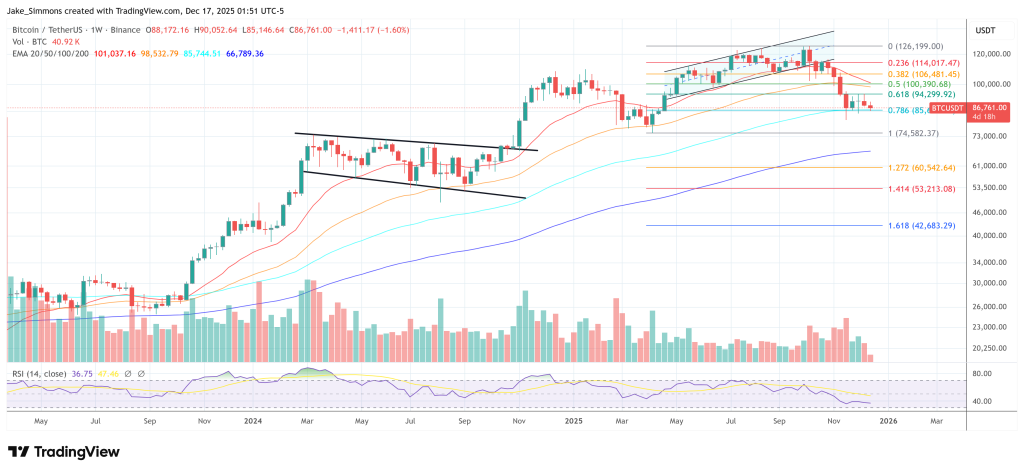
At press time, Bitcoin traded at $86,761.