Push to End Crypto Staking Double Taxation Gains Momentum in Washington

bitcoinist发布于2025-12-23更新于2025-12-23

文章摘要

As crypto staking becomes more widespread, U.S. lawmakers are pushing for clearer tax rules to avoid double taxation and simplify compliance. A bipartisan group of 18 House representatives has urged the IRS to update its guidance, arguing that taxing staking rewards only upon sale—rather than at receipt—would better reflect actual economic gains and reduce administrative burdens. They warn that current policies may discourage staking, which is crucial for blockchain security. Additionally, the newly introduced Digital Asset PARITY Act proposes a de minimis exemption for small stablecoin transactions and defers income recognition from staking for up to five years. These efforts reflect a growing consensus in Congress for more coherent crypto tax policies ahead of key 2026 tax changes.

As crypto staking shifts from a niche activity to a mainstream practice, long-standing gaps in U.S. tax policy are coming under closer scrutiny in Washington, with lawmakers warning that unclear and inconsistent rules could discourage participation in blockchain networks and complicate compliance for millions of investors.

Related Reading: Bitcoin Long-Term Holders Stay Resilient, But Profits Haven’t Fully Arrived – Here’s What To Know

With the 2026 tax year nearing, 18 bipartisan House lawmakers have urged the Internal Revenue Service to review staking tax guidance, arguing it results in double taxation, creating administrative burdens and failing to reflect actual economic gains, especially during volatile markets.
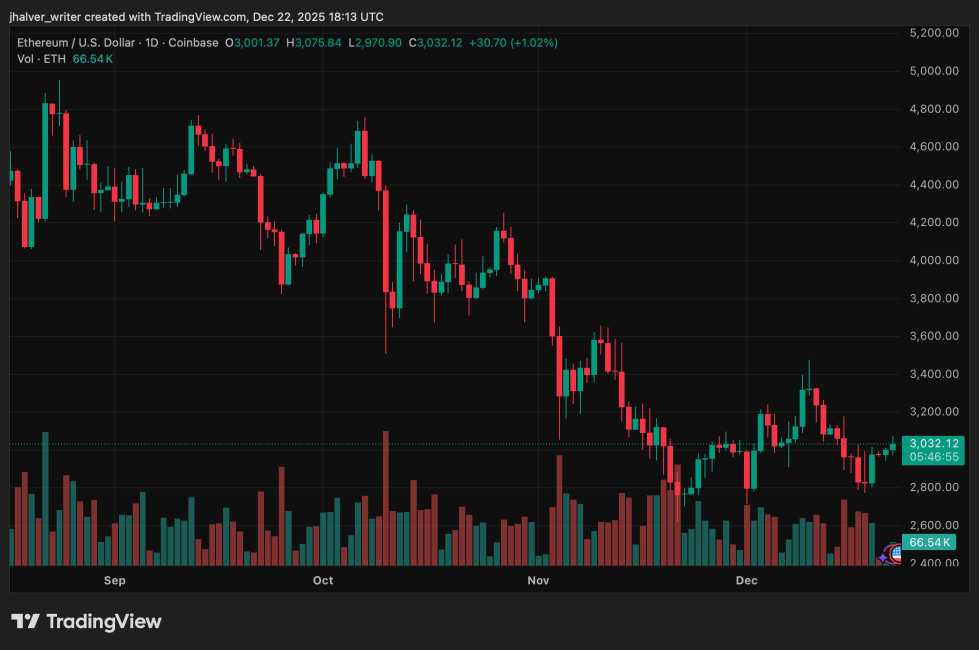
ETH's price trends to the downside on the daily chart. Source: ETHUSD on Tradingview

Lawmakers Press IRS Ahead of 2026

In a letter led by Representative Mike Carey, lawmakers asked whether any administrative barriers stand in the way of updating staking guidance before the end of the year. They argue that taxing rewards only at the point of sale would better capture actual economic gain while reducing reporting complexity.

The group also warned that current rules may discourage staking participation, which plays a critical role in securing proof-of-stake blockchains and maintaining network resilience.

The timing is deliberate. Several tax provisions are set to expire in 2026, and lawmakers want clarity on staking before broader tax debates take precedence. They also noted that prolonged uncertainty could invite unfavorable court rulings that lock in interpretations through precedent rather than policy.

The PARITY Act and Broader Crypto Tax Reform

Alongside the IRS letter, Representatives Steven Horsford and Max Miller have introduced a discussion draft known as the Digital Asset PARITY Act.

The proposal takes a wider view of crypto taxation, including a de minimis exemption for regulated stablecoin payments used in everyday transactions. Small gains or losses from these payments would generally not be taxed, mirroring existing treatment for low-value foreign currency exchanges.

For staking and mining, the PARITY Act stops short of eliminating immediate taxation but proposes allowing taxpayers to defer income recognition for up to five years.

Supporters say this could provide interim relief while lawmakers work toward permanent clarity. The bill also extends wash-sale rules and certain securities tax provisions to actively traded digital assets, aiming to curb abuse without expanding loopholes.

What Comes Next for Crypto Investors

Together, these efforts signal growing consensus in Congress that crypto taxation needs refinement rather than piecemeal fixes. While no changes are guaranteed, the push to address staking double taxation reflects a shift toward more technical, outcome-focused policymaking.

Related Reading: XRP ETFs Attract Global Pension Funds And Insurers, Canary CEO Reveals

For investors and network participants, the next year could determine whether staking remains burdened by uncertainty or moves toward a clearer, more predictable tax framework.

Cover image from ChatGPT, ETHUSD chart from Tradingview

热门币种推荐

相关问答

QWhat is the main issue with current U.S. tax policy regarding crypto staking that lawmakers are addressing?

AThe main issue is that current tax rules result in double taxation, create administrative burdens, and fail to reflect actual economic gains, especially during volatile markets.

QHow many bipartisan House lawmakers have urged the IRS to review staking tax guidance ahead of the 2026 tax year?

A18 bipartisan House lawmakers have urged the IRS to review staking tax guidance.

QWhat specific change in taxation timing do lawmakers propose to better capture actual economic gain from staking rewards?

ALawmakers propose taxing staking rewards only at the point of sale, rather than immediately, to better capture actual economic gain and reduce reporting complexity.

QWhat is the name of the proposed draft legislation that addresses broader crypto taxation, including a de minimis exemption for stablecoin payments?

AThe proposed draft legislation is called the Digital Asset PARITY Act.

QHow does the PARITY Act propose to handle income recognition for staking and mining rewards?

AThe PARITY Act proposes allowing taxpayers to defer income recognition from staking and mining rewards for up to five years, providing interim relief while seeking permanent clarity.

你可能也喜欢

Coldcard攻击升级:第四波攻击使比特币失窃金额突破9000万美元

冷钱包安全事件升级:第四波攻击导致比特币被盗金额超过9000万美元 最初只是警告的漏洞,现已演变为比特币历史上最严重的硬件钱包安全事件之一。过去三天,运行存在漏洞固件的Coldcard设备遭到攻击者利用关键缺陷清空资产。 受影响设备生成的种子短语熵值低于预期,导致其可被预测和利用。此次事件已造成约9000万美元的损失,涉及超过4500个钱包,在多轮协同攻击中被盗比特币超过1367枚。 **第四波攻击仍在持续** Galaxy Research研究主管Alex Thorn指出很可能存在第四波攻击。在区块960,778至960,792大约2.5小时内的模式显示,218笔交易涉及462个受害地址,216个新的目标地址收到了388.92枚比特币。清扫活动速率达到正常水平的约45倍,每区块13.8次清扫,而基线为0.3次。所有交易均显示没有早于Coldcard固件边界之前的输入,拓扑结构为1:1(每个受害者对应一个新目的地),没有收集漏斗。在排除6个有先前交易历史的地址后,第四波攻击的核心数据为709个地址和448.73枚比特币。部分被盗资金已转移至第二跳地址,而一些交易仍带有RBF选择加入信号,这可能为受害者提供了短暂的响应窗口。 **Coldcard的应对措施** Coldcard背后的加拿大公司Coinkite已确认该漏洞并迅速采取行动:销毁了其设施内所有剩余受影响固件设备、暂停发货,并直接联系已收到受影响订单的用户提供迁移步骤。目前所有受影响型号均已提供修补固件,但该修复仅保护新生成的种子短语。在漏洞固件上创建的任何种子即使更新后仍面临风险,用户必须生成新钱包并立即转移所有资金。Satscard、Opendime和Tapsigner因使用不同代码库未受影响。对于需要立即替代方案的用户,Coldcard建议可临时使用Bitkey、Ledger、Trezor、Jade和Bitbox。公司还要求受影响用户保留设备以支持未来可能的恢复工作。受影响的固件版本为Coldcard Mk3的v4.0.1至v5.0.3。 此次大规模漏洞事件严重动摇了市场对比特币最受信任的冷存储解决方案之一的信心,也对硬件钱包安全性提出了广泛警示。

TheNewsCrypto24分钟前

Coldcard攻击升级:第四波攻击使比特币失窃金额突破9000万美元

TheNewsCrypto24分钟前

中国科技产业,正在批量越过“可见线”

最近,中国科技产业多个领域接连进入全球视野,如大模型Kimi K3和DeepSeek-V4-Flash发布、机器人设备受国际关注、辉瑞与信达生物达成创新药合作等。这标志着中国产业能力正集中越过“可见线”——即从内部积累进入全球市场验证的阶段。 回顾过去,中国出口主力从服装家电“老三样”,到新能源汽车等“新三样”,再到如今人工智能、机器人、创新药“新新三样”,产业迭代周期明显缩短。越过“可见线”的产业通常具备四大特征:形成规模、优势突出、增长加速、带动产业链。与以往不同,当前中国产业不再只是跟进成熟市场,而是通过降低门槛、开放生态,主动参与定义新产品和新需求。 这种变化源于中国产业体系从“完整”走向“稠密”:不同领域共享技术、人才与供应链,形成能力迁移。例如,新能源汽车积累的技术向机器人产业延伸,算力需求带动芯片、存储、光通信等整条产业链。产业与研发的距离缩短,真实应用反馈加速创新,规模化成为创新的一部分。 越过“可见线”意味着中国产业的竞争焦点,从“做出产品”延伸至构建包含专利、标准、生态的持续价值系统。未来,中国需在开放中筑牢产业护城河,通过开源、协同研发扩大生态,推动技术迭代与广泛应用。 “十五五”规划已布局战略性新兴产业与未来产业,持续将新产业推向市场检验。一批又一批产业越过“可见线”,不仅体现单点突破,更意味着中国正形成持续产生新产业的能力。

marsbit48分钟前

中国科技产业,正在批量越过“可见线”

marsbit48分钟前

交易

现货

热门文章

如何购买PUSH

欢迎来到HTX.com!我们已经让购买Push Protocol(PUSH)变得简单而便捷。跟随我们的逐步指南,放心开始您的加密货币之旅。第一步:创建您的HTX账户使用您的电子邮件、手机号码注册一个免费账户在HTX上。体验无忧的注册过程并解锁所有平台功能。立即注册第二步:前往买币页面,选择您的支付方式信用卡/借记卡购买:使用您的Visa或Mastercard即时购买Push Protocol(PUSH)。余额购买:使用您HTX账户余额中的资金进行无缝交易。第三方购买:探索诸如Google Pay或Apple Pay等流行支付方法以增加便利性。C2C购买:在HTX平台上直接与其他用户交易。HTX场外交易台(OTC)购买:为大量交易者提供个性化服务和竞争性汇率。第三步:存储您的Push Protocol(PUSH)购买完您的Push Protocol(PUSH)后,将其存储在您的HTX账户钱包中。您也可以通过区块链转账将其发送到其他地方或者用于交易其他加密货币。第四步:交易Push Protocol(PUSH)在HTX的现货市场轻松交易Push Protocol(PUSH)。访问您的账户,选择您的交易对,执行您的交易,并实时监控。HTX为初学者和经验丰富的交易者提供了友好的用户体验。

1.4k人学过发布于 2024.03.29更新于 2026.06.02

如何购买PUSH

相关讨论

欢迎来到HTX社区。在这里,您可以了解最新的平台发展动态并获得专业的市场意见。以下是用户对PUSH(PUSH)币价的意见。

活动图片