The Office of the Comptroller of the Currency (OCC) has asked the public for feedback on its proposed framework to regulate stablecoins under the landmark crypto regulation, including proposals to address potential workaround on the interest payments ban.
OCC Lays Out Framework For GENIUS Act Implementation
On Wednesday, the OCC issued a proposed rulemaking to implement the landmark stablecoin legislation, the Guiding and Establishing National Innovation for U.S. Stablecoins (GENIUS) Act.
The GENIUS Act was signed into law by US President Donald Trump on July 18, 2025. The legislation establishes a regulatory framework for payment stablecoin activities in the US.
In the 376-page document, the agency included regulations for permitted payment stablecoin issuers and foreign payment stablecoin issuers under the OCC’s jurisdiction and certain custody activities conducted by OCC-supervised entities.
Notably, the OCC will have regulatory authority over certain issuers, such as subsidiaries of national banks or federal savings associations, federal qualified issuers, state qualified issuers, and foreign issuers.
The proposed rules cover all regulations the OCC is required to promulgate under the GENIUS Act, including reserve asset standards, liquidity and custody requirements, risk management controls, audits, and supervisory examinations.
However, it exempts rules related to the Bank Secrecy Act, Anti-Money Laundering, and Office of Foreign Assets Control sanctions, which will be addressed in a separate rulemaking alongside the Department of the Treasury.
“The OCC has given thoughtful consideration to a proposed regulatory framework in which the stablecoin industry can flourish in a safe and sound manner,” said Comptroller of the Currency Jonathan Gould in a statement.
“We welcome feedback on the proposal to inform a final rule that is effective, practical and reflects broad industry perspective. The OCC will continue its work to implement the GENIUS Act and provide OCC regulated entities with more opportunities to meet the needs of their customers and communities,” he added.
Rules To Address Stablecoin Yield Workarounds
The proposed draft also tackled a key issue related to the regulation of these assets: the payments of interest or yield on stablecoins. For context, the legislation prohibits interest payments on the holding or use of payment-purpose stablecoins, but only addresses permitted issuers.
Based on this, the banking sector has argued that the GENIUS Act has “loopholes” that could pose risks to the financial system and has urged senators to include language in the crypto market structure bill, known as the CLARITY Act, that also bans digital asset exchanges, brokers, dealers, and related entities from offering yield.
The OCC expanded on the GENIUS Act ban, highlighting potential areas that must be addressed to prevent these “loopholes.” The agency argued that issuers could attempt workarounds to “make prohibited payments of interest or yield to payment stablecoin holders through arrangements with third parties.”
However, it noted that due to the large and changing variety of such arrangements, it would be impossible to identify and address all of them. Therefore, it proposed to include a presumption that “certain types of arrangements with certain types of persons” would be prohibited payments of yield or interest by the issuer.
The OCC would presume that an issuer is paying the holder any form of interest or yield if: the issuer “has a contract, agreement, or other arrangement with an affiliate or a related third party to pay interest or yield to the affiliate or related third party;” and if the affiliate or related third party “has a contract, agreement, or other arrangement to pay interest or yield (...) to a holder of any payment stablecoin issued” by the permitted issuer “solely in connection with the holding, use, or retention” of these tokens.
Nonetheless, the OCC clarified that the prohibition is not intended to prevent a merchant from independently offering a discount to a holder for using payment stablecoins. It is also not intended to prevent an issuer “from sharing in the profits derived from the payment stablecoin with a non-affiliate partner in a white-label arrangement.”
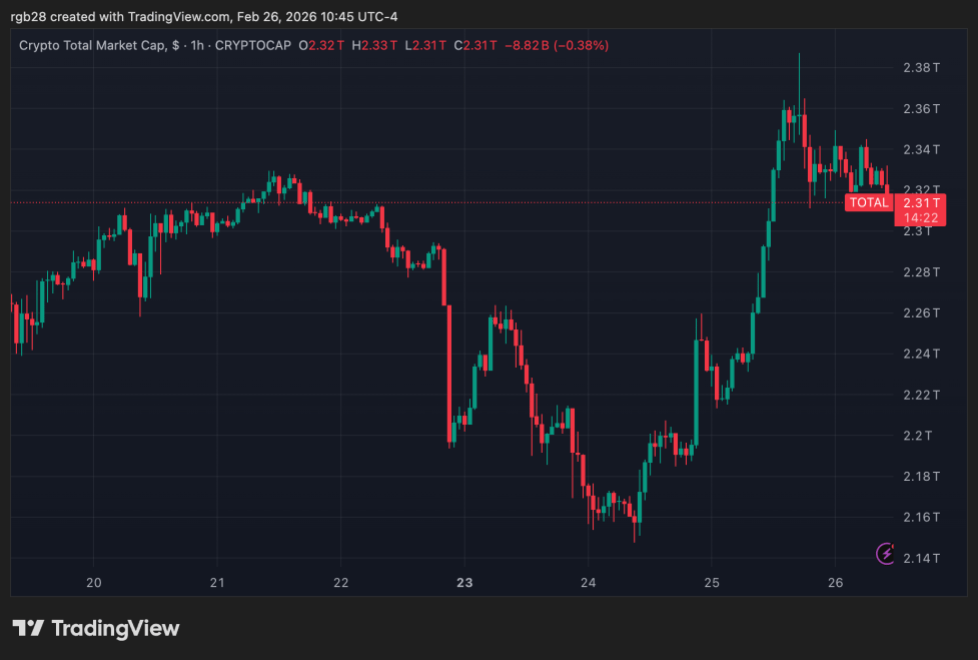
The total crypto market capitalization is at $2.31 trillion in the one-week chart. Source: TOTAL on TradingView







