Michael Saylor Vows ‘We Buy Real Bitcoin,’ No Rehypothecation

bitcoinist发布于2026-01-30更新于2026-01-30

文章摘要

Michael Saylor's firm MicroStrategy reaffirmed its Bitcoin acquisition strategy, stating it buys "real bitcoin" and does not engage in rehypothecation. This came in response to skepticism from Casa CTO Jameson Lopp, who questioned whether the company verifies that its Bitcoin holdings are not being rehypothecated by third-party custodians. The debate highlights concerns about transparency and proof of reserves for institutional Bitcoin custody. MicroStrategy disclosed purchasing 2,932 BTC for $264.1 million, bringing its total to 712,647 BTC. While some critics demanded public proof of addresses, others argued that traditional auditing and corporate controls provide sufficient validation. Saylor emphasized that the company audits its custodians and advised others to avoid rehypothecation. Bitcoin was trading at $88,001 at the time of reporting.

Michael Saylor’s Strategy has reignited a long-running Bitcoin custody debate after co-founder and CTO of Casa Jameson Lopp challenged whether the firm can know its holdings aren’t being rehypothecated by third parties. Saylor’s blunt response — “We buy real bitcoin. We don’t rehypothecate.” — quickly turned into a broader argument about what “proof” looks like for a public company warehousing BTC at institutional custodians.

The exchange landed as Strategy’s accumulation narrative is accelerating in early 2026. On Jan. 26, Saylor posted that Strategy bought 2,932 BTC for roughly $264.1 million at an average price near $90,061 per bitcoin. He added that, as of Jan. 25, the company held 712,647 BTC acquired for about $54.19 billion at an average cost of roughly $76,037 per coin.

That disclosure sparked commentary from Jesse Myers, who framed Strategy’s pace as structurally supply-tightening. Myers said the company has acquired 40,150 BTC so far in 2026, against 11,700 BTC mined year-to-date. “Eventually, the BTC price must go higher. Much higher,” he wrote, leaning on a simple imbalance: one large buyer absorbing more than new issuance.

No Paper Bitcoin?

Lopp pushed back on the implicit assumption that all of those purchases translate into unencumbered, uniquely owned UTXOs. “Your thesis is sensible... under the assumption that he’s buying real bitcoin,” Lopp wrote. “Does Strategy actually verify that their bitcoin only belongs to them and isn’t rehypothecated? I’m skeptical.”

Saylor responded with a short, definitive denial: “We buy real bitcoin. We don’t rehypothecate.” But Lopp widened the aperture from Strategy’s own behavior to the incentives and opacity of intermediaries. “But how do you know your custodians don’t? Presumably they put your BTC in segregated addresses you can monitor,” he wrote. “People ask for proof of reserves since they don’t even know what monitoring / assurances you put in place. Multiple layers of trusted black boxes make folks nervous.”

As the thread grew, some users demanded Strategy publish addresses. One account wrote, “Prove it then. Show us the addresses.” Others argued that transparency cuts both ways. “Ever considered that TradFi could be extremely frightened if Strategy were to do this, given that it opens up multiple attack Vectors?”

Defenders leaned on the mechanics of public-company controls rather than on-chain visibility. Attorney Jesse Kobernick from Miller Nash LLP argued that Strategy’s filings describe steps auditors take to verify balances and control, and that multiple third parties touch the process, including the separation between BTC purchases and the equity sales and cash proceeds that fund them. Lopp rejected that comfort. “Trusted third parties are security holes...” he replied.

Bitcoin OG Adam Back, meanwhile, pointed to mainstream custodianship norms as a reason to discount “paper bitcoin” fears. “Think about it. Their custodians are I think Fidelity and Coinbase,” Back wrote, adding that large auditors take verification and key-control standards seriously.

Lopp remained unconvinced that outside observers can know what, exactly, is being verified. “Are these auditors spinning up nodes, verifying balances at addresses, ensuring that no clients hold claims to the same BTC?” he wrote. “I’m skeptical, but ultimately we just don’t know – it’s a black box.”

Later on Jan. 28, Saylor reposted the message more broadly, escalating from denial to prescription: “We buy real bitcoin. We audit our custodians. We don’t rehypothecate.” He added: “You shouldn’t either.”

At press time, Bitcoin traded at $88,001.
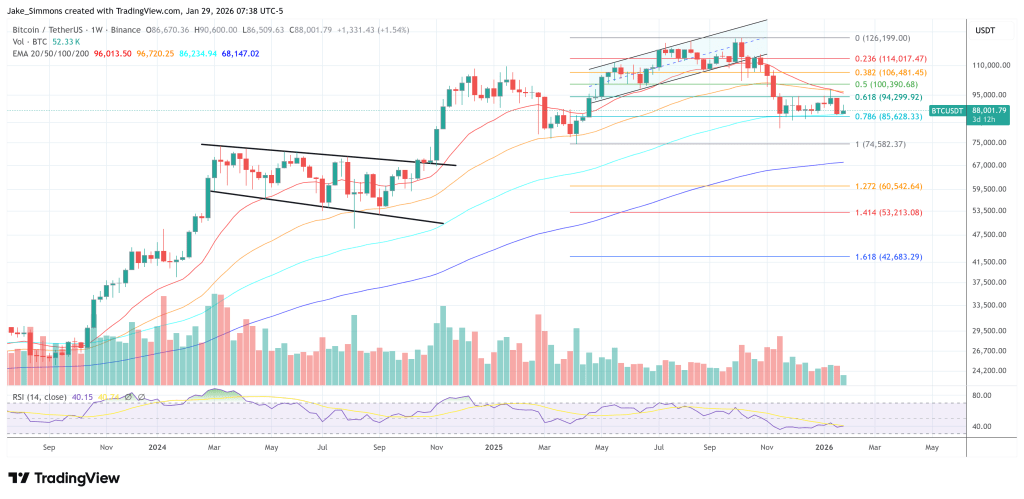
Bitcoin remains between the 0.618 and 0.786 Fib, 1-week chart | Source: BTCUSDT on TradingView.com

热门币种推荐

相关问答

QWhat is the core of the debate between Michael Saylor and Jameson Lopp regarding MicroStrategy's Bitcoin holdings?

AThe debate centers on whether MicroStrategy can verify that the Bitcoin it purchases is 'real' and not being rehypothecated (loaned out or used as collateral by others) by its third-party custodians.

QHow did Michael Saylor respond to the skepticism about MicroStrategy's Bitcoin custody?

AMichael Saylor responded with a definitive denial, stating, 'We buy real bitcoin. We don’t rehypothecate.' He later escalated his response to include, 'We audit our custodians.'

QWhat was Jesse Myers' commentary on MicroStrategy's Bitcoin acquisition pace in early 2026?

AJesse Myers commented that MicroStrategy's pace of acquisition is structurally tightening the Bitcoin supply, noting the company had acquired 40,150 BTC against only 11,700 BTC mined year-to-date, creating a significant supply imbalance.

QWhat solution did some users in the debate propose for MicroStrategy to provide proof of its Bitcoin holdings?

ASome users demanded that MicroStrategy publish the Bitcoin addresses holding its coins to provide on-chain transparency and proof of reserves.

QWhat reason did Adam Back give for discounting fears of 'paper bitcoin' in this context?

AAdam Back pointed to the mainstream custodianship norms, stating that MicroStrategy's custodians (like Fidelity and Coinbase) and their large, serious auditors have strong verification and key-control standards, making 'paper bitcoin' fears less likely.

你可能也喜欢

福建晋江,一家存储超级独角兽静悄悄

近日,随着长鑫科技A股上市成为股王,同为国内三大存储芯片项目之一的福建晋华集成电路有限公司(晋华)重新进入公众视野。这家位于福建晋江的DRAM企业,自2016年成立起便肩负打破海外垄断的使命,却因2018年被美国列入实体清单并遭遇司法指控而陷入长达数年的沉寂。2024年2月,美国法院裁定其无罪,晋华才得以摆脱法律阴影。 晋华的曲折发展与灵魂人物陈正坤密不可分。这位拥有美光与联电背景的工程师,怀揣自主开发DRAM的梦想加入晋华。公司初期通过与联电合作快速推进,但随后美光发起诉讼,指控技术窃密,导致晋华产线因设备禁运而停摆。在极端困难下,陈正坤带领团队改造国产设备、重构工艺,艰难维持运营。尽管最终赢得清白,但发展进度已被严重拖慢。目前,晋华专注于利基型DRAM市场,月产能约4万片,拥有千余项专利,但仍在美国实体清单限制之下。 晋江这座以鞋服闻名的民营经济强市,为引入晋华这一“硬科技”项目投入巨资,并以政府基金、全链条配套和持续的政策支持,助力企业在制裁中生存下来。如今,以晋华为龙头,晋江已形成超千亿规模的集成电路产业集群。在全球AI驱动存储繁荣的周期中,晋华虽规模尚小,但其在封锁中重建的经历,已成为中国存储产业自主攻坚的缩影。

marsbit23分钟前

福建晋江,一家存储超级独角兽静悄悄

marsbit23分钟前

《夏季拉锯战》仍在继续:突破67000美元将是比特币上涨的起点

比特币价格在8月1日跌至62,217美元,延续了自6月5日开始的盘整格局。目前比特币被困在58,000至67,000美元的区间内,市场参与者对下一步走向存在分歧。 技术分析显示关键价位在60,000美元和67,000美元。交易员Crypto Candy认为,只要价格低于66,000美元,就可能跌向60,000美元或更低。投资者Jelle则将当前市场比作“夏季拉锯战”,坚持定期买入的平均成本策略。 上行突破的关键在于能否站稳67,000美元以上。交易员Daan Crypto Trades认为,若无法突破此位,市场可能继续盘整。交易员Roman则预测,若伴随足够交易量有效突破67,000美元,价格可能快速上涨至70,000-80,000美元区间。 宏观分析师Gert van Lagen从更长周期观察,认为比特币正在测试一个持续七年之久的“杯柄形态”的颈线位,市场恐惧情绪在盘整中逐渐消退。他强调,长期持有者仍未出现投降迹象,NUPL指标显示他们远未进入抛售区域。 总而言之,市场共识是比特币正处于积累阶段,60,000美元和67,000美元是关键水平,对任一水平的突破都将决定资产的下一个方向。当前围绕67,000美元的博弈,也反映出短期持有者盈亏平衡点附近的心理压力。近期价格在利好新闻后迅速回落,表明市场叙事尚未转化为持续的资本流入,能否构建更稳固的上涨基础仍有待观察。

cryptonews.ru1小时前

《夏季拉锯战》仍在继续:突破67000美元将是比特币上涨的起点

cryptonews.ru1小时前

交易

现货

热门文章

加密市场宏观研报:《GENIUS Act》法案取得重大进展,BTC突破历史新高,后市全新展望

2025年5月22日,比特币价格正式突破11万美元大关,创下历史新高。在政策面、宏观经济、资金面与投资者结构共同作用下,一场结构性牛市浪潮正在展开。而此轮上涨背后的核心驱动,是美国《GENIUS稳定币法案》的实质性进展以及多项利好的叠加。本文将从政策端突破、宏观环境转向、链上与ETF资金结构、交易行为演化,以及重点受益赛道五大维度,全面解析此轮BTC再创新高的深层逻辑,并前瞻下半年市场的潜在趋势。

1.8k人学过发布于 2025.05.22更新于 2025.05.22

加密市场宏观研报:《GENIUS Act》法案取得重大进展,BTC突破历史新高,后市全新展望

相关讨论

欢迎来到HTX社区。在这里,您可以了解最新的平台发展动态并获得专业的市场意见。以下是用户对BTC(BTC)币价的意见。

活动图片