Author: Hua Lin Wu Wang, Geek Park
Editor: Jing Yu
Just as Musk was preparing to merge SpaceX and xAI to create a cosmic AI behemoth valued at $1.25 trillion, he never expected that not everyone could stomach his grand vision.
On February 10, 2026, local time, xAI co-founder Tony Wu announced his departure from Musk's AI company.
This marks the second co-founder to leave xAI since Igor Babuschkin's departure last August. Wu was responsible for AI reasoning capabilities—a key technical direction considered by the industry to be the core competitiveness of next-generation AI systems.
It is uncommon in Silicon Valley for an AI company, barely over two years old, to lose two co-founders in succession. More critically, this is happening at a time when AI competition is fiercest and talent is scarcest.
With founders leaving one after another, can Musk's AI ambitions continue?
01. Reasoning Expert Walks Away
Tony Wu's role at xAI was far more important than it appeared.
As the technical lead responsible for reasoning capabilities, Wu reported directly to Musk. At the current stage of AI development, reasoning capabilities are seen as the critical bridge between large models like GPT-4 and Claude and true "Artificial General Intelligence."
Simply put, Wu was tasked with making AI "think," not just "memorize and imitate."
Losing Wu at this juncture is a devastating blow to xAI.
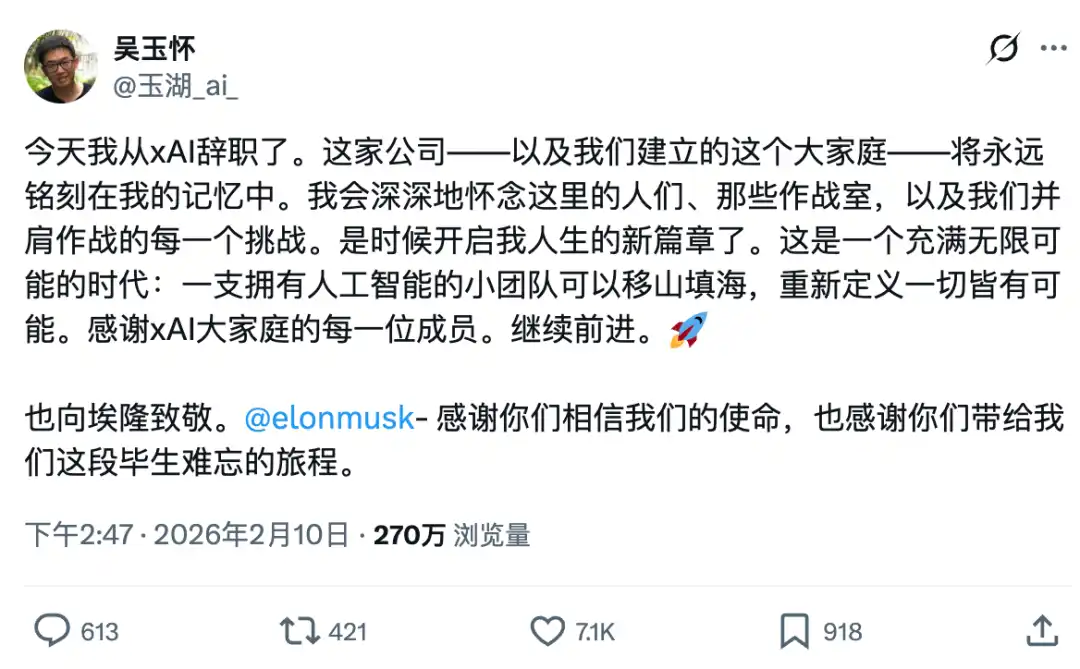
Tony Wu announced his departure on X | Image source: X
From a technical perspective, breakthroughs in AI reasoning require long-term accumulation and continuous iteration. The departure of a reasoning expert takes away not just individual expertise, but also entire technical approaches, experimental data, and judgment on future R&D directions. In the fast-paced AI industry, where progress is measured in months, losing a key technical lead often means at least six months of stalled development.
The timing is even more concerning. OpenAI just released a new code model, achieving significant breakthroughs in AI coding; Anthropic's Claude is performing increasingly well on reasoning tasks. Losing the core figure of the reasoning team at this point could easily cause xAI to fall behind in the most critical technological race.
One developer bluntly stated on X: "Losing Tony Wu is like Tesla losing its head of battery technology. On the surface, the company keeps operating, but its core competitiveness has been hit."
Tony Wu isn't the only one. In fact, over the past year, 5 out of the 12 founding members of xAI have left—a nearly 50% attrition rate, matching the efficiency of Musk's massive Twitter layoffs.
Why are top AI talents unwilling to follow Musk's AI vision?
02. The "Side Effects" of Musk-Style Management
The consecutive departures of two co-founders force a re-examination of what is really happening inside xAI.
Although the specific reasons for leaving were not disclosed officially, judging from Musk's management style at Twitter, Tesla, and SpaceX, the issue might not be compensation, but a clash of management philosophies.
Musk is known for his "extreme pressure" management style.
During the overhaul of Twitter, he once had employees sleeping in the office and conducted large-scale layoffs with an "extremely hardcore or leave" approach. This management style might work in manufacturing or relatively mature tech products, but AI R&D requires creative thinking and long-term focus, not just execution efficiency.
A former OpenAI researcher said in an interview: "AI research has its own rhythm. Sometimes a algorithmic breakthrough requires months of quiet contemplation; other times it requires repeated trial and error. If management is always催促 ('faster, even faster'), it's easy for researchers to feel frustrated."
More critical are divergences in technical路线 (roadmaps).
Musk has publicly stated that xAI pursues "maximum truth-seeking" and "understanding the universe." Such a grand vision is inspiring, but its technical implementation often requires more pragmatic path choices.
When the CEO's vision conflicts with the technical team's judgment, who has the final say?
In traditional AI research institutions, technical experts usually have greater say. But in Musk's companies, the final decision-making power often rests with him.
03. The "Bloodbath" for AI Talent
Viewing xAI's brain drain in a broader context, it is a microcosm of the "bloodbath" for talent across the entire AI industry.
In today's AI industry, top talent is as rare as nuclear physicists were in the last century.
A talented AI researcher might receive offers from OpenAI, Anthropic, and Google DeepMind simultaneously, with an annual salary easily exceeding $500,000, not to mention equity packages worth astronomical figures.
In this environment, the key to retaining talent isn't just money, but also the platform and culture. Researchers prefer places where they can focus on technology, have clear R&D paths, and aren't frequently disturbed by management.
From this perspective, OpenAI and Anthropic do have an advantage.
These two companies are led by AI researchers, where the technical team has sufficient say in key decisions. In contrast, xAI seems more like a "CEO-driven" company—Musk's personal will often overrides the technical team's judgment.
This isn't to say Musk's approach is wrong, but in the unique context of the AI industry, this management style might not be optimal.
A Reddit user hit the nail on the head: "Musk excels at engineering and productization, but the first half of AI research is more like scientific research, requiring patience and room for trial and error."
The question now is, how much time does xAI have to adjust?
In the "winner-takes-all" game of AI, falling behind by six months could mean complete elimination. Losing two co-founders could be a heavier price than imagined for an AI company still searching for its technological breakthrough.
After all, in this AI arms race, the scarcest resource has never been money, but the people who truly know how to make machines "think."