ING Germany Integrates Bitwise and VanEck ETPs as LiquidChain Unifies Cross-Chain Liquidity

bitcoinist发布于2026-02-03更新于2026-02-03

文章摘要

ING Germany, serving over 9 million customers, has integrated crypto ETPs from Bitwise and VanEck into its retail banking platform, allowing users direct access to Bitcoin and Ethereum through their banking app. This move signals a major shift toward mainstream crypto adoption in Europe’s largest economy. However, the underlying blockchain infrastructure remains fragmented, isolating liquidity across chains like Bitcoin, Ethereum, and Solana. LiquidChain ($LIQUID) aims to solve this fragmentation with a Layer 3 protocol that unifies liquidity and enables seamless cross-chain transactions. The project has raised over $500K in its presale and offers high staking rewards, targeting the growing need for interconnected DeFi infrastructure as institutional interest increases.

The barrier between traditional finance and digital assets in Europe’s largest economy isn’t just crumbling, it’s gone.

ING Germany, catering to over 9M customers, quietly integrated crypto ETPs (Exchange Traded Products) and ETNs (Exchange Traded Notes) into its retail banking interface. The partners? Asset management heavyweights Bitwise and VanEck.

This collaboration is more than a vendor agreement; it’s a merging of DNA. Bitwise brings the deep-rooted crypto native expertise and research-heavy approach, while VanEck provides the institutional pedigree of a firm that has pioneered ETFs for nearly 70 years.

Together with ING, they’ve created a ‘regulated wrapper’ that satisfies the stringent compliance demands of the German BaFin while offering investors the precise price tracking they expect from high-tier financial instruments.

This matters. Not just for the immediate volume, but for the signal it blasts to risk departments globally. When a conservative institution like ING opens crypto rails to German retail savers, the asset class graduates from ‘speculative fringe’ to ‘portfolio standard.’

Users can now access Bitcoin and Ethereum directly through their banking app. No external exchanges, no friction. Just access.

But there’s a catch. While giants like ING solve the financial exposure problem, the underlying tech is still a mess. It’s fragmented. A user holding a Solana ETP has zero interaction with Ethereum; liquidity is trapped in silos.

As institutional capital pours in, the race is on to build a backend that actually connects Bitcoin, Ethereum, and Solana. That’s the precise gap LiquidChain ($LIQUID) aims to fill.

LiquidChain ($LIQUID) Ends Asset Isolation With Unified L3 Architecture

Right now, DeFi looks a lot like the pre-Internet era of local intranets: disconnected islands of value. To move capital from Ethereum to Solana, you’re forced to navigate complex bridges, wrap assets (risky business), and juggle multiple gas tokens.

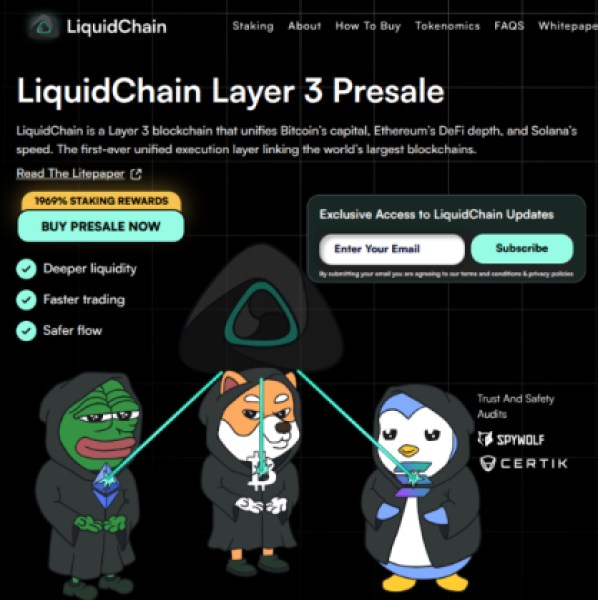
LiquidChain fixes this. It positions itself as a Layer 3 (L3) protocol that fuses liquidity from Bitcoin, Ethereum, and Solana into one execution environment. An L3 is a highly specialized, application-specific blockchain built on top of a Layer 2 to provide hyper-scalability, lower gas fees, and custom environments for specific use cases like gaming or high-frequency trading.
Source: LiquidChain

For developers, it’s a ‘Deploy-Once’ setup. Instead of rewriting code for the Ethereum Virtual Machine (EVM) and then doing it all over again for Solana’s Virtual Machine (SVM), they launch on LiquidChain L3 once. That app then accesses liquidity across all connected chains naturally. For the end-user? It’s seamless.

A transaction can source liquidity from a Uniswap pool on Ethereum and settle on Solana without the user ever touching a bridge.

It solves the primary bottleneck preventing true institutional adoption: fragmentation. The protocol’s ‘Cross-Chain VM’ acts as a translation layer for the industry’s three largest ecosystems, allowing verifiable settlement across networks.

BUY LIQUIDCHAIN ($LIQUID) HERE.

Why Smart Money Is Watching Cross-Chain Aggregation Protocols

Banks integrating crypto products signal ubiquity, sure. But it also highlights how limited the current infrastructure really is. Institutions need deep liquidity to execute large orders without slippage. Right now? That liquidity is shattered across dozens of Layer 1 and Layer 2 chains.

This sets the stage for aggregation layers. LiquidChain ($LIQUID) isn’t just a bridge; it’s a unification layer. By enabling Liquidity Staking and using $LIQUID as transaction fuel, the protocol captures value from the velocity of money moving between chains.

The project’s already raised over $500K, and tokens are priced at $0.0135. As it’s early in the presale, staking rewards are also high, currently sitting at 1968%. But this is dynamic and subject to change.

History shows the market rewards infrastructure that simplifies UX. Arbitrum and Optimism thrived by making Ethereum cheaper. LiquidChain targets the next evolution: making the multi-chain world invisible.

For investors looking beyond major caps like $BTC, projects solving this ‘liquidity fracture’ represent a sector with serious potential as the cycle matures.

VISIT THE OFFICIAL LIQUIDCHAIN ($LIQUID) PRESALE SITE.

This article is for informational purposes only and does not constitute financial or investment advice. Cryptocurrencies are volatile assets; always conduct your own research before making investment decisions.


热门币种推荐

相关问答

QWhat major step has ING Germany taken regarding digital assets for its retail customers?

AING Germany has integrated crypto Exchange Traded Products (ETPs) and Exchange Traded Notes (ETNs) from Bitwise and VanEck into its retail banking interface, allowing its over 9 million customers to access Bitcoin and Ethereum directly through their banking app.

QWhat is the primary problem that LiquidChain ($LIQUID) aims to solve in the current DeFi landscape?

ALiquidChain aims to solve the problem of fragmented liquidity and asset isolation between different blockchains, such as Bitcoin, Ethereum, and Solana, by providing a unified Layer 3 (L3) protocol that fuses liquidity from these chains into a single execution environment.

QHow does LiquidChain's L3 architecture benefit developers building decentralized applications?

ALiquidChain's L3 architecture offers a 'Deploy-Once' setup, allowing developers to launch their application on the protocol once and have it natively access liquidity across all connected chains without needing to rewrite code for different virtual machines like the EVM and SVM.

QWhat is the significance of ING's integration of crypto ETPs for the broader perception of cryptocurrency?

AING's integration signals a major shift in perception, moving the cryptocurrency asset class from a 'speculative fringe' to a 'portfolio standard' for conservative institutions and their retail customers, demonstrating increased legitimacy and acceptance within traditional finance.

QWhat are some key features or mechanisms that LiquidChain uses to capture value and facilitate cross-chain transactions?

ALiquidChain uses its 'Cross-Chain VM' as a translation layer for settlement, enables Liquidity Staking, and uses its native $LIQUID token as transaction fuel, capturing value from the velocity of money moving between different blockchains.

你可能也喜欢

意大利央行未发现稳定币在汇款中存在系统性优势

意大利银行的一项研究显示,稳定币在跨境汇款中并未展现出持续的成本与速度优势。其潜在优势被法币出入金手续费以及本地支付基础设施的处理流程所抵消。 研究比较了通过200 USDC在意大利与巴西、阿根廷、日本、阿联酋和南非等10条双向通道进行汇款的成本与结算时间,并与标准汇款服务进行对比。 结果显示,稳定币转账的总成本在0.3%到近9%之间波动,具体取决于汇款方向。在具备即时支付系统的通道中,结算可在20分钟内完成;若缺乏此类基础设施,则需一至两个工作日。 主要成本和延迟源于货币兑换以及当地基础设施的质量。区块链网络手续费并非主要因素。 尽管在大多数研究通道中,稳定币成本低于世界银行统计的全球平均汇款成本(6.65%),但与传统汇款服务商Wise相比,仅在七条可比通道中的三条具备成本优势。 研究者认为,若稳定币能直接用于商品服务消费而无需兑换成当地货币,其优势将更为明显。同时指出,禁令性监管无法消除市场对稳定币的需求,而过严的规则只会增加零售用户的使用难度。 此外,报告提及,稳定币总市值在7月已从5月峰值下跌超100亿美元,至约3100亿美元,创下自2022年5月Terra崩溃以来的最大月度跌幅。

cryptonews.ru2小时前

意大利央行未发现稳定币在汇款中存在系统性优势

cryptonews.ru2小时前

比特币热潮正酣:塞勒尔新声明引发关于购买的猜测

纳斯达克上市公司MicroStrategy(代码:MSTR)的执行董事长迈克尔·塞勒于8月2日发布信息“Bitcoin Drive engaged”(比特币驱动已启动),再次引发市场对于该公司将在周一宣布新一轮比特币购买的猜测。其周日的帖子附带了该公司惯用的购买追踪图表,这符合塞勒通常在每周财报发布前暗示其金库变动的做法。 塞勒的附图报告显示,MicroStrategy的比特币储备为843,775枚BTC,市值约532.5亿美元。平均购买成本为每枚75,653美元,未实现亏损为105.8亿美元(-16.58%)。截至8月2日,累计进行了113次购买操作。 此前在7月27日,类似的周日信号曾预告了公司的公告,当时塞勒发文称“我们还需要一种颜色”,随后MicroStrategy披露了其更大的现金储备。这种时间上的巧合强化了市场对周一将发布新金库状况公告的预期。 然而,该公司实时账本显示,在最近两次共计出售3,588枚BTC(包括1,363枚和2,225枚)后,其比特币储备已从847,363枚降至843,775枚。根据提交给美国证券交易委员会(SEC)的文件,这些出售是为了资助优先股支付并补充美元储备。最近的报告还显示,在截至7月26日的一周内,MicroStrategy没有购买任何比特币,同时将其美元储备增加至约37.5亿美元,这使其优先股股息和债务利息的预计覆盖期限延长至约2.1年。 财务风险依然高企,该公司报告2026年第二季度运营亏损83.3亿美元,与上年同期140.3亿美元的运营利润形成急剧逆转。这些业绩包含了公司数字资产方面83.2亿美元的未实现亏损,而2025年第二季度为未实现利润140.5亿美元。 管理层还可能通过额外出售比特币获得高达12.5亿美元,以补充用于支付优先股股息和债务利息的美元储备。因此,预计周一的披露将揭示“Bitcoin Drive”信息是否标志着资产积累的恢复,因为MicroStrategy需要在平衡其843,775枚BTC自有储备与不断增长的现金负债和积极的资本管理之间做出抉择。

cryptonews.ru2小时前

比特币热潮正酣:塞勒尔新声明引发关于购买的猜测

cryptonews.ru2小时前

交易

现货

热门文章

如何购买S

欢迎来到HTX.com!我们已经让购买Sonic(S)变得简单而便捷。跟随我们的逐步指南,放心开始您的加密货币之旅。第一步:创建您的HTX账户使用您的电子邮件、手机号码注册一个免费账户在HTX上。体验无忧的注册过程并解锁所有平台功能。立即注册第二步:前往买币页面,选择您的支付方式信用卡/借记卡购买:使用您的Visa或Mastercard即时购买Sonic(S)。余额购买:使用您HTX账户余额中的资金进行无缝交易。第三方购买:探索诸如Google Pay或Apple Pay等流行支付方法以增加便利性。C2C购买:在HTX平台上直接与其他用户交易。HTX场外交易台(OTC)购买:为大量交易者提供个性化服务和竞争性汇率。第三步:存储您的Sonic(S)购买完您的Sonic(S)后,将其存储在您的HTX账户钱包中。您也可以通过区块链转账将其发送到其他地方或者用于交易其他加密货币。第四步:交易Sonic(S)在HTX的现货市场轻松交易Sonic(S)。访问您的账户,选择您的交易对,执行您的交易,并实时监控。HTX为初学者和经验丰富的交易者提供了友好的用户体验。

3.3k人学过发布于 2025.01.15更新于 2026.06.02

如何购买S

相关讨论

欢迎来到HTX社区。在这里,您可以了解最新的平台发展动态并获得专业的市场意见。以下是用户对S(S)币价的意见。

活动图片