Hoskinson Outlines Cardano Funding Overhaul For 2026

bitcoinist发布于2026-03-12更新于2026-03-12

文章摘要

Charles Hoskinson, founder of Cardano, has outlined a significant shift in the ecosystem's funding strategy for 2026. He argues that the treasury has historically over-invested in infrastructure (nodes, scaling) while underfunding utility (DApps, DeFi) and user experience (wallets, onboarding, marketing). This imbalance has resulted in many applications struggling with low user activity, TVL, and revenue. Hoskinson's proposed solution is a treasury-backed investment model, replacing grants. The treasury would take ownership stakes in selected projects, requiring strategic alignment, oversight, and partial revenue-sharing in return. This model aims to foster consolidation, as he states the ecosystem cannot sustain numerous similar projects, like 25 DEXs, at current adoption levels. He also emphasized rectifying Cardano's "uncool" public narrative by properly funding content creators and ambassadors. The core message is that Cardano must transition from an "infrastructure game" to a "utility and experience game" with coordinated, strategic intent to drive adoption.

Charles Hoskinson says Cardano’s 2026 budget debate is no longer really about whether the ecosystem should fund itself, but how. In a March 10 video, the Cardano founder argued the network has spent too long overweighting infrastructure while underinvesting in the applications, user experience and narrative needed to turn technical capacity into adoption.

Hoskinson framed the ecosystem as three layers: infrastructure, utility and experience. Infrastructure covers the core rails: nodes, languages and scaling components such as Hydra while utility is the actual DApp and DeFi stack, and experience is the user-facing layer of wallets, onboarding, content and brand. His argument was that Cardano has historically lived too heavily in the first category.

“Historically, Catalyst and the Cardano treasury was over represented here and under represented here,” he said, referring to infrastructure versus utility and experience. “Not enough money for experiences, not enough money for utility [...] there’s not a lot of money for the content creators. There’s not a lot of money for the people actually building the interfaces into Cardano utilities.”

That imbalance, in Hoskinson’s telling, now collides with a harsher reality: many applications are not performing well enough to sustain themselves. He pointed to monthly active users, total value locked, daily transactions and revenue as the relevant scorecard, then delivered a blunt assessment of the current state of the ecosystem.

“All of these on Cardano, they’re not doing well. You’re lying if you say they are,” he said. “There are a lot of DApps and DeFi in the Cardano ecosystem that are losing money. They don’t have a lot of users. They don’t have a lot of TVL.”

Cardano Must Rethink Funding In 2026

His proposed solution is not more grants in the traditional sense, but a treasury-backed investment structure. Rather than handing out what he called “free money,” Hoskinson suggested Cardano create a weighted index of selected ecosystem tokens, with the treasury taking ownership stakes in funded projects. In return, those projects would accept oversight, operating expense reductions, strategic alignment, and partial revenue-sharing back to the treasury through ADA purchases.

“No free money. Sorry, that’s bad behavior,” he said. “It is a strategic investment. You give something, you get something.” He added that the treasury’s goal would be to recoup the initial outlay over time as usage and valuations improve, saying the investment could potentially “pay itself back probably one to three years.”

That model also implies a more politically difficult step: consolidation. Hoskinson argued Cardano cannot support large numbers of similar products at current adoption levels, particularly across DeFi. “We can’t have 25 DEXs at our current adoption level in volume. It’s not sustainable,” he said. “There needs to be a consolidation by category one to three. And that’s what you have when you pick winners and losers.”

Alongside utility, Hoskinson spent significant time on what he described as Cardano’s neglected experience layer. He said the ecosystem has failed to compensate ambassadors, influencers and content creators, leaving Cardano exposed to a hostile public narrative. “Cardano is considered to be the uncool chain,” he said. “Ghost chain. Nobody uses Cardano. Cardano is a dead project [...] Why do you hear it? You hear it because there’s nobody on the other side of the argument.”

He tied that brand problem directly to user growth, arguing that better wallets, simpler onboarding, stronger aggregator channels and more deliberate marketing are prerequisites for turning infrastructure into actual network activity. He also said Cardano should focus its strategic identity on areas where he believes it can differentiate, particularly Bitcoin DeFi and privacy, rather than trying to beat larger rivals on cost, liquidity or raw user count.

The broader message was that the governance system now faces a practical test. Hoskinson said the ecosystem must stop treating every treasury request as a fragmented bidding war and start acting with coordinated intent. “It’s not an infrastructure game anymore,” he said near the end of the broadcast. “It’s a utility and experience game.”

At press time, ADA traded at $0.2590.
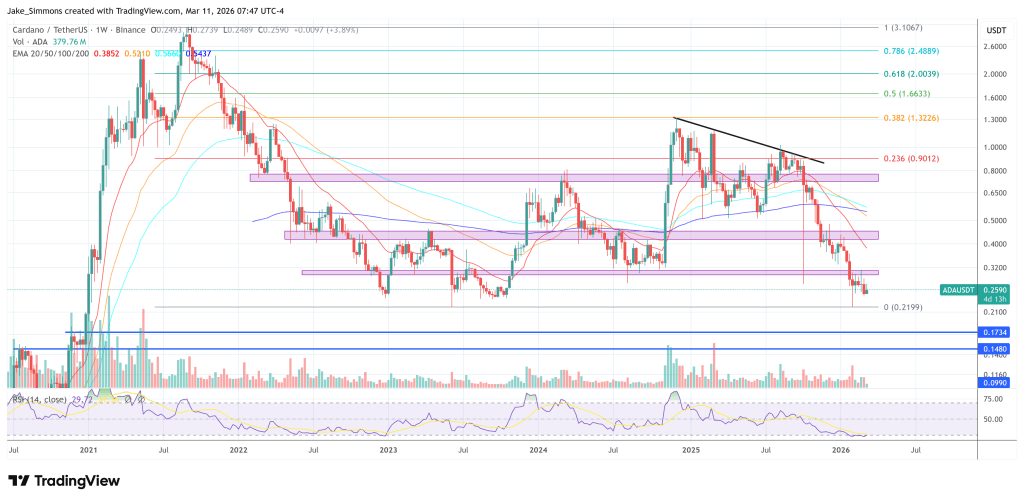
ADA hovers below key resistance, 1-week chart | Source: ADAUSDT on TradingView.com

相关问答

QWhat are the three layers of the Cardano ecosystem as outlined by Charles Hoskinson?

AThe three layers are infrastructure (core rails like nodes and scaling components), utility (the DApp and DeFi stack), and experience (the user-facing layer of wallets, onboarding, content, and brand).

QAccording to Hoskinson, what is the main problem with the current funding model in Cardano's Catalyst treasury?

AThe treasury has historically been overrepresented in funding infrastructure and severely underrepresented in funding utility and experience, leading to a lack of support for applications, user interfaces, and content creators.

QWhat is Hoskinson's proposed alternative to traditional grants for funding projects in 2026?

AHe proposes a treasury-backed investment structure where the treasury takes ownership stakes in selected projects through a weighted index of ecosystem tokens, requiring oversight, cost reductions, strategic alignment, and partial revenue-sharing in return.

QWhy does Hoskinson believe consolidation is necessary in the Cardano ecosystem, particularly in DeFi?

AHe argues that at current adoption levels, it is unsustainable to support a large number of similar products, such as 25 DEXs, and that the ecosystem needs to consolidate to one to three leaders per category.

QHow does Hoskinson link Cardano's 'brand problem' to its user growth challenges?

AHe states that the ecosystem has failed to compensate ambassadors and content creators, leading to a hostile public narrative that labels Cardano as 'uncool' or a 'ghost chain,' which hinders user adoption. Better marketing and user experience are needed to counter this.

你可能也喜欢

早报 | BitMine 上周增持 126,971 枚 ETH;交易员 Eugene 宣布退出加密市场

**重要资讯摘要:** - **交易员动态:** 知名交易员 Eugene 宣布退出加密货币市场,转而更看好股票市场的机会。 - **安全事件:** Syscoin 跨链桥遭遇攻击,涉及约 50 亿枚 SYS,目前桥接服务已暂停。 - **融资动态:** AI 公司 Moonshot AI 寻求新一轮最高 20 亿美元融资,估值目标达 300 亿美元。 - **机构持仓:** BitMine 上周大幅增持 126,971 枚 ETH,使其以太坊总持仓量增至 554.38 万枚,占以太坊总供应量的 4.59%,正在接近其持有 5% 供应量的战略目标。 - **公司动向:** 数字银行 Revolut 计划按约 1150 亿美元估值进行二级股权出售,允许早期投资者和员工部分套现。 - **提案获批:** Strategy 公司关于将 STRC 股息支付频率从每月改为每半月的提案已获股东批准,首次支付日期为 7 月 15 日。 - **其他要闻:** FTX 创始人 SBF 已正式提交总统特赦申请;Strategy 上周斥资约 1.013 亿美元购入了 1550 枚比特币。 **市场数据(Meme热门榜):** 根据 GMGN 数据,截至 6 月 9 日 09:00,过去 24 小时内: - **ETH 链**热门代币前五为:HEX、SHIB、LINK、PEPE、mUSD。 - **Solana 链**热门代币前五为:TROLL、WORLDCUP、neet、Buttcoin、PBTC。 - **Base 链**热门代币前五为:toby、ELSA、SKI、cbETH、CYPR。 **深度阅读推荐:** 文章探讨了股市“鱼尾行情”(市场顶部阶段)的原理与风险,并分析了在人工智能推理成为稀缺资源的背景下,价值将在算力栈的哪一层沉淀。

链捕手26分钟前

早报 | BitMine 上周增持 126,971 枚 ETH;交易员 Eugene 宣布退出加密市场

链捕手26分钟前

Michael Saylor最新长文:谁在定义比特币的灵魂?

迈克尔·塞勒在其文章中阐述了比特币社区内四种主要意识形态:比特币最大主义者、比特币资本主义者、比特币技术主义者和比特币原教旨主义者,并分析了它们各自的核心信念、世界观、强调重点、优势与风险。 最大主义者视比特币为占主导地位的数字货币网络,是解决货币贬值和实现经济赋权的道德与技术突破。资本主义者认为比特币需深度融入全球经济(如资本市场、信贷、企业资产负债表)才能发挥全部潜力,强调机构采用和金融整合。技术主义者关注比特币协议的持续改进,以增强可扩展性、隐私、安全性等功能性,应对未来挑战。原教旨主义者则致力于捍卫比特币的核心原则,如去中心化、自托管、抗审查和货币属性,防止其被机构俘获或协议妥协。 文章指出,这四种观点分别回应了比特币生态的不同需求:最大主义者提供信念,资本主义者推动采用,技术主义者解决技术挑战,原教旨主义者守护协议完整性。每种意识形态若走向极端都可能带来风险,如排他性、鲁莽金融化、过度干预或停滞。 塞勒认为,比特币的成功需要平衡这些视角:在保持底层协议稳定和安全(原教旨主义)的前提下,承认其主导地位(最大主义),通过高层创新与全球金融系统整合(资本主义),并适时进行谨慎的技术改进(技术主义)。最终目标是让比特币在服务于个人、企业、机构及国家等多重角色的同时,不丧失其核心价值与独特性。

marsbit1小时前

Michael Saylor最新长文:谁在定义比特币的灵魂?

marsbit1小时前

为什么以太坊还需要 Kohaku?隐私问题不只发生在交易里

以太坊基金会近期更积极地推动名为Kohaku的隐私工具集,旨在解决以太坊公开透明特性带来的用户隐私焦虑。Kohaku并非单一产品,而是一组整合隐私协议、钱包体验、开发者工具和日常使用场景的基础设施工具,目标是让隐私能力更易用、更自然地融入以太坊生态。 文章指出,以太坊的透明性虽有利于审计和可组合性,但也导致用户链上行为(如资产、交易、社交关系)近乎完全暴露。Kohaku试图补足从隐私协议到实际用户体验的中间层,具体方向包括:在钱包层鼓励用户按场景管理不同账户,而非长期复用单一地址;推动交易从“全公开”转向“可控制的可见性”,并集成Railgun等隐私池协议;保护RPC查询等网络层行为,防止信息在数据请求环节泄露;以及通过工具包降低开发者集成隐私功能的门槛。 文章澄清了关于隐私的常见误解:隐私不等于犯罪工具,而是用户的基本权利;现有隐私协议未能解决用户体验门槛问题;Kohaku是工具集合而非独立产品;隐私与合规可通过选择性披露等方式协调。若Kohaku的理念被广泛采纳,用户未来或将感受到更便捷的账户管理、更低的隐私功能使用门槛以及对信息边界的更多控制权。 最终,Kohaku代表着以太坊向成熟公共基础设施演进的关键一环——在保持开放参与的同时,让用户能保有合理的隐私边界。

marsbit1小时前

为什么以太坊还需要 Kohaku?隐私问题不只发生在交易里

marsbit1小时前

交易

现货
合约

热门文章

如何购买S

欢迎来到HTX.com!我们已经让购买Sonic(S)变得简单而便捷。跟随我们的逐步指南,放心开始您的加密货币之旅。第一步:创建您的HTX账户使用您的电子邮件、手机号码注册一个免费账户在HTX上。体验无忧的注册过程并解锁所有平台功能。立即注册第二步:前往买币页面,选择您的支付方式信用卡/借记卡购买:使用您的Visa或Mastercard即时购买Sonic(S)。余额购买:使用您HTX账户余额中的资金进行无缝交易。第三方购买:探索诸如Google Pay或Apple Pay等流行支付方法以增加便利性。C2C购买:在HTX平台上直接与其他用户交易。HTX场外交易台(OTC)购买:为大量交易者提供个性化服务和竞争性汇率。第三步:存储您的Sonic(S)购买完您的Sonic(S)后,将其存储在您的HTX账户钱包中。您也可以通过区块链转账将其发送到其他地方或者用于交易其他加密货币。第四步:交易Sonic(S)在HTX的现货市场轻松交易Sonic(S)。访问您的账户,选择您的交易对,执行您的交易,并实时监控。HTX为初学者和经验丰富的交易者提供了友好的用户体验。

2.5k人学过发布于 2025.01.15更新于 2026.06.02

如何购买S

相关讨论

欢迎来到HTX社区。在这里,您可以了解最新的平台发展动态并获得专业的市场意见。以下是用户对S(S)币价的意见。

活动图片