Here’s Why The Ethereum Validator Network Is So Strong

bitcoinist发布于2026-01-30更新于2026-01-30

文章摘要

Amid a declining cryptocurrency market, Ethereum's validator network demonstrates remarkable resilience and strength, highlighting the robustness of its proof-of-stake architecture. According to market expert Charles Allen, there is growing demand to become a validator and stake ETH, while staking withdrawals have significantly decreased. The exit queue has shortened to about one day, indicating a healthier balance between validators joining and leaving the network. Meanwhile, the deposit queue has grown to over 54 days, reflecting strong validator interest and new capital waiting to enter. This trend suggests that companies and individuals prefer staking ETH over selling it, signaling strong network security and participation. For instance, Bitmine Immersion Technologies recently staked an additional $341 million worth of ETH, bringing its total staked holdings to over 2.33 million ETH valued at $7 billion. This move underscores building long-term conviction in Ethereum among large entities.

Amid the waning cryptocurrency market, the Ethereum blockchain continues to display notable resilience, proving its position as a leader in the blockchain sector. The blockchain is experiencing significant growth, especially the ETH’s Validator network, which underscores its robust reliability and stability.

A Pillar of Stability For The Ethereum Network

Ethereum is not just becoming a settlement layer for on-chain finance; it is also becoming a secured blockchain for its numerous validators. Even with a volatile crypto condition, hindering price and network growth, the ETH validator network appears not to be affected by the bearish phase.

The Ethereum validator network is demonstrating remarkable strength, highlighting the robustness of the blockchain’s proof-of-stake architecture. In an X post, Charles Allen, a market expert and the Chief Executive Officer (CEO) of Nasdaq, has shed light on why the ETH’s validator network is demonstrating robust strength.

Charles Allen’s perspective on the subject is primarily based on the significant demand for becoming a validator. Over the past few weeks, the expert highlighted that there has been a rise in demand to become a validator and stake ETH.

Furthermore, staking withdrawals have seen a substantial drop along with the rise in validator demand, indicating a notable shift in the landscape. With a 1 month period, staking withdrawals have fallen to about a one-day wait. Interestingly, concerns about congestion or forced exits are lessened by the shorter exit queue, which suggests a better balance between validators joining and departing the network.
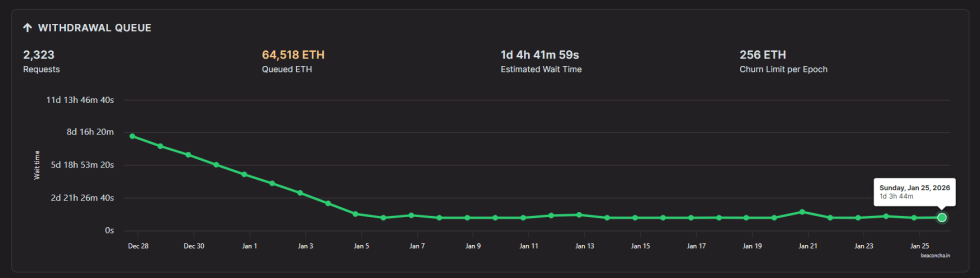
Source: Chart from Charles Allen on X

While withdrawal wait times have dropped to roughly a single day, the deposit queue has grown to more than 54 days. Such a growth reflects a strong validator interest and signals a surge of new capital waiting to enter the leading network. As more ETH becomes available for staking, the rising deposit backlog highlights the tightening of the liquid supply and the increased dedication to network security.

In simple terms, the expert stated that multiple companies and individuals wish to stake ETH rather than sell it. Allen added that this is considered a robust signal for network security and validator participation.

Bitmine Is Not Slowing Down On ETH Staking

Companies and individuals’ interest in staking Ethereum rather than selling it is largely evidenced by Bitmine Immersion Technologies’ massive staking activity lately. Broke Doomer on X reported that the largest ETH treasury holding company recently committed another $341 million worth of ETH to staking.

The chart shared by the crypto expert shows that the company conducted the transfer in a series of transactions within a single day. Following this latest move, Bitmine’s overall staking holdings are now positioned at more than 2.33 million ETH valued at a staggering $7 billion.

With this massive number of ETH, more than half of the company’s ETH holdings are currently locked and earning interest. Doomer classifies this adoption as a sign of conviction building among large entities or firms over the next few years. “You don’t do that if you’re bearish. You do that when you’re building conviction for the next few years,” the expert stated.

ETH trading at $2,961 on the 1D chart | Source: ETHUSDT on Tradingview.com

相关问答

QWhat is the main reason behind the strength of the Ethereum validator network according to the article?

AThe main reason is the significant demand for becoming a validator and staking ETH, coupled with a substantial drop in staking withdrawals, which indicates a strong commitment to network security and a shift in investor behavior from selling to staking.

QWho is Charles Allen and what insight did he provide about the Ethereum network?

ACharles Allen is the Chief Executive Officer (CEO) of Nasdaq. He highlighted that the rising demand to become a validator and the decrease in staking withdrawals demonstrate the robustness of Ethereum's proof-of-stake architecture and signal strong network security.

QWhat does the current state of the deposit and exit queues indicate about the Ethereum validator network?

AThe deposit queue has grown to more than 54 days, reflecting strong validator interest and a surge of new capital waiting to enter the network. Meanwhile, the exit queue has shortened to about a one-day wait, indicating a better balance between validators joining and leaving and reduced concerns about congestion or forced exits.

QWhich company was mentioned as evidence of large-scale ETH staking, and what was the value of their recent commitment?

ABitmine Immersion Technologies was mentioned. They recently committed another $341 million worth of ETH to staking, bringing their total staking holdings to over 2.33 million ETH valued at approximately $7 billion.

QHow does the article interpret the action of staking ETH instead of selling it?

AThe article interprets staking ETH instead of selling it as a robust signal for network security and validator participation. It reflects building conviction among large entities for the long-term potential of Ethereum, as staking locks up supply and earns interest, indicating a bullish outlook rather than a bearish one.

你可能也喜欢

《冒险岛宇宙》开放 MSU Space 并启动全球 Game Jam 比赛,作为 MSU 2.0 扩展的一部分

**《冒险岛宇宙》推出MSU Space并启动全球Game Jam比赛,作为MSU 2.0扩张的一部分** 2026年6月8日,链上驱动的《冒险岛》扩展宇宙(MapleStory Universe,简称MSU)宣布推出 **“MSU Space”** 构建者中心,并启动全球性的 **“冒险岛氛围营”** 游戏创作比赛。这标志着其 **MSU 2.0** 扩张计划的首次重大公开活动。 **核心内容:** 1. **MSU Space上线**:这是一个与AI游戏创作平台Verse8合作开发的专属构建者中心。创作者可在此使用官方的《冒险岛》资产、资源与开发工具,结合Verse8的AI辅助功能,通过自然语言提示等低门槛方式创作并发布基于《冒险岛》IP的原创游戏和体验。 2. **全球Game Jam比赛**:同步启动的“冒险岛氛围营”比赛于6月8日至29日举行,面向全球构建者,总奖池为 **6万美元的NXPC(生态代币)**。优秀项目将获得奖励及未来参与生态建设的潜在机会。 3. **MSU 2.0愿景**:此举旨在将《冒险岛》从一个封闭的游戏IP,转变为一个 **“可编程的生态系统”** 。通过结合链上基础设施、AI创作工具和社区驱动参与,降低基于经典IP进行创作的传统壁垒,让玩家和构建者都能围绕IP进行创造。 4. **合作背景**:选择Verse8平台是为了利用其AI原生创作能力,为更广泛的开发者及AI原生构建者提供易于访问的入口,吸引新群体参与MSU生态建设。 5. **生态现状**:公告提及MSU在过去一年的运营中,已累计完成超过1.5亿笔链上交易,并产生了约4910万NXPC(相当于3100万美元)的生态系统收入。 此举被视为《冒险岛宇宙》从单一游戏环境向支持创作、分发和货币化的更广阔平台扩展的关键一步。

TheNewsCrypto26分钟前

《冒险岛宇宙》开放 MSU Space 并启动全球 Game Jam 比赛,作为 MSU 2.0 扩展的一部分

TheNewsCrypto26分钟前

Reddit 一周热议美股观察:RKLB/LUNR/ASTS 集体下挫,太空板块还值得考虑吗?

Reddit股票社区上周热议集中在太空板块,SPCE、RKLB、LUNR和ASTS四只股票讨论量飙升。然而除SPCE因竞争对手Blue Origin火箭爆炸等因素单日大涨22%外,RKLB、LUNR和ASTS均出现显著下跌。 下跌主要受三大利空叠加影响:Blue Origin的New Glenn火箭测试爆炸,直接影响其发射合作伙伴ASTS的计划;SpaceX即将进行大规模IPO,引发资金从现有“替代品”中流出;部分公司内部人士在高位附近减持。 这四家公司业务实质差异巨大: - **RKLB(Rocket Lab)**:拥有实质性且加速增长的收入,业务覆盖发射服务和卫星制造,手握大量订单。但其估值较高(远期市销率约80倍),且依赖正在研发的Neutron火箭的成功。分析师认为其接近$96-$102区间时风险收益比更佳。 - **LUNR(Intuitive Machines)**:营收增长主要来自收购并表,自身业务增长不及预期,未来取决于关键的IM-3月球着陆任务结果。 - **ASTS(AST SpaceMobile)**:拥有搭建太空直连手机网络的宏大故事,但Blue Origin停飞严重打乱了其卫星发射计划,执行风险高,估值昂贵。 - **SPCE(Virgin Galactic)**:营收规模极小,近期暴涨主要由逼空交易和散户情绪驱动,缺乏基本面支撑,风险极高。 **结论**:板块长期逻辑未变,但短期定价已透支基本面。目前并非“黄金坑”,若继续下跌,RKLB因其扎实的业务基础和订单,可能最先进入合理估值区间。投资者需警惕SPCE的纯粹情绪炒作,并对LUNR和ASTS等待更明确的催化剂。

marsbit31分钟前

Reddit 一周热议美股观察:RKLB/LUNR/ASTS 集体下挫,太空板块还值得考虑吗?

marsbit31分钟前

Crypto 为什么总在造「赌场」,却很少造出「离不开的产品」?

本文探讨了加密货币为何难以创造如主流互联网平台那样让用户产生深度依赖(文中称为“沙发瘫”或“沙发锁”现象)的日常产品,而多与投机和赌博机制相关联。 作者借由“沙发奇点”的概念,指出成功平台通过提供极致便利,使用户因切换成本过高而被“锁定”。加密货币虽然通过价格波动等“可变奖励机制”吸引了大量投机行为,但这种兴奋感并未转化为实用的、高频的日常应用依赖。 核心问题在于,加密货币旨在解决的大多是普通人感知不强的底层金融效率问题(如跨境汇款中的代理银行系统),而非像互联网那样直接解决明显的日常痛点。因此,它缺乏让大众产生“顿悟时刻”的直观体验,采用门槛高,仍需大量解释。 此外,文章对比了加密货币与大型科技公司在数据资产上的差距。后者通过海量用户行为数据构建精准预测模型,而区块链主要记录金融交易,缺乏对行为动机的洞察,难以形成同等商业价值。 文章也审视了加密货币在基础设施层面的依赖问题,以及其在现实世界资产(如房地产)Token化中的矛盾角色:技术本身中立,可能反而赋能大型机构,加剧市场垄断而非促进普惠。 最终,作者认为加密货币或许更适合作为底层结算轨道等企业级基础设施存在,这虽与打造消费级“超级应用”的梦想不同,但仍是一项重大成就。其真正的潜力在于提供脱离中心化控制的工具,帮助构建对抗剥削性平台模式的新系统。

marsbit32分钟前

Crypto 为什么总在造「赌场」,却很少造出「离不开的产品」?

marsbit32分钟前

交易

现货
合约

热门文章

如何购买S

欢迎来到HTX.com!我们已经让购买Sonic(S)变得简单而便捷。跟随我们的逐步指南,放心开始您的加密货币之旅。第一步:创建您的HTX账户使用您的电子邮件、手机号码注册一个免费账户在HTX上。体验无忧的注册过程并解锁所有平台功能。立即注册第二步:前往买币页面,选择您的支付方式信用卡/借记卡购买:使用您的Visa或Mastercard即时购买Sonic(S)。余额购买:使用您HTX账户余额中的资金进行无缝交易。第三方购买:探索诸如Google Pay或Apple Pay等流行支付方法以增加便利性。C2C购买:在HTX平台上直接与其他用户交易。HTX场外交易台(OTC)购买:为大量交易者提供个性化服务和竞争性汇率。第三步:存储您的Sonic(S)购买完您的Sonic(S)后,将其存储在您的HTX账户钱包中。您也可以通过区块链转账将其发送到其他地方或者用于交易其他加密货币。第四步:交易Sonic(S)在HTX的现货市场轻松交易Sonic(S)。访问您的账户,选择您的交易对,执行您的交易,并实时监控。HTX为初学者和经验丰富的交易者提供了友好的用户体验。

2.5k人学过发布于 2025.01.15更新于 2026.06.02

如何购买S

相关讨论

欢迎来到HTX社区。在这里,您可以了解最新的平台发展动态并获得专业的市场意见。以下是用户对S(S)币价的意见。

活动图片