Crypto Should Be Judged By Economic Role, Not Tech Design: ASIC Fintech Chief

bitcoinist发布于2026-03-11更新于2026-03-11

文章摘要

According to Rhys Bollen, head of fintech at the Australian Securities and Investments Commission (ASIC), consumer harm in crypto primarily stems from intermediaries—exchanges, custodians, lenders—rather than the tokens themselves. In a paper presented at the Melbourne Money and Finance Conference, Bollen argued that Australia should regulate digital assets based on their economic function, not their technological design. Tokens that act like securities should be treated as such, stablecoins moving money should fall under payments law, and consumer protection rules should cover the rest. This approach contrasts with jurisdictions like the U.S. and EU, which are creating crypto-specific laws. Australia is already implementing this through its Digital Asset Framework bill, which integrates digital assets into existing financial regulations rather than building a separate legal structure.

Most harm done to consumers in the crypto space has come not from the tokens themselves, but from the platforms handling them — the exchanges, custodians, lenders, and yield services.

That finding sits at the center of a new paper delivered this week by Rhys Bollen, the head of fintech at the Australian Securities and Investments Commission, who argues Australia should stop treating digital assets as something categorically new and start applying the financial laws already on the books.

Regulating What It Does, Not What It’s Called

Bollen made the case at the Melbourne Money and Finance Conference, where he argued that crypto tokens should be judged by their economic function. A token that acts like a security should be treated as one. A stablecoin that moves money should fall under payments law.

Consumer protection rules should pick up whatever else remains. His argument strips away the technological wrapping and asks a simpler question: what does this thing actually do?
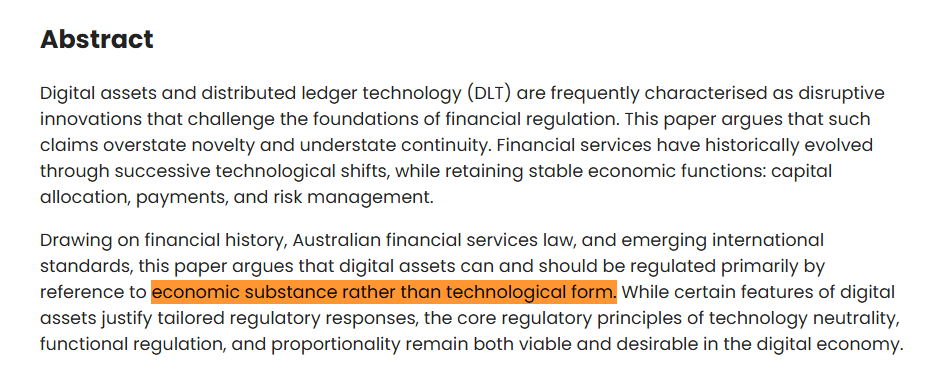
Paper presented at the Melbourne Money & Finance Conference, University of Melbourne by Dr. Rhys Bollen, Senior Executive Leader, FinTech

Crypto-Specific Law

That framing puts Australia at odds with how other countries have gone about it. The US is pushing the CLARITY Act, a purpose-built crypto framework. The European Union has rolled out its Markets in Crypto-Assets rules, known as MiCA. Both create dedicated regulatory structures for digital assets.

Bollen’s position, by contrast, is that building a separate system from scratch misses the point — and leaves gaps that bad actors will find.

“Opportunities for regulatory arbitrage” is how Bollen describes those gaps. Build a crypto-specific law, and someone will structure a product to fall outside it. Attach crypto to existing law based on what the product does, and that exit shrinks.

BTCUSD trading at $69,615 on the 24-hour chart: TradingView

Australia Already Writing It Into Law

Australia isn’t waiting on theory. The country’s Digital Asset Framework bill, currently moving through parliament, doesn’t attempt to replace the Corporations Act.

Reports indicate the bill amends it — slotting digital asset platforms into the existing regulatory structure rather than building a lane beside it.

ASIC’s own guidance document, Information Sheet 225, has already confirmed that existing definitions of financial products and services under the Corporations Act can apply to crypto, depending on how a given asset functions.

Bollen was direct about what that means in practice. Regulators, he said, should be focused on intermediaries — the companies sitting between users and their crypto — rather than on the tokens themselves. That’s where the consumer harm has actually shown up.

Featured image from Cyber Security News, chart from TradingView

相关问答

QAccording to Rhys Bollen, where has most consumer harm in the crypto space originated from?

AMost consumer harm has come not from the tokens themselves, but from the platforms handling them, such as exchanges, custodians, lenders, and yield services.

QWhat is the core argument made by the ASIC FinTech chief regarding how crypto should be regulated?

ACrypto tokens should be judged by their economic function rather than their technological design, meaning a token that acts like a security should be treated as one, and existing financial laws should be applied based on what the product actually does.

QHow does Australia's proposed regulatory approach for digital assets differ from that of the US and EU?

AAustralia is amending its existing Corporations Act to slot digital assets into the current regulatory structure, whereas the US is pushing the purpose-built CLARITY Act and the EU has created a dedicated framework called MiCA.

QWhat does the term 'regulatory arbitrage' refer to in the context of crypto regulation, as mentioned by Bollen?

A'Regulatory arbitrage' refers to the opportunities for bad actors to structure crypto products in a way that falls outside the scope of a purpose-built, crypto-specific regulatory framework, thereby creating gaps in consumer protection.

QWhat is the practical focus for regulators that Bollen suggests to prevent consumer harm in the crypto space?

ARegulators should focus on the intermediaries—the companies that sit between users and their crypto, such as platforms and service providers—rather than on the tokens themselves, as that is where the actual consumer harm has occurred.

你可能也喜欢

帕克·刘易斯解释为何比特币仍是最佳货币

知名比特币分析师帕克·刘易斯在访谈中批评了某些上市公司以“数字信贷”形式销售永续优先股的营销策略,认为这从根本上扭曲了比特币的本质。他指出,比特币在算法层面不具备法币收益性,承诺定期分红主要依赖牛市吸引新投资者来维持,风险极高。 刘易斯引用数据说明此类衍生品的巨大风险:全球信贷市场规模达300万亿美元,而永续优先股市场仅约1万亿美元,这表明机构有意规避这种无还款期限的资产,将风险转嫁给信息不足的散户。 针对“比特币波动性太大”的常见观点,他认为波动性是这一供应量严格受限的新资产被大规模采用过程中的自然数学结果。新人入场需出更高价从早期持有者手中购买,导致价格剧烈波动。他建议投资者直接持有比特币,这比投资MicroStrategy等公司发行的衍生品更安全。 投资者将焦点从直接持有加密货币转向公司衍生品,会忽视法币急速贬值的真正威胁。刘易斯以自创的“肋眼牛排指数”为例,指出其本地超市一款牛排价格从2020年的19.99美元涨至37.99美元,反映年化约12-13%的真实通胀,远超官方平滑后的CPI数据。 在全球通胀环境下,最明智、保守且安全的策略仍是直接持有比特币并完全掌控私钥。追逐加密货币国库股等公司工具的收益只会叠加隐性系统风险,而理解去中心化货币的本质才能有效保护财富免受宏观经济动荡影响。

cryptonews.ru2小时前

帕克·刘易斯解释为何比特币仍是最佳货币

cryptonews.ru2小时前

比特币为何在美联储强硬暂停后守住 64,000 美元关口

比特币在美联储暂停加息后维持在64,000美元附近,结束了7月的交易。市场对美联储维持利率不变的决定反应剧烈,但并未获得政策即将转向的明确信号。在此背景下,资金重新流入比特币现货ETF,加密货币总市值保持在2.29万亿美元左右,主要山寨币走势分化。 投资者目前处于观望状态。一方面,高利率和美联储的强硬立场抑制了风险偏好;另一方面,市场未出现恐慌性抛售、比特币ETF恢复资金净流入以及关键价位的韧性表明,数字资产市场尚未准备好大幅下跌。 **关键信息:** - 美联储维持利率在3.50%-3.75%,投票结果为9:3,三位委员支持加息。 - 比特币现货ETF净流入3210万美元,结束了连续流出;以太坊ETF则净流出约1865万美元。 - 比特币在63,000-66,000美元区间内盘整,63,000-63,500美元构成支撑,66,000美元是近期阻力。 - 以太坊价格在1,900美元附近承压,但其网络基本面(如质押意愿)保持稳定。 - 资金在主要加密货币间轮动,比特币重获机构青睐,Solana相关产品也有资金流入。 - 美国CLARITY Act法案审议被推迟至秋季,降低了其在2026年内通过的可能性。 技术层面,比特币能否在63,000美元上方保持稳固、以太坊能否守住1,860美元以及机构资金流入能否持续,被视为市场能否在2026年下半年构筑复苏基础的关键信号。

cryptonews.ru2小时前

比特币为何在美联储强硬暂停后守住 64,000 美元关口

cryptonews.ru2小时前

交易

现货
活动图片





