CLARITY Act edges closer – But ONE disagreement is holding everything up

ambcrypto发布于2026-03-18更新于2026-03-18

文章摘要

The CLARITY Act, a key piece of U.S. crypto market structure legislation, is advancing but remains stalled due to a major disagreement over interest-bearing stablecoins. While the crypto industry supports such products, traditional banks oppose them, fearing capital flight from deposits. Despite this impasse, political pressure is mounting, notably from President Donald Trump, who publicly demanded the bill's swift passage to maintain U.S. financial leadership and prevent innovation from moving abroad. The crypto community expresses growing confidence in the bill's eventual success, with Polymarket bettors assigning a 62% probability of it passing in 2026. The legislation aims to provide regulatory clarity and unlock institutional investment, but disagreements continue to delay progress.

The GENIUS Act, passed in 2025, created a regulatory framework for U.S. stablecoins. However, clear rules for the rest of the crypto market are still missing.

That may soon change, as the recent data from Santiment suggested the Digital Asset Market CLARITY Act is moving closer to the final stage of the legislative process.

If passed, the bill could mark a turning point for institutional investment in crypto, providing clearer regulatory guidance for large investors.
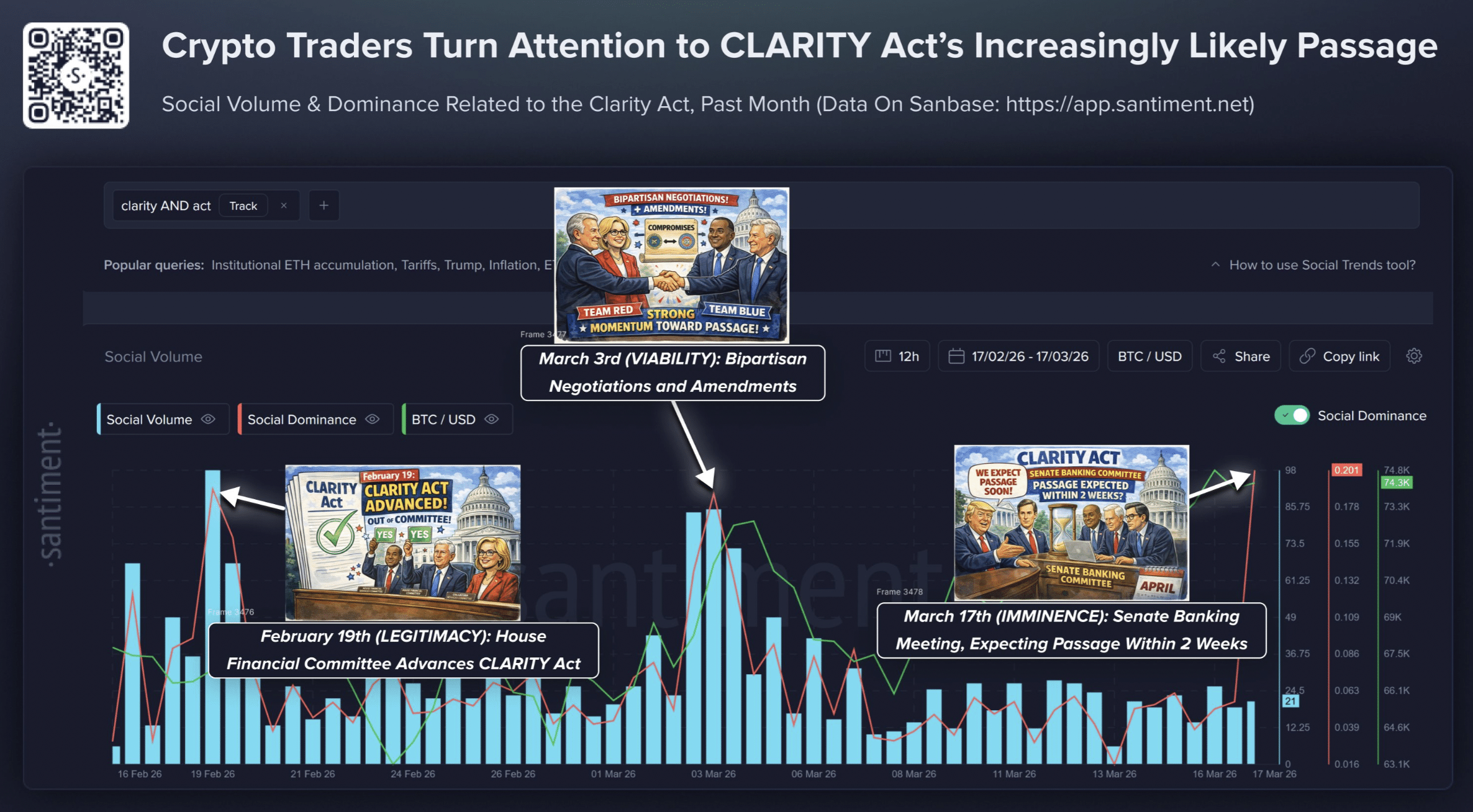
Source: Santiment/X

CLARITY Act talks continue

Talking about the same at the DC Blockchain Summit on the 17th of March, Senate Banking Committee Chair Tim Scott said the bill is still delayed due to a disagreement over interest-bearing stablecoins.

While the crypto industry supports such products, banks fear they could pull large amounts of money away from traditional deposits.

That said, Senators Thom Tillis and Angela Alsobrooks are currently reviewing these concerns and pushing for stronger safeguards if crypto products function like bank services.

This cautious approach has slowed the bill’s progress. Meanwhile, political pressure is growing, especially after U.S. President Donald Trump urged lawmakers to pass the Act quickly.

President Trump demands CLARITY Act passage

On the 4th of March, U.S. President Donald Trump wrote in a post on Truth Social,

The Genius Act is being threatened and undermined by the Banks, and that is unacceptable — We are not going to allow it. The U.S. needs to get Market Structure done, ASAP.

Donald Trump’s statement has shifted the debate around the CLARITY Act from a technical policy issue to a broader economic and strategic concern.

He argues that without clear crypto regulations, capital and innovation could move to countries like China, making the bill important for maintaining U.S. financial leadership.

Trump also criticized major banks for resisting crypto reforms, despite reporting record profits, suggesting they are prioritizing their own interests.

By linking the CLARITY Act to his goal of making the U.S. the global crypto capital, he has increased pressure on lawmakers to move the legislation forward.

Crypto community stands confident

The confidence was also reflected in the crypto community, as noted by Senator Kevin Cramer when he said,

I think we have to make this a committee priority for some time just before Easter or shortly after.

Echoing similar sentiments, Dan Spuller, EVP of Industry Affairs at Blockchain Association, added,

I’m now increasingly confident we’re going to get CLARITY through, and we’re not going to let the banks rig the outcome.

Polymarket odds and other hiccups

Additionally, Polymarket bettors have also pushed the odds of the CLARITY Act passing in 2026 to a commanding 62%.
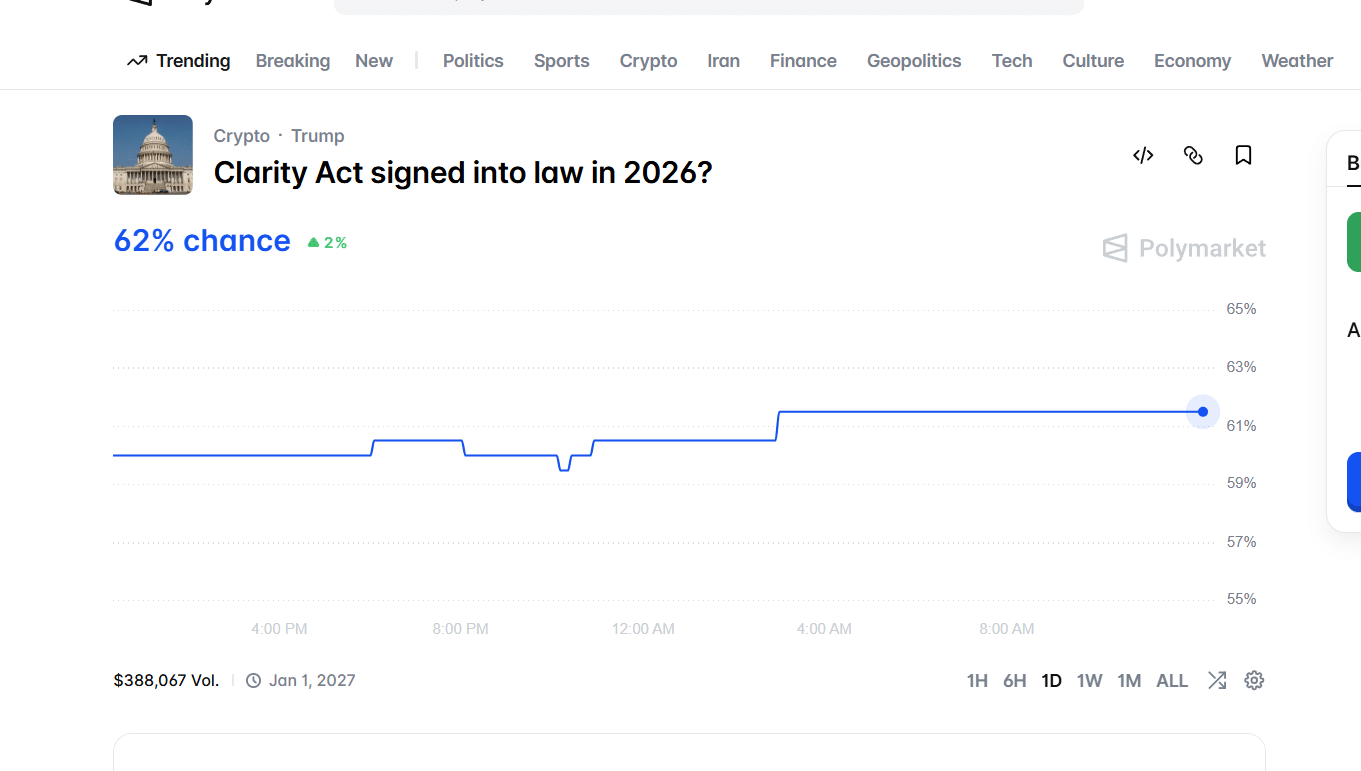
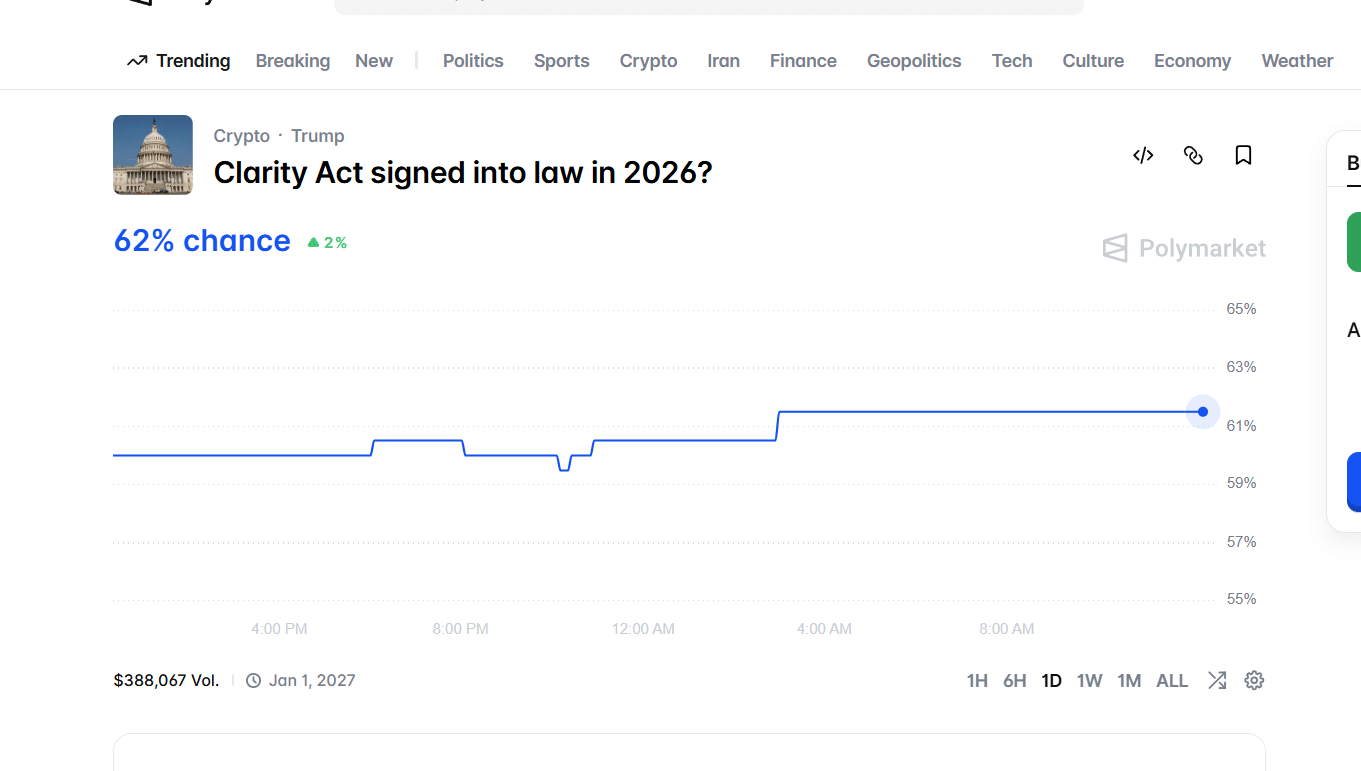
Source: Polymarket

Needless to say, the bill has now become the center of a growing clash between the U.S. government and traditional banks.

This disagreement has stalled the bill since early 2026. Thus, as expected, Trump’s crypto advisor, Patrick Witt, had put it best when he said,

The CLARITY Act must remain a pro-innovation piece of legislation. Attempts to hijack the legislative process and turn it into an anti-competition bill are shameful.


Final Summary

  • Clear rules could unlock large institutional capital that has remained cautious due to regulatory uncertainty.
  • However, a key disagreement over interest-bearing stablecoins continues to slow progress.

相关问答

QWhat is the main disagreement holding up the CLARITY Act according to the article?

AThe main disagreement is over interest-bearing stablecoins, with the crypto industry supporting such products while banks fear they could pull large amounts of money away from traditional deposits.

QWhat did U.S. President Donald Trump say about the CLARITY Act and the banks?

APresident Trump stated that the 'Genius Act' (referring to the CLARITY Act) is being 'threatened and undermined by the Banks' and that this is unacceptable. He argued that the U.S. needs to get Market Structure done ASAP and criticized major banks for resisting crypto reforms despite reporting record profits.

QAccording to the article, what is the predicted probability of the CLARITY Act passing in 2026 on Polymarket?

APolymarket bettors have pushed the odds of the CLARITY Act passing in 2026 to 62%.

QHow did Trump's advisor, Patrick Witt, characterize attempts to change the CLARITY Act?

APatrick Witt characterized attempts to hijack the legislative process and turn the CLARITY Act into an anti-competition bill as 'shameful,' stating that the act must remain a pro-innovation piece of legislation.

QWhat previous legislation created a regulatory framework for U.S. stablecoins, as mentioned in the article?

AThe GENIUS Act, passed in 2025, created a regulatory framework for U.S. stablecoins.

你可能也喜欢

中国AI为什么发展得这么快?答案藏在实验室内部

本文通过作者走访中国头部AI实验室的经历,探讨了中国AI快速发展的原因及其与美国的路径差异。文章指出,中国AI的优势不仅在于人才、工程和迭代速度,更在于其务实的组织方式:少谈概念,多做模型;强调团队执行而非个人明星;倾向于自研核心技术栈而非依赖外部服务。 中国AI生态呈现出与美国不同的发展模式:美国注重原创范式、资本投入和顶尖科学家的个人影响力;中国则更擅长在已有方向上快速追赶,通过开源协作、工程优化和大量年轻研究者的投入,将模型能力迅速推向前沿。中国的许多核心贡献者是学生,他们带着谦逊和专注投入工作,较少受个人主义或哲学讨论的干扰,更专注于模型构建本身。 在产业层面,中国公司普遍持有“技术所有权”心态,倾向于自建而非购买技术栈,大型科技公司纷纷研发自己的大语言模型以掌控核心技术。尽管对英伟达算力有强烈需求,且国内数据产业不如西方发达,但中国AI需求正在增长,更接近云市场的支出模式而非传统的SaaS市场。 文章认为,未来的AI竞争不仅是模型能力的比拼,更是组织能力、开发者生态和产业执行力的竞争。中国AI正以自身独特的方式参与全球前沿,两种不同的发展路径正在形成。作者最后强调,尽管存在地缘政治紧张,但全球开放AI生态的繁荣对世界更为有益,并表达了对中美在AI领域协同发展的期望。

marsbit9小时前

中国AI为什么发展得这么快?答案藏在实验室内部

marsbit9小时前

3年5倍,百年玻璃厂重生

本文探讨了拥有175年历史的玻璃制造商康宁公司如何在AI数据中心建设浪潮中,借助光纤需求爆发实现业绩与股价的飞跃。文章核心内容如下: AI数据中心对光纤的需求出现结构性爆发,根据CRU数据,年增长率高达75.9%,导致供需缺口扩大。英伟达为此投资康宁等三家公司,总金额达45亿美元,旨在打通从激光器、光芯片到光纤的全链条。康宁作为被选中的光纤供应商,承诺大幅扩张产能。 需求爆发的背后有两重逻辑:一是光纤核心材料“预制棒”的扩产周期长、工艺要求高,供给存在刚性约束;二是AI芯片算力提升迫使数据通信从电转向光,以降低能耗并提高传输效率,这直接推动了高端特种光纤(如用于CPO共封装光学)的需求。AI数据中心的光纤用量可达传统机柜的5-10倍,并随GPU集群规模超比例增长。 在此背景下,康宁光通信业务收入从2023年的13亿美元快速增长,2026年Q1同比增长93%,并获得了Meta、英伟达等科技巨头的长期大额订单。虽然从全球市场份额看康宁并非最大,但其在超低损耗、高密度、高抗弯等AI所需的高端特种光纤技术上具备优势,且企业级(数据中心)客户收入占比已超40%,这使其区别于以电信运营商客户为主的其他厂商。 文章指出,光纤涨价红利正惠及全行业。康宁当前股价和估值已大幅攀升,未来表现将取决于CPO技术落地节奏、大客户订单执行情况以及“空芯光纤”等潜在技术变革的影响。尽管前景看好,但短期过快的涨幅也可能带来波动风险。

marsbit10小时前

3年5倍,百年玻璃厂重生

marsbit10小时前

交易

现货
合约

热门文章

如何购买ONE

欢迎来到HTX.com!我们已经让购买Harmony(ONE)变得简单而便捷。跟随我们的逐步指南,放心开始您的加密货币之旅。第一步:创建您的HTX账户使用您的电子邮件、手机号码注册一个免费账户在HTX上。体验无忧的注册过程并解锁所有平台功能。立即注册第二步:前往买币页面,选择您的支付方式信用卡/借记卡购买:使用您的Visa或Mastercard即时购买Harmony(ONE)。余额购买:使用您HTX账户余额中的资金进行无缝交易。第三方购买:探索诸如Google Pay或Apple Pay等流行支付方法以增加便利性。C2C购买:在HTX平台上直接与其他用户交易。HTX场外交易台(OTC)购买:为大量交易者提供个性化服务和竞争性汇率。第三步:存储您的Harmony(ONE)购买完您的Harmony(ONE)后,将其存储在您的HTX账户钱包中。您也可以通过区块链转账将其发送到其他地方或者用于交易其他加密货币。第四步:交易Harmony(ONE)在HTX的现货市场轻松交易Harmony(ONE)。访问您的账户,选择您的交易对,执行您的交易,并实时监控。HTX为初学者和经验丰富的交易者提供了友好的用户体验。

813人学过发布于 2024.03.29更新于 2025.06.04

如何购买ONE

相关讨论

欢迎来到HTX社区。在这里,您可以了解最新的平台发展动态并获得专业的市场意见。以下是用户对ONE(ONE)币价的意见。

活动图片