Quick Facts:
- ➡️ Institutional Bitcoin holdings are robust, with models suggesting prices would need to collapse to ~$8,000 to trigger debt insolvency for major treasuries.
- ➡️ The resilience of Layer 1 is driving demand for Layer 2 utility, as investors seek yield and speed on top of their secure collateral.
- ➡️ Bitcoin Hyper utilizes the Solana Virtual Machine (SVM) to bring high-speed smart contracts to Bitcoin, solving the network’s historic latency issues.
- ➡️ Smart money interest is rising, with over $31M raised in the presale and significant whale accumulation recorded on-chain.
Corporate Bitcoin treasuries have hardened into the bedrock of the modern crypto economy. But analysts are now stress-testing exactly how far the market would need to bleed to break them.
According to recent strategic modeling regarding leverage and asset-backed debt, Bitcoin would need to catastrophically devalue to approximately $8,000 for major institutional holdings to fail in covering their debt obligations.
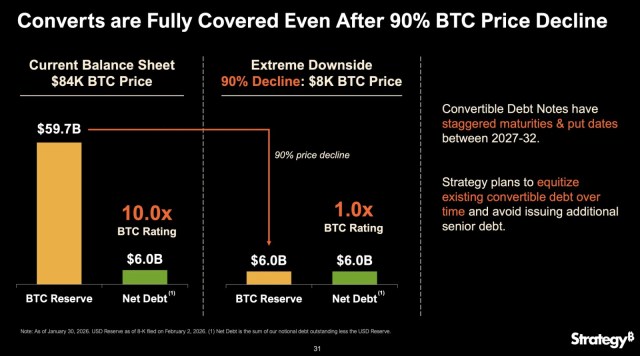
That is a staggering 92% drawdown from current levels. This figure is significant not because it’s likely, but because it highlights the extreme buffer institutional giants like MicroStrategy have built against volatility.
The data reveals a massive ‘invalidation zone.’ Critics often argue that leveraged institutional exposure poses a systemic risk of cascading liquidations. Well, sort of, but if the insolvency threshold is truly in the four-figure range, the current market structure is far more resilient than the bearish sentiment implies.
It shifts the narrative from ‘risk of collapse’ to ‘efficiency of capital.’ Institutions have effectively turned Bitcoin into a pristine collateral layer. Think of it as a digital Fort Knox.
Yet, a vault isn’t a payment rail. While the ‘Strategy’ of holding Bitcoin protects wealth, it doesn’t do much to generate yield or facilitate commerce. The base layer remains constrained by 10-minute block times and limited scriptability.
This disconnect, between Bitcoin as a passive asset and the market’s hunger for active capital, has triggered a migration of liquidity toward high-performance infrastructure.
As the base layer solidifies, capital is rotating into Layer 2 solutions capable of unlocking the trillion-dollar dormant value on the network. That trend is visibly accelerating the presale momentum of Bitcoin Hyper ($HYPER).
$HYPER is available here.
Bitcoin Hyper ($HYPER) Activates The SVM Liquidity Engine
The market is no longer satisfied with Bitcoin acting solely as a ‘pet rock.’ The demand is for programmable money. However, previous attempts to layer smart contracts atop Bitcoin have struggled with high latency and bridging risks.
Bitcoin Hyper ($HYPER) addresses this by integrating the Solana Virtual Machine (SVM) directly as a Bitcoin Layer 2. This isn’t merely an incremental upgrade; it’s a complete architectural shift. By using the SVM, Bitcoin Hyper enables transaction throughput that rivals traditional finance, bypassing the EVM limitations that hamstring many other L2s.
This integration solves the ‘velocity problem.’ On the main chain, Bitcoin is sluggish.
On Bitcoin Hyper, it becomes a high-frequency asset. The protocol features a Decentralized Canonical Bridge, allowing for trustless transfers of $BTC into a wrapped environment primed for DeFi, high-speed payments, and gaming.
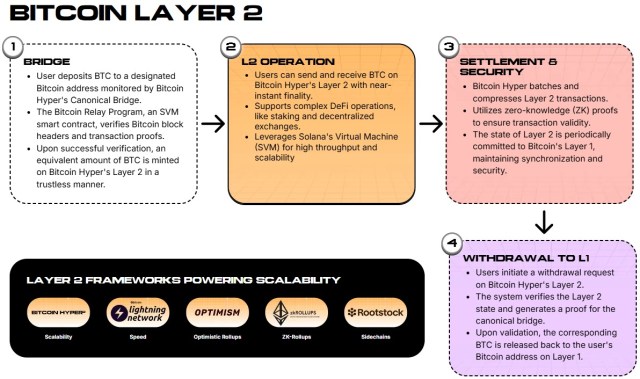
Plus, with support for Rust and a dedicated SDK, developers can deploy dApps that benefit from Bitcoin’s security guarantees without suffering from its execution bottlenecks.
The implication here is profound. If Bitcoin is the savings account, Bitcoin Hyper is the checking account and the investment bank combined. It enables users to stake, swap, and lend without leaving the Bitcoin ecosystem for less secure chains.
The technical architecture relies on a modular design: Bitcoin L1 handles final settlement (the anchor), while the SVM-powered L2 handles execution. This separation of duties allows for sub-second finality, a metric essential for modern DeFi applications but previously impossible on the Bitcoin network.
Check out Bitcoin Hyper here.
Whales Accumulate $HYPER As Presale Crosses $31M
While the base layer stabilizes, smart money is aggressively positioning itself in the infrastructure layer. Financial metrics from the Bitcoin Hyper presale indicate a decoupling from broader market sentiment, with capital flowing heavily into this new L2 narrative.
According to official data, the project has successfully raised over $31.2M and counting. That figure suggests high conviction among early adopters who view the SVM-on-Bitcoin thesis as the next logical cycle driver.
The token is currently priced at $0.0136752, but the volume of high-value transactions tells the clearer story.

On-chain data from Etherscan reveals that two whale wallets accumulated $500K and $380K respectively in recent transactions.
This specific activity suggests that sophisticated investors are looking past the short-term noise of Bitcoin’s price action and betting on the infrastructure that will service the network in the coming years.
Investors are likely drawn by the incentives structure. Bitcoin Hyper offers immediate staking after the Token Generation Event (TGE), with a 7-day vesting period for presale stakers. Unlike governance tokens with vague utility, $HYPER serves as the fuel for the L2 ecosystem, aligning holder interests with network activity.
When whales move $500K into a presale asset, it often signals an anticipation of a liquidity rotation, moving from the heavy, slow collateral of L1 into the high-velocity, yield-bearing potential of L2.
Join the Bitcoin Hyper presale.
This article is for informational purposes only and does not constitute financial advice. Cryptocurrencies are high-risk assets. The $8,000 figure cited regarding debt coverage is a theoretical model and not a price prediction. Always conduct independent due diligence before investing.

Related Posts

Bitcoin Teeters on Edge: Will $60K Hold or Is a V-Shape Recovery Imminent? $HYPER Keeps Pumping

Senator Lummis Urges Banks to Adopt Stablecoins Amidst CLARITY Act Delay, as Maxi Doge Turns Heads

Robinhood CEO Says Prediction Markets Will Soar as Bitcoin Hyper ($HYPER) Reaches $31.2M in Presale

Vitalik Buterin Cashes Out $6.6 Million In Ether After Early Signals

While Bitcoin And Ether Falter, XRP Optimism Stands Out: Analysts