Bitfarms Dumps Bitcoin, Rebrands As Keel Infrastructure In Full AI Shift

bitcoinist发布于2026-04-01更新于2026-04-01

文章摘要

Bitfarms, a former Bitcoin mining company, is fully exiting the cryptocurrency business and rebranding as Keel Infrastructure. The company is relocating from Canada to the US and shifting its focus entirely to building data centers for high-performance computing and artificial intelligence. This strategic pivot follows a fiscal year 2025 net loss of $284.5 million, driven by falling Bitcoin prices and increased mining difficulty. Despite the loss, investors reacted positively, with shares rising 6.6%. The company still holds approximately $161 million in debt-free Bitcoin, providing financial flexibility during its transition. This move aligns with a broader industry trend of crypto miners seeking higher margins in AI and computing.

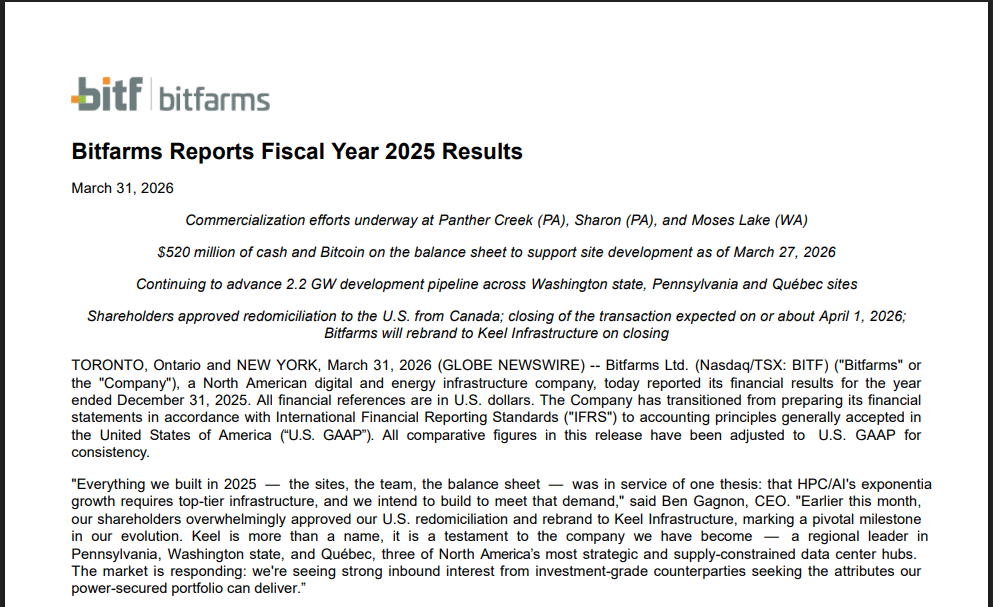
A company that built its name on cryptocurrency mining is walking away from the business entirely. Bitfarms announced plans Tuesday to rebrand as Keel Infrastructure and move its legal base from Canada to the US, capping a five-month exit from Bitcoin that management described as a deliberate break from the past.

No Half-Measures In The Company’s New Direction

CEO Ben Gagnon made the company’s position plain during an earnings call. “No half-measures, no compromises, and in time, no Bitcoin,” he said. “We built a new company.” Bitfarms is now focused on building and operating data centers that power high-performance computing and artificial intelligence platforms.

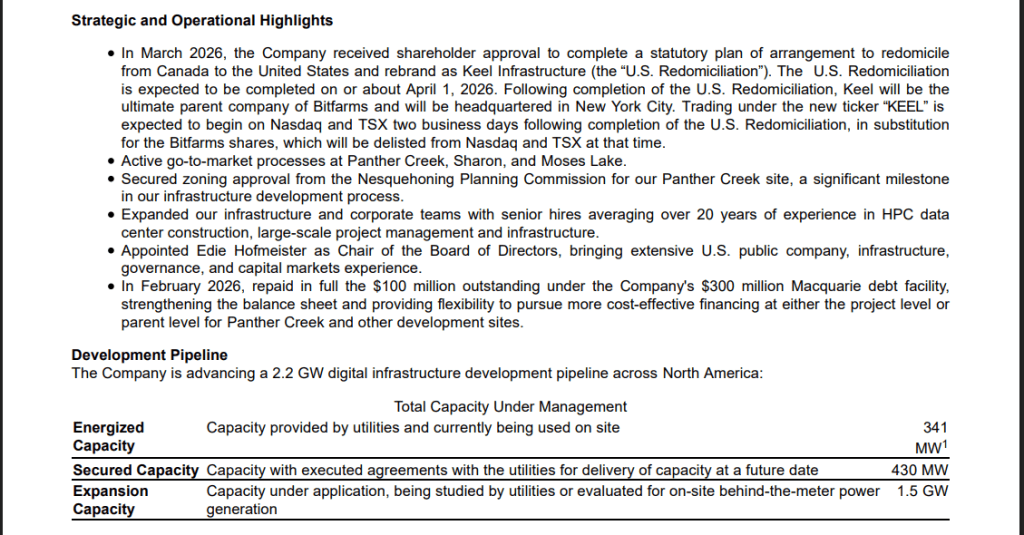
According to company filings, it is developing a 2.2-gigawatt infrastructure pipeline across North America, targeting what it calls hyperscalers and next-generation cloud providers.

The rebrand and the relocation have both received shareholder approval. The move to the US signals a deliberate repositioning — one aimed at tapping a market where AI infrastructure spending has been climbing steadily.
Bitfarms Fiscal Year 2025 Results. Source: Bitfarms

A Year Of Heavy Losses Tied To Falling Bitcoin Prices

The company’s 2025 financial results, also released Tuesday, showed a net loss of $284.5 million — wider than the year before. Revenue rose 70% year-on-year to close to $230 million, but the cost of generating that revenue came in at $248 million, producing a gross loss before other expenses were counted.

General and administrative costs also increased. A swing in the fair value of digital assets cost the company almost $51 million last year, compared to a $26 million gain in 2024. A $28 million gain from selling digital assets partially offset those figures.
Bitfarms Fiscal Year 2025 Results. Source: Bitfarms

Bitcoin mining has become a harder business to run. Data shows the leading cryptocurrency has dropped 45% from its October high. Mining difficulty — a measure of how hard it is to earn new coins — has risen 58% since the last halving in May 2024. Those conditions squeezed margins across the industry, not just at Bitfarms.

Despite the losses, investors responded positively. Shares closed Tuesday up 6.60%, trading at 2.73 Canadian dollars, or roughly $1.96 US.

BTCUSD trading at $68,780 on the 24-hour chart: TradingView

Bitcoin Holdings Still On The Books For Now

Reports indicate the company still holds about $161 million in Bitcoin that carries no debt against it. That reserve provides some financial flexibility as the transition continues.

Bitfarms is not alone in making this kind of shift. Iris Energy has been scaling AI cloud services using Nvidia graphics processors. Cipher Mining locked in a long-term hosting deal with AI cloud firm Fluidstack.

Riot Platforms and MARA Holdings have both expanded into AI and high-performance computing as well. The pattern reflects a broader move by mining companies seeking higher margins in a different corner of the tech sector.

For Bitfarms, the message from leadership is that the old business is done. What comes next is being built from the ground up — under a new name, in a new country, chasing a different market entirely.

Featured image from Akos Stiller/Bloomberg via Getty Images, chart from TradingView

热门币种推荐

相关问答

QWhat is the new name and focus of Bitfarms after its rebranding?

AThe company has rebranded as Keel Infrastructure and is now focused on building and operating data centers that power high-performance computing and artificial intelligence platforms.

QWhat was the key financial result that contributed to Bitfarms' net loss in fiscal year 2025?

AThe company reported a net loss of $284.5 million, which was influenced by a $51 million loss from the change in fair value of its digital assets, despite a 70% increase in revenue.

QHow did the market conditions for Bitcoin mining affect Bitfarms' decision to shift its business?

ABitcoin's price dropped 45% from its October high, and mining difficulty increased by 58% since the last halving in May 2024, squeezing industry margins and prompting the shift to a more profitable sector.

QWhat strategic move did Bitfarms make alongside its rebrand to position itself in the AI infrastructure market?

AThe company received shareholder approval to relocate its legal base from Canada to the United States, aiming to tap into a market where AI infrastructure spending has been steadily climbing.

QWhich other cryptocurrency mining companies have similarly expanded into AI and high-performance computing?

AIris Energy, Cipher Mining, Riot Platforms, and MARA Holdings have all expanded into AI and high-performance computing, reflecting a broader industry trend towards higher-margin tech sectors.

你可能也喜欢

年薪百万抢电工,Meta急到自己办技校

AI竞赛正面临新的瓶颈:工地。美国正面临严重的电工、建筑工等技术工人短缺,这已成为微软、Meta、OpenAI等公司快速建设超大规模AI数据中心(如OpenAI耗资160亿美元的“星际之门”项目)的“头号障碍”。 尽管AI公司愿支付高薪(如电工年薪可达24-28万美元),远超传统行业,但熟练技工仍供不应求。麦肯锡预测,美国在2023-2030年间需额外培养13万名电工和24万名建筑工,而劳工统计局预计每年仍有8万个电工岗位空缺。这种短缺导致项目延迟,每月可能造成数百万美元的收入损失。 AI数据中心建设复杂,需应对巨大功耗(一座设施耗电堪比数十万户家庭)、复杂的配电系统以及高密度散热(需液冷技术)等挑战,因此亟需大量技术娴熟的工人。 为此,科技巨头开始亲自下场培养人才。例如,Meta投入1.15亿美元建立建筑工人培训学校,提供免费培训及生活补贴,以快速输送工人上岗。OpenAI则与建筑工会合作,提前锁定熟练劳动力。同时,企业也将招聘目光投向高中生,鼓励年轻人投身技工行业。这些举措已见成效,Z世代对技工职业的兴趣显著上升。 然而,更深层的挑战在于电力。AI数据中心用电量正以惊人速度增长,已推高部分地区的电价。此外,数据中心建设是项目制的,建设期需要成千上万的工人,但建成后仅需少量常驻人员。这意味着未来可能面临熟练工人短期过剩、并流向其他行业压低薪资的风险。如何实现劳动力与电力资源的长期平衡,仍是悬而未决的问题。

marsbit5分钟前

年薪百万抢电工,Meta急到自己办技校

marsbit5分钟前

OpenAI 不靠最贵的模型卖钱了

OpenAI近期调整了API定价策略,旗舰模型GPT-5.6 Luna降价80%,Terra降价20%,而顶级模型Sol未降价但新增了更快的“Fast”模式。此次调整的核心并非单纯的价格战,而是标志着OpenAI首次引导用户根据任务需求选择不同模型,而非一味追求最强模型。官方建议复杂任务可由Sol进行规划,再由Luna等成本更优的模型执行。 此举与Anthropic近期推出半价替代旗舰的Claude Opus 5策略相似,显示硅谷领先公司正形成默契:旗舰模型(如Sol、Fable)的角色正从直接盈利转向树立技术品牌和探索上限,而商业化走量和利润则主要由中端及性价比模型(如Luna、Opus)承担。这类似于汽车等行业“旗舰立形象,走量车型赚利润”的模式。 更深层的变化在于成本下降的驱动力。OpenAI透露,此次降价部分得益于由Sol模型自身参与优化底层生产内核,实现了效率提升与成本降低,开启了“模型优化模型”的自我加速循环。 行业竞争焦点正从“谁最聪明”的单项性能比拼,转向为企业提供基于任务重要性、出错成本、规模等因素的“模型组合”最优解,追求整体ROI。这类似于云计算按数据冷热使用不同存储的策略。 OpenAI的长期战略日益清晰:其真正目标并非依靠单一模型的高毛利,而是通过极低的调用成本构建庞大的开发者生态与调用量,形成类似操作系统或云平台的渗透率与用户粘性。当API调用成本低至可被忽略,AI将如水电般无缝嵌入所有业务流程,其发展也将从追求智能巅峰的“产品时代”,进入驱动全面自动化与效率的“基础设施时代”。

marsbit5分钟前

OpenAI 不靠最贵的模型卖钱了

marsbit5分钟前

交易

现货

热门文章

从H2A到A2A:AI Agent经济体与Crypto新机遇

6月17日,哈佛大学独立研究员、美国AI科学院(NAAI)通讯院士、比特币基金会终身会员韩锋做客火币HTX《大咖讲堂》第三期,以《从H2A到A2A》为主题,分享了其对Agent经济、Crypto基础设施及数字社会未来发展的思考。

539人学过发布于 2026.07.01更新于 2026.07.01

从H2A到A2A:AI Agent经济体与Crypto新机遇

美股TradFi:传统金融在AI IPO浪潮下的稳健锚点

2026年,美股IPO市场重回高热度。本文梳理即将上线或受关注的热门赛道龙头,分析具备投资潜力的交易标的及其逻辑,并探讨宏观趋势与相关风险。

2.5k人学过发布于 2026.07.08更新于 2026.07.08

美股TradFi:传统金融在AI IPO浪潮下的稳健锚点

相关讨论

欢迎来到HTX社区。在这里,您可以了解最新的平台发展动态并获得专业的市场意见。以下是用户对AI(AI)币价的意见。

活动图片