Epoch Ventures founder Erik Yakes is urging bitcoin investors and protocol watchers to slow down on quantum “panic” and resist premature upgrades, arguing that the practical threat to Bitcoin’s cryptography remains unproven and that moving too early could lock the network into inefficient signature schemes for years.
In a section on quantum risk in his 2026 Bitcoin Ecosystem report, Yakes framed the late-2025 flare-up in quantum anxiety as something closer to a behavioral event than a technical one. He wrote that “a focus on quantum computing risks to bitcoin’s underlying cryptography potentially drove an institutional investor sell-off,” and attributed that reaction to “loss aversion, herd mentality, and availability.” The core of his argument is not that quantum computing is irrelevant, but that the market’s implied timeline is being built on expectations rather than observable progress.
At the center of the debate is “Neven’s law,” the idea that quantum computational power grows at a doubly exponential rate relative to classical computing, sometimes translated into a claim that the clock to break Bitcoin’s cryptography could be “as short as 5 years.” Yakes pushed back on treating that as an empirical trajectory. He compared it to Moore’s law, but drew a sharp distinction: “Moore’s law was an observation. Neven’s law is not an observation because logical qubits are not increasing at such a rate. Neven’s law is an expectation of experts.”
Yakes’ skepticism is anchored in what he characterizes as the gap between lab metrics and real-world cryptographic capability. “Today, quantum computers have not observably factored a number greater than 15,” he wrote, arguing that the industry has yet to demonstrate the kind of scaling evidence that would make the threat tangible to Bitcoin. Progress, in his view, has been largely confined to “physical (not logical) qubits” and declining error rates, without translating into the logical-qubit reliability needed for meaningful factorization. Rising physical qubits and lower error rates are not increasing logical qubits and factorization,” he said.
He also highlighted a compounding problem that could limit practical breakthroughs even if headline qubit counts climb: “a potentially existential issue for quantum computing is that error rates scale exponentially with the number of qubits.” If that relationship persists, Yakes suggested, quantum systems may not convert theoretical scaling into usable cryptographic attacks. He went further, arguing that in a world where algorithmic improvements and classical hardware continue to advance, “it may even be more likely that classical computers, through Moore’s law and algorithm improvements, break the cryptography used by Bitcoin before quantum computers do.”
Bitcoin Could Pay A High Price If It Rushes Quantum Signatures
Where Yakes becomes most concrete is in describing the trade-offs of “quantum-resistant” mitigation. He doesn’t argue the ecosystem lacks candidate solutions, he argues the network should be careful about choosing the wrong one too early. “Quantum-resistant signature algorithms exist — implementing one of them is not the issue,” he wrote. “The issue is that they’re all too large for Bitcoin and would consume block space, thereby lowering transaction throughput on the network. New signatures emerging today are being tested and are increasingly data-efficient.”
That sizing problem is central to his warning about premature action. In a network where block space is scarce and transaction throughput is a persistent constraint, large signature schemes don’t just change security posture; they reshape the economics of using the chain. Yakes called out what he sees as the “worst-case scenario” for quantum risk planning: not a sudden cryptographic collapse, but a rushed upgrade that hard-codes an avoidable performance penalty.
“The worst-case scenario we see for quantum risk is that a solution is implemented prematurely, with an exponentially lower efficiency trade-off had we waited longer before implementing,” he wrote.
Yakes pointed to existing research and mitigation pathways that could buy time if quantum progress suddenly accelerates. He cited Chaincode Labs’ work recommending “a 2-year contingency plan and a 7-year comprehensive plan,” and described a near-term lever tied to modern Bitcoin script and address design.
“For the short-term contingency plan, we know that taproot address types can make commitments to spend before the public key is revealed — thus hiding the public key from a quantum computer and protecting quantum-vulnerable public keys,” he wrote. “Basically, modern address types have a hidden form of quantum resistance that can be unlocked, and this could be used if quantum factorization suddenly grows exponentially.”
The harder question, in his telling, is governance and coordination. Bitcoin’s bar for consensus is deliberately high, and “achieving bitcoin consensus for improvement proposals is very challenging,” Yakes noted, emphasizing the ecosystem’s history of adopting soft forks. If an existential threat materialized, he expects a broader stakeholder alignment could emerge, yet he still flags the risk that any adopted signature transition “would materially decrease the efficiency of the blockchain,” pointing to ongoing work by “the BIP360 team” on such proposals.
For investors, Yakes’ bottom line is to triage: quantum is worth understanding, but not worth displacing more immediate risks in a “geopolitical environment with monetary commodities and fiat currencies.” “We do not view quantum computing as a primary risk for the reasons above,” he wrote. “If you’re reducing your allocation because of quantum risk, you’re being driven by behavioral bias and failing to see the benefits of a bitcoin allocation on net.”
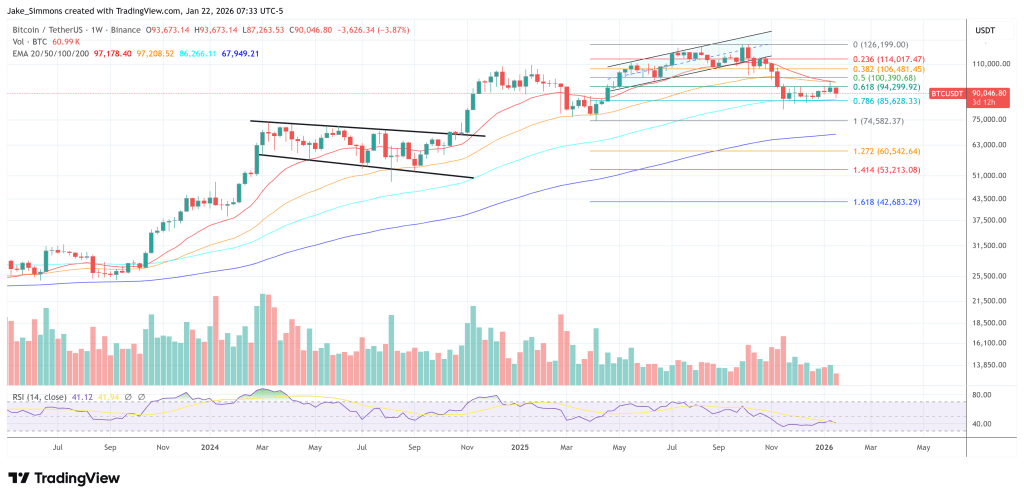
At press time, BTC traded at $90,046.