Bitcoin Rallies On Venezuela Oil Story: Here’s What’s Wrong

bitcoinist发布于2026-01-06更新于2026-01-06

文章摘要

Bitcoin's 5% rally on January 5 was widely attributed to a narrative linking Venezuela's political shift to lower oil prices, reduced inflation, anticipated rate cuts, and a subsequent BTC surge. However, Bitwise Head of Research Ryan Rasmussen disputes this theory. He points out that market-implied probabilities of Federal Reserve rate cuts showed little to no change following the news, indicating the rally wasn't driven by monetary policy expectations. Instead, Rasmussen attributes the price increase to sustained institutional demand from new ETF inflows, a favorable regulatory shift post-election, a broader risk-on sentiment driven by AI optimism, and the ongoing expectation of future quantitative easing. He concludes that while the Venezuela event had some relevance, it was not the primary catalyst for Bitcoin's move.

Bitcoin’s roughly 5% jump on Jan. 5 landed on a clean, TV-friendly explanation: a shock political turn in Venezuela would “unlock” oil supply, push energy prices down, cool inflation, bring rate cuts forward, and lift BTC. Bitwise Head of Research Ryan Rasmussen says there’s a major flaw with that.

The catalyst for the narrative was Venezuela’s weekend drama, culminating in Nicolás Maduro’s capture and transfer into US custody, an episode that immediately spilled into geopolitics, commodities chatter, and macro cross-asset takes.

Rasmussen, posting in a thread on X, summarized the “Wall Street theory” as follows: “Venezuela oil reserves unlocked >> lower oil prices >> lower inflation >> interest rates >> bitcoin rallies. A thread on why that’s wrong.”

Why This Bitcoin Theory Is Wrong

Rasmussen’s central point is mechanical: if the rally is being driven by a sudden repricing of monetary policy expectations, it should show up in the probabilities traders are assigning to rate cuts. In his read, it didn’t.

He cited a slight dip in the implied odds of a 25 basis-point cut in January 2026 immediately after the Venezuela headlines. “Probability of a 25bps Rate Cut in Jan’26: Prior to Maduro’s Capture: 16.6%. After Maduro’s Capture: 16.1%,” Rasmussen wrote, adding that “the probability of a 25bps rate cut this month actually fell.”

Even further out, he argued, the change was marginal to nonexistent. “Probability of a 25bps Rate Cut in Dec’26: Prior to Maduro’s Capture: 19.1%. After Maduro’s Capture: 19.2%,” he wrote, framing it as “barely moved.”
That’s the mismatch Rasmussen wants investors to notice: a tidy causal story was making the rounds, but the pricing in the instrument closest to that story, rate expectations, was effectively unchanged.

If not a Venezuela-to-Fed chain reaction, what explains the day’s BTC strength? Rasmussen pointed to a cluster of themes that have been building without needing a weekend headline to justify them.

First is institutional demand. Rasmussen argued that the post-2024 spot bitcoin ETF channel continues to widen, with more major platforms beginning to allocate. He cited an example of “+$500m into bitcoin ETFs on Jan. 2nd,” and named Morgan Stanley, Wells Fargo, and Merrill Lynch as part of the distribution wave which have opened their door with the beginning of the year.

Second is the regulatory backdrop. Rasmussen described a “pro-crypto regulatory shift” following the 2024 election, saying crypto markets are beginning to “feel the benefits” as wealth managers, endowments, pensions, and sovereigns get more comfortable adopting bitcoin.

Third is a broader risk-on tone tied to AI. In Rasmussen’s framing, “fears of an AI-bubble are settling,” and investors have been “piling into risk-on assets, like tech stocks and bitcoin.”

Finally, he returned to policy, just not via Venezuela. “Did Maduro’s capture materially change short-term rate cut expectations? No. Does that mean QE is out of the picture. Also no,” Rasmussen wrote, before adding: “QE is just beginning. The market was—and still is—expecting 50bps (or more) rate cuts in 2026.”

Overall, Rasmussen did not argue Venezuela is irrelevant. His conclusion was narrower: “Yes. Somewhat,” he wrote when asked whether the weekend’s events matter for bitcoin, before answering the bigger question whether it’s the main reason for the +5% move with a flat “No. Zoom Out.”

At press time, BTC traded at $93,750.
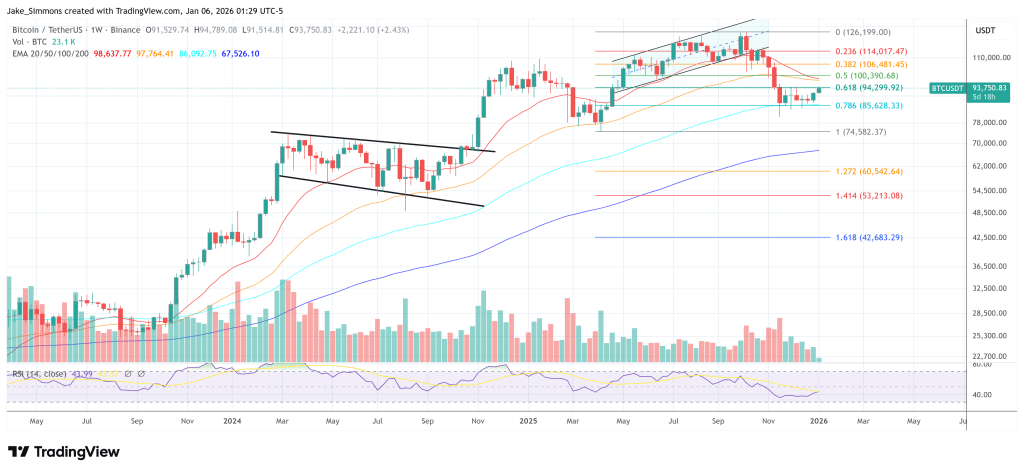
Bitcoin remains below the 0.618 Fib, 1-week chart | Source: BTCUSDT on TradingView.com

热门币种推荐

相关问答

QWhat was the main flaw in the 'Wall Street theory' that linked Venezuela's political events to Bitcoin rally, according to Ryan Rasmussen?

AThe main flaw was that the theory suggested a causal chain from Venezuela's oil supply to lower inflation and rate cuts, but the actual pricing in rate expectations showed no meaningful change, indicating the narrative didn't align with market mechanics.

QHow did the probability of a 25 basis-point rate cut in January 2026 change after the Venezuela headlines, as cited by Rasmussen?

AThe probability slightly decreased from 16.6% prior to Maduro's capture to 16.1% after, which Rasmussen argued showed no supportive evidence for the theory.

QWhat were the key factors Rasmussen identified as the real drivers behind Bitcoin's 5% jump, instead of the Venezuela narrative?

ARasmussen pointed to institutional demand from ETFs, a pro-crypto regulatory shift post-2024 election, a broader risk-on tone tied to AI investments, and ongoing expectations of rate cuts in 2026.

QDid Ryan Rasmussen completely dismiss the relevance of Venezuela's events to Bitcoin's movement?

ANo, he acknowledged the events mattered 'somewhat,' but concluded they were not the main reason for the 5% move, urging investors to 'zoom out' for broader context.

QWhat example of institutional demand did Rasmussen provide to support his argument?

AHe cited over $500 million flowing into bitcoin ETFs on January 2nd and mentioned major platforms like Morgan Stanley, Wells Fargo, and Merrill Lynch increasing allocations.

你可能也喜欢

印度最大资管 SBI 上市,交易数据能看出什么信号?

印度最大资管公司SBI Funds Management于7月21日上市,完成约10亿美元发行,获得约42倍认购,但首日收盘价仅较发行价上涨约6.3%。这组交易数据释放出复杂信号:一方面,强劲的认购倍数验证了印度市场对大体量优质资产的需求依然存在;另一方面,温和的首日涨幅(远低于上市前灰市约16%的溢价预期)表明,市场虽有买盘,但拒绝无条件追高,定价趋于理性。 此次IPO被视为印度IPO市场的一个关键“价格锚”和风向标。其成功意味着IPO窗口正在重新打开,但窗口优先面向那些品牌力强、现金流稳定、能清晰阐述长期增长逻辑的公司(如后续可能推进的NSE、Reliance Jio等项目)。SBI的案例显示,强资产可以发行,大资金愿意承接,但估值不能仅依赖稀缺性和故事。 另一个值得关注的变量是极低的承销费率(据报道约0.01%),这导致部分国际大行退出。这并非“华尔街看空印度”,而是反映了如SBI这类强势发行人议价能力的提升。它们倚重自身品牌、母行渠道和本土分销网络,降低了对外部投行销售的依赖。本土券商则更愿意以较低费用换取项目资源。但这种低费率模式若被弱势发行人复制,可能带来定价质量下降等风险。 SBI的高认购得益于印度资管行业渗透率提升的长期叙事,但其温和涨幅也提醒市场,行业增长虽稳定(年复合增长率预计16%-18%),但仍受股市表现、利率环境等多因素影响,投资者不愿提前支付过高溢价。 总之,SBI的上市标志着印度IPO市场有条件重启。其真正意义将在后续大型项目(如Jio、NSE)的推进中得到检验:它们能否在合理估值下成功发行,将决定当前市场信心的成色,以及发行人议价权上升是否是结构性趋势。

marsbit32分钟前

印度最大资管 SBI 上市,交易数据能看出什么信号?

marsbit32分钟前

交易

现货

热门文章

如何购买S

欢迎来到HTX.com!我们已经让购买Sonic(S)变得简单而便捷。跟随我们的逐步指南,放心开始您的加密货币之旅。第一步:创建您的HTX账户使用您的电子邮件、手机号码注册一个免费账户在HTX上。体验无忧的注册过程并解锁所有平台功能。立即注册第二步:前往买币页面,选择您的支付方式信用卡/借记卡购买:使用您的Visa或Mastercard即时购买Sonic(S)。余额购买:使用您HTX账户余额中的资金进行无缝交易。第三方购买:探索诸如Google Pay或Apple Pay等流行支付方法以增加便利性。C2C购买:在HTX平台上直接与其他用户交易。HTX场外交易台(OTC)购买:为大量交易者提供个性化服务和竞争性汇率。第三步:存储您的Sonic(S)购买完您的Sonic(S)后,将其存储在您的HTX账户钱包中。您也可以通过区块链转账将其发送到其他地方或者用于交易其他加密货币。第四步:交易Sonic(S)在HTX的现货市场轻松交易Sonic(S)。访问您的账户,选择您的交易对,执行您的交易,并实时监控。HTX为初学者和经验丰富的交易者提供了友好的用户体验。

3.0k人学过发布于 2025.01.15更新于 2026.06.02

如何购买S

相关讨论

欢迎来到HTX社区。在这里,您可以了解最新的平台发展动态并获得专业的市场意见。以下是用户对S(S)币价的意见。

活动图片