Bitcoin nears $70K: Why BTC’s $5.95B demand gap signals trouble

ambcrypto发布于2026-04-07更新于2026-04-07

文章摘要

Bitcoin is approaching the $70,000 mark again, but underlying demand conditions remain weak. The key metric, Apparent Demand, has dropped to -86,000 BTC (approximately $5.95 billion), indicating that newly issued supply is not being sufficiently absorbed. This negative trend often aligns with downward price pressure. Furthermore, long-term holders, who typically accumulate, are now distributing coins, as signaled by the Binary Coin Days Destroyed metric. In contrast, whales have increased their market presence and are driving the short-term rebound. However, their activity is often reactive and may not be enough to sustain a rally, especially given the fundamental weakness in demand and the recent significant losses recorded by large holders in Q1.

Bitcoin [BTC] continues to present mixed directional signals, even as bulls attempt to regain control. At press time, the BTC was nearing the $70,000 level after trading below it for about eleven days.

Despite this recovery attempt, underlying demand conditions remain fragile. Both retail participants and long-term holders appear to be reducing exposure, raising questions about the sustainability of the current move.

Apparent demand highlights structural weakness

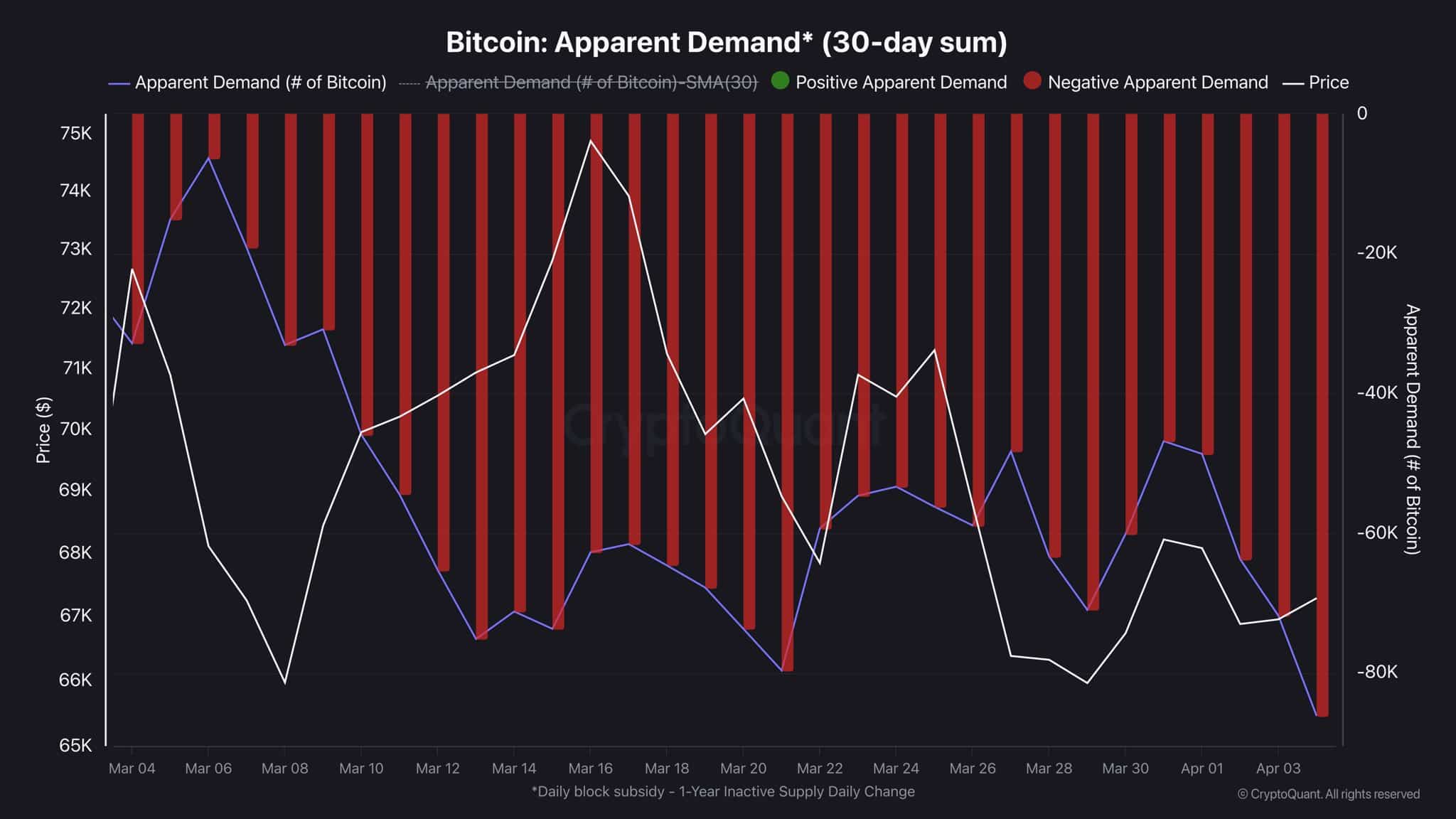
Bitcoin Apparent Demand, a key metric used to assess whether newly issued supply is being absorbed, suggests that April has opened on a weak footing. The metric measures the difference between Bitcoin issuance and the volume of coins that remain inactive for over one year.

Recent data shows apparent demand has dropped to negative 86,000 BTC, equivalent to approximately $5.95 billion at press time. This indicates that newly supplied Bitcoin is not being sufficiently absorbed, reflecting weak market demand rather than strength.
Source: CryptoQuant

There is currently a clear relationship between apparent demand and price action.

A sustained negative trend in demand typically aligns with downward price pressure. Notably, this marks the weakest reading in over a month, reinforcing concerns about underlying market structure.

Long-term holders shift to distribution

Long-term holders are contributing to this weakness. This cohort, historically associated with accumulation and low selling activity, now appears to be distributing.

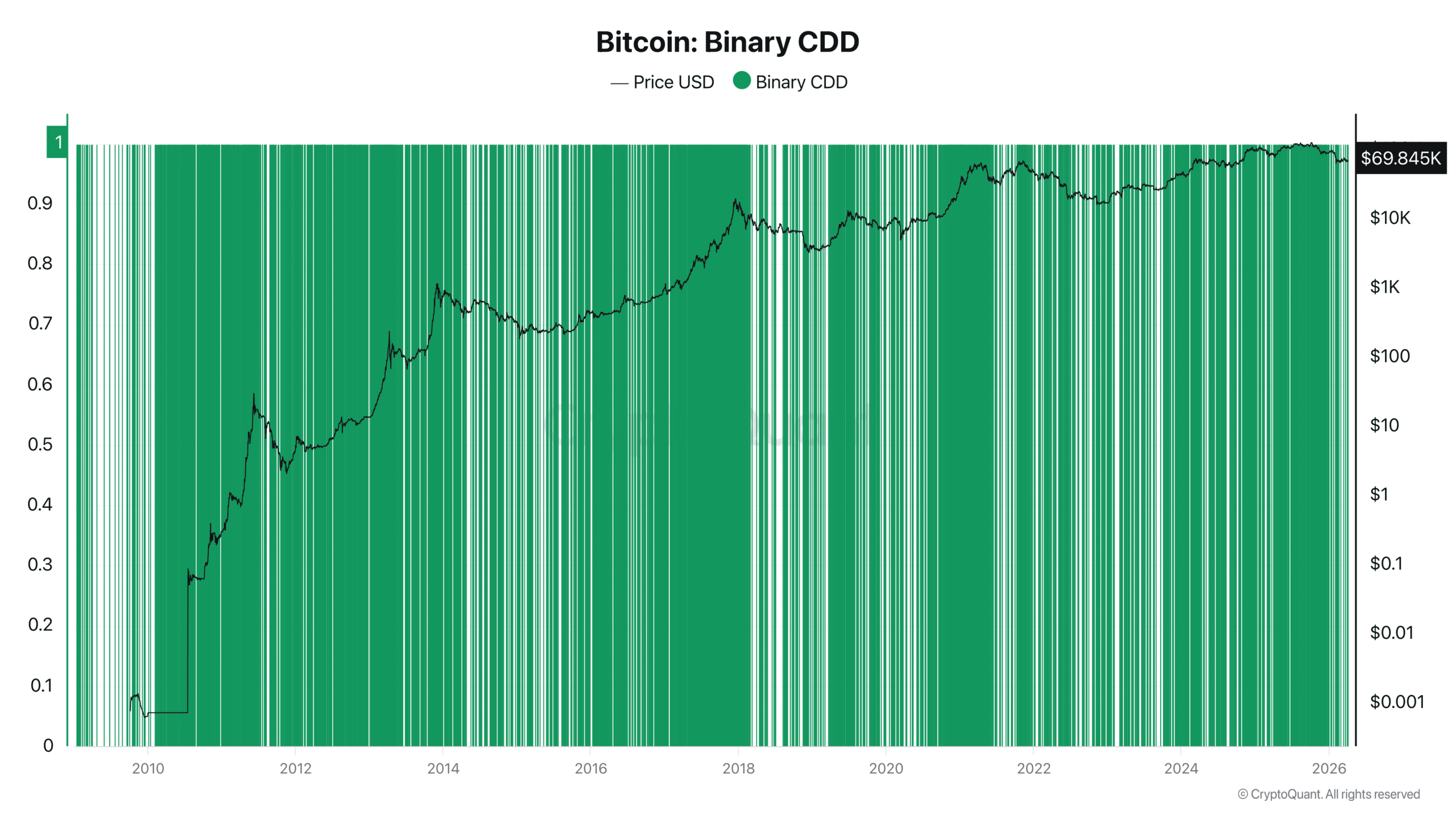
Data from CryptoQuant shows the Binary Coin Days Destroyed (CDD) has reached 1. When this metric prints 1, it signals that older coins are being moved, an event commonly associated with selling activity from long-term holders.
Source: CryptoQuant

If sustained, this behavior could weigh further on Bitcoin’s price outlook. In contrast, whales are taking the opposite stance. Large holders have increased their presence in the market as Bitcoin attempts to recover.

Spot average order size data shows that whales, particularly larger entities, have dominated trading activity across major exchanges in recent sessions. Their orders account for a significant share of volume, positioning them as key drivers of short-term momentum.

Given Bitcoin’s recent rebound, this activity suggests that whales have turned tactically bullish, at least over the past 48 hours.

Whale activity alone may not sustain the rally

However, relying on whale accumulation as a standalone signal remains risky. Whale behavior is often reactive and can shift quickly with market conditions.

AMBCrypto previously reported that in Q1, Bitcoin investors holding between 100 and 10,000 BTC recorded combined losses of $30.9 billion, with whales accounting for an average daily loss of $337 million. This context underscores that large holders are not infallible, and periods of accumulation do not always translate into sustained upward trends.

With long-term holders distributing and apparent demand reflecting weak supply absorption, the current whale-driven momentum may lack the fundamental backing required for a sustained rally.


Final Summary

  • Bitcoin’s apparent demand has fallen to negative 86,000 BTC, worth about $5.95 billion, pointing to weak absorption of supply.
  • Long-term holders are distributing while whales accumulate, creating a divergence in market behavior.


热门币种推荐

相关问答

QWhat is Bitcoin's Apparent Demand and what does its negative value of 86,000 BTC indicate?

ABitcoin Apparent Demand is a metric that measures the difference between Bitcoin issuance and the volume of coins that remain inactive for over one year. A negative value of 86,000 BTC, equivalent to $5.95 billion, indicates that newly supplied Bitcoin is not being sufficiently absorbed by the market, reflecting weak underlying demand rather than strength.

QWhat does a Binary Coin Days Destroyed (CDD) value of 1 signify for long-term Bitcoin holders?

AA Binary Coin Days Destroyed (CDD) value of 1 signals that older coins are being moved, an event commonly associated with selling activity from long-term holders. This indicates a shift from their historical behavior of accumulation to distribution.

QHow are whale activities contrasting with the actions of long-term holders in the current Bitcoin market?

AWhile long-term holders are distributing (selling) their coins, whales (large holders) are accumulating. Data shows that whales have dominated recent trading activity on major exchanges, positioning them as key drivers of the short-term momentum in Bitcoin's price.

QAccording to the article, why might whale accumulation alone be insufficient to sustain a Bitcoin price rally?

AWhale accumulation alone is a risky signal because whale behavior is often reactive and can shift quickly with market conditions. Furthermore, with long-term holders distributing and apparent demand remaining weak, the whale-driven momentum lacks the broad, fundamental backing required for a sustained rally.

QWhat was the financial impact on Bitcoin investors holding between 100 and 10,000 BTC in Q1, as mentioned in the article?

AIn Q1, Bitcoin investors holding between 100 and 10,000 BTC recorded combined losses of $30.9 billion. Whales within this group accounted for an average daily loss of $337 million.

你可能也喜欢

股票跌得比加密货币还狠,钱去了哪?

7月底,韩国Kospi指数罕见连续两天触发熔断,全球半导体股集体暴跌。SK海力士业绩虽创纪录但不及预期,股价重挫,其两倍做多杠杆ETF市值更蒸发超万亿港元。与此同时,比特币却从低点反弹约15%,呈现“股票跌出币圈样,比特币装死躺赢”的反常局面。 此次暴跌并非全市场恐慌,而是对前期最拥挤交易(如AI半导体)的精准去杠杆。催化剂包括不及预期的财报、中国存储芯片扩产带来的竞争压力,以及日元套息交易平仓带来的流动性压力。分析认为,产业逻辑未死,死的是过高的杠杆。 那么,从股市流出的资金是否流入了比特币?答案是否定的。比特币的相对抗跌,是因为它在5月至6月已提前经历大幅调整,美国现货比特币ETF曾出现历史性资金外流。真正的避险资金流向了黄金。数据显示,比特币与黄金的相关性已降至极低水平,“数字黄金”叙事在此次危机中暂时失效。机构将两者视为不同资产:黄金用于避险,比特币用于博弈高波动回报。 资金未来的流向取决于三个条件:全球流动性压力缓解、美联储在不引发衰退的前提下降息,以及美国CLARITY加密法案的最终落地。当前,比特币与纳斯达克指数的走势正在脱钩,其价格更依赖全球流动性而非单一科技股盈利。这种低相关性可能使其在未来成为机构资产配置中分散风险的选择。尽管当前并非避风港,但比特币已提前出清,为未来资本重新配置占据了有利位置。

marsbit37分钟前

股票跌得比加密货币还狠,钱去了哪?

marsbit37分钟前

交易

现货

热门文章

加密市场宏观研报:《GENIUS Act》法案取得重大进展,BTC突破历史新高,后市全新展望

2025年5月22日,比特币价格正式突破11万美元大关,创下历史新高。在政策面、宏观经济、资金面与投资者结构共同作用下,一场结构性牛市浪潮正在展开。而此轮上涨背后的核心驱动,是美国《GENIUS稳定币法案》的实质性进展以及多项利好的叠加。本文将从政策端突破、宏观环境转向、链上与ETF资金结构、交易行为演化,以及重点受益赛道五大维度,全面解析此轮BTC再创新高的深层逻辑,并前瞻下半年市场的潜在趋势。

1.8k人学过发布于 2025.05.22更新于 2025.05.22

加密市场宏观研报:《GENIUS Act》法案取得重大进展,BTC突破历史新高,后市全新展望

相关讨论

欢迎来到HTX社区。在这里,您可以了解最新的平台发展动态并获得专业的市场意见。以下是用户对BTC(BTC)币价的意见。

活动图片