Chinese-Canadian educator and Predictive History host Jiang Xueqin has stirred debate after arguing that Bitcoin may have been created by the CIA or a broader US “deep state,” rather than by the pseudonymous Satoshi Nakamoto. The claim, made on the April 15 episode of the Jack Neel Podcast, quickly drew pushback from prominent Bitcoin commentators who said Jiang’s argument rests on a basic misunderstanding of how the network works.
Was Bitcoin A CIA Project?
Jiang, a Beijing-based commentator with 2.3 million YouTube subscribers, framed the theory around what he described as a game-theory process of elimination. He said the standard origin story “makes no sense,” asking why someone would spend years or even decades developing blockchain technology only to release it to the world for free and then disappear.
“So then you have to ask yourself three questions,” Jiang said. “First of all is who would have the technology and the expertise to create something like the blockchain. Second of all, you have to ask who would benefit from this blockchain creation. The third question you want to ask is why would they keep it secret?”
From there, Jiang argued that the likely candidates were US intelligence and defense agencies, citing the role government-linked institutions played in building foundational internet infrastructure. “Probably the same people who created the internet, probably the same people who created GPS, DARPA, NSA, CIA, probably these guys,” he said. In his telling, blockchain would serve two strategic purposes: surveillance and covert financing.
He pushed the argument further by suggesting that the network’s value depends on people believing it sits outside political control. “The answer is only if people believe that this was transparent, open and beyond authority, beyond political control, would it have value,” Jiang said. “So the moment people recognize that this is a CIA operation, people won’t put their money into blockchain. People won’t put their money into Bitcoin.”
Jiang also pointed to what he sees as suspicious early adoption, specifically referencing the Winklevoss twins’ decision to allocate millions of dollars into Bitcoin when it was still a fringe asset. “These are not technologists, right?” he said. “How why would they put millions and millions of dollars into this thing? That’s really strange.”
Professor Jiang Xueqin claims bitcoin was created by the CIA.
“Why would you spend years, possibly decades, in your basement creating a new technology and then just give it for free to the world? That makes no sense.”
“When you do game theory analysis, you look at all... pic.twitter.com/uLtRVpkj0t
— TFTC (@TFTC21) April 15, 2026
Bitcoin Community Reacts
The backlash from Bitcoin-focused voices was immediate and blunt. Ansel Lindner dismissed the theory as the product of people who “don’t understand decentralization,” adding “This is the opinion of so many midwits. It’s also the reason even some gold bugs cannot comprehend bitcoin to this day, and why midwits believe in centralized scam sh*tcoins.”
Lyn Alden agreed. “Ansel is right,” she wrote. “People with this view don’t truly understand the open source aspect or the proof of work aspect fully. A strong point about Bitcoin is that it literally doesn’t matter who created it. It can be assessed on its own merits since it’s transparent and decentralized.”
That line of rebuttal goes to the core of the dispute. Jiang’s theory hinges on origin and hidden control; but the facts about Bitcoin’s design makes those questions far less important than he suggests, because the network is public, open-source, and maintained by participants rather than by a central operator.
MDB, another Bitcoin commentator, focused on one of Jiang’s specific questions: “Where are the servers of Bitcoin located?” He said that question alone showed the core problem and lack of understanding by Xueqin. “Bitcoin does not run on one company’s servers,” MDB wrote. “Bitcoin runs on a distributed network of nodes spread across the world, which is exactly why it is hard to censor, shut down, or control.”
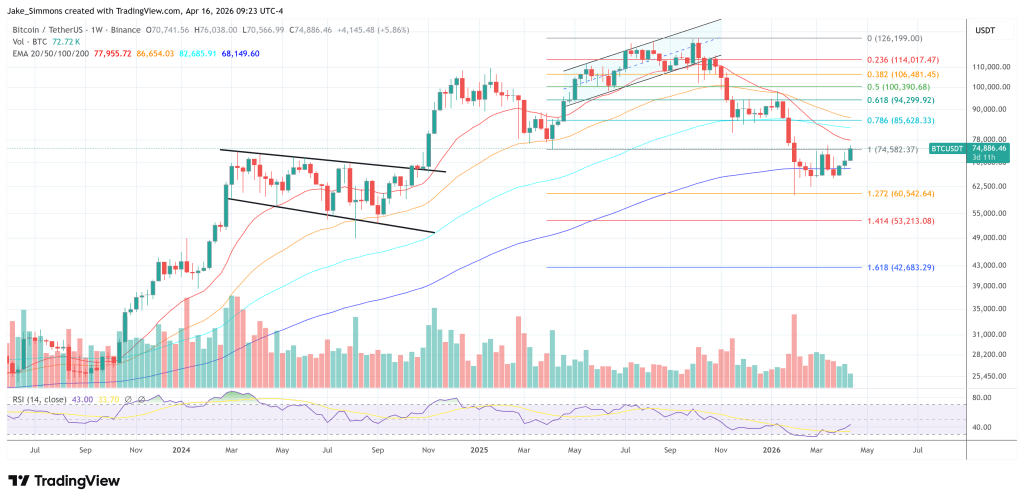
At press time, BTC traded at $74,886.