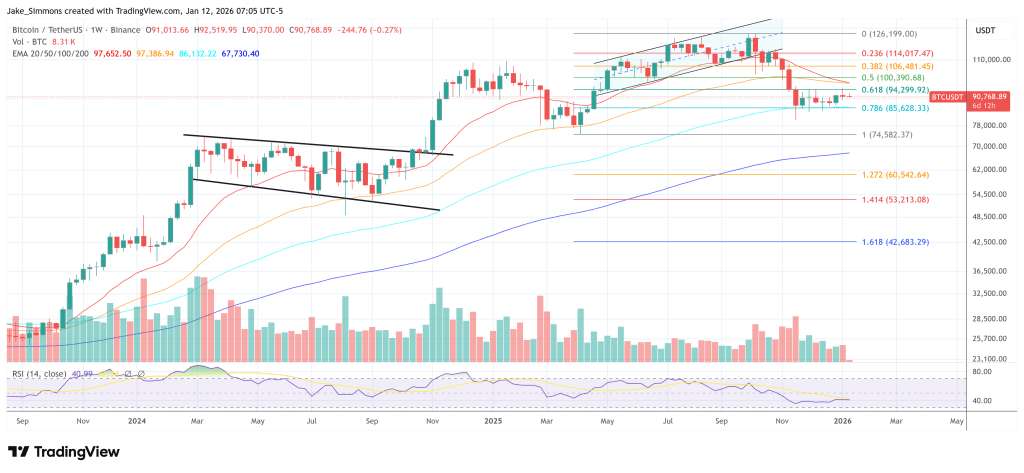
Bitcoin and the broader crypto market are heading into a tightly packed US macro calendar just as Washington’s crypto rulebook lurches toward a key committee vote.
The week’s tone was set late Sunday when Federal Reserve Chair Jerome Powell disclosed that the Justice Department had served the Fed with grand jury subpoenas and threatened a criminal indictment tied to his prior testimony on a Federal Reserve building renovation.
Powell framed it as political pressure aimed at monetary policy and dismissed the probe’s stated rationale in unusually blunt terms: “The threat of criminal charges is a consequence of the Fed setting rates based on our best assessment of what will serve the public, rather than following the preferences of the President.”
The immediate market reaction was measured but clear: dollar softness and weaker US equity futures, meanwhile Bitcoin rallied back above $92,000 while major altcoins also registered modest gains. However, it needs to be seen how these gains can be sustained when the US market opens.
#1 Bitcoin And Crypto Face Crucial Macro Week
The first major scheduled macro waypoint is US CPI for December 2025, due Tuesday, Jan. 13 at 8:30 a.m. ET. With crypto still trading as a high-beta expression of global liquidity and real-rate expectations, CPI remains the week’s most direct input into the front end of the curve and, by extension, the dollar’s near-term direction.
For the US inflation prints, the market is walking into Tuesday with a fairly tight consensus: December CPI is expected at +0.3% month-over-month, with headline inflation seen holding at 2.7% year-over-year. On the core side, estimates cluster around +0.31% m/m and 2.7% y/y.
The last CPI read (November 2025) was 2.7% y/y on headline and 2.6% y/y for “all items less food and energy” (core). Because the October CPI observation was not published due to the 2025 lapse in appropriations, BLS reported the monthly change as a two-month move: CPI-U rose 0.2% from September to November on a seasonally adjusted basis.
On Wednesday, attention shifts to the delayed producer-price release. BLS is scheduled to publish the November 2025 PPI on Jan. 14, and it has said October data will be published alongside that November release (there will be no standalone October PPI report).
As for the numbers traders will key off, calendar consensus going into the Jan. 14 release points to headline PPI at +0.3% m/m and 2.7% y/y, with core PPI seen at +0.1% m/m and 2.6% y/y. The last available PPI print before that batch release was September 2025, which showed +0.3% m/m and +2.7% y/y for final demand.
Later the same day, markets may also have to price a legal headline with macro reach: The US Supreme Court is expected to issue rulings on Jan. 14, with President Donald Trump’s sweeping tariffs among the major cases still pending. The Court does not pre-announce which cases will be decided, but a tariff decision could have a heavy price impact on all financial markets, with Bitcoin and crypto likely to follow the move from US equities.
#2 Senate Committee Markup Set For Jan. 15
On the crypto-native side, US market structure legislation is moving toward a decisive committee step. Senate Banking Committee Chairman Tim Scott announced the committee will hold a markup on “comprehensive digital asset market structure legislation” on Thursday, Jan. 15.
That markup matters less as a final outcome than as a signal on whether negotiators have the votes and the coalition to advance a coherent framework toward a floor process.
#3 BNB Chain’s Fermi Upgrade
BNB Chain has scheduled its Fermi hard fork for Jan. 14 at 02:30 UTC, delivered via the BSC v1.6.4 client release. The chain’s own blog positions the upgrade as a speed-and-reliability push: “Fermi focuses on making BSC faster [...] predictable and reliable as network usage grows. The upgrade shortens block times, strengthens finality [...] and ensures the chain continues to perform consistently.”
The headline technical changes are a reduction in block time from 0.75 seconds to 0.45 seconds and tightened fast-finality rules—parameters that matter most for latency-sensitive applications and high-throughput periods.
#4 Polygon’s Open Money Stack
Polygon is teeing up a Jan. 13 X Spaces event (12 p.m. ET) billed as an “inside scoop” on its “Open Money Stack” vision from Sandeep Nailwal and Polygon Labs CEO Marc Boiron. The published vision frames the initiative as a modular stack spanning rails, wallets, on/off-ramps, stablecoin interoperability, compliance, and onchain identity—aimed at making stablecoin and tokenized-money movement feel more like default internet plumbing than a bespoke crypto workflow.
Polygon’s own write-up makes the ambition explicit: “But our north star is clear: move all money onchain [...] Because onchain money is more versatile, money will move and remain onchain.”
At press time, Bitcoin traded at $90,768.