Amplify ETFs for stablecoins, tokenization go live for trading

cointelegraph发布于2025-12-24更新于2025-12-24

文章摘要

Amplify has launched two new exchange-traded funds: the Amplify Stablecoin Technology ETF (STBQ) and the Amplify Tokenization Technology ETF (TKNQ), both now trading on NYSE Arca. These ETFs track indexes of companies involved in stablecoin and tokenization infrastructure, including major players like Visa, Circle, Mastercard, PayPal, BlackRock, and JPMorgan. The launch comes amid growing regulatory clarity in the U.S. and Europe, with laws like the GENIUS Act and MiCA positioning stablecoins as compliant digital finance tools. Tokenization and stablecoins have gained significant traction this year as institutions explore digitizing traditional financial services.

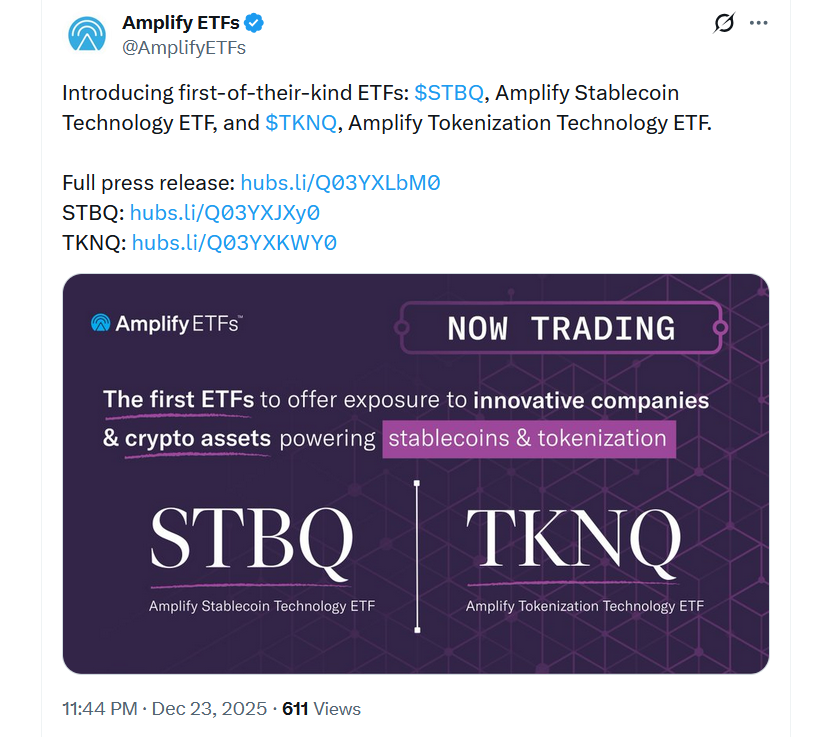
Digital asset manager Amplify has launched two exchange-traded funds tracking blockchain projects across stablecoins and tokenization.

The company said on Tuesday that its Amplify Stablecoin Technology ETF (STBQ) and Amplify Tokenization Technology ETF (TKNQ) both went live on the NYSE Arca exchange.

Both funds track a diversified index of companies working on products or infrastructure, along with projects that generate revenue from tokenization and stablecoins.

“These new ETFs expand Amplify’s lineup at a time when the infrastructure behind stablecoins and the growth of tokenization are shaping the next phase of digital finance,” the company said.
Source: Amplify ETFs

Stablecoins and tokenization have been among the most popular themes in crypto this year, with the US passing laws that have given institutions confidence to launch stablecoins, and regulators opening dialogue on how they should treat assets such as tokenized stocks.

Amplify said its stablecoin-focused ETF tracks shares of companies “generating significant revenue from payments technology, digital asset infrastructure, and trading platforms.”

It holds shares in companies working on stablecoins such as Visa, Circle, Mastercard and PayPal, alongside crypto ETFs from Grayscale, iShares and Bitwise.

The firm pointed to regulatory developments in the US and EU, noting that the “GENIUS Act in the US and MiCA in Europe are positioning stablecoins as the compliant backbone of digital finance.”

Related: Clarity Act delays led to $952M in crypto fund outflows: CoinShares

Meanwhile, the tokenization fund includes exposure to BlackRock, JPMorgan, Figure Technology Solution, Citigroup and the Nasdaq, which all have made tokenization plays over the past few years as they seek opportunities to digitize traditional financial services.

Crypto and blockchain ETFs stormed onto the market in 2025 after the US Securities and Exchange Commission under chair Paul Atkins loosened requirements for crypto ETFs.

Magazine: Big questions: Would Bitcoin survive a 10-year power outage?

相关问答

QWhat are the names of the two new ETFs launched by Amplify and on which exchange did they go live?

AThe two new ETFs are the Amplify Stablecoin Technology ETF (STBQ) and the Amplify Tokenization Technology ETF (TKNQ). They both went live on the NYSE Arca exchange.

QWhat is the primary focus of the Amplify Stablecoin Technology ETF (STBQ)?

AThe Amplify Stablecoin Technology ETF (STBQ) tracks shares of companies generating significant revenue from payments technology, digital asset infrastructure, and trading platforms related to stablecoins.

QWhich major companies are included in the stablecoin-focused ETF's holdings?

AThe stablecoin-focused ETF holds shares in companies such as Visa, Circle, Mastercard, PayPal, as well as crypto ETFs from Grayscale, iShares, and Bitwise.

QWhat regulatory developments does Amplify cite as supporting the growth of stablecoins?

AAmplify points to the GENIUS Act in the US and the Markets in Crypto-Assets (MiCA) regulation in Europe, which are positioning stablecoins as the compliant backbone of digital finance.

QWhich types of companies does the Amplify Tokenization Technology ETF (TKNQ) provide exposure to?

AThe tokenization fund provides exposure to companies like BlackRock, JPMorgan, Figure Technology Solution, Citigroup, and Nasdaq, which are involved in tokenizing traditional financial services.

你可能也喜欢

当AI开始审计世界:从Claude发现ZEC漏洞,看加密行业正在进入“递归安全时代”

人工智能正从生产力工具演变为复杂系统的分析者与参与者,其影响正从研发领域延伸至安全领域。近期,Anthropic提出了“递归自我改进”概念,揭示AI已开始协助人类进行模型研发、代码优化等环节,形成加速自身发展的飞轮效应。几乎同时,Claude AI在审计Zcash代码时发现了一个零知识证明系统中的关键漏洞,并促使团队快速修复。这一事件超越了单纯的技术发现,它标志着AI开始深度参与理解、分析和验证复杂系统,尤其可能重塑区块链安全范式。 传统的区块链安全高度依赖人工审计与有限工具,面对日益增长的系统复杂度存在瓶颈。AI,特别是大模型,擅长处理海量信息与复杂逻辑关联,能大幅降低风险发现成本、缩短漏洞存在时间,使安全从阶段性检查转向持续监测与响应。这种由AI与人类专家协同驱动、具备持续反馈与进化能力的机制,可被称为“递归安全”。 安全行业因其需在庞杂系统中定位少数异常点的特性,成为AI能力释放的优先领域。AI不会消除风险,而是加速了整个攻防体系的信息处理效率,对防御方和攻击方能力均有提升。未来,安全的关键可能不再是漏洞数量,而在于风险发现速度、修复效率及系统韧性。行业竞争维度将转向构建持续的风险管理能力。Claude发现ZEC漏洞正是这一趋势的早期信号,预示着一个由AI驱动、持续演化的“递归安全时代”正在开启。

marsbit1小时前

当AI开始审计世界:从Claude发现ZEC漏洞,看加密行业正在进入“递归安全时代”

marsbit1小时前

从 MSTR 到 STRC+:Strategy 宇宙的尽头在哪里

摘要:本文探讨了Strategy公司(前身为MicroStrategy)如何从一家持有大量比特币的上市公司,演变为围绕比特币构建复杂金融产品和链上信用体系的生态。公司核心在于通过发行普通股(MSTR)、永续优先股(STRC)及其他结构化工具,将比特币持仓转化为不同风险、久期和收益偏好的金融产品,并尝试将这些传统市场的现金流引入DeFi(如Saturn和Apyx协议),以创造链上稳定币收益。 文章分析了MSTR的估值飞轮依赖于比特币价格上涨和资本市场给予的溢价(mNAV),但其弱点在于受市场情绪、融资成本和比特币价格波动的多重制约。重点剖析了STRC作为高收益信用工具的风险来源:其股息支付能力根本上取决于比特币资产缓冲的厚度、公司的现金管理能力以及市场对整体叙事的信心。在极端市场条件下,STRC可能面临价格脱锚风险。 最后,文章展望了Strategy生态的三种可能前景:乐观情况下成为连接比特币、传统资本与DeFi的信用基础设施;中性情况下作为高风险高收益的细分产品存在;悲观情况下则在市场压力下回归为纯粹的比特币信用风险资产。其终极边界在于市场是否长期接受以比特币为抵押基础、以上市公司为中介、以优先股股息为收益来源的整套新信用体系。

marsbit1小时前

从 MSTR 到 STRC+:Strategy 宇宙的尽头在哪里

marsbit1小时前

交易

现货
合约
活动图片