All about why blockchain firms will now become part of U.S Treasury’s cybersecurity program

ambcrypto发布于2026-04-10更新于2026-04-10

文章摘要

The U.S. Department of the Treasury has launched a new initiative through its Office of Cybersecurity and Critical Infrastructure Protection (OCCIP) to include blockchain and crypto firms in a cybersecurity program. This move aims to share timely cyber threat intelligence to help these firms prevent and respond to attacks. The announcement comes amid ongoing security challenges in the crypto industry, highlighted by incidents like the 2026 Drift Protocol attack, which resulted in approximately $285 million in losses and was linked to state-backed cyber operations. The article underscores that security vulnerabilities remain a critical systemic risk in crypto, capable of triggering prolonged market downturns, as seen during the 2022 crash following the collapse of FTX. By providing early warnings and fostering coordinated risk management, the Treasury’s program seeks to strengthen institutional confidence and reduce the likelihood of future large-scale market disruptions.

When we talk about “risk” in crypto, the real and often underestimated risk lies in security.

Over the years, the crypto industry has expanded rapidly, bringing institutional participation, new products, and large-scale adoption. And yet, the underlying investment risk has not fully disappeared. The reason is simple – Security vulnerabilities continue to exist across smart contracts, bridges, wallets, and exchanges.

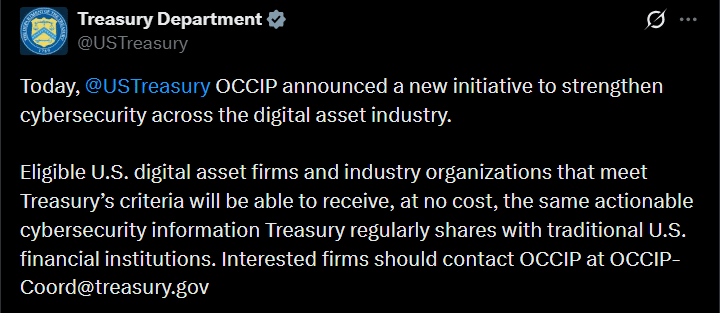
Seen in this light, the latest move by the U.S Treasury becomes relevant. Notably, the U.S Department of the Treasury has launched a new cybersecurity initiative. Through its Office of Cybersecurity and Critical Infrastructure Protection (OCCIP), the program will share timely cyber threat information with eligible crypto and blockchain firms to help them prevent and respond to attacks.
Source: X

Interestingly, the timing of this initiative feels almost deliberate.

Just four months into 2026, the crypto market has already faced another reminder of its security gaps. The recent Drift Protocol attack exposed vulnerabilities within the platform’s trading mechanisms, resulting in losses estimated at around $285 million. In fact, early investigations have linked the activity to DPRK-style operations, suggesting a level of planning typically associated with state-backed cyber groups.

Against this backdrop, the U.S Treasury’s decision to roll out a cybersecurity program for digital asset firms carries significant importance. The key question now is – Will stronger government-backed cybersecurity coordination help strengthen institutional confidence in crypto assets?

OCCIP’s significance viewed through crypto’s 2022 crash

The impact of security lapses goes far beyond a temporary wave of FUD in the market.

In some cases, the consequences are long-lasting. The collapse of FTX in 2022 serves as a clear example. What initially appeared to be a single exchange failure quickly evolved into a security crisis for the entire industry. Billions of dollars were lost, and major lending firms faced significant liquidity stress.

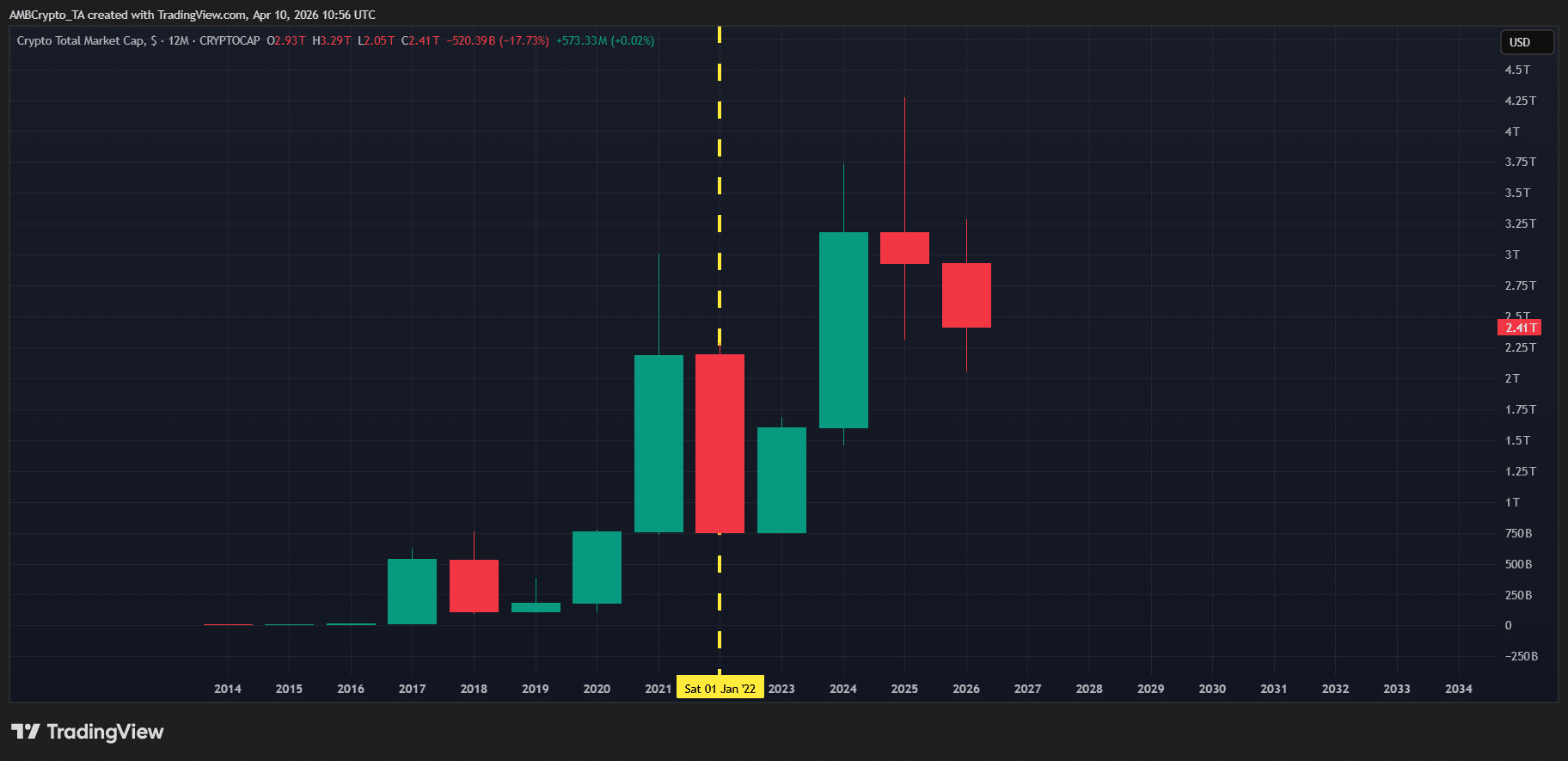
From a technical standpoint, the impact was equally severe. The crypto market ended 2022 down roughly 66%, a period still considered one of the harshest bear markets in crypto history. Recovery was slow rather than immediate.

Throughout 2023, the market managed to regain only 50% of the losses as investors remained cautious.

In fact, it wasn’t until the 2024 cycle that broader momentum returned.
Source: TradingView (TOTAL/USDT)

In essence, the impact of major security failures in crypto extends well beyond price correction.

Instead, they reshape market cycles, delay institutional adoption, and reinforce the industry’s need for stronger security infrastructure and coordinated risk management. Fast forward to now, this is exactly where the U.S Treasury’s OCCIP program starts to become relevant.

From a broader perspective, risks around digital assets have not disappeared. Instead, they are evolving. Alongside protocol exploits and exchange breaches, newer concerns like quantum computing threats are beginning to enter the discussion, keeping long-term security risks on the radar and raising concerns about another 2022-style market shock.

However, the shift now seems to be towards prevention rather than reaction. With OCCIP, digital asset firms will gain access to early warning signals, allowing them to strengthen defenses before vulnerabilities escalate. In turn, this will help keep institutional confidence intact, lowering the chances of another market shock.


Final Summary

  • Security is crypto’s real systemic risk, with repeated exploits showing how security failures can trigger long-term market downturns.
  • By giving digital asset firms access to cyber intelligence, the U.S Treasury’s move could reduce the risk of another shock.


相关问答

QWhat is the main focus of the U.S. Treasury's new cybersecurity initiative for blockchain firms?

AThe U.S. Treasury's new cybersecurity initiative, through its Office of Cybersecurity and Critical Infrastructure Protection (OCCIP), aims to share timely cyber threat information with eligible crypto and blockchain firms to help them prevent and respond to attacks.

QHow did the 2022 FTX collapse demonstrate the long-lasting impact of security failures in crypto?

AThe FTX collapse in 2022 evolved from a single exchange failure into an industry-wide security crisis, resulting in billions of dollars lost, significant liquidity stress for major lending firms, and a prolonged market downturn with the crypto market ending the year down roughly 66%.

QWhat recent security incident in 2026 highlighted ongoing vulnerabilities, according to the article?

AThe recent Drift Protocol attack in early 2026 exposed vulnerabilities in the platform's trading mechanisms, resulting in estimated losses of around $285 million, with investigations linking the activity to DPRK-style operations.

QHow does the OCCIP program aim to change the approach to cybersecurity risks for digital asset firms?

AThe OCCIP program shifts the approach from reaction to prevention by providing digital asset firms with early warning signals and cyber intelligence, allowing them to strengthen defenses before vulnerabilities escalate and reduce the risk of market shocks.

QWhat broader risks beyond protocol exploits and exchange breaches are mentioned as emerging concerns?

ANewer concerns like quantum computing threats are beginning to enter the discussion, keeping long-term security risks on the radar and raising concerns about potential future market shocks.

你可能也喜欢

红杉专访哈萨比斯:信息是宇宙的本质,AI将开启全新的科学分支

本文整理自DeepMind联合创始人兼CEO德米斯·哈萨比斯(Demis Hassabis)在红杉资本AI Ascent 2026峰会的专访。哈萨比斯分享了他从游戏开发到神经科学,再到创立DeepMind并致力于通用人工智能(AGI)研发的心路历程。 他认为游戏是AI极佳的试验场,能有效验证算法并为研发提供早期支持。在创业方面,他强调时机的重要性,应“领先时代五年,而非五十年”,找到技术突破与落地需求的平衡点。 DeepMind的使命明确:第一步是构建AGI,第二步是利用AGI解决科学、医学等所有复杂难题。他特别强调“AI for Science”的价值,指出AI是描述生物学等复杂系统的完美语言,有望将新药研发周期从数年缩短至数周,实现个性化医疗。 哈萨比斯预见,AI系统自身的复杂性将催生“机制可解释性”等全新工程科学,而AI驱动的模拟技术将使人类能对经济学等社会系统进行受控实验,从而开辟全新的科学分支。他提出一个核心观点:信息可能是宇宙最本质的构成,物质、能量与信息可以相互转化,这赋予了AI更深远的科学意义。 在技术层面,他认为以神经网络为代表的现代AI系统证明,经典图灵机足以模拟许多曾被认为需要量子计算的问题(如蛋白质折叠),人脑很可能就是一种高度近似的图灵机。关于意识,他认为这是由自我认知、时间连续性等组件构成的复杂命题,在迈向AGI的征途中,应首先将其视作强大工具,再借助工具去探索意识本身。 最后,哈萨比斯预测AGI有望在2030年实现,并展望了利用AGI进一步理解现实本质的愿景。

链捕手9分钟前

红杉专访哈萨比斯:信息是宇宙的本质,AI将开启全新的科学分支

链捕手9分钟前

大摩2026半导体报告:买封装、买测试、买中国芯,避开传统赛道

**大摩2026年半导体报告核心摘要** 报告指出,全球AI资本开支超预期扩张,算力供给正从“NVIDIA主导”转向“GPU + ASIC + 中国芯”三轨并行。核心投资逻辑是抓住AI供应链红利,回避被边缘化的传统赛道。 **核心结论(按重要性排序):** 1. **买封装**:先进封装(CoWoS/SoIC)是确定性最强主线。AI服务器需求直接拉动产能,台积电(TSMC)因其不可替代性成为核心受益者。 2. **买测试设备**:测试设备(Handler/Socket/探针卡)是估值最低、成长最确定的细分方向。AI芯片复杂度导致测试时长结构性翻倍增长,市场重估严重滞后。重点公司:鸿精密、颖崴科技(WinWay)、MPI。 3. **买中国AI芯片**:出口管制倒逼国产替代,中国云厂商加速切换。国产芯片在推理场景已具备总拥有成本(TCO)优势。市场呈分化格局,华为占据主导(62%),寒武纪(14%)因客户锁定和盈利确定性成为首选标的。 4. **避开传统赛道**:非AI半导体(消费/汽车/工控)被AI系统性虹吸供应链资源,复苏弱于预期,建议回避纯传统敞口。存储内部分化,坚定看多HBM(海力士最受益),对传统DRAM/NAND持谨慎态度。 5. **宏观与结构变量**:地缘政治(出口管制)强化中国芯替代逻辑;AI需求对非AI供应链的“蚕食效应”是传统半导体疲软的核心原因;科技通胀(晶圆/封测/存储成本上涨)挤压非AI芯片设计公司利润。 **一句话总结**:聚焦AI基础设施核心环节(封装、测试)及中国替代龙头(寒武纪),规避传统半导体复苏幻想,时间窗口在2026-2027年。

marsbit55分钟前

大摩2026半导体报告:买封装、买测试、买中国芯,避开传统赛道

marsbit55分钟前

交易

现货
合约
活动图片