Author: Kaff
Compiled by: Yuliya, PANews
TL;DR
-
Bittensor consists of 128 independent subnets, each operating like a startup with its own token (Alpha), revenue model, and team.
-
There are two ways to make money: TAO emissions (protocol subsidies from staking inflows) and Alpha token PnL (capital gains from subnet performance).
-
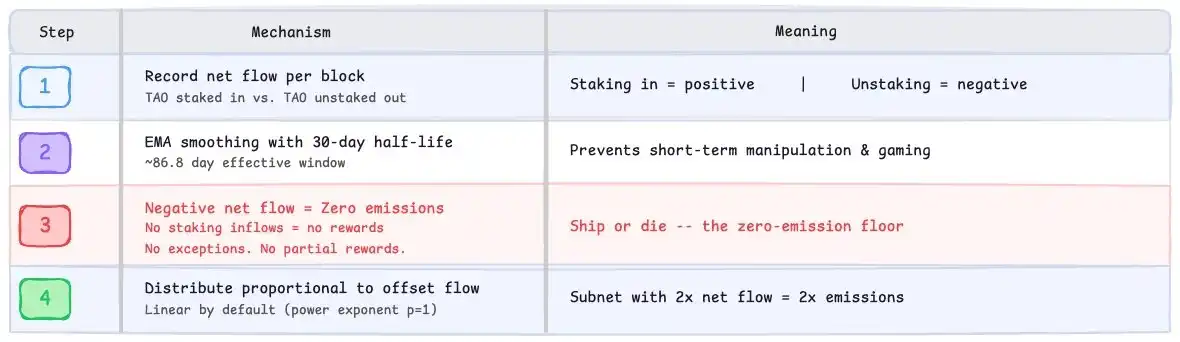
Since Taoflow in November 2025, subnets with negative net staking inflows receive zero emissions—forcing them to either succeed or die.
-
Approximately 3,600 TAO (~$960k) is distributed daily across all subnets, with the top ten controlling ~56% of the share.
-
Chutes (SN64) is the clearest example of product-market fit: 400k+ users, 9.1T tokens processed, 85% cheaper than AWS.
-
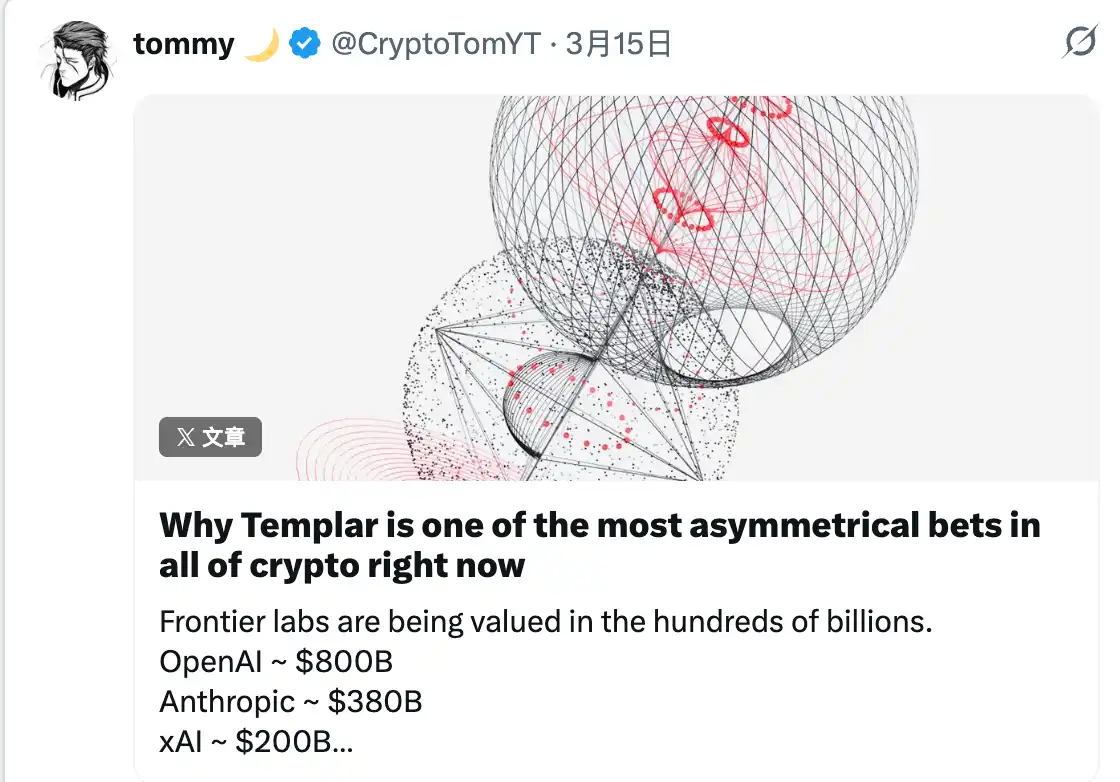
Templar (SN3) is the most asymmetric bet: fully decentralized training of frontier LLMs with a ~$60M market cap vs. OpenAI’s $800B.
-
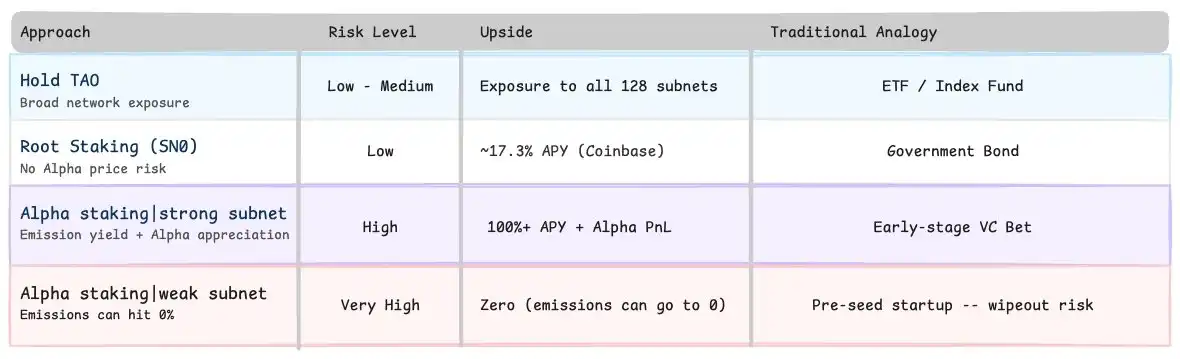
TAO = broad index fund to the entire network, while Alpha staking = concentrated investment in specific startups—with 100%+ APY potential but real risk.
-
Alpha tokens carry no formal yield promise; their value depends entirely on market dynamics and team execution.
1. Subnet Structure: Who Does What?
When people think of Bittensor, the most common mental model is: this is a decentralized AI project. While true, it’s incomplete.
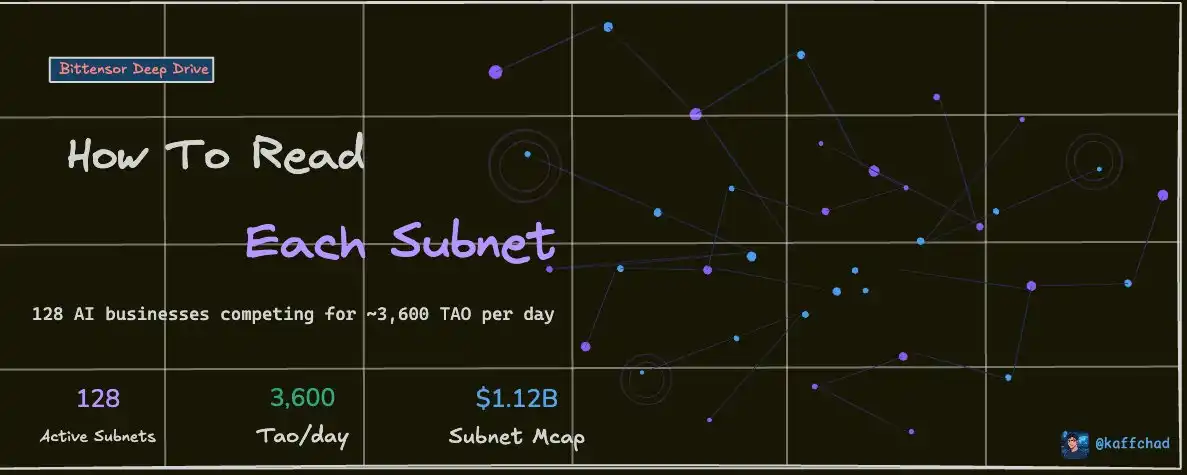
In reality, Bittensor is 128 independent AI startups competing in a brutal economic system, each with its own token, revenue model, and struggle for survival. By March 2026, the total market cap of all subnet tokens was ~$1.12B, equivalent to 27% of TAO’s own market cap. Grayscale calls it “Y Combinator for decentralized AI.” Except instead of a committee deciding who gets funded, the market decides.
Understanding this mechanism allows you to evaluate which subnets are creating real value and which are dying.
Each subnet is an incentive-based competitive market producing specific digital goods—AI inference, GPU compute, model training, financial data analysis, and more.
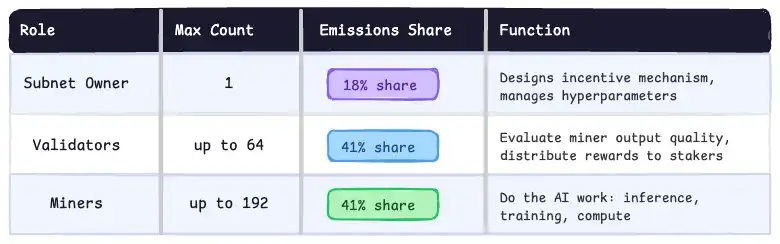
Each subnet is driven by three roles: subnet owner, validators, and miners:
Alpha Tokens: Equity in the Subnet
When you stake TAO to a subnet, your TAO enters an on-chain AMM pool (similar to Uniswap V2 mechanics). In return, you receive Alpha tokens. The price formula is:
Alpha Price = TAO in Pool ÷ Alpha in Pool
Alpha tokens have a hard cap of 21M (echoing TAO’s supply), and they auto-compound every ~72 minutes (one “tempo” = 360 blocks).
2. Two Revenue Streams and Why They’re Overlooked
In Bittensor, there are two completely separate ways to make money:
Revenue Stream 1: TAO Emissions via Taoflow
Since November 2025, Bittensor adopted the Taoflow model, a fundamental shift in how emissions are allocated.
Previously, emissions were calculated based on token price. This created a loophole: projects could artificially inflate their token price to capture emissions, build a “TAO treasury,” and slowly dump while still collecting rewards.
Taoflow fixed this by tracking net staking flow of TAO: staking inflows minus unstaking outflows. The mechanism runs in four steps:
After TAO’s first halving on Dec 14, 2025, block rewards dropped from 1 TAO to 0.5 TAO/block. Currently, ~3,600 TAO (~$960k at current prices) is distributed daily across 128 subnets. DCG estimates over $100M flows into the ecosystem annually.
Revenue Stream 2: Alpha Token PnL
This is the part most TAO holders aren’t tracking.
If a subnet performs well, Alpha’s price (denominated in TAO) rises. When you unstake, you receive more TAO than you initially put in. This is Alpha PnL = capital gains from holding a specific subnet’s token.
Taoflow creates a powerful flywheel effect:
-
Great product → more people stake TAO → positive net flow
-
Positive flow → more emissions → deeper liquidity pool
-
Deeper liquidity → lower slippage → attracts more capital
-
More capital → Alpha price rises → Alpha PnL increases for existing holders
The reverse is also true, and equally brutal. Sustained negative flow subnets → zero emissions → stakers continuously withdraw → death spiral.
3. Which Subnets Are Winning and Why?
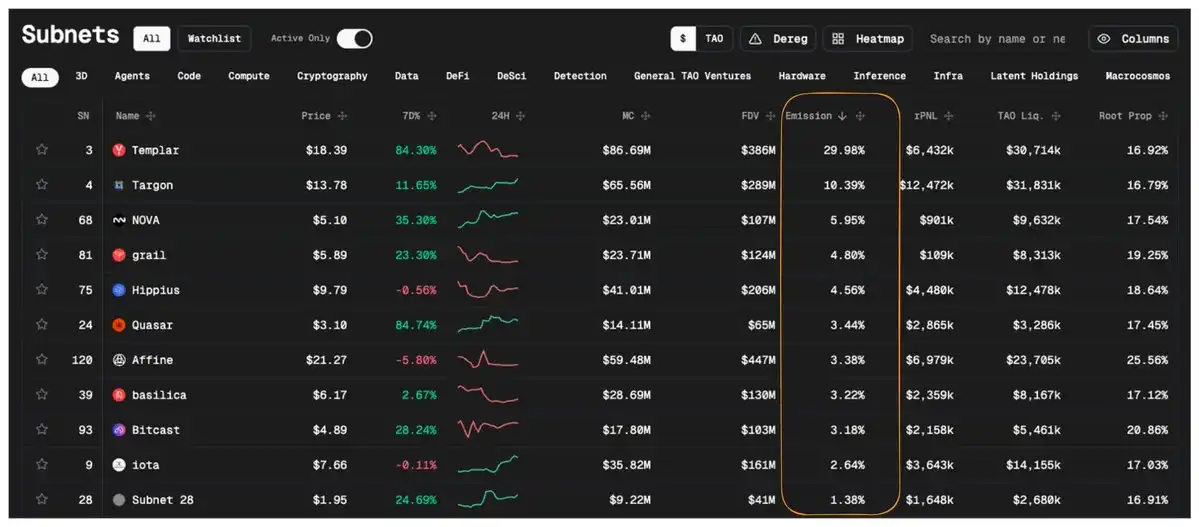
Here’s a snapshot of leading subnets ranked by emission dominance and realized PnL (rPnL):
-
SN3| templar: Large-scale LLM pre-training | Emission Share: 30.39% | rPnL: $6.43M
-
SN4| Targon: AI inference market—hosting and serving AI models for real-time predictions | Emission Share: 10.39% | rPnL: $12.47M
-
SN68| METANOVA: AI drug discovery company developing therapies to reprogram body and mind | Emission Share: 5.95% | rPnL: $900k
-
SN81| grail: Verifiable LLM post-training processing | Emission Share: 4.8% | rPnL: $109k
-
SN75| Hippius: Decentralized storage and web infrastructure with IP management | Emission Share: 4.56% | rPnL: $4.48M
The top 10 subnets control ~56% of the total daily emissions.
Case Study: Chutes, The Textbook Example of Product-Market Fit (PMF)
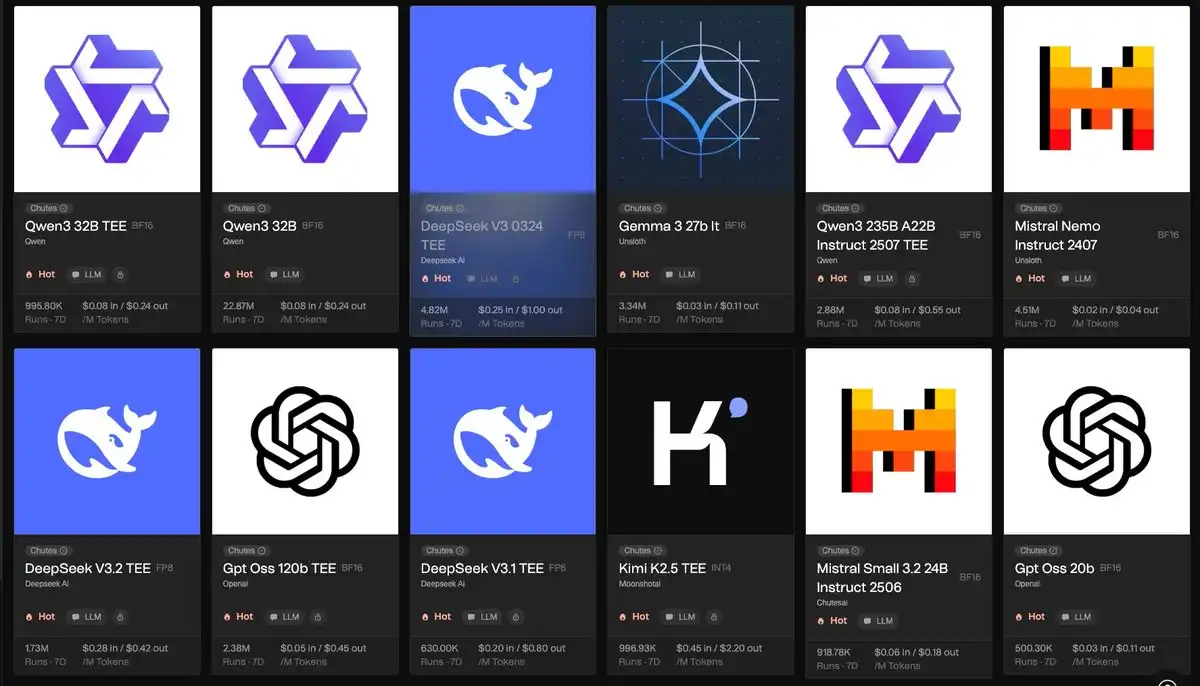
Built by Rayon Labs, Chutes is a decentralized serverless AI inference market, a Web3 alternative to OpenAI API and AWS for model deployment.
What stands out about Chutes:
-
Processed 9.1T tokens since late 2024
-
400k+ users (100k+ via API)
-
85% cheaper AI model deployment costs vs. AWS
-
Models supported: DeepSeek, Mistral, LLaMA, and dozens more
-
Platform revenue auto-staked → buys back Alpha tokens → organic demand flywheel
During a spike in February 2026, Chutes attracted over 2,740 TAO in just 9 hours. Alpha tokens peaked at $99.94 (0.225 TAO), with an FDV of 2.05M TAO (~$518M at TAO’s peak).
Rayon Labs also operates SN56 (Gradients—model training) and SN19 (Nineteen—high-frequency inference), collectively commanding over 23% of total emissions at their peak.
Case Study: Templar (SN3), The Most Asymmetric Bet in the Subnet Ecosystem
On March 10, 2026, Templar (SN3) completed Covenant-72B, a 72B parameter model hailed as the largest decentralized pre-training run in history.
4. The Mechanics Behind It: Registration, Yuma Consensus, and Competitive Pressure
Registration, A Competitive Arena
Not everyone can open a subnet. Registration uses a dynamic burn pricing mechanism: the cost doubles with each new subnet registration and halves linearly over 28,800 blocks (~4 days) with no new registrations.
When all 128 slots are full, new subnets must replace the worst-performing existing subnet (measured by lowest EMA price). Newly registered subnets get a 4-month grace period before being eligible for deregistration. The network is expected to expand to 256 subnets in 2026.
Yuma Consensus, Automated Independent Auditing
Within each subnet, Yuma consensus transforms validators' subjective assessments into objective reward distribution:
-
Validators submit weight vectors, scoring each miner they evaluate
-
The blockchain calculates the stake-weighted median for each miner (kappa=0.5)
-
Weights above the median are clipped—to prevent collusion and over-evaluation
-
Validators use a commit-reveal mechanism—submitting sealed weights, revealed only after a set number of blocks—to prevent weight copying
-
Validators who identify good miners early and evaluate consistently build stronger bonded positions and earn larger dividend shares
The result: No subnet owner can unilaterally change who gets rewards. This is the fundamental difference between Bittensor and typical crypto “AI projects.”
5. Investment Framework: TAO = Index Fund, Alpha Staking = Startup Bet
Auditless Research summarized it perfectly: “TAO is effectively more of an options token—a call option that can be pointed at the emissions of whatever Alpha token looks undervalued.”
How to Read a Subnet Like a Balance Sheet
-
Emissions = Protocol subsidies - network revenue, similar to government grants or accelerator funding
-
Alpha PnL = Market cap signal - the market is pricing the subnet’s true value
-
Net staking flow = Revenue growth indicator - positive flow = “product sells,” negative flow = churning customers
-
Subnet owner = Founder quality - communication frequency, delivery speed, and product roadmap are things to track
-
Number of validators = Board quality - more independent validators = less chance of manipulated scoring
Institutional Signals Are Growing
This is no longer just a retail story:
-
DCG holds over 500k TAO (~2.4% of total supply)
-
Polychain Capital holds ~$200M worth of TAO
-
Grayscale GTAO Trust listed on NYSE on January 6, 2026
-
Stillcore Capital (co-founded by Jason Calacanis) launched a fund dedicated to subnet tokens
6. Conclusion: A Starter Framework
Bittensor has created a structure unique in crypto: 128 AI businesses competing for a shared ~3,600 TAO (~$960k) daily, where capital allocation is determined solely by staker behavior.
When evaluating a subnet, ask these five questions:
-
Product: What does this subnet offer? Is there real demand for it?
-
Flow: Is net staking flow positive or negative? What’s the 30-day trend?
-
Team: Is the subnet owner communicating and delivering consistently?
-
Flywheel: Does revenue create organic demand for Alpha, or is it pure speculation?
-
Exit: Is the liquidity pool deep enough to exit without significant slippage?
TAO gives you broad exposure to the entire ecosystem. Alpha staking gives you a concentrated bet on a specific “startup”—with all the accompanying upside potential and downside risk.