A Critical Moment for Capital? The AI Narrative Shifts from Technology to Financing, Giants' Cash Flow Dries Up, Debt Markets Sound Alarm

marsbit发布于2026-08-17更新于2026-08-17

文章摘要

The narrative of AI investment is shifting from a technology story to a capital expenditure story, and now to a financing story. This marks a "critical moment for capital," as noted by Bridgewater's Greg Jensen. Morgan Stanley forecasts that the total cost of AI infrastructure through 2028 will reach $3.2 trillion, with approximately $1.75 trillion expected to be raised from credit markets. However, free cash flow projections for major hyperscale cloud providers are declining sharply, with Oracle's 2027 forecast nearing -$40 billion. The bond market is already pricing in the rising risks. Apollo data shows AI-related bonds constitute 40% of long-duration supply. Credit spreads for hyperscalers have widened significantly this year—around 25 basis points for high-quality names—while the overall investment-grade market remained flat. Oracle's credit default swaps (CDS) have surged dramatically, indicating particular market concern. Renowned bond investor Jeff Gundlach sharply criticized financing plans using AI assets like GPUs as collateral, comparing them to "issuing 30-year ABS backed by bananas" due to the assets' rapid obsolescence. Although current balance sheets for hyperscalers appear strong, the future funding gap is widening. Morgan Stanley has nearly doubled its 2027 cloud capital expenditure growth forecast to 29%, amplifying the financing challenge. Purchasing commitments have exploded to $982 billion, with significant capital expenditures now existing off-balance...

The narrative around AI investment is shifting. It began as a technology story, evolved into a capital expenditure story, and is now becoming a financing story.

Recently, Bridgewater's Greg Jensen summarized the current situation in one sentence: "We are entering a critical moment for capital."

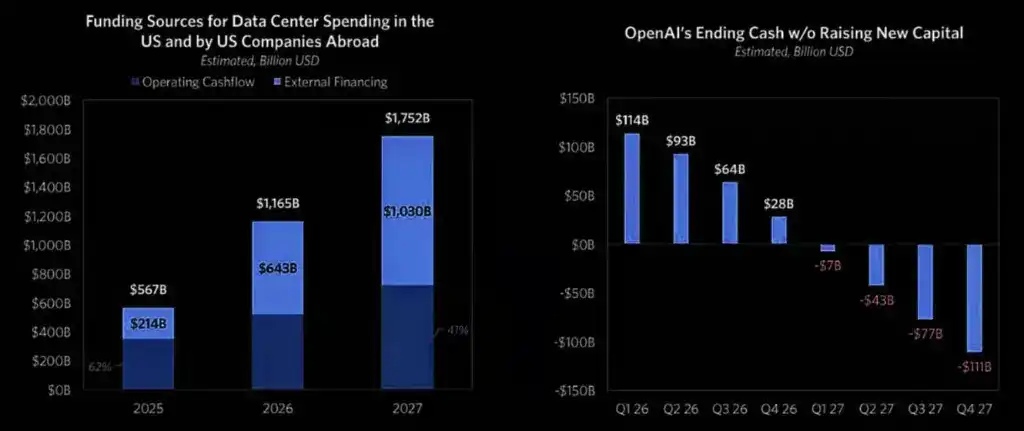
Morgan Stanley predicts that total spending on AI infrastructure construction will reach $3.2 trillion by 2028, with approximately $1.75 trillion needing to be raised through the credit markets. Funding sources have expanded from traditional investment-grade bonds to leveraged loans, private credit, and securitized products. Money is available, but it won't be cheap.

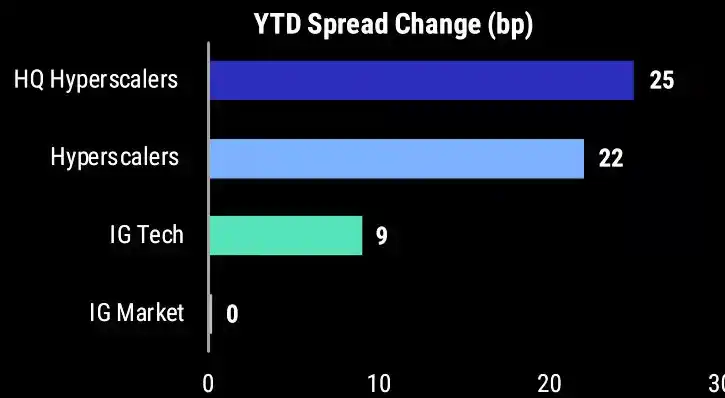
The bond market has already started to react. Apollo data shows that AI-related bond issuance now accounts for 40% of long-duration supply. Credit spreads for hyperscale cloud providers (Hyperscalers) have widened significantly this year, while the overall investment-grade market has remained virtually unchanged.

The "new bond king" Gundlach was even more direct, stating that issuing long-term bonds backed by GPUs is akin to "making a 30-year ABS out of bananas."
Cash Flow is Moving in the Wrong Direction

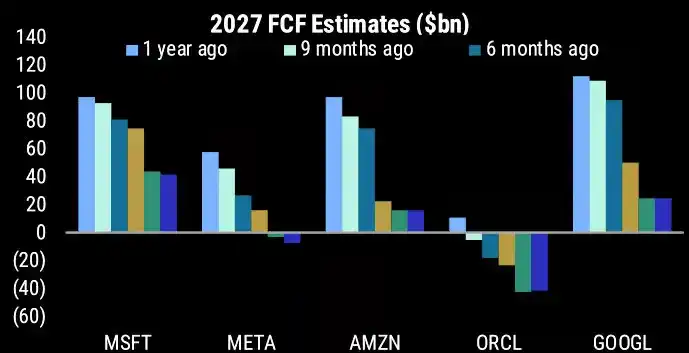
Capital expenditure forecasts are repeatedly revised upwards, while free cash flow forecasts continue to slide.

Morgan Stanley has significantly lowered its free cash flow forecasts for major hyperscale cloud providers for 2027. Oracle's situation is the most prominent, with its 2027 free cash flow forecast now approaching -$40 billion.
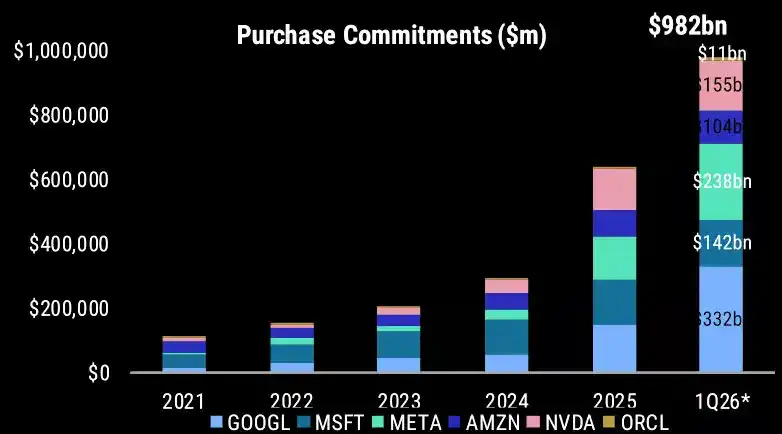
The scale of spending commitments is equally staggering. Purchase commitments from hyperscalers have exploded to $982 billion. Morgan Stanley points out that a significant portion of the real capital expenditure now exists off-balance-sheet. This means that looking only at the balance sheet severely underestimates the actual funding pressure.
Credit Markets Have Begun Pricing Risk

Investors are demanding higher compensation for risk.

Morgan Stanley data shows that credit spreads for hyperscale cloud providers have "widened significantly this year, far exceeding the overall investment-grade market"—spreads for high-quality hyperscalers (HQ Hyperscalers) widened by about 25 basis points, regular hyperscalers widened by about 22 basis points, while the overall investment-grade market spread changed by 0.
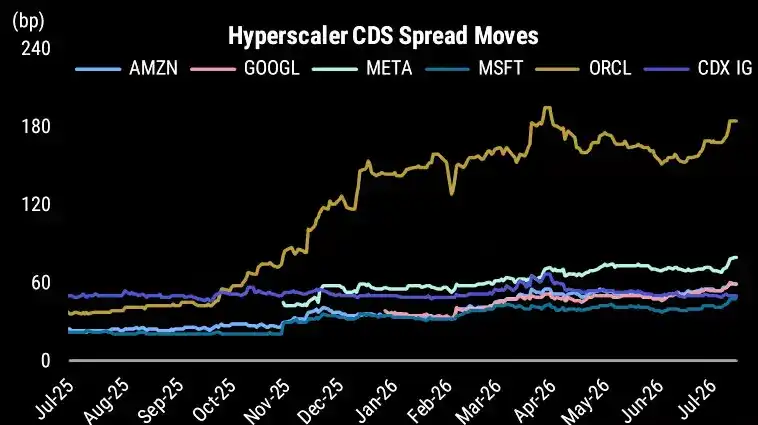
Oracle is the most watched case among them. While other hyperscalers' credit default swaps (CDS) generally trade in the 30 to 80 basis points range, Oracle's CDS surged from around 40 basis points in mid-2025 to a peak near 190 basis points in April 2026, and currently hovers around 180 basis points. Meta's CDS has risen more modestly to about 75 basis points. The credit market has clearly singled out the company it is most concerned about.
Balance Sheets are Strong, But the Problem Lies Ahead

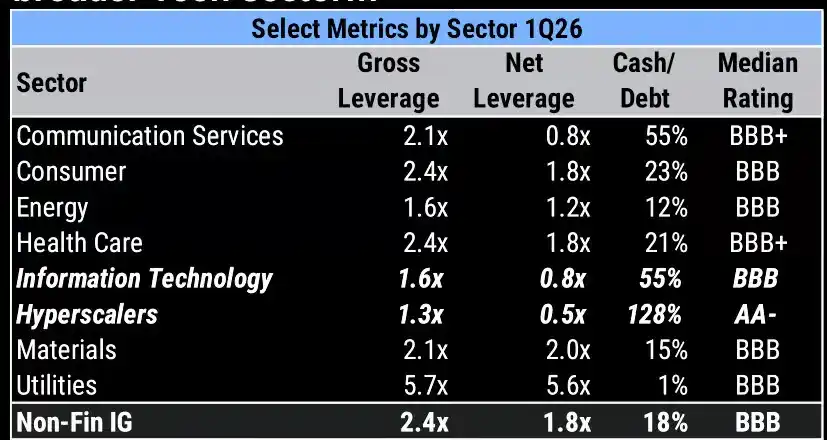
Morgan Stanley's Q1 2026 data shows that hyperscalers' total leverage ratio is only 1.3x, net leverage is 0.5x, the cash-to-debt ratio is as high as 128%, and the median credit rating is AA-. In contrast, the overall non-financial investment-grade universe has a total leverage ratio of 2.4x and a rating of BBB.

But the problem lies ahead. Morgan Stanley has sharply raised its forecast for cloud computing capital expenditure growth in 2027 from 14% to 29%, while hyperscalers are "reaffirming confidence in investment returns." As spending forecasts double, the financing gap widens accordingly.
"New Bond King" Gundlach: Using GPUs as Collateral is Like Using Bananas for ABS

Regarding financing schemes emerging in the market that use AI assets as collateral, renowned bond market investor Jeff Gundlach offered sharp criticism.

He warned about a planned $50 billion fund consortium, stating the plan is "likely not to stand the test of time." He asked on social media: "Using assets with unknown life spans as collateral for long-term debt? Why not do a 30-year ABS trade backed by bananas in a warehouse?" He added, these are "brand new engineered bananas with unknown life spans."

Gundlach's analogy gets to the core issue: GPUs depreciate extremely quickly, with technology refresh cycles far shorter than the tenure of the debt. When using such assets as collateral for long-term financing, the actual value of the collateral is highly uncertain.


热门币种推荐

相关问答

QWhat is the main shift in the narrative of AI investment according to the article?

AThe narrative is shifting from being a technology story to a capital expenditure story, and is now becoming a financing story.

QWhat is the significant warning that Jeff Gundlach gives about using AI assets as collateral?

AJeff Gundlach warns that using assets like GPUs as collateral for long-term debt is akin to using bananas for a 30-year ABS, highlighting the risk due to their fast depreciation and short technological lifecycle compared to the debt tenure.

QWhat do the widening credit spreads for Hyperscalers indicate, according to the article?

AThe widening credit spreads for Hyperscalers indicate that investors are demanding higher risk compensation, signaling growing market concern about their future financial health amidst heavy AI infrastructure spending.

QWhich company's financial situation is highlighted as particularly concerning in the credit markets?

AOracle's financial situation is highlighted as particularly concerning. Its Credit Default Swap (CDS) spreads surged dramatically to around 190 basis points, far exceeding those of other Hyperscalers, and its 2027 free cash flow forecast is deep in negative territory.

QAccording to Morgan Stanley, what is the estimated total spending on AI infrastructure by 2028 and the financing need?

AMorgan Stanley predicts total AI infrastructure spending will reach $3.2 trillion by 2028, with approximately $1.75 trillion of that needing to be raised through credit markets.

你可能也喜欢

回购美债影响力只有24小时?贝森特:我们有很多工具,拭目以待

美国财长贝森特于8月20日密集释放政策信号。针对此前财政部宣布加倍长债回购但市场反弹仅持续不到24小时的情况,贝森特表示“24小时内都是噪音”,并强调财政部拥有庞大的“工具箱”来干预债市,未来单次回购规模可能远超40亿美元,具体将视情况而定。他同时认为当前美债收益率,尤其是30年期,并未充分反映美国经济基本面。 贝森特透露,特朗普总统已责成其与预算管理局局长牵头一项新的财政整顿计划,预计本周末或下周初公布,旨在通过打击欺诈、削减拨款等方式节省开支。此外,他重申美国将维持强势美元政策。 在伊朗问题上,贝森特宣布将于8月24日举行新闻发布会,阐述对伊行动计划。他暗示将通过施加“前所未有的经济孤立”和“最大程度的经济压力”来达成目标,以期避免大规模的军事冲突。对于当日油价上涨,他表示不解,但称美国的行动将使油价回落。 贝森特还谈及,企业对AI投资的高回报预期使其公司债发行对收益率“近乎不敏感”,他相信这类投资最终将推动生产率增长。市场分析认为,财政部的回购操作虽能短期影响流动性,但难以扭转由财政赤字、债务供给和通胀预期等基本面驱动的长期收益率上行趋势。

marsbit36分钟前

回购美债影响力只有24小时?贝森特:我们有很多工具,拭目以待

marsbit36分钟前

美国商品期货交易委员会主席:若CLARITY法案未通过,该机构将继续推进加密货币监管工作

美国商品期货交易委员会(CFTC)主席迈克尔·塞利格表示,即使《数字资产监管清晰法》(CLARITY)未获国会通过,该机构也将继续推进加密货币监管工作。塞利格称,此举旨在帮助特朗普总统兑现其承诺。他已指示工作人员制定新规,允许注册及未注册机构提供杠杆或保证金加密货币交易,并研究对开发者的保护措施。 目前,CLARITY法案的审议因美国参议院休会而暂停,预计9月恢复后将进行程序投票。该法案在参议院需获得60票才能通过,之后将送回众议院,并可能提交总统签署。 塞利格的言论是在他与特朗普及加密行业领袖于白宫会晤后一天发表的。特朗普曾呼吁国会通过一项“公平版本”的CLARITY法案,以使美国在相关领域领先于中国。然而,国会许多民主党人要求加强法案中的道德条款,特别是涉及特朗普家族加密投资的问题。法案能否获得足够支持尚不确定。 与此同时,美国证券交易委员会(SEC)也于本周发布了数字资产监管的拟议规则,旨在为加密公司提供安全港待遇。 塞利格目前是CFTC唯一获参议院批准的领导层委员,自去年12月以来一直主导该机构议程。此外,CFTC咨询委员会在会议上还讨论了人工智能和预测市场相关议题,塞利格声称CFTC对预测市场拥有“专属管辖权”。

cryptonews.ru3小时前

美国商品期货交易委员会主席:若CLARITY法案未通过,该机构将继续推进加密货币监管工作

cryptonews.ru3小时前

交易

现货

热门文章

如何购买FLOW

欢迎来到HTX.com!我们已经让购买Flow(FLOW)变得简单而便捷。跟随我们的逐步指南,放心开始您的加密货币之旅。第一步:创建您的HTX账户使用您的电子邮件、手机号码注册一个免费账户在HTX上。体验无忧的注册过程并解锁所有平台功能。立即注册第二步:前往买币页面,选择您的支付方式信用卡/借记卡购买:使用您的Visa或Mastercard即时购买Flow(FLOW)。余额购买:使用您HTX账户余额中的资金进行无缝交易。第三方购买:探索诸如Google Pay或Apple Pay等流行支付方法以增加便利性。C2C购买:在HTX平台上直接与其他用户交易。HTX场外交易台(OTC)购买:为大量交易者提供个性化服务和竞争性汇率。第三步:存储您的Flow(FLOW)购买完您的Flow(FLOW)后,将其存储在您的HTX账户钱包中。您也可以通过区块链转账将其发送到其他地方或者用于交易其他加密货币。第四步:交易Flow(FLOW)在HTX的现货市场轻松交易Flow(FLOW)。访问您的账户,选择您的交易对,执行您的交易,并实时监控。HTX为初学者和经验丰富的交易者提供了友好的用户体验。

1.5k人学过发布于 2024.03.29更新于 2026.06.02

如何购买FLOW

相关讨论

欢迎来到HTX社区。在这里,您可以了解最新的平台发展动态并获得专业的市场意见。以下是用户对FLOW(FLOW)币价的意见。

活动图片