According to Coinfello, AI Agents Can Bypass Robinhood's Restrictions on Stock Tokens

cryptonews.ru发布于2026-08-03更新于2026-08-03

文章摘要

Despite launching its own blockchain (Robinhood Chain), Robinhood's attempt to restrict U.S. residents from accessing its tokenized stocks faces a significant vulnerability, according to industry experts. While these "Stock Tokens" are blocked in Robinhood's own app, they are available through integrated third-party wallets like Trust Wallet, revealing that the geo-block is merely a front-end interface restriction, not hard-coded into the smart contracts themselves. This creates a regulatory contradiction on the same chain, where U.S. users can access products like Robinhood Earn but are technically barred from the tokenized stocks. The problem is exacerbated by the integration of AI trading agents via Robinhood's Model Context Protocol. These agents can potentially guide any user to any on-chain contract, effectively bypassing the interface-based restrictions by converting simple commands into complex contract interactions, all without custodianship of user assets. Experts argue that for true compliance, restrictions must be embedded within the token contracts themselves, enabling programmatic enforcement by any wallet or agent, rather than relying on easily circumvented front-end blocks. The outcome will set a precedent for how decentralized finance handles jurisdictional boundaries as Robinhood Chain's trading volume grows.

Amid much hype and fanfare, the Robinhood Chain network launched on July 1. Built on Arbitrum's Nitro stack and designed for tokenized real-world assets and 24/7 trading, it uses a single sequencer managed by Robinhood but lacks the ability to transition to a permissionless alternative mechanism. Furthermore, the company appears to have direct control over transaction ordering, even though the underlying smart contracts remain open to all.

Stock Tokens — tokenized debt securities issued through Robinhood Assets (Jersey) Limited, which track shares of companies like Nvidia and Tesla without conferring shareholder rights — are available in over 120 countries, but explicitly prohibited for U.S. residents under securities law. Additionally, quite recently, Trust Wallet integrated with Robinhood Chain — one of several third-party wallets that can access the same contracts while bypassing Robinhood's own application.

On paper, such integrations look great, but the gap between a restricted product operating parallel to an open network seems to have alarmed many industry figures, including MinChi Park, co-founder of the onchain-agent platform Coinfello. She believes that an interface-level block is a poor substitute for real enforcement, adding:

Geoblocking at the interface level protects the issuer. It protects the user much less. Here's a test: if the restriction disappears the moment a user opens a third-party wallet, then it was never a mechanism for regulatory compliance. It was a liability shield.

A Split in Eligibility Already Exists

Robinhood's own product lineup demonstrates how uneven this enforcement already is: while Stock Tokens remain unavailable to U.S. residents, Robinhood Earn (a credit product built on Morpho, offering an Annual Percentage Yield (APY) of around 7% on USDG) became available to eligible U.S. clients on the same chain starting last month.

The launch of Earn touches Robinhood's base of 27.7 million funded customers holding $377 billion in assets on the platform, meaning: a U.S. user can provide loans to the Morpho vault on Robinhood Chain, while remaining deprived of access to tokenized Nvidia shares that are just one click away in the same wallet. Park argues this split is not a temporary launch issue that Robinhood will fix later, noting:

Regulation is tied to the 'wrapper,' and composability is tied to the asset. These two things are now pulling in opposite directions on the same chain.

Each product has its own issuer and jurisdictional boundaries, but the moment a restricted token becomes collateral on a lending market or passes through an aggregator, those boundaries begin to blur.

Where AI Agents Complicate the Picture

In May 2026, Robinhood added multi-agent trading to this structure, allowing clients to connect third-party AI agents via the company's Model Context Protocol servers to analyze, trade, and manage portfolios without manual intervention. CEO Vlad Tenev characterized this move as giving retail users the same automated tools that institutional trading desks have used for decades.

However, experts are concerned that agents remove the technical barriers that previously served as informal protection. In other words, a non-custodial agent that guides any user to any asset cannot be viewed as a neutral entity, but rather as a bypass mechanism with a convenient user interface.

Previously, directly accessing a restricted contract required finding the address, understanding the code, and manually managing keys—this skill barrier prevented most restricted users from accessing most restricted products. An agent that converts a plain-language request into a multi-step contract call removes this barrier, all while never taking custody of the user's assets, which Park says renders the custody question moot.

What Real Restriction Enforcement Could Look Like

One solution could be moving compliance checks directly into the asset itself, rather than leaving them at the application settings. This means restrictions would be encoded directly into the token contract in a form that wallets and agents can read and comply with programmatically, and also that agents would display disclosure information at the moment of action, rather than bypassing a rule they can technically read.

Robinhood's own tokens already contain one disclosure that is worth displaying precisely at that moment: for example, Stock Tokens confer no voting rights or shareholder privileges and allow only cash redemption—such a structure has already sparked a separate discussion about what buyers actually own.

Whether Robinhood or its DeFi partners will implement such a level of on-chain eligibility verification will matter far beyond one chain. Trading volume on Robinhood Chain recently exceeded $9 billion, and every wallet or agent connecting to it inherits the same gap between what the interface blocks and what the underlying contract permits.


热门币种推荐

相关问答

QWhat is the main function of Robinhood Chain, and what technology does it use?

ARobinhood Chain is designed for tokenized real-world assets and 24/7 trading. It is built on Arbitrum's Nitro stack and uses a single sequencer managed by Robinhood, but without a path to a permissionless alternative.

QWhat are Robinhood's Stock Tokens, and why are they restricted for U.S. residents?

ARobinhood's Stock Tokens are tokenized debt securities issued by Robinhood Assets (Jersey) Limited that track stocks like Nvidia and Tesla but do not confer shareholder rights. They are explicitly prohibited for U.S. residents due to securities laws.

QAccording to Coinfello's MinChi Park, what is problematic about Robinhood's geoblocking method for Stock Tokens?

APark argues that geoblocking at the application interface level is a weak substitute for real enforcement. It primarily protects the issuer from liability, not the user, as the restriction disappears when a user switches to a third-party wallet like Trust Wallet, making it an enforcement shield rather than a true compliance mechanism.

QHow do AI agents potentially bypass Robinhood's restrictions on Stock Tokens?

AAI agents connected via the Model Context Protocol server allow users to analyze, trade, and manage portfolios without manual intervention. These agents lower technical barriers by converting plain language requests into multi-step smart contract calls, providing a user-friendly mechanism to access restricted contracts that the app's interface blocks, without ever taking custody of user assets.

QWhat is one proposed solution to properly enforce product restrictions like those on Stock Tokens on Robinhood Chain?

AA proposed solution is to embed compliance checks directly into the asset's token contract itself. This means restrictions would be programmatically encoded so that wallets and AI agents can read and enforce them at the contract level, and agents would display relevant disclosures at the moment of action rather than bypassing a rule they can technically access.

你可能也喜欢

XRP Ledger活跃用户数逼近20万

XRP Ledger的日活跃用户数正逼近20万,创下近月来最高水平。尽管XRP价格仍低于重要技术阻力位,但链上数据显示网络活动显著加速,表明生态系统使用率正在增强,而价格动能则相对滞后。 数据显示,日活跃用户数已增至约19.08万,且增长趋势在7月下旬持续稳定,并非短期波动。此前在网络整体调整期间,该数据曾难以维持在10万以上,因此近期回升反映了用户因实际应用而回归,而非单纯投机交易。更高的地址活跃度通常意味着区块链的采用范围扩大,并能促进交易量、支付额及基于XRP Ledger的去中心化应用的流动性提升,这些被视为比价格波动更健康的网络实际使用指标。 尽管网络基本面改善,XRP价格未能同步反弹,近期交易于1.07美元附近,多次未能有效突破1.10美元阻力位。它仍处于50日及100日移动平均线下方,技术结构呈盘整状态。长期关键阻力位于200日移动平均线约1.21美元处,需有效突破该水平才能强化技术前景。动量指标相对强弱指数约为47,显示卖压较前几个月已显著减弱。 总结而言,XRP Ledger用户活跃度正接近年度高点,但价格仍低于关键技术水平。若用户参与度持续提升,且价格能恢复至主要移动平均线之上,资产的技术面或将开始反映链上基本面的增强。

cryptonews.ru28分钟前

XRP Ledger活跃用户数逼近20万

cryptonews.ru28分钟前

ZEC价格刚刚突破490美元大关——这是其上涨的原因

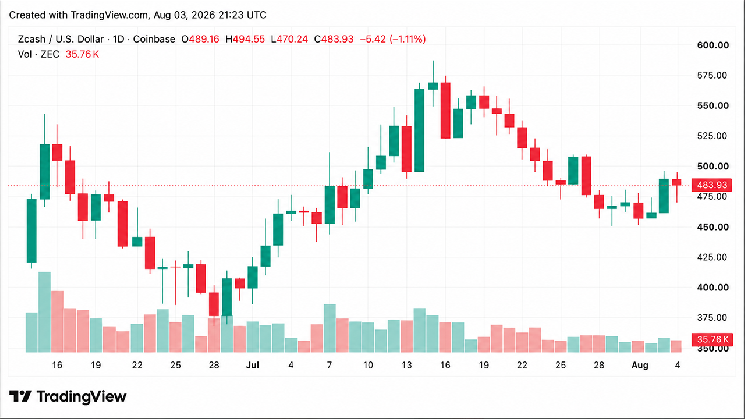
8月3日下午,具备隐私功能的加密货币Zcash(ZEC)在六小时内飙升近5%,上涨超过20美元。行情数据显示,ZEC从凌晨4:10(EST)的略高于470美元水平,反弹至接近494美元的盘中高点,并重新站上490美元关口。这使得ZEC市值再度突破80亿美元,巩固了其作为最昂贵隐私币的地位。本月以来,ZEC已上涨近8%,成为8月市场领跑者之一。 ZEC的优异表现部分得益于整体加密货币市场的看涨情绪,但超预期涨幅主要源于一个重要基本面催化剂:Nym公司集成了Zcash的新型受保护资金池Ironwood。该集成允许用户直接使用ZEC进行端到端的安全支付以换取网络服务,被视为隐私优先的去中心化金融(DeFi)领域的一次标志性胜利。 此次上涨也伴随着行业对隐私问题的重新关注。业内观察家Will McEvoy指出,隐私是加密货币的“最后前沿”,并追溯了行业从概念验证到功能可扩展性的演变过程。他强调,隐私是早期先驱的核心目标之一,而如今零知识证明(ZK)技术已经成熟,使得隐私保护在数字资产面临机构化、AI数据处理和强制年龄验证等压力时变得至关重要。 此外,Zcash在去中心化治理路线图上取得了切实进展,推出了追溯性赠款计划,将国库资金分配从封闭委员会转向代币持有者的直接投票,这进一步提振了价格。ZEC的上涨也推动整个隐私币板块总市值超过300亿美元。其他表现突出的币种包括NEAR(+2.4%)、ZK(+4.5%)和NOCK(+5.3%),但ZANO(-5.5%)、ZBT(-6.5%)和COTI(-10.2%)等币种的下跌部分抵消了板块的整体涨幅。

cryptonews.ru42分钟前

ZEC价格刚刚突破490美元大关——这是其上涨的原因

cryptonews.ru42分钟前

交易

现货

热门文章

如何购买S

欢迎来到HTX.com!我们已经让购买Sonic(S)变得简单而便捷。跟随我们的逐步指南,放心开始您的加密货币之旅。第一步:创建您的HTX账户使用您的电子邮件、手机号码注册一个免费账户在HTX上。体验无忧的注册过程并解锁所有平台功能。立即注册第二步:前往买币页面,选择您的支付方式信用卡/借记卡购买:使用您的Visa或Mastercard即时购买Sonic(S)。余额购买:使用您HTX账户余额中的资金进行无缝交易。第三方购买:探索诸如Google Pay或Apple Pay等流行支付方法以增加便利性。C2C购买:在HTX平台上直接与其他用户交易。HTX场外交易台(OTC)购买:为大量交易者提供个性化服务和竞争性汇率。第三步:存储您的Sonic(S)购买完您的Sonic(S)后,将其存储在您的HTX账户钱包中。您也可以通过区块链转账将其发送到其他地方或者用于交易其他加密货币。第四步:交易Sonic(S)在HTX的现货市场轻松交易Sonic(S)。访问您的账户,选择您的交易对,执行您的交易,并实时监控。HTX为初学者和经验丰富的交易者提供了友好的用户体验。

3.3k人学过发布于 2025.01.15更新于 2026.06.02

如何购买S

相关讨论

欢迎来到HTX社区。在这里,您可以了解最新的平台发展动态并获得专业的市场意见。以下是用户对S(S)币价的意见。

活动图片