Author: Zen, PANews
On July 25th, at an event named the "Silicon Valley Venture Capital Meetup" hosted by South Korean President Lee Jae-myung, the National Pension Service (NPS) of South Korea signed memorandums of understanding with six leading U.S. venture capital firms.
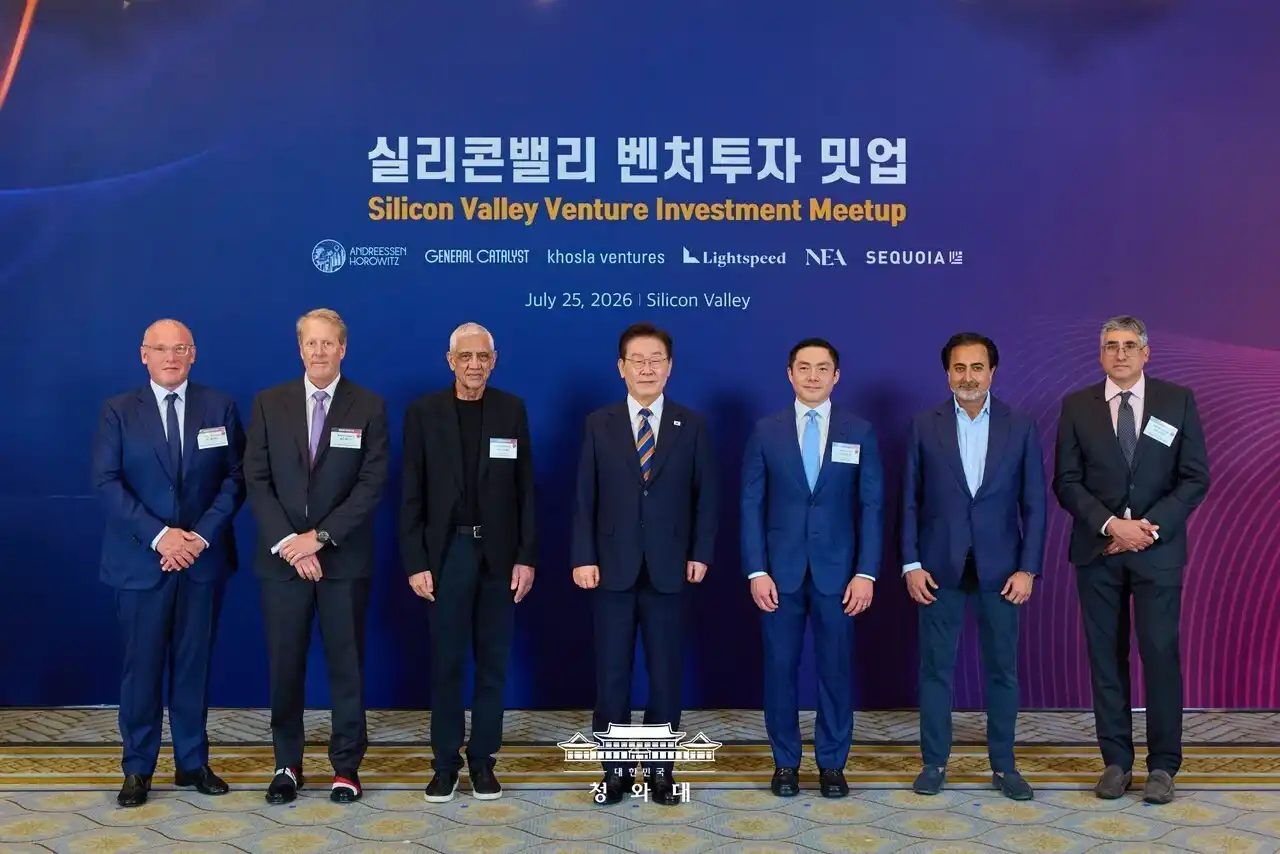
Sitting across the negotiating table were Sequoia Capital, a16z, Khosla Ventures, Lightspeed Venture Partners, General Catalyst, and NEA. These six firms collectively manage approximately $313 billion in assets, with investment portfolios covering well-known tech giants like Apple, NVIDIA, Google, OpenAI, and Anduril.
According to the MOUs, both sides plan to establish long-term cooperation channels to explore global venture capital opportunities and share market and project information. The South Korean government set the stage for this meeting, but the entity that actually brought its balance sheet to the table was the National Pension Service (NPS), managing assets of nearly 1,690 trillion won (about $1.16 trillion).
In South Korea, individual investors known as "Western Learning Ants" are already accustomed to opening their brokerage apps late at night, waiting for the New York market to open. Data from the Korea Securities Depository shows that as of June 2, 2026, the value of U.S. stocks held in custody by domestic South Korean investors through local brokerages reached about $206.3 billion, hitting a record high. After entering July, capital inflows accelerated again, with net purchases of U.S. stocks from July 1st to 24th accumulating to approximately $2.596 billion, already about four times the total for the entire month of June.
One bears the responsibility for national retirement, the other pursues personal wealth growth. These two types of funds have vastly different investment horizons, risk tolerance, and institutional constraints, but both are increasingly frequently crossing the Pacific Ocean.
Late-Night 'Western Learning Ants' and the Pension Fund that the Local Market Cannot Fully Accommodate
South Korean retail investors' enthusiasm for U.S. stocks has persisted for years. In South Korea's investment parlance, individual investors who stay in the domestic stock market are called "Eastern Learning Ants," while those venturing into overseas markets are "Western Learning Ants."
There's a time difference between the U.S. stock market and Seoul, with the normal trading hours coinciding with late night in South Korea, but this isn't a problem for South Koreans who love staying up late. Moreover, after South Korean brokerages began offering services like foreign currency exchange, fractional share trading, and extended trading hours, buying U.S. stocks has become not much different from buying Korean stocks.
This enthusiasm encompasses two factors. Part of the capital is engaged in normal global asset allocation. South Korea's economy boasts strong industries like semiconductors, automobiles, batteries, and shipbuilding, but its domestic listed company structure is relatively concentrated. Another part carries a stronger speculative flavor. South Korean retail investors have long favored thematic stocks, leveraged products, and high-volatility assets. They quickly concentrate funds during rallies, but also tend to cause stampedes when the market reverses.

Recently, South Korean regulators tightened access requirements for single-stock leveraged ETFs precisely to control market volatility caused by highly concentrated retail capital.
The NPS's move overseas follows another logic.
The South Korean National Pension System began in 1988, resembling a nationwide public pension insurance. Starting from July 2026, enterprise employees contribute 9.5% of their assessed monthly income as pension insurance premiums, with the employer and employee each bearing 4.75%; self-employed subscribers typically bear the full contribution themselves. After paying current pensions, the remaining funds form a surplus, which is then invested by the NPS into stocks, bonds, real estate, infrastructure, and private equity funds.
As of the end of April 2026, the assets of the South Korean National Pension Fund reached 1,670.7 trillion won. Since the system's inception, it has cumulatively received 945.5 trillion won in insurance premiums and other income, while cumulative investment returns amounted to 1,177.9 trillion won; pension payments and management expenses cumulatively totaled 452.8 trillion won.
The most notable point here is: The funds earned from NPS investments over the years have already exceeded the cumulative insurance premiums received. This means it has long transcended its role as an administrative body that merely "collects premiums and disburses pensions."
In 2025, South Korea completed its first major National Pension reform in 18 years. The contribution rate will gradually increase from the original 9% to 13%, while the pension replacement rate will be adjusted. The reform has pushed back the projected depletion time of the fund, but pressure from South Korea's aging population on its revenues and expenditures is still rising. In the future, investment returns will become a crucial variable in extending the fund's lifespan.
Simultaneously, the NPS has grown so large that it is difficult to concentrate long-term within South Korea's borders.
As of the end of April 2026, NPS had allocated 930.7 trillion won overseas, accounting for 55.7% of its financial assets. This includes 604.5 trillion won in foreign stocks, 103.1 trillion won in foreign bonds, and about 221.4 trillion won in foreign alternative assets. Domestic investments accounted for the remaining 44.3%.
If such a massive fund were primarily kept in South Korea, the NPS would continuously increase its holdings in large companies like Samsung Electronics and SK Hynix, and its buying and selling would significantly impact market prices. The South Korean stock market has high industry concentration, and if pensions, employment, resident income, and investment portfolios all simultaneously depend on the domestic economy, risks would be compounded.
Therefore, expanding overseas investments serves a dual purpose: on one hand, seeking more diverse sources of return; on the other hand, reducing constraints from the limited domestic market capacity and single economic cycle. Reuters once estimated NPS's asset size to be equivalent to about 60% of South Korea's GDP. This scale dictates that it must allocate funds on a global level.
From New York's Public Markets to Silicon Valley's Private Circle
The NPS's entry into Silicon Valley is not a sudden shift.
In 2002, NPS began delegating the management of overseas stocks to external institutions; in 2005, it entered global alternative investments; in 2011, it established a New York office, followed by layouts in London and Singapore. In 2024, NPS opened an office in San Francisco, extending its reach to the area most concentrated with U.S. tech startups and venture capital.
Today, over half of NPS's financial assets are managed by external management institutions. While the pension fund can directly purchase public market stocks and bonds, entering fields like private equity, venture capital, real estate, and infrastructure relies more on professional managers for deal sourcing, due diligence capabilities, and local networks.

The United States holds a significant position in this global allocation. The latest 13F filing submitted by NPS to the U.S. Securities and Exchange Commission shows that as of the end of March 2026, its disclosed holdings of U.S. listed securities were valued at approximately $131.7 billion, involving a total of 562 assets. The 13F only covers U.S. listed securities meeting the reporting criteria and cannot represent all of NPS's investments in the U.S., but it is sufficient to show its scale on Wall Street.
Signing agreements with the six VCs, including Sequoia and a16z, further pushes this route into the Silicon Valley venture ecosystem.
Large tech companies in the public markets have already entered mature stages. Early-stage projects in AI, robotics, biotech, and defense tech are primarily held by VCs. For NPS to build its own team to individually find, evaluate, and manage these startups would be very costly and lack local networks. Establishing fixed cooperation channels with leading VCs can help it gain access to fund interests, growth-stage projects, and market information.
For the six VCs, NPS is also attractive. Venture capital firms need to continuously raise new funds. Public pension funds, with their large scale and long-term capital, are important sources of institutional limited partners (LPs). Especially in the context of continuously expanding financing rounds for AI infrastructure, robotics, and deep tech, the value of long-term capital becomes even more pronounced.
However, this MOU currently remains a roadmap for cooperation. The officially disclosed content mainly involves exploring global investment opportunities, information exchange, and long-term cooperation. There are no specific fund commitments, nor is there evidence that NPS has already allocated large sums of money collectively to these six institutions. NPS emphasized in its announcement that it will evaluate investment opportunities, market conditions, and risk factors before gradually expanding overseas venture investments.
Additionally, the South Korean government hopes this channel can also serve domestic startups. Information released by the Presidential Office mentioned that both sides also discussed investment in South Korean startups and their entry into the global market. a16z has already established an office in South Korea. For NPS, investment returns and pension fund safety remain the primary measures. At the same time, helping South Korean companies connect with Silicon Valley may also bring industrial spillover effects.
The Same Dollar Direction, Two Different Sets of Risks
Both South Korean retail investors and NPS are expanding overseas investments, but they are engaging in fundamentally different trades.
Retail investors can concentrate their funds on a few tech stocks and use leverage to chase short-term trends. NPS needs to simultaneously manage stocks, bonds, real estate, infrastructure, and private assets, with an investment horizon spanning decades. Personal investment losses are borne by households, while significant mistakes by the pension fund can affect the retirement expectations of the entire society.
Their true commonality lies in the recognition of the boundaries of the South Korean domestic market.
Ordinary investors seek the growth opportunities offered by U.S. tech companies; NPS, on the other hand, must find sufficiently numerous and diversified assets for a fund exceeding 1,600 trillion won. When the South Korean economy cannot provide exposure to all industries and the necessary market capacity, capital naturally extends to global markets, with the United States becoming one of the most important destinations.
This choice is also starting to have macroeconomic impacts.
Purchasing overseas assets requires exchanging for U.S. dollars. The sustained buying of U.S. stocks by South Korean retail investors and NPS's continuous increase in overseas allocations both create demand for dollars. In early 2026, the buying frenzy of South Korean retail investors for U.S. stocks was seen as an important internal factor putting pressure on the Korean won; NPS's foreign exchange operations are on a much larger scale, where a single adjustment can influence market supply and demand.
To reduce the impact caused by the NPS's concentrated purchases of dollars in the spot market, the Bank of Korea and NPS have extended their foreign exchange swap arrangement until the end of 2026. NPS can obtain dollars for overseas investment through the central bank's foreign exchange reserves, reducing the need to directly sell won; during rapid won depreciation, NPS also conducts strategic foreign exchange hedging.
South Korean policy thus faces a long-standing balancing act: pension funds need global diversification and higher returns, while exchange rate stability and the domestic capital market hope funds remain somewhat within the country.
In May 2026, NPS raised its target proportion for domestic stocks to 20.8% by year-end, while setting the target for foreign stocks at 35.6% by the end of 2027. This adjustment considered both the rise in the South Korean stock market and responded to the pressure on the won caused by overseas investments, indicating that NPS's globalization path will be continuously calibrated according to market conditions.
Therefore, NPS entering Silicon Valley does not mean the South Korean government is starting to gamble the national pension fund on high-risk tech bets. It is more akin to an extension of its over-twenty-year globalization strategy: the fund size continues to grow, the domestic market capacity is limited, and demographic structure demands it seek higher, more diversified long-term returns. In this regard, pension funds from European countries like the Netherlands and Switzerland are ahead.
What is truly worth noting is that the wealth structure of South Korean residents is changing. Work, real estate, and pension responsibilities remain rooted in South Korea, but an increasing amount of financial assets is seeking growth in the U.S. and global markets. The MOU signed by NPS with the six Silicon Valley VCs is merely the latest node in this process.