Author:angelilu, Foresight News
Hyperliquid founder Jeff Yan posted an announcement about HIP-4 on his Discord, stating that outcome markets will support permissionless deployment in an upcoming network upgrade, first on testnet and then on mainnet.
The wording of the announcement is that, just like the deployment of spot and perpetual contracts, this outcome markets technology needs to undergo sufficient real-world testing in an environment deployed by validators before it can be expanded to permissionless deployment.
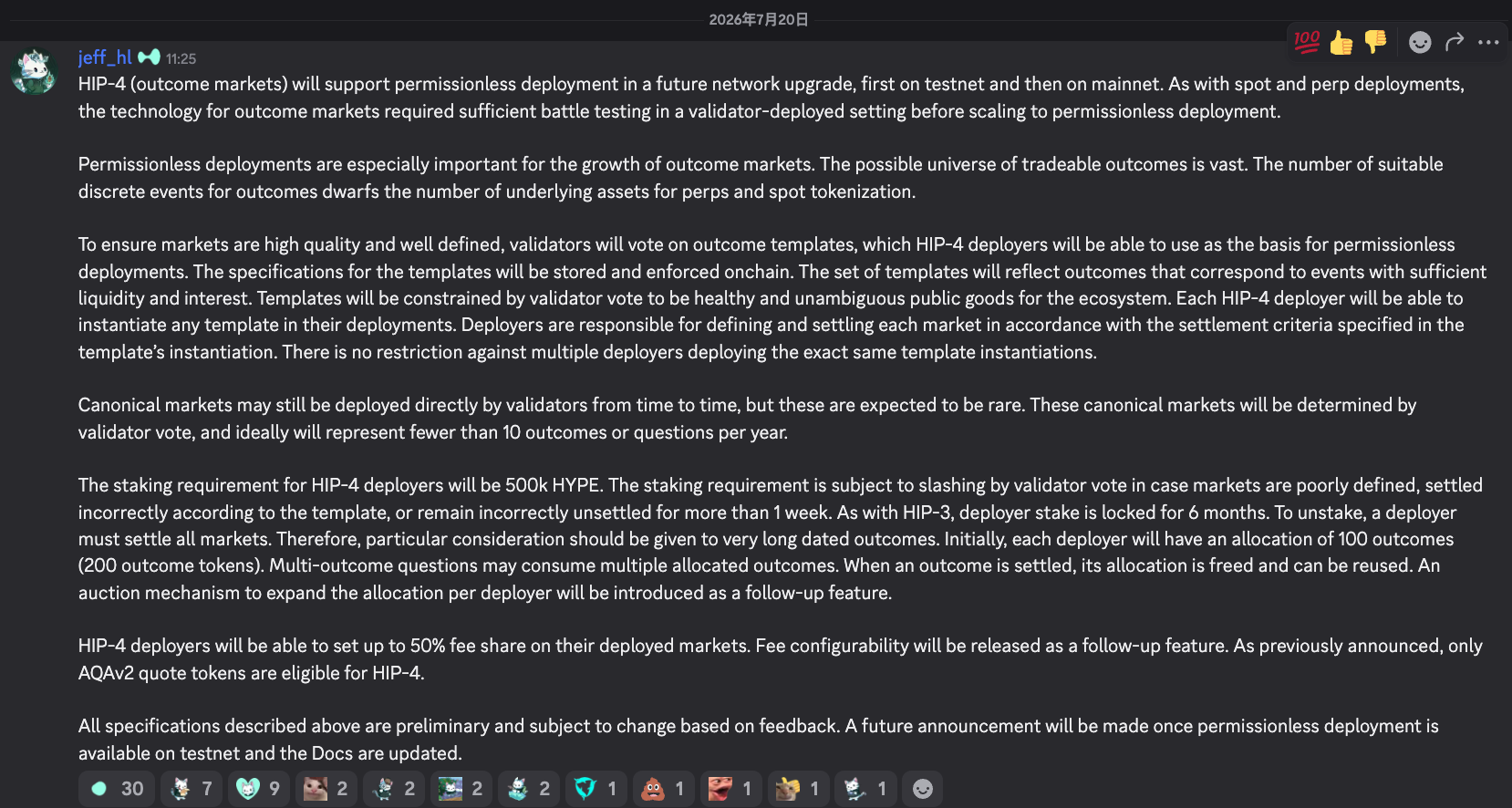
The announcement did not give a specific date and noted at the end that all specifications are preliminary and may be adjusted based on feedback. However, it disclosed a set of mechanism details that had not been made public in detail before.
What Stage Has HIP-4 Reached Now?
On February 2, 2026, the Hyperliquid team announced HIP-4, introducing a new primitive called "Outcome Trading." According to the official documentation definition, outcome contracts are fully collateralized, with settlement prices falling within a fixed range. They are suitable for prediction markets and bounded option-like instruments, introducing nonlinear characteristics and dated contracts, and involve no leverage or liquidation. Each outcome market has two directions, each corresponding to a token, typically labeled Yes and No, with their order books merged to share liquidity. A "question" is a collection of outcomes, where exactly one outcome will settle as Yes.
In the same month, HIP-4 went live on testnet. On May 2nd, it officially launched on mainnet, with the first market being a cyclic binary outcome market, settling daily at 06:00 UTC based on the BTC mark price on HyperCore, with zero fees for opening positions. Subsequently, Hyperliquid extended outcome markets to off-chain events, with the first off-chain market being "May CPI YoY."
However, this mainnet phase is "validator-deployed." Which markets to open are decided by validator votes, and external parties cannot launch markets themselves. Therefore, this new announcement is about the upcoming next phase.
Why Is Permissionless Deployment Necessary?
The reason given by Hyperliquid founder Jeff Yan in the announcement is straightforward: within outcome markets, the universe of tradable outcomes is extremely vast. The number of discrete events suitable for outcome contracts far exceeds the number of underlying assets for perpetual contracts and spot tokenization. The underlying assets for perpetual contracts are finite - coins, stocks, commodities, indices - they can be counted. However, real-world events that can be bet on are infinite. Relying on validators to vote on listing them one by one can never keep up with supply and demand.
To understand the urgency of permissionless deployment, one must first look at the actual performance of HIP-4 on mainnet over these two and a half months.
Over 78 days since HIP-4 launch, cumulative trading volume reached $370 million, with a cumulative number of trades reaching 7 million. The peak daily volume occurred on June 27th, at $12.96 million.
https://hl.eco/hip4
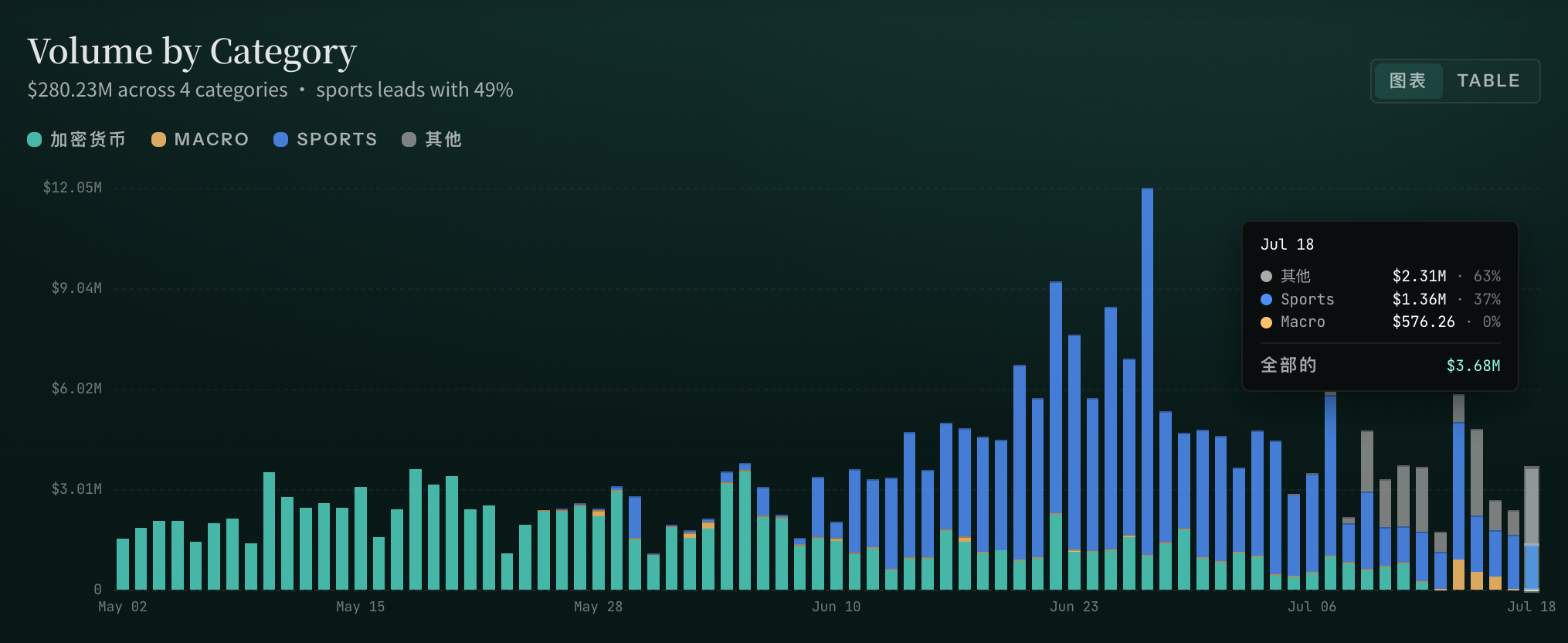
From May 2nd to early June, trading was almost entirely from cryptocurrency categories, with daily volume between $1 million and $3.5 million. When the World Cup started on June 11th, sports categories instantly took over, pushing volume to three to four times the previous baseline.
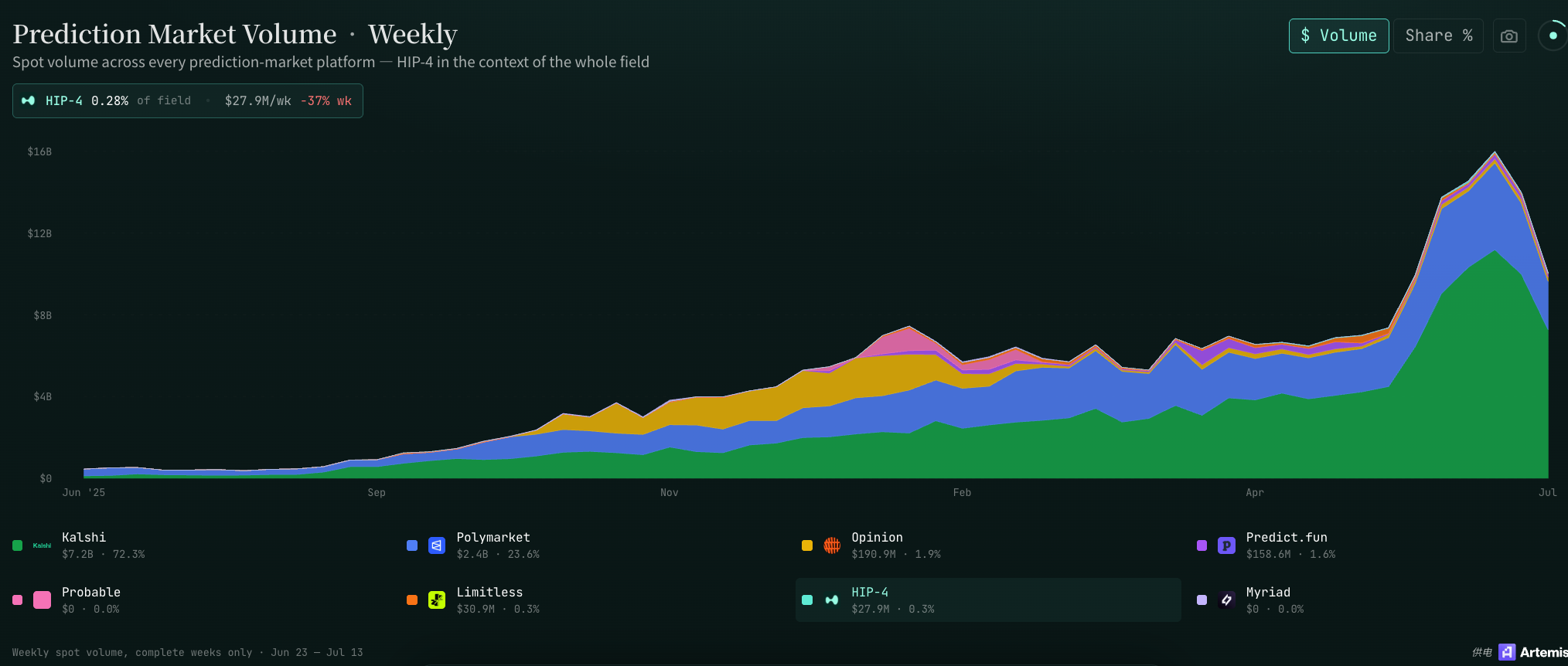
The figures from competitors during the same period are of another order of magnitude. Taking weekly data as an example, for the week of July 13th (during the World Cup), the weekly trading volumes for Kalshi and Polymarket were $7.2 billion and $2.4 billion respectively, while HIP-4's trading volume was $27.9 million. HIP-4's market share in prediction markets was only 0.3%.
But this logic has already been successfully validated once on Hyperliquid. HIP-3 allowed anyone to deploy perpetual contract markets after staking HYPE. It launched on October 13, 2025, and subsequently listed Nvidia, Tesla, gold, crude oil, S&P 500, and other underlying assets.
According to HIP-3 Ecosystem data, as of the time of writing, HIP-3's historical trading volume is $387.72 billion, and open interest has grown from about $790 million in January 2026 to $3.43 billion in July; HIP-3's share of Hyperliquid's trading volume reached 47.2% at the time of writing. Opening up the supply side indeed brought explosive growth.
Several New Mechanisms for HIP-4
Therefore, at the end of the World Cup, when all prediction markets are exploring new underlying assets, Hyperliquid announced several new mechanisms for HIP-4 at this time.
Staking Threshold is 500,000 HYPE Tokens
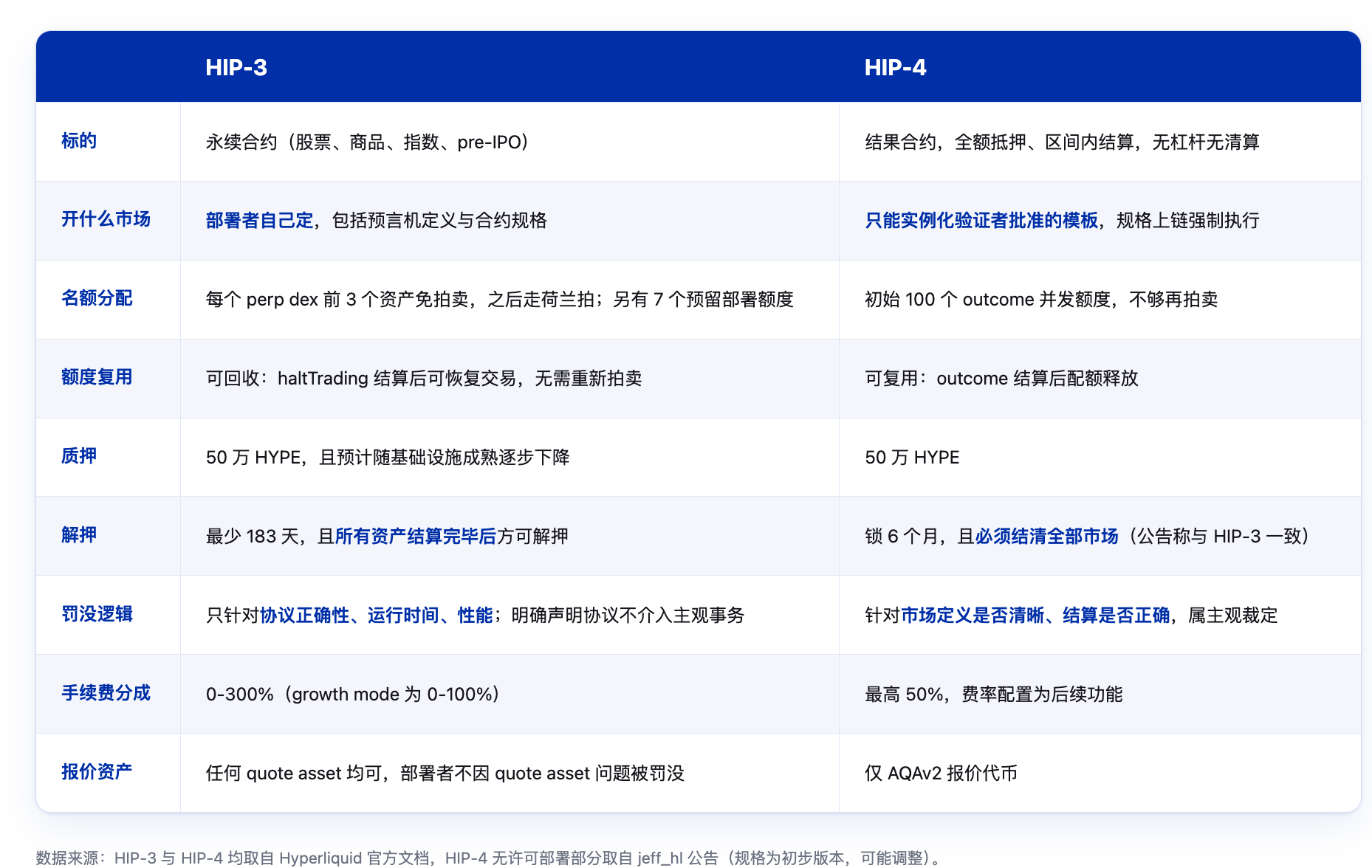
As for the staking threshold for HIP-4 deployers, this announcement is the first time Hyperliquid has publicly explained the staking requirements for HIP-4 permissionless deployment. Previously, community speculation placed the number at 1 million HYPE, twice that of HIP-3. This announcement states it's 500,000 HYPE, aligning with HIP-3. Staked tokens will be locked for 6 months and may be slashed if market definitions are unclear or settlements are delayed.
Template System
The template system is the core of this design. To ensure market quality and clear definitions, validators will vote on "outcome templates." Template specifications are stored on-chain and enforced. HIP-4 deployers can only perform permissionless deployment based on these templates, filling in parameters themselves to instantiate specific markets. The announcement requires that templates must be "healthy and unambiguous public goods for the ecosystem" and that corresponding events must have sufficient liquidity and attention. Deployers are responsible for defining and settling each market according to the settlement criteria specified when instantiating the template. The announcement explicitly does not restrict multiple deployers from deploying identical template instances.
Why add this layer? It's related to the product form. Perpetual contracts have continuous prices; if the market is off, it corrects itself. Outcome contracts settle at a definite value upon expiration; once the settlement is judged incorrectly, money is directly awarded to the wrong side.
Quota System
The quota system is another new element. Each deployer is initially allocated 100 outcomes (200 outcome tokens). One outcome corresponds to YES and NO two tokens. Multi-outcome questions consume multiple outcomes; for example, a five-choice question is split into five binary outcomes, occupying five. The quota is released and can be reused after an outcome settles; this is a concurrent upper limit, not a lifetime limit. The announcement states that an auction mechanism will be introduced later to expand an individual deployer's quota.
Slashing and Locking
Slashing and locking determine what this market will ultimately become. Stakes can be slashed by validator vote for three reasons: unclear market definition, failure to settle correctly according to the template, and failure to settle correctly for over a week. As with HIP-3, deployer stakes are locked for 6 months, and all markets must be settled before unstaking. The announcement itself warns that special caution is needed for very long-term outcomes.
The consequence of this rule is very practical. Launching a market that settles two years later means 500,000 HYPE is locked for two years, and the quota is also occupied the entire time. Rational deployers will only create markets with short cycles and frequent settlements. The difference in product form between HIP-4 and Polymarket is not entirely a strategic choice; it's also a result pushed by the mechanism.
Additionally, deployers can set up to 50% fee share for the markets they deploy; fee rate configuration will be released as a subsequent feature; only AQAv2 quote tokens can be used for HIP-4; validators may still occasionally deploy outcome markets directly, but it is expected to be very rare, aiming for fewer than 10 outcomes or questions per year.
Issues Not Addressed by the Template System
From the HIP-3 experience, there are aspects worth HIP-4 being cautious about.
hl.eco shows HIP-3 currently has 8 active deployers and 204 markets, but Trade.XYZ alone accounts for over 90% of all HIP-3 open interest. Some analyses indicate that this high concentration by a single deployer may constitute a structural/centralization risk for Hyperliquid.
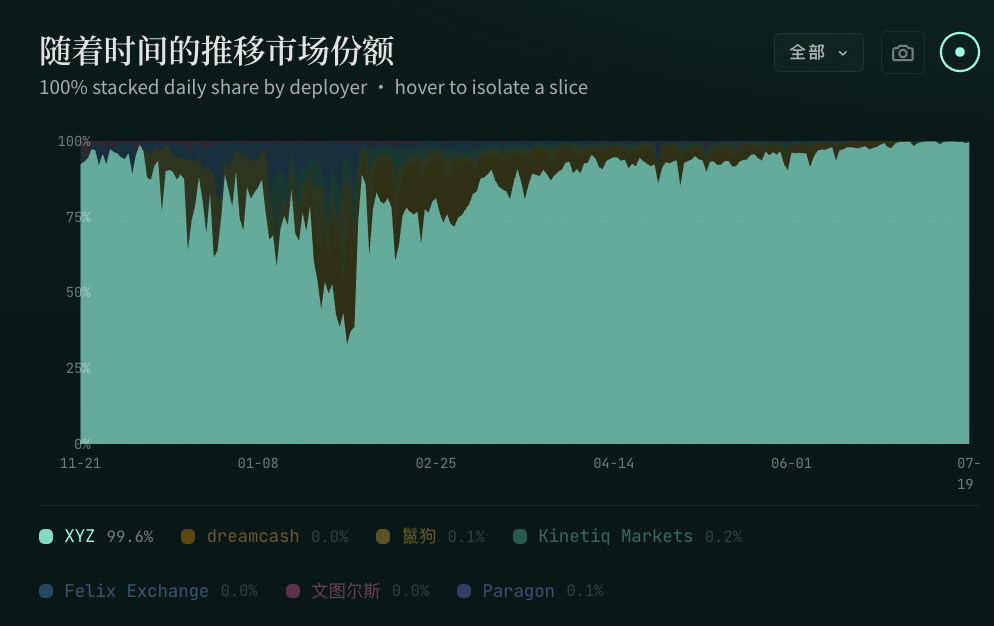
The template system in these new HIP-4 rules governs market quality, not market share. Where users trade depends on depth. HIP-4 explicitly allows multiple deployers to instantiate identical templates, which sounds like encouraging competition. However, if the same question is opened as five identical markets, liquidity will only be further fragmented, ultimately still converging towards the deepest pool.