Bitcoin may not be done capitulating – Why a $50K bottom is still in play

ambcrypto发布于2026-07-06更新于2026-07-06

文章摘要

Bitcoin faces potential further downside toward $50,000 despite long-term holder (LTH) resilience. Currently, LTHs control a record 78% of supply and are accumulating rather than selling during the downturn, diverging from historical capitulation patterns seen at market bottoms. However, with BTC posting seven consecutive monthly losses—short of the nine that marked prior cycle bottoms in 2018 and 2022—the capitulation phase may not be over. Shifting macroeconomic expectations, with markets pricing in potential Fed rate hikes instead of cuts, add pressure. If history repeats, LTH capitulation could trigger a final washout, driving Bitcoin toward $50,000 by Q3's end before a durable bottom forms.

Conviction in a risk-off market is often the hallmark of long-term strength.

Bitcoin’s [BTC] current setup reflects that conviction. Technically, BTC has posted three straight quarterly losses, with an average decline of around 20% each quarter. It’s the first three-quarter losing streak since the 2022 bear market, leaving more than 50% of Bitcoin’s circulating supply underwater and putting long-term holders (LTHs) firmly in focus.

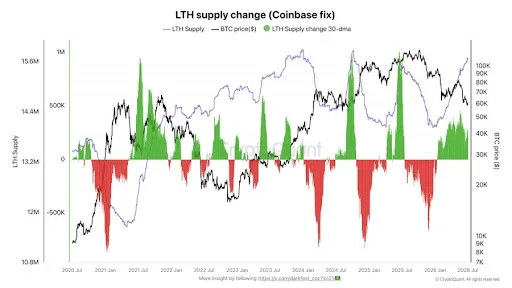
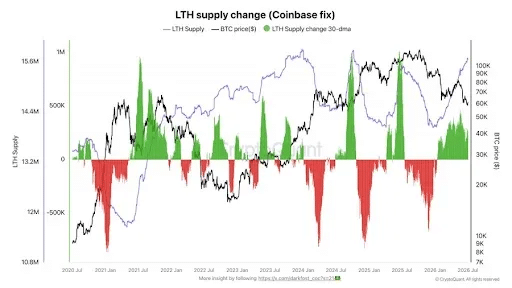
The logic is simple: LTHs now control 78% of Bitcoin’s circulating supply. In other words, a large share of the underwater supply is held by investors who have held BTC for more than five months, covering the rally to its $126,000 all-time high and the subsequent correction to around $60,000. That makes their conviction a key factor in shaping Bitcoin’s Q3-Q4 outlook.
Source: CryptoQuant

Notably, what’s standing out is that long-term holders aren’t selling into the weakness.

Instead, they’re absorbing it. Despite the correction, LTH supply reached a record high in June, reinforcing the view that these investors continue to accumulate rather than exit. Historically, Bitcoin has tended to bottom when long-term holders begin to capitulate. So far, this cycle is unfolding differently.

That said, long-term holders remain highly sensitive to macroeconomic developments, as they tend to price in the broader economic outlook when positioning their portfolios. From that perspective, Bitcoin’s capitulation phase may not be over yet.

Why Bitcoin’s strongest cohort may soon face their toughest test

Bitcoin’s past bear markets provide a useful benchmark for the current cycle.

Before drawing parallels, though, it’s worth looking at what’s changed on the macro front. Fed rate expectations for the July and September FOMC meetings have shifted noticeably. For July, there’s a 77% probability the Fed keeps rates unchanged, while the odds of a 25-basis-point hike stand at 23%.

By September, the picture becomes more balanced. Markets are pricing a 41% chance of no change, a 47% probability of a 25 bps hike, and a 10.5% chance of a 50 bps hike. In other words, markets are increasingly positioning for tighter financial conditions into the fall rather than the rate cuts many had anticipated.
Source: TradingView

That shift makes Bitcoin’s previous bear markets a relevant reference point.

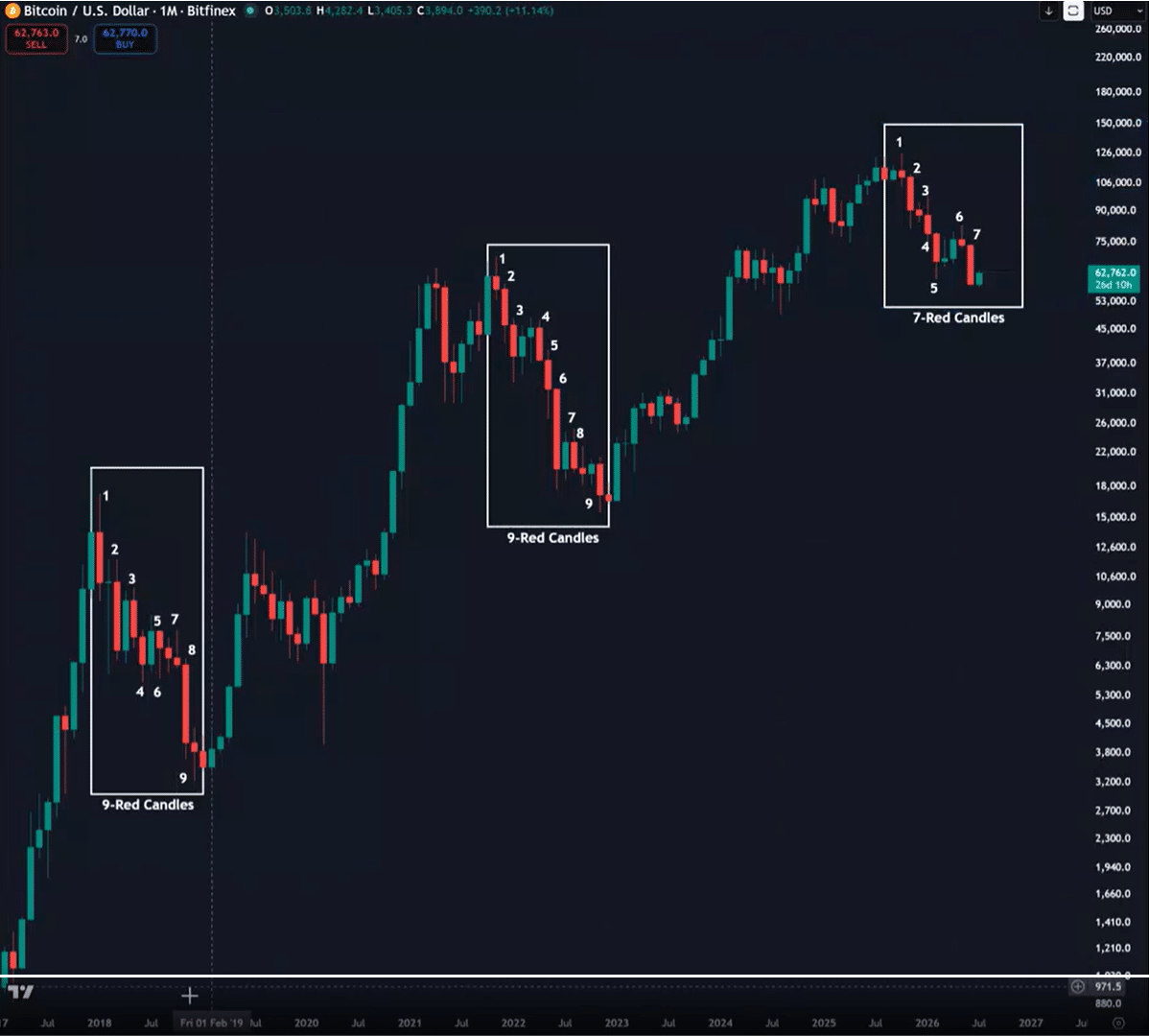
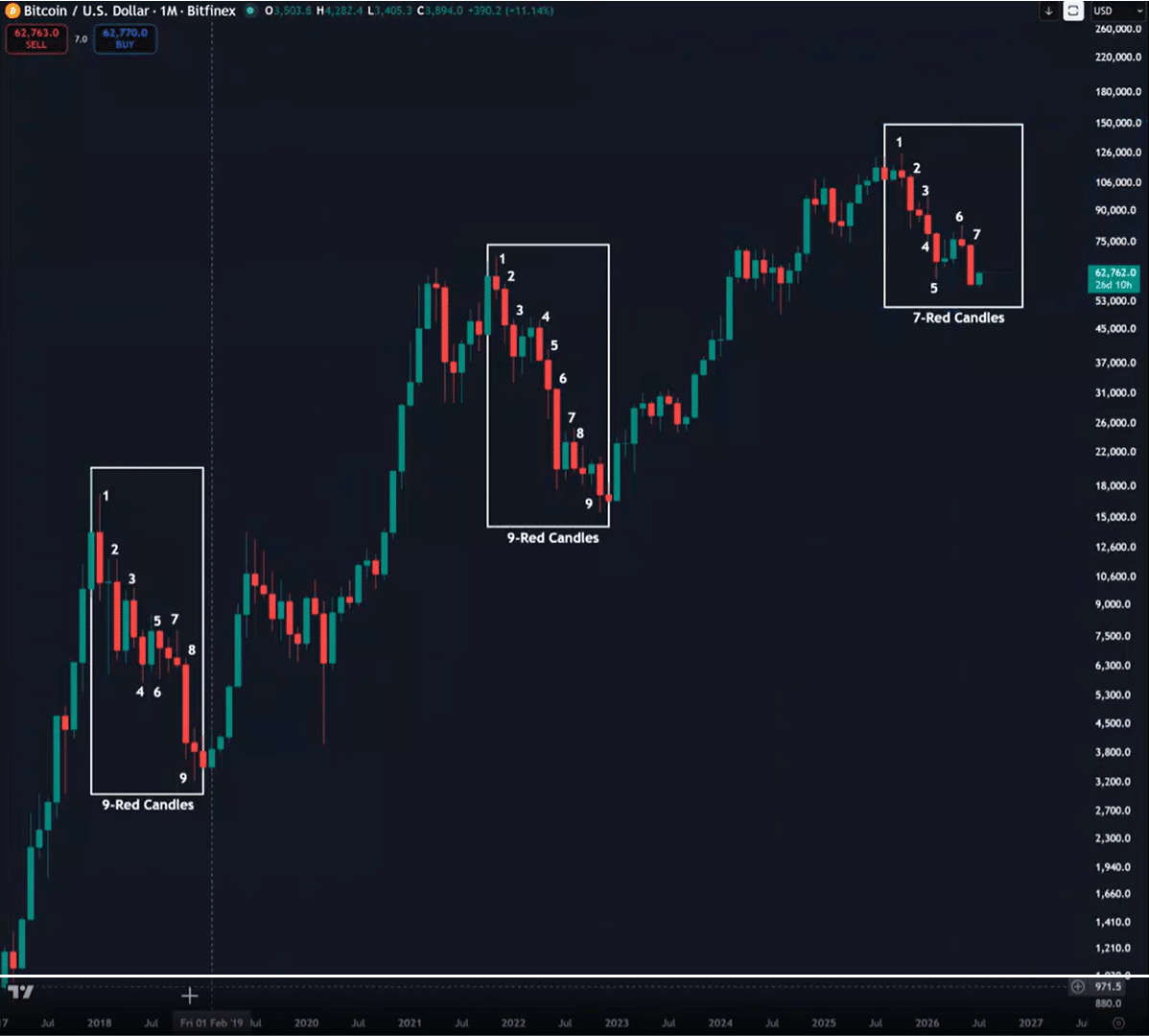
As the chart above shows, both the 2018 and 2022 bear cycles didn’t bottom until BTC had printed nine consecutive monthly red candles. The current cycle has produced seven so far. If the historical pattern holds, Bitcoin’s capitulation phase may still have room to run before a durable bottom is established.

That’s where the expanding pool of underwater long-term holders meets an increasingly uncertain macro backdrop. If this cycle follows the same script, long-term holder capitulation could mark Bitcoin’s final washout, potentially sending BTC toward the $50,000 region by the end of Q3 before a bottom takes shape.



Final Summary

热门币种推荐

相关问答

QWhat is the significance of long-term holders (LTHs) not selling Bitcoin during the current market weakness?

ATheir conviction and continued accumulation, rather than capitulation, is seen as a sign of long-term strength. Historically, Bitcoin bottoms have formed when LTHs begin to sell. Their current holding pattern makes this cycle different so far.

QAccording to the article, why might Bitcoin's capitulation phase not be over yet?

ATwo main reasons: 1) Historical patterns show Bitcoin didn't bottom in past bear markets until after nine consecutive monthly losses; the current cycle has only seen seven. 2) Long-term holders are highly sensitive to macroeconomic shifts, and the outlook is turning towards tighter financial conditions (potential rate hikes) rather than anticipated cuts.

QWhat historical pattern from the 2018 and 2022 bear markets is mentioned as a benchmark for the current Bitcoin cycle?

AIn both the 2018 and 2022 bear cycles, Bitcoin did not establish a bottom until it had printed nine consecutive monthly red candles (losses). The article notes the current cycle has produced seven such months so far.

QWhat potential price level does the article suggest Bitcoin could test if long-term holders begin to capitulate?

AThe article suggests that if long-term holder capitulation occurs, following the historical pattern, it could send Bitcoin toward the $50,000 region by the end of Q3 as a final washout before a bottom is formed.

QHow have market expectations for the U.S. Federal Reserve's interest rate policy shifted, according to the article?

AExpectations have shifted from anticipated rate cuts to pricing in tighter financial conditions. For September, markets see a 47% probability of a 25 bps hike and a 10.5% chance of a 50 bps hike, compared to a 41% chance of no change.

你可能也喜欢

Token经济如何改写AI“度量衡”的商业规则丨ToB产业观察

本文探讨了AI时代中Token经济的兴起及其如何重塑商业规则。文章指出,随着AI技术的快速发展,特别是大模型和算力的指数级增长,企业面临如何评估AI投资价值的难题。Token作为AI服务的计量单位,正成为衡量其价值的关键。 Token调用量在中国呈现爆发式增长,从2024年初的日均1000亿跃升至2026年3月的140万亿,增长超千倍。专家将其类比为“智能时代的电”,预示其巨大潜力。然而,Token的价值在不同行业和场景下差异巨大,例如药物研发领域的Token价值远高于闲聊场景,关键在于其产生的“智力水平”和是否为“有效Token”。 针对Token定价与价值评估的混乱,联想集团副总裁阿不力克木提出了Token经济的“三大定律”: 1. **惯性定律**:单位Token成本将持续下降,得益于芯片、能源、模型的技术创新,系统调优以及运行时智能调度。 2. **加速定律**:单位Token创造的价值将加速释放,这取决于AI嵌入业务流程的深度、工程化程度以及配套的人才、基础设施和治理体系的完善。 3. **奇点定律**:企业AI应用存在一个成本与价值的转折点(奇点)。奇点之前,AI主要节省成本;奇点之后,AI将创造前所未有的增量价值,实现“创新的规模化”。 现实中,许多企业如Uber、Meta已面临AI使用成本超预算的困境,问题根源包括Token定价不透明、计费方式复杂以及智能体应用导致Token消耗量剧增。为应对挑战,产业界正推动建立“高质量Token”标准,并发展如Token工厂、算力套餐等更高效、透明的服务模式。 文章最后强调,Token经济的核心在于让每次AI调用产生真实价值。AI的终极目标并非替代人力,而是让创新本身能够规模化,其意义如同电力普及一样深远。

marsbit34分钟前

Token经济如何改写AI“度量衡”的商业规则丨ToB产业观察

marsbit34分钟前

交易

现货

热门文章

加密市场宏观研报:《GENIUS Act》法案取得重大进展,BTC突破历史新高,后市全新展望

2025年5月22日,比特币价格正式突破11万美元大关,创下历史新高。在政策面、宏观经济、资金面与投资者结构共同作用下,一场结构性牛市浪潮正在展开。而此轮上涨背后的核心驱动,是美国《GENIUS稳定币法案》的实质性进展以及多项利好的叠加。本文将从政策端突破、宏观环境转向、链上与ETF资金结构、交易行为演化,以及重点受益赛道五大维度,全面解析此轮BTC再创新高的深层逻辑,并前瞻下半年市场的潜在趋势。

1.7k人学过发布于 2025.05.22更新于 2025.05.22

加密市场宏观研报:《GENIUS Act》法案取得重大进展,BTC突破历史新高,后市全新展望

相关讨论

欢迎来到HTX社区。在这里,您可以了解最新的平台发展动态并获得专业的市场意见。以下是用户对BTC(BTC)币价的意见。

活动图片