Loopring Ends Its Pioneer zk-Rollup DEX After Years of Limited User Adoption

TheNewsCrypto发布于2026-06-29更新于2026-06-29

文章摘要

Loopring has officially shut down its decentralized exchange, ending one of Ethereum's earliest zk-rollup platforms. The project, which raised $45 million in 2017, pioneered scaling solutions but ultimately failed to achieve significant user adoption. The team cited several reasons for the closure: the platform's lack of a virtual machine limited developer innovation, business execution was insufficient, and new zkEVM networks like zkSync and StarkNet surpassed its technology. User funds remain safe, with a two-week balance verification period before direct distribution to wallets begins. This follows the discontinuation of its wallet services in 2025, marking Loopring's complete exit from the DEX business.

Loopring officially shut down its decentralized exchange, marking the end of one of Ethereum’s earliest zk-rollup platforms. All trading functionalities were immediately stopped, and the relayer was turned off right after the official announcement made via Loopring’s X account.

The shutdown ends a project that once demonstrated how zero-knowledge rollups could efficiently scale Ethereum. Loopring raised $45 million through its initial coin offering in 2017.

Despite its technical merits, Loopring acknowledged that users never adopted the platform on a meaningful scale. The team pointed out that the lack of a virtual machine on the platform did not allow developers to compose and develop more advanced real-world applications. Without payment use cases and an evolving ecosystem, Loopring found it difficult to compete with new infrastructure built for blockchain technology.
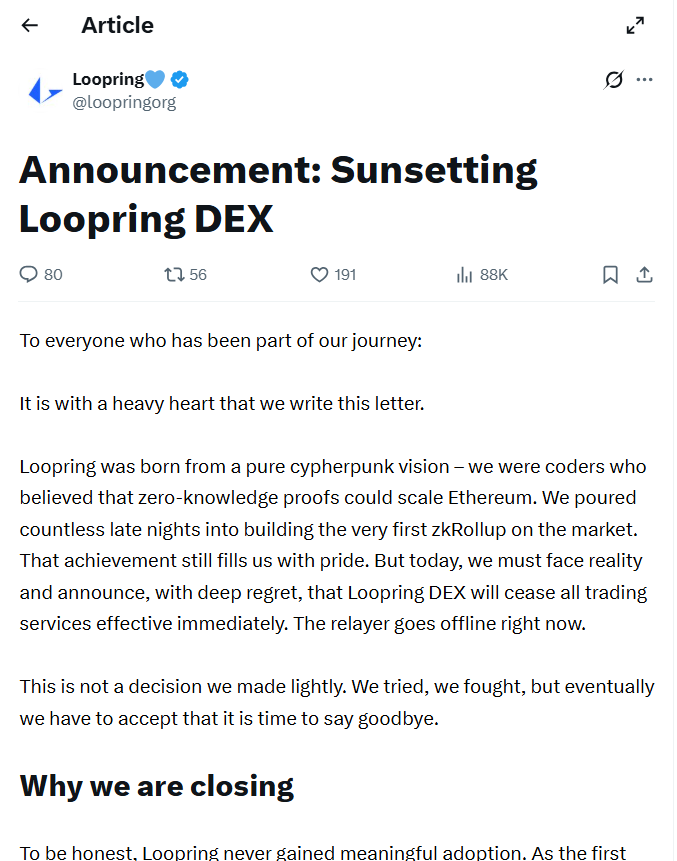
Source: X Article

Additionally, Loopring admitted it was good at the software but failed to build the business acumen needed to drive adoption. Furthermore, it mentioned that the delisting of the LRC token throughout 2026 only worsened the problems.

New zkEVM Networks Outperformed Loopring’s Technology

Finally, the development team admitted that modern zkEVM-based networks were able to surpass its proprietary technology. New projects such as zkSync, Scroll, and StarkNet created Ethereum-based environments that allowed deploying smart contracts more easily and developing a decentralized applications ecosystem.

The team admitted that it simply did not make sense anymore to continue working on Loopring. This is why the exchange was closed down in an orderly fashion. The project had earlier ended wallet services in July 2025 owing to scaling issues. The latest update marks Loopring’s eventual exit from the original decentralized exchange business.

Direct Distribution of Assets by Team

The Loopring team made assurances that all user funds are still safe despite the imminent closure. Final balances will be computed, an inventory of assets provided, and two weeks allocated to check balances before any distribution can take place.

Distributions will follow after the two-week period, whereby the Loopring team will distribute assets directly to the wallets in batches. The team will automatically convert liquidity pool holdings to the respective token, take care of all gas fees, and undertake the whole process without the need for Merkle proofs.

Highlighted Crypto News:

$3M Exploit Hits Polymarket: Users to Receive Full Refunds After Third-Party Breach

TagsBlockchainCryptocurrencyDEXETHEREUMEthereum (ETH)LoopringZK-rollupszkrollup

热门币种推荐

相关问答

QWhat was the official reason given by Loopring for shutting down its decentralized exchange?

ALoopring officially shut down its DEX due to years of limited user adoption. The team acknowledged a lack of business acumen to drive growth, the technical limitation of not having a virtual machine for advanced applications, and the inability to compete with newer zkEVM-based networks like zkSync, Scroll, and StarkNet.

QAccording to the article, what key technological feature did newer zk-rollup projects have that Loopring lacked?

ANewer zk-rollup projects like zkSync, Scroll, and StarkNet are based on zkEVM (Zero-Knowledge Ethereum Virtual Machine) technology. This allowed them to create environments where developers could easily deploy smart contracts and build a decentralized applications ecosystem, surpassing Loopring's proprietary technology which did not include a virtual machine.

QHow will the Loopring team handle the distribution of user assets after the shutdown?

AThe Loopring team will compute final user balances, provide an asset inventory, and allow a two-week period for balance verification. After this, they will distribute assets directly to user wallets in batches. They will automatically convert liquidity pool holdings, cover all gas fees, and conduct the process without requiring Merkle proofs.

QWhat earlier service did Loopring end in July 2025, and why?

ALoopring ended its wallet services in July 2025 due to scaling issues.

QHow much funding did Loopring raise in its 2017 initial coin offering (ICO)?

ALoopring raised $45 million through its initial coin offering (ICO) in 2017.

你可能也喜欢

Bitmine以太坊储备增至98亿美元:"加密货币最好的年份尚未到来"

比特浸入科技(Bitmine Immersion Technologies)近期再次成为头条,其在一周内增持了27,084枚以太坊(ETH)。这使得其以太坊总持有量达到5,700,040枚,按每枚1,569美元计算,价值约90.1亿美元,占以太坊总供应量的4.7%。此次增持发生在以太坊价格从约1780美元下跌至1578.54美元(撰稿时)的一周内。同时,根据SoSo Value数据,以太坊ETF在整个六月大部分时间出现资金外流,总额达5.0139亿美元。 针对疲软的市场状况,比特浸入科技董事长汤姆·李(Tom Lee)表示,近期市场对加密货币投资者颇具挑战,并指出临近季度末的“粉饰橱窗”行为导致投资者减持过去三个月表现不佳的资产是常见现象。此外,迈克尔·赛勒(Michael Saylor)的公司Strategy正面临持续审查,据报道其持有约140亿美元未实现亏损,而其普通股和优先股价格均跌破100美元水平,引发加密社区部分人士建议其停止扩张比特币持仓。 由于比特浸入科技常被称为“以太坊的Strategy”,市场担忧其持续的以太坊积累行为可能面临类似困境与批评。目前上市公司共持有价值约749.4亿美元的比特币和114.8亿美元的以太坊,Strategy是最大的比特币持仓上市公司。 然而,目前这些担忧仅是推测。比特浸入科技并非单纯积累以太坊,其每年质押收入估计达2.11亿美元,同时持有5.55亿美元现金及等价物以及488万枚质押的ETH。该公司还于6月26日被纳入罗素1000大型股指数。汤姆·李强调,公司计划稳步增长至2026年,并认为市场正开启新一轮牛市周期,代币化和人工智能的快速进展将推动区块链和去中心化加密领域的指数级需求增长。 最终摘要: * 新增持后,比特浸入科技持有5,700,040枚ETH,价值约90.1亿美元。 * 尽管以太坊价格疲软、ETF资金外流且Strategy面临批评,比特浸入科技仍持续购入以太坊。

ambcrypto2小时前

Bitmine以太坊储备增至98亿美元:"加密货币最好的年份尚未到来"

ambcrypto2小时前

你天天用的Claude和Codex,Meta内部不让随便用了

今年5月,Meta为其应用AI工程部门的工程师划定了红线:限制内部使用Claude Code和Codex这两款流行的AI编程工具,相关限制至今仍在生效。作为这些工具的主要客户之一,Meta此举并非因其不好用,而是恰恰相反——担心其过于强大和好用。 Meta正在自研名为MetaCode的AI编程助手,旨在替代外部模型以节省成本并掌握核心技术。限制使用外部模型的核心原因,是防止“蒸馏陷阱”:即担忧员工在构建MetaCode的训练数据、编程题库和评测标准时,过度依赖或掺入Claude/Codex的输出。这会导致自研模型在不知不觉中学习对手的“本事”和判断标准,使能力来源模糊,并可能违反与OpenAI、Anthropic等竞争对手的服务条款,引发法律风险。 内部指南明确禁止了可能让外部AI模型“定义能力”的三类任务:不能用其输出来生成测试题目、不能用其分析代码或设计测试点、其生成内容不得进入被测模型的访问环境。仅允许AI处理搭建工作流、整理文件等“打下手”的辅助性任务,且所有AI产出必须经过人工审核。 这一事件揭示了AI行业的一个普遍困境:在利用强大外部工具加速自身研发的同时,如何清晰界定并守护自身模型能力的原创性,避免陷入知识产权与合同风险。随着AI参与创造AI的循环加深,“本事究竟是谁的”这条界线正变得越来越模糊。

marsbit3小时前

你天天用的Claude和Codex,Meta内部不让随便用了

marsbit3小时前

交易

现货

热门文章

相关讨论

欢迎来到HTX社区。在这里,您可以了解最新的平台发展动态并获得专业的市场意见。以下是用户对ZK(ZK)币价的意见。

活动图片