Today, at the Compile conference, Cursor announced several product "futures": an upcoming 1.5T model utilizing more computing power, and Origin, a "GitHub-like" Git platform designed for AI agents.
This quickly drew widespread attention from users, as it came almost simultaneously with the news that SpaceX had officially announced it had exercised its option to acquire Cursor in an all-stock transaction. According to the agreement, Cursor will receive SpaceX stock valued at $60 billion, with the specific transaction expected to be completed in the third quarter of 2026. Previous reports indicated that Cursor had turned down acquisition interest from several major AI companies last year.
"At this rate, Cursor will become the #1 or #2 coding agent within a year. The team is incredible... and now backed by unlimited compute. This is the best acquisition since Instagram and YouTube." commented one netizen.
Secured Compute, Training Models from Scratch
Several netizens revealed that Cursor CEO Michael Truell shared details about the new model at today's Compile conference: a new model with over 1.5T parameters, no longer a shell over Kimi, pre-trained from scratch on over 100,000 GPUs.
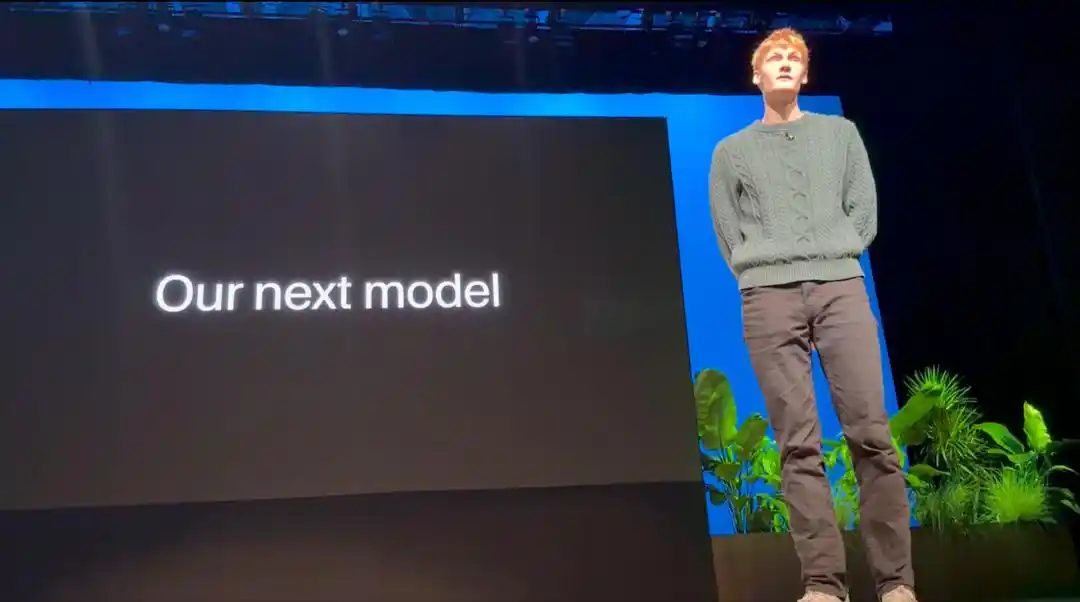
Over the past few months, SpaceXAI has been jointly training a model with Cursor, which will soon be released on Cursor and Grok Build.
Speculation is that the new model Michael mentioned is the 1.5T foundation model Musk referred to on May 25th, followed by two reinforcement learning pipelines, one for Cursor and one for Grok.
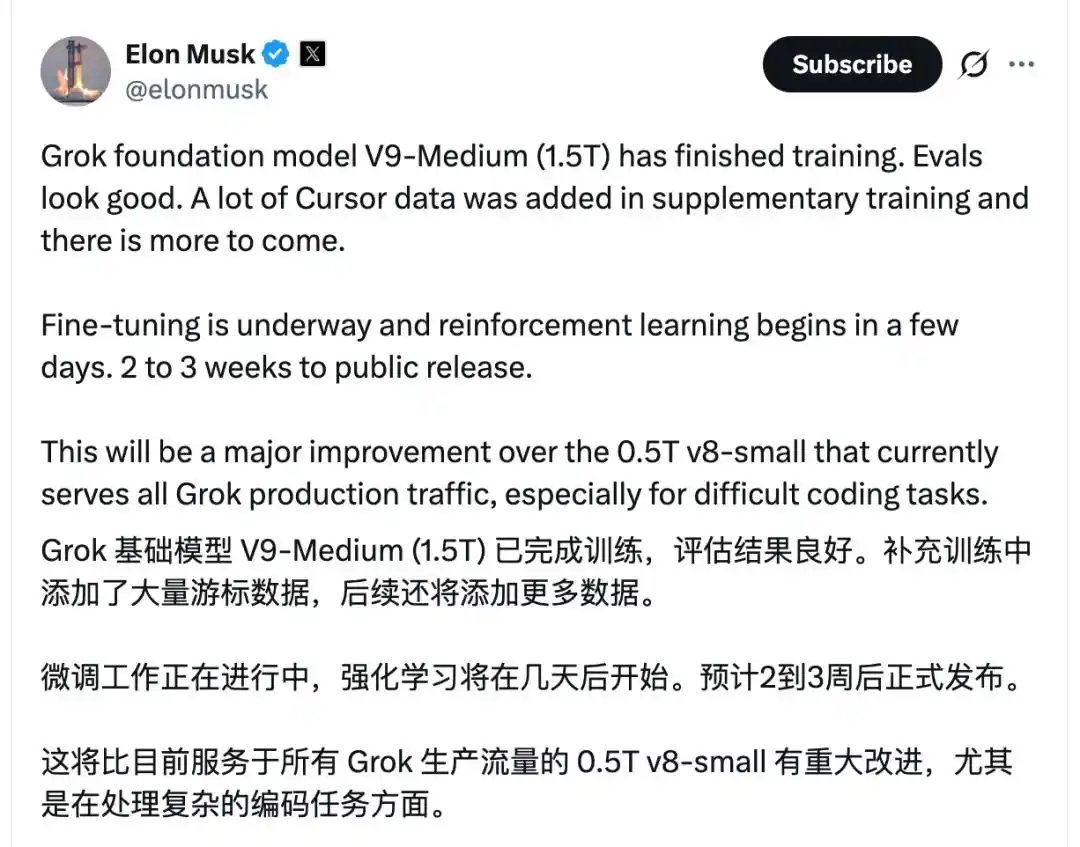
At the conference, Michael revealed three key differences in the new model being trained.
First, it is large-scale, on the same magnitude as OpenAI's AGI-level models.
Second, it is trained from scratch, not fine-tuned from an open-source model. "We love open source and want to find more ways to give back to the community. But training a base model from the ground up allows us better control over model behavior and further coverage of the workloads that I and you truly care about," Michael said. Previously, Cursor was alleged to have been a shell over Kimi.
Third, and most crucially, the computational resources Cursor now uses are 10 to 20 times what was previously available. While the previous generation model used more resources than before, this marks the first truly massive increase in compute investment.
"This is hugely important," Michael stated. "In the past, from Composer 1 to Composer 2.5, the compute scale for training our models was actually quite small compared to frontier labs, which greatly limited what we could do. Many methods for making models better essentially run into the same problem: can we run more experiments, can we train the model longer. So, this order-of-magnitude increase in compute does allow us to create differentiated capabilities and, hopefully very soon, get those into your hands and deliver truly exciting, powerful new features."
However, netizen Lisan al Gaib pointed out, "Opus 4.5 to 4.8, and GPT-5 to GPT-5.5, aren't actually that huge! (They are all below 2 trillion parameters)." He continued, "This means the current performance of GPT-5.5 and Opus 4.8 is achievable for open-source models. Because guess what else is at this scale? DeepSeek-V4-Pro."
Gaib stated that the only remaining moat is scale:
So far, Anthropic is the only lab that has successfully transitioned to the ~10T parameter scale, which is also why I no longer think OpenAI can catch up by year-end. Anthropic just needs to keep pouring RL compute into Mythos, and it will keep improving for the next 1-2 years.
Google didn't go that big, and they pulled back a bit too much on sparsity. They also clearly don't know how to actually polish a model to usability with RL.
OpenAI is still haunted by the ghost of GPT-4.5.
xAI and Meta are still in the planning phase.
Previously, Wall Street investor Gavin Baker spoke highly of Cursor: "Besides Anthropic, Cursor has more 'proprietary code training data tokens' than any other lab in the world. Cursor's internal code model, Composer 2.5, is already approaching frontier model levels even before undergoing a full Colossus-level training."
Some netizens are optimistic about the acquisition deal: "Cursor excels at reinforcement learning, and SpaceX has enough computing power to train a 10T model. Therefore, SpaceX might win the AI race."
More Than Just Code
Additionally, some netizens noticed that Cursor's announcement tweet did not describe itself as "for developers," but simply as "useful AI." Therefore, they believe Cursor is likely to become a direct competitor to Codex and Claude Desktop.
To some extent, this aligns with Michael's emphasis on the new model's positioning at the conference: "This will be an intelligent model that's not just good at writing code."
Michael believes this is crucial for what the team wants to achieve. "Our goal is to enable anyone to build what they want with a computer. And right now, the bottleneck is shifting from 'writing code' itself to the full range of capabilities you'd want from an engineering colleague."
This means it needs to know how to use the tools an engineer uses; it needs to be able to monitor, plan, genuinely test software, and click buttons in an interface; it also means the team needs to present the user experience well, letting users clearly see what changes the agent has made.
"So, we're moving beyond just 'trustworthy coding' to give this model stronger general intelligence. The training for this has already started and will be released in the coming weeks. And all of this is powered by our collaboration with SpaceX. And as you know, this is more than just an ordinary partnership now," Michael said.
In his view, there aren't actually many AI players or institutions today that can truly co-design both the product layer and the model layer simultaneously. The company DNA of other players often comes from either big tech companies or started as labs before gradually moving towards the developer and product side. The company behind Cursor, for better or worse, is fundamentally built around developers. It's a company made up of people who genuinely want to make tools useful for developers.
Therefore, Michael believes that as the company enters its next phase, it's the first time a group of people who truly understand product details and developer workflows are combined with the ability to directly modify the foundational capabilities of the model. "What we can influence isn't just pixels on the screen; we can also edit the underlying capabilities of the model itself, and model capability is a very important part of the product."
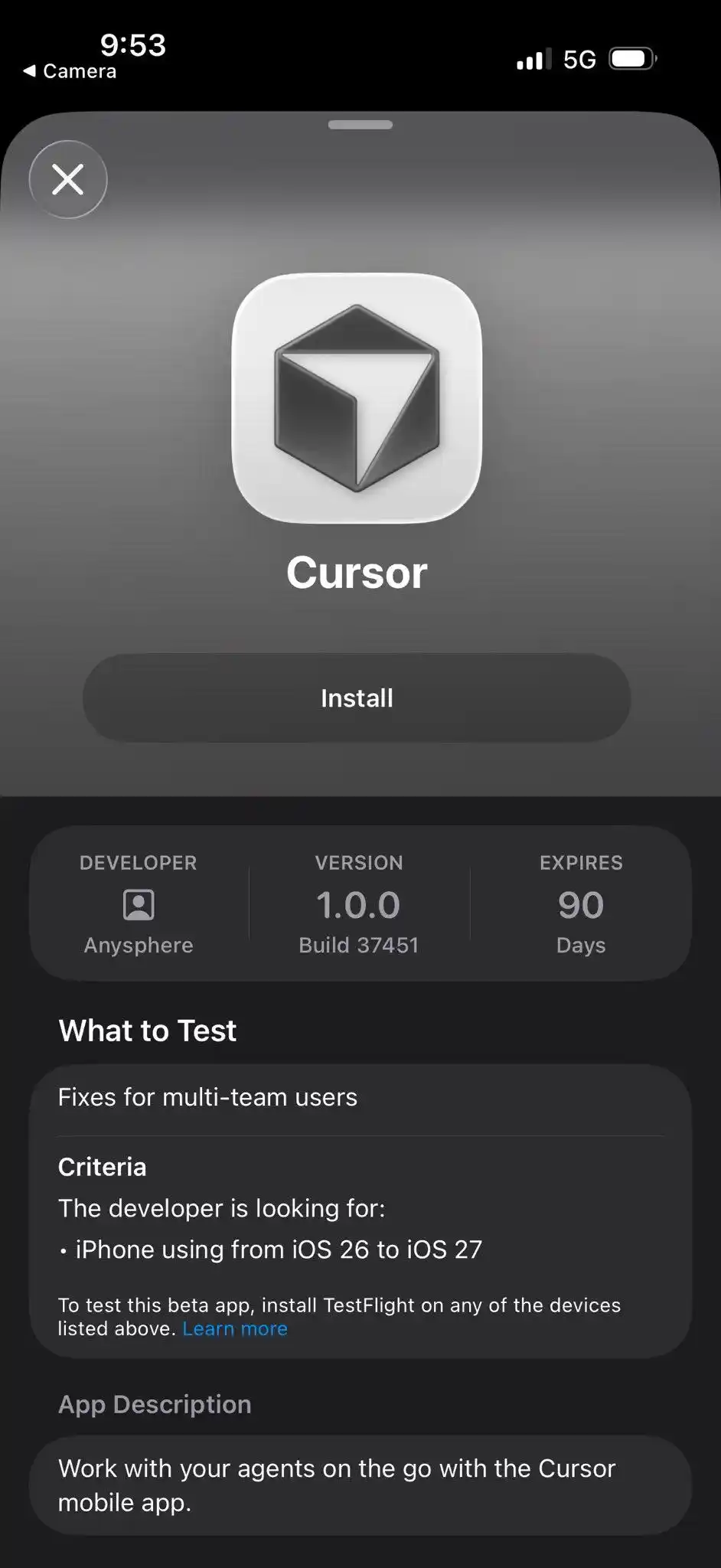
It's worth noting that Cursor Mobile is now in beta, which includes remote control functionality for Mac hosts.
Git Platform for Agents, Challenging Microsoft's GitHub
In addition to the model, Cursor also announced Origin, an agent-native Git platform.
"Modern Git hosting platforms are designed for human developers: they only clone repos occasionally, push code a few times a day, not for AI agents that will clone and push thousands of times a day," Cursor engineer Austin Nick Piel stated on X. "Excited to be building a Git hosting platform for this new world."
Origin is Cursor's attempt to build a "agent-native" competitor to GitHub: it's a Git-compatible code hosting platform, but its underlying assumption is that in the future, a massive number of AI agents will be cloning, creating branches, committing code, rebasing, reviewing code, and fixing failed tasks in parallel.
Some netizens believe this also makes the company's acquisition of Graphite last year more interesting. "Graphite brought stacked PRs, code review workflows, merge queues, and a clearer collaboration experience, while Origin adds the code hosting layer underneath."
Thus, Cursor is no longer just "VS Code with AI." They are attempting to control the entire AI software factory: write code in Cursor, run agents in parallel, review code with a Graphite-style workflow, and host and merge code via Origin.
"GitHub was built for human-scale software development. Origin is packaged as the infrastructure for the next bottleneck: in an era of mass agent-generated code, how do you coordinate, review, and safely merge that code?" they summarized.
According to videos posted by netizens, Graphite co-founder Tomas Reimers was the one introducing Origin at the Compile conference.
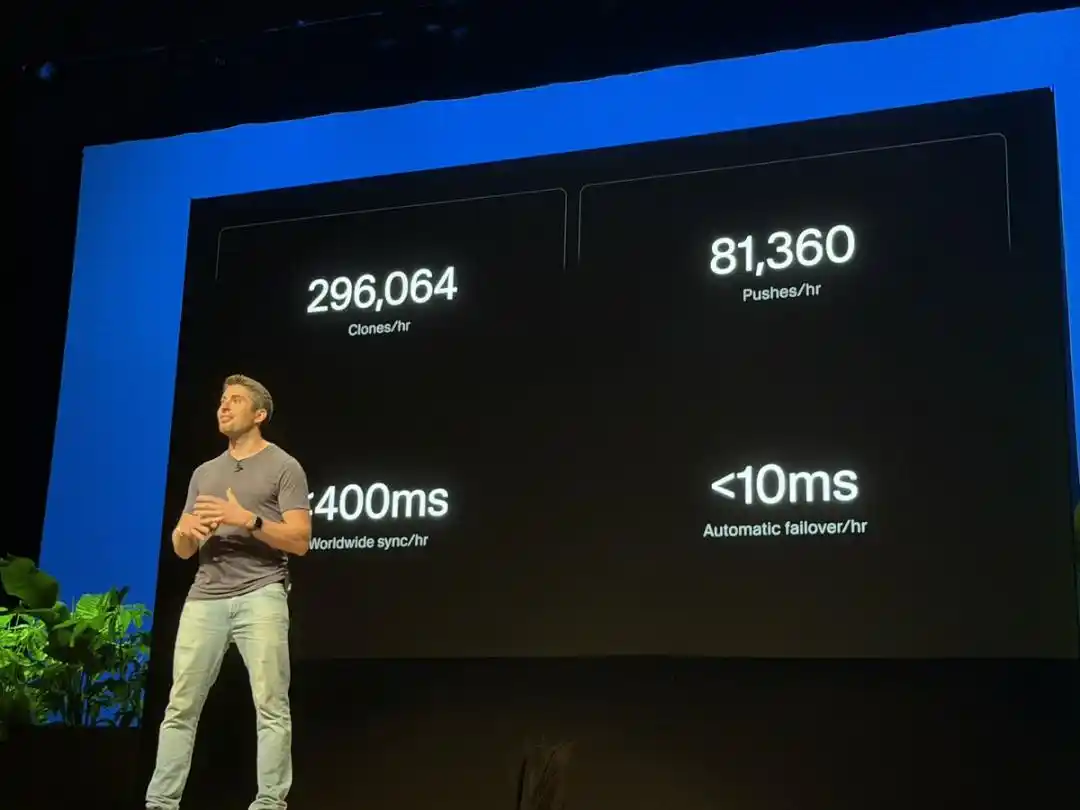
Software development is far more than just writing code. It also includes testing, reviewing, merging, and deploying correctly. We've been working hard to find the best ways to accelerate these parts of the software development process.
"Over the past few years, we've noticed a trend: as these companies start adopting AI programming, the tools they've relied on in the past are beginning to become unreliable. That's because AI tools have completely transformed the industry over the last few years. They've given every developer the chance to become a 10x to 100x more productive developer," Tomas said. "But that change also requires developer tools to fundamentally change. That's why, after being acquired by Cursor, we accelerated our most ambitious project: rebuilding this layer of infrastructure from scratch."
Reportedly, Origin is scalable to handle agent workloads, supports API and MCP extensions, and has built-in agent mechanisms for automatically resolving merge conflicts and collaboration failures.
One developer commented, "My favorite feature is probably automatic conflict resolution. When dozens of AI agents submit code simultaneously, causing huge merge conflicts, Origin will be able to automatically fix those conflicts."
"Perhaps it's time for a competitor to GitHub, to see if that can bring about change," another netizen quipped. "GitHub watches everyone slowly recreate its features, one by one." Of course, some also questioned, "Cursor can't even manage its own customer service, and now they want to do Git?"
Officially, Origin is set to launch this fall, with a waitlist now open. Some developers worry that by the time this "future" product actually launches, people might have forgotten about it.
Conclusion
Many are impressed by the achievements of Cursor, founded in 2023 by four MIT graduates: starting as a crypto communications startup, later expanding into AI programming tools. The company was one of the earliest to fully integrate major model capabilities into an IDE. It is a fork of Visual Studio Code with deep AI integration. However, incumbent platforms and larger AI companies have since introduced similar features.
Currently, Cursor's annualized revenue has reached several billion dollars. But as Anthropic's Claude Code gained dominance in this space, Cursor's market share has also declined. Foreign media reports indicate that Cursor is still striving to achieve profitability.
Cursor's tools allow developers to switch between different AI models, including those from OpenAI, Anthropic, xAI, Google, and others. The company competes with Anthropic's Claude Code and OpenAI's Codex, products capable of writing code, debugging software, and automating tasks.
As a wholly-owned subsidiary of SpaceX, Cursor now has more computing power, and some analysts suggest SpaceX can also leverage this to win lucrative enterprise customers. Previously, many enterprise customers largely avoided using SpaceX's self-developed chatbot assistant, Grok. Competing with Claude and ChatGPT, Musk positions Grok as an "anti-woke," truth-seeking chatbot, but it still lags behind other frontier models.
News of Cursor's acquisition by SpaceX emerged as early as April. At that time, SpaceX signed a compute and option agreement with Anysphere, Cursor's parent company. SpaceX would provide Cursor with GPU cluster compute at a certain scale, and the two would collaborate to improve existing models, including Grok, and potentially jointly develop new AI models and related products.
At the time, this collaboration did not equate to an acquisition. According to SpaceX's prospectus, SpaceX obtained a right, but not an obligation, to acquire Cursor in the future at a pre-agreed price. If SpaceX exercised the option after this offering, the consideration would be paid in SpaceX Class A common stock, based on an implied equity valuation of $60 billion for Cursor and the volume-weighted average closing price of SpaceX Class A common stock over the seven consecutive trading days preceding the acquisition's completion.
The agreement also included a substantial exit "breakup fee." If SpaceX terminated the option agreement, or if Cursor terminated it due to a material breach by SpaceX, Cursor would be entitled to a $1.5 billion termination fee, plus $8.5 billion in deferred service fees under the agreement, totaling $10 billion. The fee could be paid in cash; if SpaceX's IPO had not been completed by then, it could also be paid in Class A common stock.
SpaceX completed its public offering last Friday, with its stock rising 19% on the first day, 20% on Monday, and about 5% on Tuesday, with a current market capitalization of approximately $2.66 trillion. After the stock price increase, SpaceX's market cap surpassed Amazon's on Tuesday, entering the ranks of the top 5 US-listed companies by market value.
Today, SpaceX's acquisition of Cursor is finalized, but it's also a new beginning. Whether the two can disrupt the current market landscape as many developers hope remains to be seen.
References:
https://www.wsj.com/business/spacex-agrees-to-buy-ai-coding-agent-cursor-for-60-billion-7a473340?st=2addXh&reflink=article_copyURL_share
https://x.com/morganlinton/status/2066946225837109735
This article is from WeChat official account "InfoQ" (ID: infoqchina), author: Chu Xingjuan.