Broadcom vs AMD: Which is the Most Promising AI Chip Stock to Bet on After Nvidia?

marsbit发布于2026-06-09更新于2026-06-09

文章摘要

Amidst Nvidia's dominance in the AI chip market, Broadcom and AMD are key contenders for the second-place spot. AMD competes directly in general-purpose GPUs, gaining some traction with clients like Meta but facing significant challenges overcoming Nvidia's entrenched CUDA software ecosystem. In contrast, Broadcom pursues a differentiated strategy by designing custom XPU chips tailored to specific AI workloads for major clients like Anthropic, Google, Meta, and OpenAI. This approach offers efficiency advantages and greater customer stickiness, particularly as AI compute shifts from training to inference. Despite a recent stock sell-off following a Q2 revenue guidance miss, Broadcom's CEO reaffirmed the long-term target of $100 billion in annual AI chip revenue by fiscal 2027. With Q2 AI revenue at $10.8 billion, significant growth potential remains as its custom chip projects ramp up. While Broadcom trades at a higher valuation multiple than AMD, analysts argue this premium is justified given its superior competitive positioning and expected faster growth trajectory, making it the more compelling investment choice following its recent pullback.

Author: Justin Pope

Compiled by: Tide Research

Introduction: Beyond Nvidia, the battle for the runner-up position in AI chips is heating up. AMD has chosen to directly challenge Nvidia's general-purpose GPU path, while Broadcom takes a differentiated approach with custom chips (XPU), securing top clients like Anthropic, Google, Meta, and OpenAI.

Following the latest earnings report, Broadcom's stock price fell sharply, but the CEO still maintains the target of reaching $100 billion in annual AI chip revenue by fiscal year 2027. Motley Fool analyst Justin Pope believes that even though Broadcom is more expensive, this premium is worth paying.

Caption: Source Getty Images

Nvidia still firmly holds the top spot in the AI data center chip market. But the AI pie is simply too large, making the runner-up position equally valuable. According to Statista estimates, the AI chip market will grow to $333 billion by 2030.

This means other companies also have the opportunity to make investors a lot of money. Broadcom (AVGO, down 7.49% on the day) and AMD (down 11.01% on the day) are the two most competitive candidates. Both companies have made progress in the AI chip field, but overall, one is clearly more worthy of holding than the other.

AMD Chose a More Difficult Path

The core question is: How can a smaller company compete for market share with an industry giant?

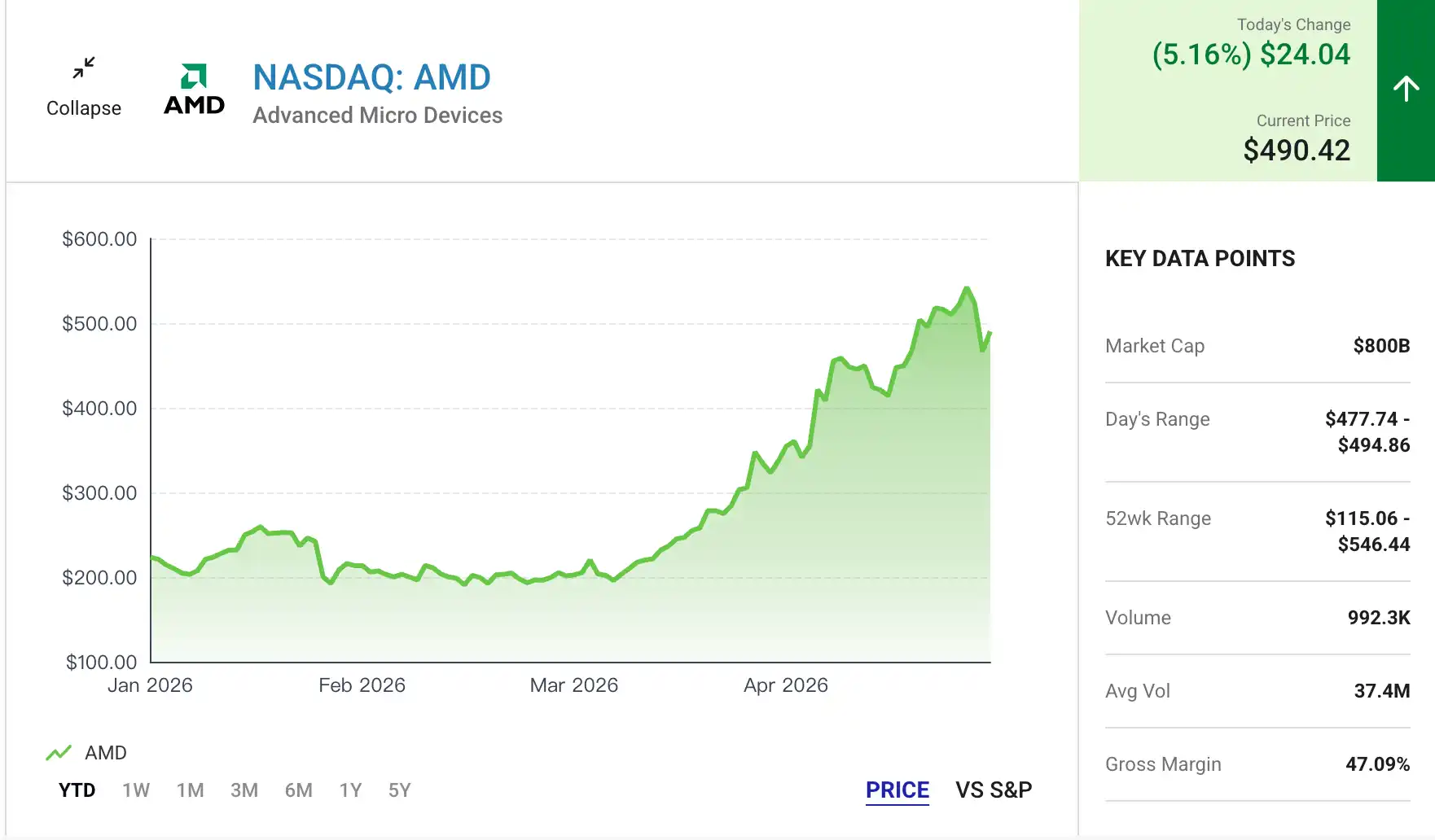
AMD's strategy is to compete head-on with Nvidia in the field of general-purpose AI chips. To be fair, it has indeed achieved some results. Q1 2026 data center revenue grew 57% year-over-year to $5.8 billion.

AMD benefits from AI hyperscalers' natural desire not to put all their eggs in Nvidia's basket. AMD recently announced it will supply Meta with 6 GW of Instinct GPUs, with the first GW being a custom version.

But AMD is unlikely to truly threaten Nvidia's dominance. Meta and other Nvidia customers are deeply entrenched in Nvidia's CUDA software ecosystem. The moat of CUDA cannot be crossed by hardware specifications alone.
Broadcom's Custom Chip Path is the Winner

To breach Nvidia's moat, one must take a different path. Broadcom has achieved this with its XPU chips.

Unlike AMD, which emphasizes general-purpose AI chips, Broadcom tailors chips to each customer's specific AI workloads. This approach brings efficiency advantages and makes customer relationships stickier. Currently, Broadcom is designing custom chips for companies like Anthropic, Alphabet (Google's parent company), Meta, and OpenAI.

As computing demand shifts from training to inference, efficiency becomes even more critical, further amplifying the advantages of custom chips.

Following the latest Q2 earnings report, Wall Street heavily sold off Broadcom, mainly due to Q3 AI revenue guidance falling short of expectations. But CEO Hock Tan reiterated on the earnings call that the company's long-term expectation of reaching $100 billion in annual AI chip sales by fiscal 2027 remains unchanged. Q2 AI revenue was $10.8 billion, and there is still significant growth potential as custom chip projects ramp up.

You Get What You Pay For

With a roster of top-tier AI clients and steady progress toward the $100 billion annual revenue target, Broadcom indeed has a stronger competitive position than AMD. Investors may note that Broadcom's stock is more expensive than AMD's, but this premium is justified.
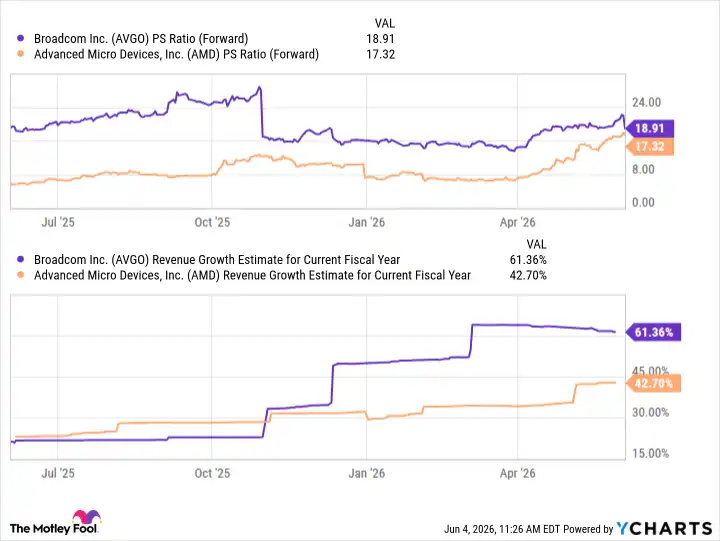
Caption: AVGO vs AMD Forward Price-to-Sales Ratio Comparison, Source YCharts

Analysts expect Broadcom's growth to be significantly faster than AMD's, and the valuation gap between the two is not that large. Especially after the pullback following the earnings report, Broadcom is more worthy of a buy.
相关问答

QAccording to the article, what are the main differences between AMD's and Broadcom's strategies in the AI chip market?

AAMD is taking a generalist approach, competing directly with Nvidia in the market for general-purpose AI GPUs. In contrast, Broadcom follows a differentiated, custom chip (XPU) strategy, designing chips tailored to the specific AI workloads of individual clients like Anthropic, Google, Meta, and OpenAI.

QWhat reason does the analyst give for Broadcom's stock being more expensive (having a valuation premium) compared to AMD's?

AThe analyst argues that Broadcom's premium valuation is justified because it holds a superior competitive position with a roster of top-tier AI clients and is projected to grow significantly faster than AMD, as it progresses toward its long-term AI revenue target of $100 billion annually by fiscal 2027.

QWhat was the market reaction and the CEO's response following Broadcom's latest quarterly earnings report?

AFollowing its Q2 earnings report, Broadcom's stock fell sharply due to a Q3 AI revenue forecast that fell short of expectations. However, CEO Hock Tan reaffirmed the company's long-term target of achieving $100 billion in annual AI chip sales by fiscal 2027.

QWhat is identified as a key competitive barrier that makes it difficult for AMD to challenge Nvidia's dominance?

AThe article identifies Nvidia's CUDA software ecosystem as a key competitive barrier or 'moat.' Major clients like Meta are deeply entrenched in this ecosystem, making it very difficult for competitors like AMD to overcome through hardware specifications alone.

QWhy might Broadcom's custom chip (XPU) strategy become even more advantageous in the future, according to the article?

AThe article suggests that as the focus of computing demand shifts from AI training to inference, efficiency becomes more critical. Broadcom's custom chips, which are optimized for specific client workloads, offer efficiency advantages that will likely become even more valuable in this evolving market landscape.

你可能也喜欢

SPCX要涨到400美元?期权能否把SpaceX推向全球市值第一

ZeroHedge等激进财经媒体认为,SpaceX(股票代码SPCX)由于上市初期流通盘较低、散户买盘高度集中,且期权即将开放交易,存在引发“伽马挤压”的可能,极端情况下股价或飙升至400美元,对应市值约5.2万亿美元,接近甚至可能短暂超越英伟达。 SPCX的特殊性在于其作为超大规模公司,上市初期可自由交易的股份比例有限,这使得其短期价格行为更像小盘股,对资金流入高度敏感。期权(特别是虚值看涨期权)的开放为波动加上了杠杆。若散户大量买入这类期权,做市商为对冲风险将被迫买入正股,可能形成“股价上涨→做市商加仓对冲→进一步推高股价”的正反馈循环。 数据显示,SPCX连续占据散户净买入榜首,资金高度集中于此单一标的,而非全市场风险偏好扩散。这既放大了短期上行动能,也意味着持仓结构脆弱,一旦预期落空或流动性变化,反向波动也可能剧烈。 目前,400美元仅是基于特定市场结构的极端推演,并非市场共识或基本面锚定价值。关键验证点在于期权上市后的真实交易情况:需观察虚值看涨期权的未平仓量是否集中、隐含波动率变化以及正股在高位是否有持续的实际买盘承接。投资者应密切关注这些数据,而非仅依赖社交媒体上的夸张价格目标。

marsbit18分钟前

SPCX要涨到400美元?期权能否把SpaceX推向全球市值第一

marsbit18分钟前

SpaceX 万亿估值的底座:谁在瓜分马斯克每年的百亿资本开支?

SpaceX(股票代码待定)上市后,其万亿估值背后是每年数百亿美元的资本开支,这为供应链上的众多公司带来了机遇。文章认为,投资SpaceX的供应链企业,可能比直接投资其本身更具潜力和确定性。 SpaceX的业务主要由三部分构成:稳定盈利的星链(Starlink)业务、持续投入的火箭发射业务(猎鹰、星舰)以及仍在亏损的AI业务(包括地面超算和规划中的轨道数据中心)。公司形成一个资金循环:星链的利润支持火箭研发以降低发射成本,低成本发射再将AI硬件送入太空,最终通过出租AI算力创造新收入。这个循环每年产生巨大的采购需求。 供应商按其可替代性分为三类: 1. **短期内无法替代**:包括提供GPU和CUDA生态的英伟达(NVDA)、持有关键卫星通信频谱的欧洲通信卫星公司(Eutelsat,SATS)、为星链卫星提供毫米波放大器的Filtronic(FTC)、全球铍金属主要供应商Materion(MTRN),以及提供相控阵天线芯片的意法半导体(STM)。 2. **技术上可换但代价高昂**:包括提供火箭飞控系统的霍尼韦尔(HON)、提供发动机特种钢的Carpenter Technology(CRS)、供应航天碳纤维的赫氏(Hexcel, HXL)、负责高速数据交换的博通(AVGO),以及在发射场附近供应液氧液氮的林德集团。 3. **需要稳定量产、成本优先**:这类公司集中在星链终端等需要大规模生产的产品上。例如,星链终端主要代工厂启碁科技(6285),以及多家A股公司,如信维通信(300136)、派克新材(605123)、西部材料(002149)、应流股份(603308)、天银机电和通宇通讯等。此外,还有提供时间同步、配电、散热等关键“螺丝钉”功能的美股公司。 文章指出,当前关注SpaceX供应链恰逢其时,原因有三:一是SpaceX的采购量正处于加速增长的起点;二是公司上市后提高了财务透明度,便于跟踪验证供应链订单;三是参照苹果、特斯拉产业链的发展历史,SpaceX供应链目前可能类似于特斯拉2018年的阶段,正进入快速增长期。 最后,文章总结,无论SpaceX股价如何波动,其庞大的、持续的采购订单将为供应链上的公司带来确定的营收。对于投资者而言,关注这些“安静供货”的供应链企业,或许是参与太空经济浪潮的另一种方式。

链捕手1小时前

SpaceX 万亿估值的底座:谁在瓜分马斯克每年的百亿资本开支?

链捕手1小时前

交易

现货
合约

热门文章

如何购买CHIP

欢迎来到HTX.com!我们已经让购买USD.AI(CHIP)变得简单而便捷。跟随我们的逐步指南,放心开始您的加密货币之旅。第一步:创建您的HTX账户使用您的电子邮件、手机号码注册一个免费账户在HTX上。体验无忧的注册过程并解锁所有平台功能。立即注册第二步:前往买币页面,选择您的支付方式信用卡/借记卡购买:使用您的Visa或Mastercard即时购买USD.AI(CHIP)。余额购买:使用您HTX账户余额中的资金进行无缝交易。第三方购买:探索诸如Google Pay或Apple Pay等流行支付方法以增加便利性。C2C购买:在HTX平台上直接与其他用户交易。HTX场外交易台(OTC)购买:为大量交易者提供个性化服务和竞争性汇率。第三步:存储您的USD.AI(CHIP)购买完您的USD.AI(CHIP)后,将其存储在您的HTX账户钱包中。您也可以通过区块链转账将其发送到其他地方或者用于交易其他加密货币。第四步:交易USD.AI(CHIP)在HTX的现货市场轻松交易USD.AI(CHIP)。访问您的账户,选择您的交易对,执行您的交易,并实时监控。HTX为初学者和经验丰富的交易者提供了友好的用户体验。

571人学过发布于 2026.04.21更新于 2026.06.02

如何购买CHIP

相关讨论

欢迎来到HTX社区。在这里,您可以了解最新的平台发展动态并获得专业的市场意见。以下是用户对CHIP(CHIP)币价的意见。

活动图片