Codex's update frequency has been utterly insane recently.
Over the past two months, OpenAI has been cramming new features into Codex almost every few days.
First came plugins, a built-in browser, computer operation, PR review, remote SSH, mobile access... Then on May 21st, Codex had its own "Crazy Thursday," releasing several major features in one go: one-click screen sharing with Codex, letting Codex work persistently on a goal, continued remote use after computer lock, and support for team-shared plugins and usage data viewing.
There was a widely circulated meme online before: waking up to see another Claude update. Now Codex is following suit.
It's just that Claude's updates are more "fragmented" and refined, while Codex has released more major features.

Notably, their updates are all heading in the same direction—enterprise entry points and real-world workflows.
Claude Code has already proven the value of this path. Anthropic has even started to make the market believe that frontier model companies don't necessarily have to burn cash forever; they also have a chance to turn their profit statements positive.
Codex is doing the same thing. At this juncture, it's backed by OpenAI, which is preparing for an IPO.
ChatGPT has proven that OpenAI has users, but users do not equal business, and popularity doesn't necessarily bring profits. Especially for a frontier model company, compute costs, training investments, and inference overhead are all significant. OpenAI needs to prove to the market that it's not just good at making hit chatbots, but can also integrate AI into the production processes that enterprises are truly willing to pay for.
Codex's high-frequency updates are precisely filling this gap.
It's not just a development tool; it's the card that most easily articulates commercial value for OpenAI right now.
01
What has Codex been doing these past two months?
We used ChatGPT Images 2.0 to create a chart showing Codex's recent updates over the past two months.
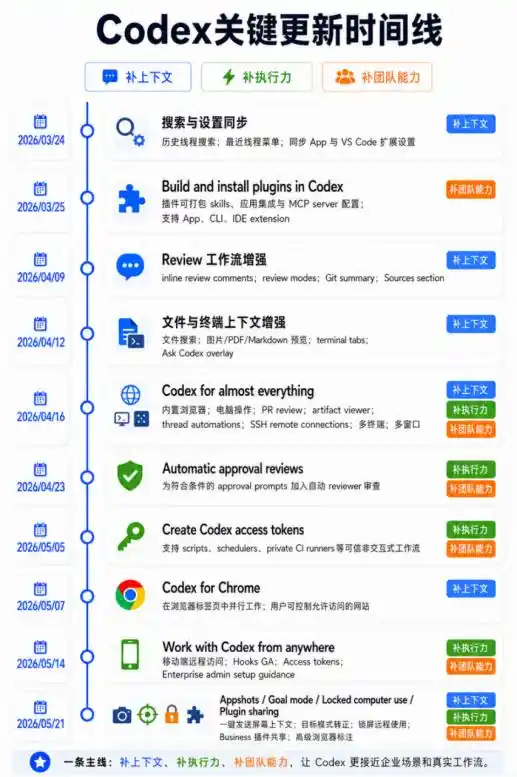
March 24th, Search & Settings Sync.
The Codex App added historical thread search, quick jump to recent threads, and synchronized key settings between the Codex App and VS Code extension. Basically foundational experience optimization: letting users quickly retrieve past tasks and ensuring a more consistent experience between desktop and editor usage.
March 25th, Plugin System Launched.
Codex began supporting plugins. Plugins can package skills, application integrations, and MCP server configurations to reuse workflows, supporting the Codex App, CLI, and IDE extension.
April 9th, Code Review Workflow Enhancement.
The Codex App added collapsible inline review comments, different review modes, Git summaries, and source blocks. Codex started delving deeper into code review and PR collaboration.
April 12th, File & Terminal Context Enhancement.
Codex added file search in the command menu, support for previewing images, PDFs, and Markdown in the sidebar, added a terminal tab for each thread, and supported directly asking Codex about selected text.
April 16th, Codex for almost everything.
This was the first major milestone in the past two months. OpenAI began pushing Codex to become a more comprehensive AI workbench. This wave of updates included a built-in browser, computer operation, thread automation, task sidebar, PR workflows, result previews, SSH remote connections, multi-terminal, multi-window, Intel Mac support, and a batch of new plugins.
April 23rd, Auto-Approve Reviews.
Codex could send eligible approval requests to an auto-review agent for risk assessment first, then display review status and risk level, ultimately leaving the decision to approve or not to the user.
May 5th, Codex Access Tokens Launched.
ChatGPT Enterprise workspace owners and administrators could allow members to create Codex access tokens for use in trusted non-interactive local workflows like scripts, schedulers, and private CI runners. Codex started approaching CI, automation, and enterprise engineering systems.
May 7th, Codex Enters Chrome.
Codex launched a Chrome extension, allowing parallel work in browser tabs without directly taking over the user's browser. Users could also control which websites allow Codex usage. The browser is the entry point for many backend systems, internal tools, and web debugging scenarios. This step brought Codex closer to the real office environment.
May 14th, Codex Supports Phone Control.
OpenAI supported users using Codex from the ChatGPT mobile app, connecting to a Mac running the Codex App. Users could check task progress, approve actions, view code diffs, and test results on their phones. This wave also included Hooks becoming generally available, access tokens, and enterprise admin setup guides. Codex started becoming a work agent that could be monitored remotely.
May 21st, Appshots, Goal Mode, Lock Screen Remote Use, and Plugin Sharing.
This was the second major milestone. Appshots could directly send a screenshot of the current Mac window and available text to Codex; Goal Mode officially launched, allowing users to give Codex a goal and have it work persistently on it for hours or even days; Lock Screen Remote Use allowed Codex to continue operating desktop apps after the Mac was locked, no longer needing to "leave a window open."
Simultaneously, ChatGPT Business began supporting team-shared plugins; the built-in browser's annotation capabilities were further enhanced, allowing direct adjustment of fonts, colors, spacing, and other styles.
The features themselves are important, but the overall update trend is equally noteworthy. Whether it's Appshots or Goal Mode, or the Chrome extension, access tokens, and plugin sharing, they are all filling the basic requirements for entering real workflows: seeing the field, pushing tasks forward, and managing risks.
To see the field, what needs to be complemented is contextual capability.
Real development tasks rarely happen only in code editors. File search, file preview, terminal tabs, built-in browser, browser annotation, Chrome extension, Appshots—essentially, these are all about reducing the user's cost of describing context to the AI.
Previously, you had to tell the AI what the problem was via description or Ctrl+C/V. Now, OpenAI wants Codex to see these things directly.
To push tasks forward, long-running task and remote execution capabilities are crucial.
Goal Mode solves "whether it can keep going." Mobile remote access and lock screen remote use allow tasks to continue even when the user isn't at the computer. Access tokens and Hooks further integrate Codex into enterprise engineering systems like scripts, schedulers, and CI runners.
Managing risks is a matter of enterprise and team management.
For individual developers using tools, the core concern is usability. But enterprise tools involve more complex issues: how to manage permissions, how to distribute plugins, who is using them and how much, how to review risks, whether they can integrate with CI, whether they can be managed uniformly by the team.
Codex has also done a lot of work in this area. The plugin system allows workflows to be packaged and reused; plugin sharing allows teams to distribute tools uniformly; auto-approve reviews are about controlling agent execution risks; access tokens and enterprise admin settings are about integrating Codex into existing enterprise engineering and governance processes.
02
"The Hope of the Whole Village"
Codex's updates have brought it a very impressive user growth rate.
In early March, Codex's weekly active users were around 1.6 million. By May 14th, OpenAI officially mentioned while introducing the mobile version of Codex that over 4 million people use Codex weekly. This means that in about two months, Codex's weekly active user count increased significantly again.
This growth trajectory is inseparable from the underlying model's capabilities. The premise for users being willing to entrust real tasks to Codex more frequently is that it can actually get the job done. Especially after GPT-5.5, Codex's coding, tool use, long-context, and multi-step task capabilities have a better foundation.
But having a model alone isn't enough. The market won't pay just because a model's benchmark improves; it cares more about whether these capabilities can translate into revenue.
This is what OpenAI must clarify before its IPO.
OpenAI holds many cards, but each has its own uncertainties.
ChatGPT is the largest user entry point, proving OpenAI has global users and consumer subscription capabilities. The problem is, the larger the user base, the heavier the inference costs; whether consumer subscriptions can sustain a frontier model company's long-term investments still needs further proof.
API is a fundamental revenue source, selling model capabilities to developers and enterprises. But the API market can easily become a price war, and enterprise clients may not bind themselves to just one model supplier. The more general the model capabilities, the more likely clients are to use multiple models.
ChatGPT Enterprise, Agents, and industry solutions are OpenAI's direct entry into the enterprise market. But these products need time, sales, integration, and industry-specific implementation to truly penetrate enterprise processes.
Looking further ahead, OpenAI also has hardware, data centers, multi-cloud partnerships, and compute infrastructure. These stories have great imaginative potential but are also heavier, more distant, and more capital-intensive. They can support the long-term vision but struggle to immediately explain short-term commercial returns.
In contrast, Codex's commercial value is easier to explain. It targets a very clear group: developers and engineering teams.
This is a group already willing to pay for services. Engineer time is expensive, software project cycles are long, and code maintenance costs are high. Bug fixes, testing, code reviews—each stage has a calculable cost.
Software development itself is also one of the most core production processes for enterprises. Financial companies have risk control and trading systems, retail companies have supply chain and membership systems, healthcare companies have data and compliance systems, media companies have content backends and distribution systems... Even non-tech companies have vast internal tools, data pipelines, automation scripts, and business systems that need maintenance—virtually every company today relies on software systems.
In other words, Codex is cutting into where companies spend money and consume manpower every single day.
In a sense, it's the hope for OpenAI to articulate a compelling IPO narrative. This becomes particularly important as OpenAI prepares to enter the capital markets.
Because in the IPO narrative, OpenAI no longer faces questions like "Does AI have a future?" The truly difficult question to answer is another one: Can a frontier model company find a clear, stable, and profitable enough commercial path beyond massive compute investments?
What's more troublesome is that Anthropic has already taken a step forward on this issue.
03
Anthropic Has Already Taken the Lead
There's another crucial reason Codex must be pushed to the forefront: OpenAI's biggest competitor, Anthropic, has already paved a path on the enterprise side.
Although in terms of revenue scale, OpenAI still leads—The Information reported OpenAI's Q1 2026 revenue at approximately $5.7 billion, higher than Anthropic's $4.8 billion for the same period—the issue now isn't just about revenue size. The real pressure for frontier model companies is whether revenue growth can outpace cost growth.
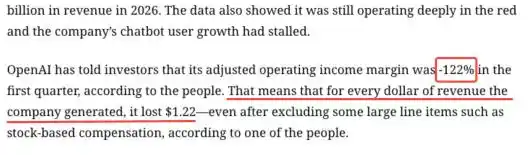
OpenAI's Q1 revenue was high, but its adjusted operating margin was approximately -122%. Calculated on this basis, for every $1 of revenue, adjusted operating costs might be about $2.22, ultimately losing $1.22.
Over the past few years, the outside world has consistently questioned the capital intensity of large model companies: training, inference, GPUs, talent expenses—each is a bottomless pit. The more users, the more calls, the heavier the costs.
The signal recently released by Anthropic has changed the imagination around this issue.
According to The Wall Street Journal, Anthropic expects Q2 2026 revenue to exceed $10.9 billion and is approaching its first quarterly operating profit, estimated at around $559 million.
While this doesn't mean Anthropic has forever escaped the burn problem, it gives the market a very important signal: Frontier model companies don't necessarily have to rely on fundraising to survive forever. As long as the model capabilities are strong enough and the products are close enough to high-value enterprise scenarios, revenue growth can potentially outpace costs.
Anthropic doesn't have a mass-market entry point like ChatGPT, nor does it have as many simultaneous narratives. Its path is narrower and purer: directly enter areas enterprises are willing to pay for, especially high-value scenarios like developers, finance, law, research, data analysis, and internal knowledge work.
Claude Code is the most typical card in this deck. It started as a coveted tool among developers, focusing on programming scenarios. Later, it progressively added long-running tasks, plugins, permissions, team management, and enterprise governance, gradually becoming an important entry point for Anthropic into enterprise workflows. Developers adopt it first, teams follow, eventually turning into enterprise procurement and budgets.
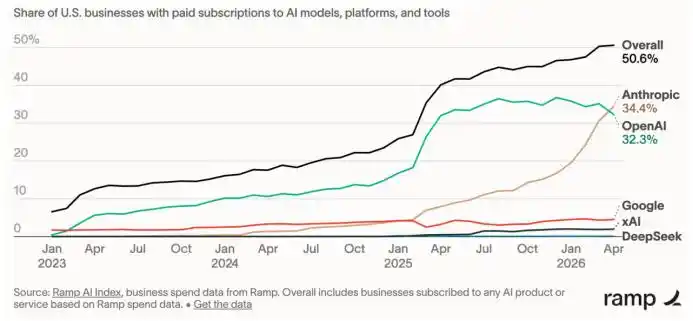
In April 2026, among sample enterprises on the Ramp platform, Anthropic's adoption rate rose to 34.4%, while OpenAI's fell to 32.3%. Although this is only a sample based on enterprise spending on the Ramp platform and not a full-market statistic, this data at least indicates that Anthropic's momentum in enterprise-paid scenarios is strengthening.
This is precisely where the pressure lies for Codex.
OpenAI's revenue scale still leads, but if it's to enter the capital markets, it can't just talk about user scale or model capabilities. It needs a product closer to enterprise production to prove it can turn AI into stable enterprise revenue.
If Claude Code has proven that developer workflows can become Anthropic's enterprise entry point, then Codex must prove that OpenAI can also walk this path.
Codex lead Tibo Sottiaux recently half-jokingly summarized the company's "master plan": release better, more efficient models, release better products every week, then acquire more compute (and increase time surfing on X).
Better models determine whether Codex can truly work; higher-frequency product updates determine whether Codex can enter real workflows; more compute determines whether all of this can support growing usage.
All of this is very important for the IPO.

In other words, Codex's recent intensive updates aren't just about chasing features; they're also chasing the enterprise-oriented path that Anthropic has already carved out.
ChatGPT has already proven OpenAI has users.
And Codex must prove that OpenAI is a business that can make money.
This article is from WeChat public account "字母AI", author: Yuan Xinyue