Bitcoin Exchange Supply Remains At 8-Year Lows: Bullish Sign?

bitcoinist发布于2026-05-16更新于2026-05-16

文章摘要

Bitcoin exchange reserves, a measure of supply held on centralized platforms, have remained near their lowest levels in eight years despite recent price recovery. This stagnant trend, with around 5.6% of BTC's total supply on exchanges, suggests investors are not depositing coins for potential selling, which is typically viewed as a bullish sign. In contrast, Ethereum's exchange supply has seen a recent increase from 4.2% to 4.6%, though it also remains near historical lows. The on-chain data indicates continued holder accumulation for Bitcoin, even as its price trades around $79,400. Analysts note that the significance of exchange reserves alone has evolved with the rise of off-chain investment vehicles like spot ETFs.

On-chain data shows the Bitcoin exchange reserves have been at 8-year lows for the past month despite the recovery that the asset has witnessed.

Bitcoin Supply On Exchanges Has Been Flat Recently

As highlighted by on-chain analytics firm Santiment in an X post, Bitcoin and Ethereum have differed in their trend of the Supply On Exchanges. This indicator measures, as its name suggests, the total amount of a given asset that’s currently stored in the wallets associated with centralized exchanges.

When the value of the metric rises, it means investors are depositing a net number of tokens to these platforms. As one of the main reasons why holders transfer to exchanges is for selling-related purposes, this kind of trend can have a bearish impact on the cryptocurrency’s price.

On the other hand, the indicator witnessing a decline suggests the exchange outflows are overwhelming the inflows. Such a trend implies the investors may be participating in accumulation, which can naturally be a bullish signal.

Now, here is the chart shared by Santiment that shows the trend in the Supply On Exchanges for Bitcoin and Ethereum over the past year:
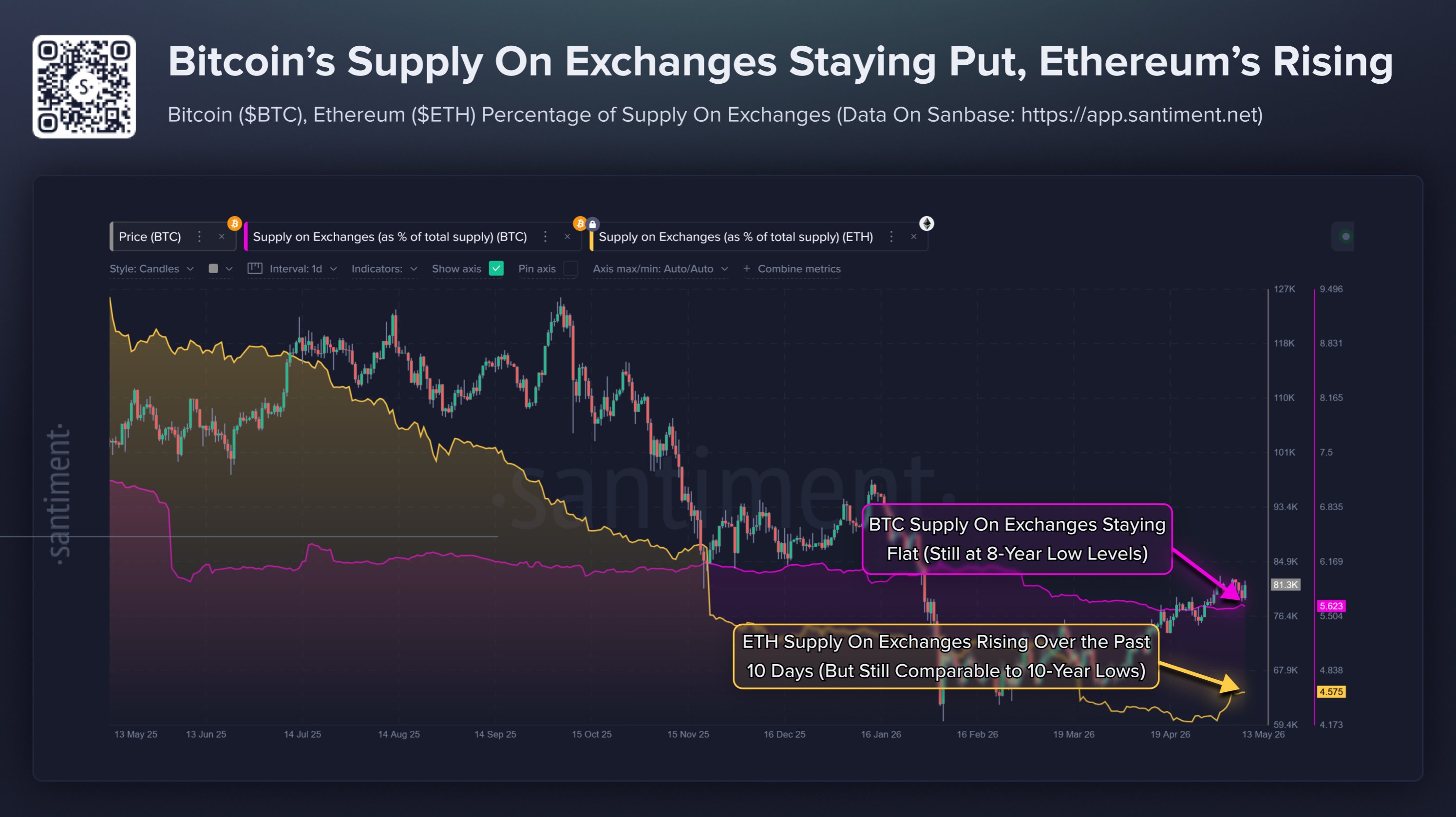
Looks like the value of the metric has gone up for ETH in recent days | Source: Santiment on X

As displayed in the above graph, the Bitcoin Supply On Exchanges observed some decline during March and has since followed a mostly flat trajectory. Currently, around 5.6% of the BTC supply is sitting inside exchange-connected wallets. “It has stayed consistent around this level for the past month, and it is the lowest ratio of BTC supply on exchanges since 2018,” noted the analytics firm.

While Bitcoin has witnessed its exchange supply remain flat at 8-year lows recently, the trend has been a bit different for Ethereum. From the chart, it’s apparent that ETH observed a much more dramatic decline in the Supply On Exchanges compared to BTC for most of the past year, but recently, the trajectory has flipped for the network.

Over the past 10 days, Ethereum has seen the indicator go from 4.2% to 4.6%, which is a notable increase. “Nevertheless, this is also still near the lowest levels we’ve seen since $ETH’s public trading inception back in 2015,” explained Santiment.

Interestingly, the flat exchange netflow for Bitcoin has arrived while BTC has observed a recovery surge. This means that despite the profit-taking opportunity, holders haven’t made deposits to sell.

Something to note when it comes to the Supply On Exchanges is that while exchanges held a central role in the digital asset sector earlier, the paradigm has shifted recently as a result of the emergence of off-chain investment routes like the spot exchange-traded funds (ETFs). As such, the exchange reserves alone no longer capture the full picture of the market.

BTC Price

At the time of writing, Bitcoin is floating around $79,400, down 0.9% in the last seven days.

The trend in the price of the coin over the last five days | Source: BTCUSDT on TradingView


相关问答

QWhat does the 'Supply On Exchanges' indicator measure for Bitcoin, and what does a decline in this indicator typically signify?

AThe 'Supply On Exchanges' indicator measures the total amount of a given asset currently stored in wallets associated with centralized exchanges. A decline in this indicator suggests that exchange outflows are overwhelming the inflows, implying investors may be accumulating the asset, which is generally considered a bullish signal.

QHow does the current percentage of Bitcoin supply on exchanges compare to historical levels, and why is this notable?

ACurrently, around 5.6% of the Bitcoin supply is sitting on exchanges, which is the lowest ratio of BTC supply on exchanges since 2018. This is notable because it has remained consistent at this 8-year low for the past month, even during a price recovery, indicating a lack of selling pressure from holders.

QHow has the trend for Ethereum's 'Supply On Exchanges' differed from Bitcoin's in recent days?

AIn recent days, Ethereum's 'Supply On Exchanges' has increased from 4.2% to 4.6%, which is a notable rise. This is in contrast to Bitcoin's supply, which has remained flat at its 8-year low. However, despite the recent increase, Ethereum's exchange supply is still near its lowest levels since its public trading began in 2015.

QAccording to the article, what is an important limitation of the 'Supply On Exchanges' metric in today's market?

AAn important limitation is that while exchanges were central earlier, the emergence of off-chain investment routes like spot ETFs has shifted the paradigm. Therefore, exchange reserves alone no longer capture the full picture of the market, as significant investment activity now occurs outside of centralized exchanges.

QWhat price movement for Bitcoin is mentioned alongside the flat exchange netflows, and what does this combination suggest about holder behavior?

ABitcoin has observed a recovery surge in price. The combination of a price increase and flat exchange netflows suggests that despite the profit-taking opportunity, holders have not been making significant deposits to exchanges to sell, indicating potential confidence in holding or further price appreciation.

你可能也喜欢

沃什上任第一天,市场给个“下马威”:预期今年加息

美联储新任主席沃什于5月22日正式就职,上任首日即面临市场严峻考验。由于伊朗冲突推高能源与运输成本加剧通胀压力,加上美联储理事沃勒同日发表强硬鹰派言论,称未来加息与降息可能性“五五开”,市场加息预期急剧升温。美债遭抛售,2年期收益率升至2月以来新高,期货市场已完全定价美联储今年将加息25个基点。 沃勒在讲话中明确表示通胀已成为政策核心“驱动力”,并支持删除政策声明中的“宽松偏向”措辞。他承认近期数据已改变其长期宽松立场,虽称油价冲击可能消退且近期未必立即加息,但也无法排除未来因通胀持续而加息的可能性。 沃什即将于6月中旬首次主持FOMC会议,压力巨大。数据显示通胀指标已升至三年来高位。分析指出,若沃什在6月会议上选择不加息,即便经济未过热,市场也可能将此解读为变相宽松,因为在不加息的情况下应对广泛通胀风险等同于政策放松。 市场预期从年初的多次降息大幅转向为目前预期加息,形成鲜明反差。尽管长端美债估值略显便宜,但分析师指出,在宏观风险未变的情况下,其收益率仍面临结构性上行压力。 沃什是在白宫宣誓就职的格林斯潘以来首位美联储主席,其独立性备受关注。特朗普曾希望其更顺从降息要求,但当前市场明确传递信号:通胀是最紧迫议题,新主席几乎没有缓冲时间。

marsbit9小时前

沃什上任第一天,市场给个“下马威”:预期今年加息

marsbit9小时前

交易

现货
合约

热门文章

加密市场宏观研报:《GENIUS Act》法案取得重大进展,BTC突破历史新高,后市全新展望

2025年5月22日,比特币价格正式突破11万美元大关,创下历史新高。在政策面、宏观经济、资金面与投资者结构共同作用下,一场结构性牛市浪潮正在展开。而此轮上涨背后的核心驱动,是美国《GENIUS稳定币法案》的实质性进展以及多项利好的叠加。本文将从政策端突破、宏观环境转向、链上与ETF资金结构、交易行为演化,以及重点受益赛道五大维度,全面解析此轮BTC再创新高的深层逻辑,并前瞻下半年市场的潜在趋势。

1.6k人学过发布于 2025.05.22更新于 2025.05.22

加密市场宏观研报:《GENIUS Act》法案取得重大进展,BTC突破历史新高,后市全新展望

相关讨论

欢迎来到HTX社区。在这里,您可以了解最新的平台发展动态并获得专业的市场意见。以下是用户对BTC(BTC)币价的意见。

活动图片