By: Huahua, Banjun
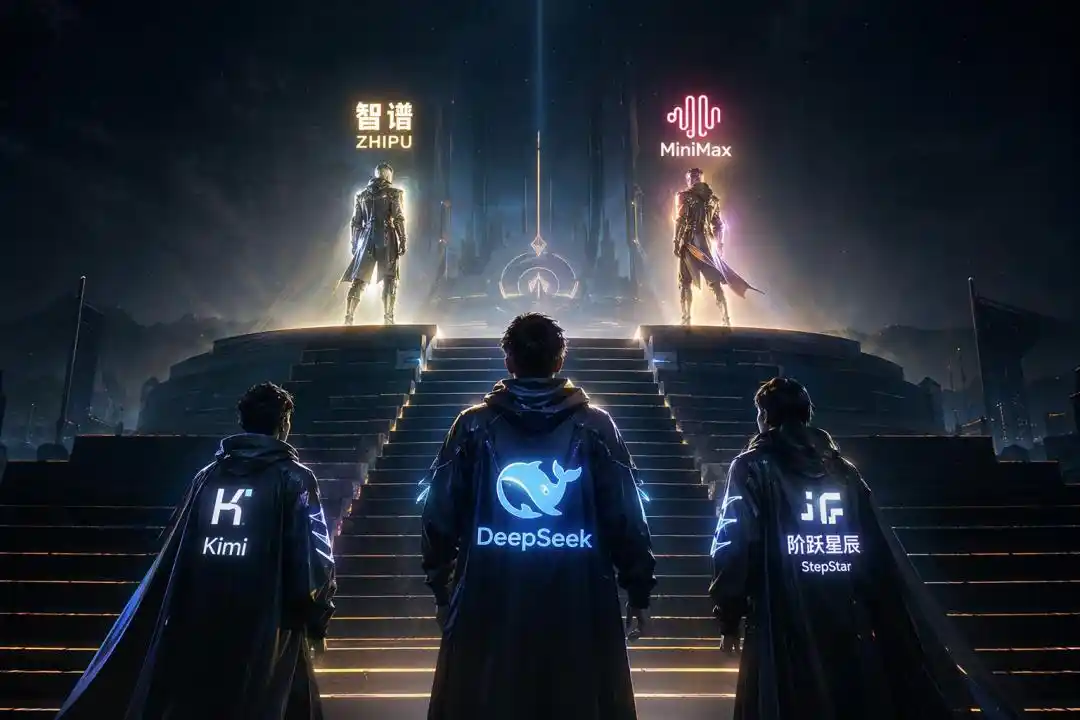
Over the past week, China's large model industry suddenly entered a state of nearly frenzied fundraising.
Kimi secured $2 billion in funding, with its valuation surpassing $20 billion.
StepFun was reported to be close to completing nearly $2.5 billion in funding, while accelerating the dismantling of its VIE structure, with its Hong Kong IPO entering the final sprint.
DeepSeek was rumored for the first time to be accepting external investment, with national-level funds stepping in, pushing its valuation range to $45–$50 billion.
Three companies, three days, over $7 billion flooded in simultaneously. This is no longer just supplementary investment post-funding; it's more like a collective scramble for future survival quotas.
On the surface, this seems like the hottest moment for the large model industry.
But truly dangerous industries are often the hottest.
When capital no longer spreads evenly but pushes all its chips toward the final few leading players, the industry appears exceptionally prosperous, but in reality, it has already entered the night before the shakeout.
The soaring valuations of Zhipu and MiniMax post-IPO have gradually made everyone realize:
The time left for independent large model companies may be running out.
I. Models Are Becoming Commoditized
Over the past two years, the biggest consensus in the large model industry was the existence of massive generational gaps in model capabilities.
GPT-4 was once seemingly unreachable. As long as a startup could get slightly closer in some dimension—long context, reasoning, multimodality, Agent—capital was willing to offer a high premium.
Everyone believed capability gaps would form long-term moats.
But the situation changed in 2026.
Long context is no longer scarce. Reasoning capability is no longer scarce. Multimodality is no longer scarce.
After DeepSeek V4 brought open-source capabilities close to the level of GPT-4 or even newer versions, the industry truly realized for the first time that model capabilities themselves might be easier to catch up with than everyone imagined.
Gaps still exist between Qwen, DeepSeek, Gemini, Claude, and GPT-5.5, but it's already difficult to form generational碾压.
Models are becoming commoditized.
Once commoditization occurs, the capital market will ask a question anew: What's left besides the model?
Thus, the industry's narrative suddenly switched scripts.
In 2023, all companies talked about stronger models, more parameters, better reasoning, longer context. Today, they talk about holding the end-user touchpoint, binding to the industrial chain, possessing user entry points, and having national strategic value.
This shift marks the large model industry's official move from a technology race into a phase of position consolidation.
Capital market data already reflects this.
During the 2023 "Hundred Models Battle," the number of domestic large model companies proliferated exponentially. Data from Yibang Power showed that year, the "Six Tigers" collectively raised over 6 billion RMB, accounting for more than half of the early-stage funding for domestic large models. 2024 was even crazier, with over 168 global large model industry chain funding rounds exceeding 100 million RMB, totaling over 400 billion RMB.
The Six Tigers collectively raised at least 20 billion RMB for the year, with single-round records constantly being broken.
Then came 2025. A sharp turn downward.
According to reports from Touzijie, AI model-layer companies completed only 22 investments for the full year, with a total disclosed amount of 9.4 billion RMB, a 52.9% drop from 2024. The proportion of large model funding in total AI investment plummeted from 51% in 2024 to 14%. Companies with single-round funding exceeding 2 billion RMB were only Zhipu, MiniMax, and Moonshot.
One hundred companies became less than ten that could get funding. Two years, an elimination rate over 90%.
So when we see these three funding rounds totaling $7 billion concentrated in one week in May 2026, its meaning is clear: money isn't flowing to the industry; it's flowing to the last few players.
The larger this funding, the higher the concentration. The higher the concentration, the smaller the space left for those behind.
II. The Music Hasn't Stopped, But the Seats Are Already Insufficient
The crazy surge of Zhipu and MiniMax post-IPO did something with profound impact on the entire industry: it established a reference point in the secondary market for how much domestic large models are worth.
Once this reference standard is set, all unlisted companies face a life-or-death sprint. If they don't lock in their valuation during the current window, and the market experiences aesthetic fatigue leading to a correction, their private market valuations could be instantly shattered.
The window wasn't opened by you; it was propped open by the first movers. If you don't jump in, it closes.
StepFun plans to submit its Hong Kong listing application by the end of June and complete its IPO by year-end. Its VIE structure has been dismantled. The shareholding system reform landed in April. All preparatory steps compressed within months.
Kimi's ARR rose from $100 million to $200 million within a month. Investors proactively disclosed this number to the media, which is extremely rare in the private market. Usually, only when preparing for the next funding round or sprinting towards an IPO would a company allow core financial metrics to leak.
This eagerness to "prove innocence" indicates the private market no longer believes in pure imagination; they want to see revenue, see the certainty of exit. (Extended reading: Kimi isn't short of money; it's short of DeepSeek)
DeepSeek had never previously accepted external funding. Now, state-level funds have entered.
The three companies seem to be doing different things, but the underlying logic is identical: lock in identity, lock in valuation, lock in exit channels. While the window is still open.
III. More Expensive, Yet Less Valuable
Why now? Why not wait?
The reason lies in the economic model of the large model industry, which is exposing an increasingly fatal contradiction.
On the cost side: GPU clusters, inference compute, long context, multimodality, Agent. Each new capability devours cash.
But what's truly terrifying isn't training. It's inference.
Training is a one-time investment. Inference costs grow in sync with user scale. Every token, every API call, every Agent task corresponds to real GPU consumption.
In the mobile internet era, more users meant more profit for the platform. In the AI era, more users might first make the model company poorer.
One more user for WeChat, Tencent's marginal cost hardly changes. One more user for Douyin, ByteDance gets one more ad slot. One more high-frequency user for Doubao, behind it lies continuously increasing inference expenses. (Extended reading: More Users, The Poorer ByteDance Gets)
Large model companies inherently require continuous fundraising ability. And private market money cannot be supplied infinitely.
The reason why going public suddenly becomes so crucial isn't just about exit; more critically, it's about obtaining a public capital channel for long-term blood transfusion.
This is what truly makes all independent model companies anxious today.
The revenue side is even more brutal.
DeepSeek truly brought a price war into the large model industry. High capability, open-source, extremely low price—these three things hold true simultaneously for the first time.
This is a devastating shock to the entire industry. The profit margin in the API market is directly compressed.
The entire industry suddenly realizes model capability might not be the scarcest thing. What's truly scarce is the ability to keep burning money, endure long-term losses, and withstand price wars.
And these abilities, startups inherently can't match giants.
The scary thing about giants isn't their models. It's that they possess cross-subsidization capabilities startups will never have. ByteDance can run Doubao for free long-term because its ad business continuously provides blood transfusions. Recent plans for Doubao to start charging also show it can't sustain the burn, indicating how crazy the spending is.
Tencent can push Yuanbao at low prices because its gaming and social businesses are still profitable. A startup's model must learn to support itself.
Giants compete on ecosystem. Startups compete on survival.
There's another change many haven't realized yet.
Back in 2023, when capital invested in large models, it was essentially buying "possibility."
Because everyone believed that as long as you built the next GPT-4, you could redefine the internet. So at that stage, funding looked at founder background, tech team, model capability, and imagination.
But today, capital is starting to look at another set of things.
It starts asking: Do you have cash flow? Do you have end-user entry points? Do you have ecosystem bindings? Can you survive the next price war?
This means the fundraising logic for the large model industry has shifted from venture capital towards infrastructure investment.
Venture capital believes in the future. Infrastructure investment only believes in survival rates.
Once an industry enters the infrastructure stage, capital naturally concentrates towards the top. Because infrastructure industries never need many players.
IV. The Sense of Deja Vu from the "Four AI Dragons"
This script isn't playing out for the first time.
Around 2018, the "Four AI Dragons" in the computer vision赛道—SenseTime, Megvii, Cloudwalk, Yitu—experienced almost identical plotlines: frenzied fundraising, soaring valuations, record-breaking rounds. Everyone believed the AI era had arrived.
What happened later?
Tencent, Alibaba, Huawei entered the field comprehensively. Computer vision was turned into a standard feature within cloud services. The technology premium of independent companies evaporated instantly, commercialization couldn't achieve scale, and finally, they could only experience prolonged post-IPO破发 and silence.
Today's large model赛道 is entering the same phase. The difference is the stakes are higher this round, the burn rate is faster, and the giants'碾压 is more direct. ByteDance's annual spending on AI might exceed the total funding of the entire "Six Tigers."
Global money is telling the same story. In Q3 2025, the overall funding scale for global AI startups reached $97 billion, of which nearly 46%, about $44.6 billion, concentrated in流向不超过 five leading foundational model companies like Anthropic and xAI.
Entering 2026, funding for leading model companies further accelerated, reaching new levels:
OpenAI completed a $122 billion funding round in March, with a post-money valuation of $852 billion; Anthropic then completed a $30 billion Series G in February, valued at $380 billion,紧接着又 launched a new pre-IPO round of about $50 billion, targeting a valuation直奔 $900 billion.
Capital is concentrating towards the very top with unprecedented intensity. Middle-layer companies are experiencing the longest liquidity winter.
This trend holds true in China as well. In the full year of 2025, large model funding's share of total AI investment dropped from 51% to 14%, but the top three took the vast majority of that. Money didn't disappear; it just stopped being evenly distributed.
And the淘汰速度 is far faster than the last generation. The mobile internet took nearly a decade to go from the "Hundred Groupons War" to AT monopoly. The large model industry might take only three years to go from the "Hundred Models Battle" to shakeout.
A year ago, Baichuan AI was still one of the companies most resembling a Chinese OpenAI. Wang Xiaochuan appeared in almost every large model discussion. Today, it rarely appears at the center of funding news. 01.AI was once a star startup team, with Kai-Fu Lee高调 announcing "All in AI." But the industry increasingly seldom discusses whether it can enter the next round.
The large model industry淘汰 companies doesn't require their technology to fall behind. It only requires the capital window to close first.
V. Three Paths, Three Bets
Today's large model startups have already diverged into three completely different paths.
DeepSeek chose to become a national-level technical asset.
Its $45 billion valuation doesn't come entirely from commercialization, but from the strategic significance of its technical moat and领先 in algorithmic efficiency, making it a kind of national reserve. The entry of national funds indicates its positioning has transcended commercial competition. Its risk lies elsewhere—fragile organizational structure, with several core researchers having departed.
StepFun chose to bind itself to the hardware industry chain. Huaqin, Longcheer, Omnivision, ZTE—core players in the consumer electronics supply chain collectively invested.
The logic of StepFun's Chairman Yin Qi is clear: foundational model capabilities will eventually level out. The real moat lies in who can embed the model into the end-device supply chain, making it impossible for competitors to replace you without replacing the entire chain. By the end of 2025, numbers like 42 million预装 phones, covering 60% of top brands—their importance lies not in scale, but in depth of嵌入.
Kimi chose user scale and speed. ARR growing from $100 million to $200 million in a month, paid subscriptions and API growing simultaneously. But its problems are also the sharpest: monthly active users dropping from a peak of 36 million to 8.33 million, ByteDance's Doubao with 350 million MAUs forming absolute压制, and its B2B API pricing又被 DeepSeek打穿.
Kimi's product is still excellent. But having an excellent product is no longer enough.
The three paths are completely different, but share one commonality: None of them are still talking about building the best model in China. Everyone has started talking about what position they have卡住了.
VI. The End Goal of Fundraising Isn't Expansion
Why did $7 billion flow in simultaneously within three days?
On the surface, it's industry heat. But when an industry is truly hottest, fundraising should be从容; companies would slowly挑选 investors,延长 cycles, waiting for higher valuations.
Now the keyword is only one: scramble.
StepFun scrambles to list. Kimi scrambles to prove revenue. DeepSeek scrambles to complete身份确认.
They aren't scrambling for money. Money is just the tool. What they are truly scrambling for is the last window for independent survival.
The large model industry might not end up leaving many independent players. Infrastructure industries have always been like this: cloud computing eventually归属 to a few giants; communication networks ultimately只剩 three operators; power systems are高度集中.
When model capabilities become commoditized, API prices approach zero, and giants harvest users with免费 strategies, independent model companies either go public to obtain continuous fundraising ability, get integrated into some ecosystem, or disappear.
Going public is obtaining an ID card. State-level endorsement is another form of ID card. An ID card doesn't guarantee you'll win. But without an ID card, you can't even enter the next round.
And for those names not appearing in this week's news, the silence itself is already the answer.
Words 【Off the Page】:
In 2023, the most frequently asked question about the domestic large model赛道 was: Who can build it?
In 2026, the question has become: Who can survive?
From building it to surviving it, only three years passed in between. But these three years are enough for an industry to jump directly from spring to autumn.
This article is from the WeChat public account "Off the Page," author: Huahua